The EEI Filing Deadline for Carriers Explained: A 2026 Compliance Guide
The Electronic Export Information (EEI) filing deadline for carriers depends primarily on the mode of transport. For vessel shipments, information must be filed 24 hours before loading. For air cargo, the deadline is 2 hours before sch...
The Electronic Export Information (EEI) filing deadline for carriers depends primarily on the mode of transport. For vessel shipments, information must be filed 24 hours before loading. For air cargo, the deadline is 2 hours before scheduled departure. Trucking requires filing 1 hour before arrival at the border, while rail requires 2 hours.
Contents
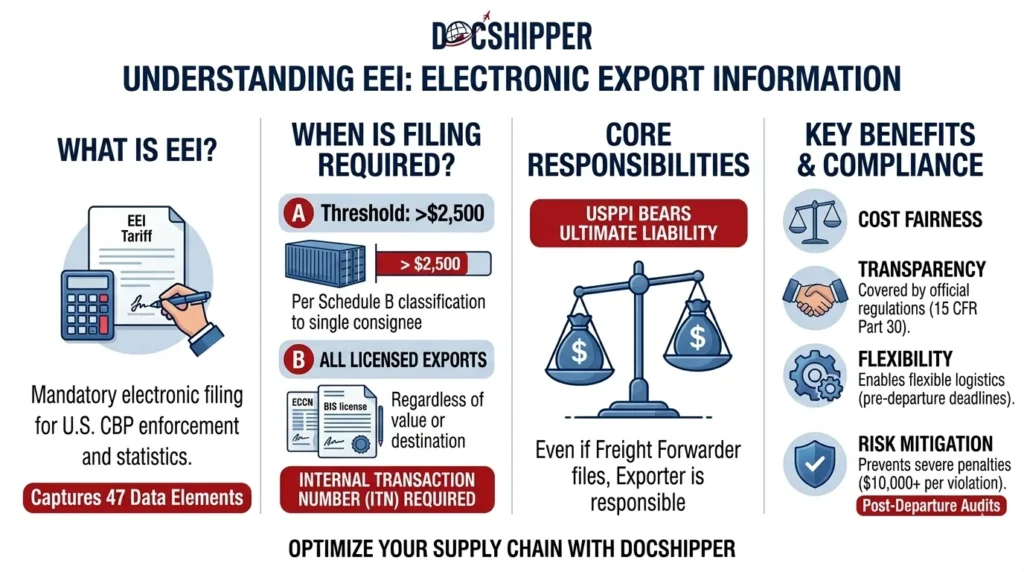
In the complex ecosystem of international trade, the Electronic Export Information (EEI) serves as the primary vehicle for the U.S. government to collect trade statistics and enforce export controls. Formerly known as the Shipper’s Export Declaration (SED), the EEI is now filed exclusively through the Automated Export System (AES) within the Automated Commercial Environment (ACE). For carriers—including steamship lines, airlines, trucking companies, and railroads—understanding the specific filing deadlines is not merely a matter of administrative preference; it is a critical regulatory requirement enforced by the U.S. Census Bureau and U.S. Customs and Border Protection (CBP).
As of 2026, the regulatory landscape under 15 CFR Part 30 (the Foreign Trade Regulations or FTR) continues to place significant pressure on carriers to verify compliance before cargo moves. While the responsibility for filing the EEI typically rests with the U.S. Principal Party in Interest (USPPI) or their authorized agent, the carrier acts as the ultimate gatekeeper. Moving cargo without a valid Internal Transaction Number (ITN) or a specific exemption legend can lead to severe financial penalties and operational delays.
The Critical Role of the Carrier in EEI Compliance
Before examining specific timelines, it is essential to distinguish between the party responsible for filing the data and the party responsible for verifying it. In most export transactions, the USPPI (the person or legal entity in the United States that receives the primary benefit, monetary or otherwise, from the export transaction) is responsible for filing the EEI. However, carriers have a dual responsibility: they must ensure that the proof of filing (the ITN) or the citation for an exemption is provided on the bill of lading, air waybill, or other commercial loading documents.
In a "Standard Export Transaction," the USPPI files the data. In a "Routed Export Transaction," where a foreign principal party in interest (FPPI) hires a U.S. freight forwarder to handle the export, the forwarder usually files. Regardless of who files, the carrier cannot legally export the goods until they have received the ITN or an exemption statement. If a carrier loads cargo for which no EEI has been filed within the mandated timeframe, they are in direct violation of the FTR.
EEI Filing Deadlines by Mode of Transportation
The Census Bureau establishes different "time of filing" requirements based on how the goods are leaving the country. These windows are designed to give CBP sufficient time to review the data for security risks or export license violations before the goods are beyond U.S. jurisdiction.
Vessel Cargo (Ocean Freight)
For goods moving by sea, the EEI must be filed no later than 24 hours prior to loading the cargo on the vessel at the U.S. port where the cargo is laden. This "24-hour rule" for EEI is separate from the "24-hour rule" for the vessel manifest (AMS), though they often overlap in logistics planning. Carriers must be vigilant here; if a container arrives at the terminal without a valid ITN, it should not be included in the stowage plan for the next day's loading.
Air Cargo
The timeline for air transport is significantly tighter. The EEI must be filed no later than two hours prior to the scheduled departure of the aircraft from the last U.S. port of export. This two-hour window allows for the fast-paced nature of air express and general cargo while still providing a buffer for CBP intervention if the shipment contains restricted items or requires an export license that hasn't been properly cited.
Trucking (Land Transport)
For shipments moving by truck to Mexico or Canada (where an exemption doesn't apply), the EEI must be filed at least one hour prior to the arrival of the truck at the United States border. This allows CBP officers at the port of entry to see the digital filing in their system before the driver reaches the booth. If the ITN is not "live" in the system when the truck arrives, the driver is often diverted to secondary inspection or sent back to a bonded warehouse, causing significant supply chain friction.
Rail Cargo
Rail transport follows a slightly longer lead time than trucking. The EEI must be filed no later than two hours prior to the arrival of the train at the U.S. border. This accounts for the complexity of manifest processing for long trains carrying hundreds of containers or boxcars from multiple different shippers.
Other Modes and Specific Scenarios
- Mail: For shipments sent via the U.S. Postal Service, the EEI must be filed prior to mailing at the post office.
- Pipeline: For continuous exports like oil or gas, the filing is done on a different schedule, typically within four calendar days following the end of the month.
- Fixed Transport (non-pipeline): For other fixed methods, the deadline is generally 24 hours before export.
Summary of 2026 EEI Filing Deadlines
The following table summarizes the mandatory filing windows that carriers must enforce to remain compliant with the Foreign Trade Regulations.
| Mode of Transport | Filing Deadline Requirement | Primary Documentation Needed |
|---|---|---|
| Vessel / Ocean | 24 Hours prior to loading cargo | ITN or Exemption Legend on Bill of Lading |
| Air | 2 Hours prior to scheduled departure | ITN or Exemption Legend on Air Waybill |
| Truck | 1 Hour prior to arrival at the border | ITN or Exemption Legend on Manifest |
| Rail | 2 Hours prior to arrival at the border | ITN or Exemption Legend on Rail Manifest |
| USPS (Mail) | Prior to mailing at the Post Office | ITN or Exemption Legend on Package/Forms |
| Pipeline | Within 4 days after the end of the month | Monthly Summary Filings |
Understanding the ITN and Exemption Legends
The Internal Transaction Number (ITN) is the unique confirmation number generated by the AES when an EEI filing is accepted. It typically looks like AES X20260101123456. For a carrier, the receipt of this number is the "green light" to proceed.
However, not every shipment requires an EEI filing. Carriers must be equally familiar with Exemption Legends. If a shipper claims they do not need to file an EEI, they must provide the carrier with the specific FTR citation. Common examples include:
- Low-Value Shipments (15 CFR 30.37a): Most goods valued at $2,500 or less per Schedule B number do not require an EEI. The legend used is
NOEEI 30.37(a). - Shipments to Canada (15 CFR 30.36): Most shipments to Canada are exempt from EEI filing because of a data-sharing agreement between the U.S. and Canada, unless the goods require an export license or involve used self-propelled vehicles. The legend used is
NOEEI 30.36. - Tools of the Trade (15 CFR 30.37b): Temporary exports of certain tools or equipment used by the exporter.
A carrier who accepts cargo without either an ITN or one of these specific legends is assuming a massive regulatory risk. In the eyes of CBP, the absence of this information on the manifest is a "red flag" for potential smuggling or export control evasion.
The Consequences of Missing the Deadline
In 2026, enforcement is highly automated. The ACE system cross-references carrier manifests with EEI filings in real-time. If a carrier's manifest lists a shipment that lacks a corresponding ITN in the system, or if the ITN was generated after the cargo was loaded or the truck reached the border, a violation is triggered.
Civil Penalties
The Census Bureau can assess civil penalties for late filings, failure to file, or filing false/misleading information. Penalties generally range from $1,100 to over $10,000 per violation. For a carrier handling thousands of shipments, even a small percentage of non-compliance can lead to six-figure fines during a single audit.
Operational Impacts and Seizures
Beyond fines, CBP has the authority to seize cargo that is not properly documented. If a vessel is found to have loaded containers without EEI filings, CBP may order those containers to be offloaded at the carrier’s expense. This results in:
- Demurrage and Detention Charges: Excessive costs for the shipper and carrier.
- Reputational Damage: Shippers will avoid carriers that frequently experience "CBP holds."
- Increased Inspection Rates: Carriers with a history of filing violations are flagged for more frequent physical inspections, further slowing down their operations.
Best Practices for Carriers to Ensure Compliance
To mitigate the risks associated with EEI filing deadlines, carriers should implement robust Standard Operating Procedures (SOPs).
1. Hard Stops in Booking Systems
Modern logistics software should include a "hard stop" feature. This prevents a booking from being finalized or a gate-pass from being issued unless the ITN or exemption legend field is populated. For ocean carriers, this check should occur 48 hours before loading to allow time for troubleshooting if the data is missing.
2. Regular Training for Documentation Teams
Documentation clerks must be able to recognize the difference between a valid ITN and a placeholder. They must also understand the basic exemptions. For example, if a clerk sees a shipment destined for China labeled with the Canada exemption (NOEEI 30.36), they should immediately flag it for correction.
3. Verification of the "Ultimate Destination"
Carriers are often the first to notice discrepancies in the country of ultimate destination. Since EEI requirements change based on the destination (e.g., shipments to Puerto Rico require EEI, but shipments from the U.S. Virgin Islands to the U.S. do not), having a clear geographical validation process is vital.
4. Communication with Shippers and Forwarders
Clear communication of "cutoff times" is essential. If the regulatory deadline for a vessel is 24 hours before loading, the carrier’s internal deadline for the shipper should be 36 or 48 hours. This provides a buffer for the carrier to verify the ITN against the manifest.
FAQ: Frequently Asked Questions
What happens if the AES system is down?
If the Automated Export System (AES) experiences a verified technical outage, the Census Bureau and CBP will typically issue an "AES Downtime" notice. During these periods, carriers may be allowed to move cargo using a specific downtime filing citation. However, once the system is back online, all backlogged EEI filings must be completed immediately. Carriers should monitor official CBP CSMS (Cargo Systems Messaging Service) alerts for these instructions.
Does a carrier have to file the EEI for a "Routed Export Transaction"?
No, the carrier does not typically file the EEI in a routed transaction. In a routed export, the FPPI (Foreign Principal Party in Interest) authorizes a U.S. agent (usually a freight forwarder) to file the EEI. The carrier's job remains the same: ensure they receive the ITN from that agent before loading or moving the goods across the border.
Are shipments to Puerto Rico exempt from EEI filing?
No. Unlike most domestic shipments, goods sent from the United States to Puerto Rico (and vice versa) generally require an EEI filing if the value per Schedule B number exceeds $2,500. This is a common point of confusion for carriers new to the Puerto Rican trade lanes.
Can a carrier be fined if the shipper provided a fake ITN?
While the primary responsibility for the accuracy of the EEI data lies with the filer, a carrier can still face scrutiny if they did not perform due diligence. If the ITN is formatted correctly but is actually "dead" or associated with a different shipment, CBP will investigate. Carriers should use the ACE portal to verify ITNs if they have concerns about a particular shipper's compliance history.
Is the deadline different for "Used Self-Propelled Vehicles"?
Yes, the regulations for used vehicles (under 19 CFR 192) are much stricter. Regardless of value or destination (including Canada), these shipments require the EEI to be filed and original titles to be presented to CBP at the port of export at least 72 hours prior to export. Carriers must ensure they do not move these vehicles until the 72-hour CBP review period has expired.
Strategic Recommendation for Carriers
In 2026, the most successful carriers are those that treat EEI compliance as a digital asset rather than a paperwork hurdle. It is highly recommended that carriers integrate their Transportation Management Systems (TMS) directly with the ACE via an API. This allows for real-time validation of ITNs. Instead of manually checking a PDF bill of lading, the system can automatically query the ACE database to confirm that an ITN is valid and matches the manifest's weight and piece count. This level of automation significantly reduces the risk of human error, prevents costly "late filing" fines, and ensures that the carrier maintains a high "trusted trader" status with U.S. Customs.
Image Gallery