Understanding the Liquidated Net Worth of a Business
The liquidated net worth of a business represents the total cash value that would remain if the company ceased operations immediately, sold all of its tangible and intangible assets at realistic market or liquidation prices, and paid o...
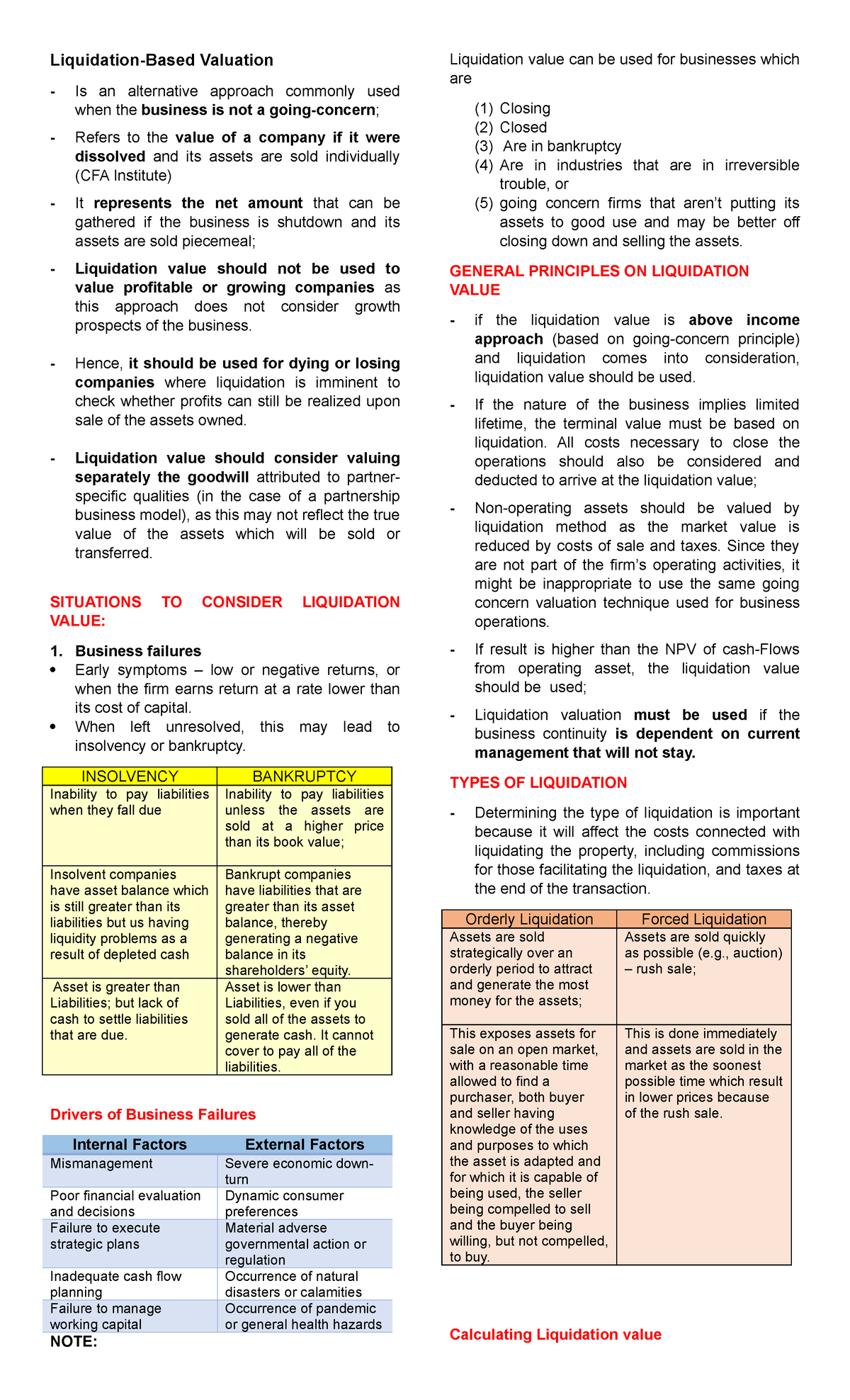
The liquidated net worth of a business represents the total cash value that would remain if the company ceased operations immediately, sold all of its tangible and intangible assets at realistic market or liquidation prices, and paid off all outstanding liabilities and creditor claims.
Contents
Evaluating the financial health of an enterprise often requires moving beyond standard balance sheet metrics. While book value and market capitalization provide a snapshot of historical costs or investor sentiment, they frequently fail to reflect the harsh realities of a company forced to close its doors. Understanding the liquidated net worth of a business provides stakeholders, creditors, prospective buyers, and business owners with a realistic floor for asset valuation. This metric exposes the true safety net beneath a company's operations, dictating recovery expectations during distress, bankruptcy, or strategic wind-downs.
Defining Liquidated Net Worth vs. Other Financial Metrics
To fully grasp the concept of liquidated net worth, one must separate it from other common corporate finance terms. Confusion often arises between book value, market value, and liquidation value.
- Book Value: This is an accounting figure calculated by taking total assets minus total liabilities as recorded on the balance sheet. Assets are typically listed at historical cost minus accumulated depreciation. Consequently, book value rarely reflects current market conditions.
- Market Value: This represents what a willing buyer would pay a willing seller for the entire enterprise as a going concern. It factors in future earnings potential, brand reputation, customer lists, and ongoing cash flows. Market value can be significantly higher—or in times of distress, lower—than book value.
- Liquidated Net Worth: This metric strips away the going-concern assumption entirely. It assumes the business stops operating immediately. Assets are sold off piece-meal or in bulk under time constraints, yielding a cash recovery amount that is subsequently used to erase all liabilities.
The resulting figure is usually lower than both book value and market value. Liquidation forces deep discounts on inventory, equipment, and real estate, while transaction costs and administrative fees consume a portion of the gross proceeds.
The Core Components of Liquidation Valuation
Calculating the liquidated net worth of a business requires a granular breakdown of its balance sheet, separating items that retain real-world conversion value from those that evaporate upon cessation.
Tangible Assets
Tangible assets form the bedrock of any liquidation analysis, though their realized values rarely match their book values:
- Accounts Receivable (AR): Receivables are rarely collected at 100% during a shutdown. Customers often dispute invoices or withhold payment when a vendor goes out of business. A realistic liquidation model typically applies a heavy discount (often 30% to 70% or more) depending on the age of the receivables.
- Inventory: Raw materials, work-in-process, and finished goods suffer severe devaluation during liquidation. Specialized manufacturing inventory may only fetch scrap value, while consumer goods might be sold to liquidators for pennies on the dollar.
- Machinery, Equipment, and Real Estate: Heavy machinery, office furniture, and vehicles are subject to forced-sale conditions. Real estate may command market value if commercial property markets are stable, but specialized facilities often require time to sell that a liquidating business does not have.
Intangible Assets
Intangible assets like patents, trademarks, proprietary software, and goodwill often carry significant weight on a balance sheet. However, in a liquidation scenario, their realization value is frequently zero unless a specific buyer steps forward to purchase the intellectual property portfolio separately. Goodwill, by definition, disappears completely when a business closes.
Liabilities and Senior Claims
Net worth is strictly a residual calculation. To arrive at the final liquidated net worth, total liabilities must be subtracted from the net realizable value of the assets. Crucially, these liabilities include more than just standard trade payables and bank loans:
- Secured creditors (banks holding liens on specific equipment or real estate) have first priority to liquidation proceeds.
- Priority unsecured claims (such as unpaid employee wages, accrued taxes, and administrative liquidation expenses) must be satisfied next.
- General unsecured creditors (trade suppliers, uncollateralized lenders) receive whatever residual cash remains, which is frequently nothing in severe insolvency cases.
The Liquidation Process: Step-by-Step
Determining and executing a business liquidation follows a structured path. Understanding these phases helps analysts and owners anticipate value erosion.
- Inventory and Audit: Conduct a complete physical count of all assets. Categorize them by liquidity, ownership status (owned outright versus leased or encumbered), and estimated forced-sale value.
- Appraisal: Engage certified liquidation appraisers to evaluate specialized machinery, inventory, and real estate under forced-sale conditions.
- Liability Accounting: Compile a comprehensive schedule of all debts, contingent liabilities, lease commitments, severance obligations, and potential litigation costs.
- Asset Monetization: Execute the sale of assets through public auctions, private treaty sales, or bulk liquidator buyouts.
- Debt Settlement and Distribution: Apply net proceeds sequentially according to legal priority rules. The remaining balance represents the true liquidated net worth.
| Asset Class | Typical Book Value Treatment | Expected Liquidation Recovery Rate | Primary Valuation Challenges |
|---|---|---|---|
| Accounts Receivable | Face value minus bad debt allowance | 30% – 70% | Customer disputes, lost contact, lack of collection leverage |
| Raw Material Inventory | Historical purchase cost | 10% – 30% | Obsolescence, specialized utility, bulk discounting |
| Finished Goods | Cost of production or acquisition | 20% – 40% | Seasonal demand, lack of warranty support, market glut |
| Machinery & Equipment | Historical cost minus depreciation | 15% – 50% | Removal costs, specialized applications, technological age |
| Real Estate | Purchase price minus depreciation | 70% – 100% | Market liquidity, forced-sale timelines, environmental liens |
Why Liquidated Net Worth Matters
While most businesses operate under the assumption of going concern, evaluating liquidated net worth serves critical strategic and defensive purposes.
Creditor Protection and Loan Underwriting
Lenders extending asset-based loans rely heavily on liquidation analysis. If a borrower defaults, the lender needs to know that the collateral can be liquidated quickly to cover the outstanding principal. Loan covenants often require a borrower to maintain a minimum net worth or current ratio, indirectly protecting the lender's recovery position.
Corporate Restructuring and Bankruptcy
In Chapter 7 or Chapter 11 bankruptcy proceedings, the concept of liquidated net worth—often evaluated through the lens of the "best interests of creditors" test—dictates whether a reorganization plan can be confirmed. Creditors must receive at least as much under a reorganization plan as they would receive if the company were liquidated under Chapter 7.
Partnership Disputes and Dissolution
When co-founders or shareholders decide to part ways and cannot agree on a buyout price, a court-ordered dissolution may ensue. Establishing the liquidated net worth ensures an equitable, objective distribution of remaining value, eliminating emotional or inflated valuations of ongoing potential.
Common Pitfalls in Liquidation Valuation
Miscalculating a company's liquidation potential can lead to severe financial missteps, failed turnarounds, or unexpected shortfalls for creditors.
- Ignoring Liquidation Costs: Selling assets incurs substantial expenses, including auctioneer fees, legal counsel, security, transportation, storage, and administrative overhead. These costs directly reduce net proceeds.
- Overestimating Inventory Recovery: Business owners frequently assume their inventory is worth what they paid for it or what it retails for. In a liquidation, specialized parts, outdated electronics, or private-label goods often yield little more than scrap or recycling value.
- Overlooking Contingent Liabilities: Environmental cleanup mandates, pending lawsuits, multi-employer pension plan withdrawal liabilities (under ERISA regulations), and guaranteed leases can suddenly materialize and consume liquidation proceeds before unsecured creditors see a dime.
- Failing to Account for Leased Equipment: Many companies lease machinery, vehicles, or IT infrastructure. These assets do not belong to the business and cannot be liquidated; instead, lease termination penalties add to the company's liability burden.
Strategic Alternatives to Forced Liquidation
Because forced liquidation typically destroys enterprise value, business owners and advisors actively seek alternatives when a company faces severe distress.
- Going-Concern Sale (Asset or Stock Sale): Selling the business as an operating entity to a competitor or private equity firm usually yields a far higher return than liquidating piece-meal. Buyers pay for customer relationships, trained staff, and operational momentum.
- Out-of-Court Workouts: Negotiating directly with major creditors to restructure debt, extend maturities, or convert debt to equity can restore solvency without triggering asset sell-offs.
- Managed Wind-Down: Unlike an abrupt bankruptcy liquidation, an orderly wind-down allows management to fulfill existing contracts, collect accounts receivable at higher rates, and sell inventory strategically over several months, minimizing value destruction.
Frequently Asked Questions
How does liquidated net worth differ from book value?
Book value is an accounting measure derived from historical costs minus accumulated depreciation as recorded on the balance sheet. Liquidated net worth is an economic estimate of the actual cash remaining if all assets were sold immediately at forced-sale prices and all debts were paid. Book value assumes the business continues operating, whereas liquidation value assumes an immediate shutdown.
Can liquidated net worth be a negative number?
Yes. If total liabilities (debt, accounts payable, taxes, lease obligations) exceed the realistic cash recovery value of all company assets, the liquidated net worth is negative. This indicates severe insolvency, meaning unsecured creditors and equity holders will receive zero recovery in a shutdown.
Are intangible assets included in liquidation calculations?
Generally, intangible assets like brand reputation, goodwill, and proprietary processes are excluded or valued at zero in a liquidation analysis. They rely on the business operating as a going concern to generate economic value. The exception is standalone intellectual property—such as patents or trademarks—that can be auctioned off to third parties.
Why do banks require liquidation appraisals?
Lenders use liquidation appraisals to establish loan-to-value ratios and determine their margin of safety. If a borrower defaults, the bank needs an objective, conservative measure of what the collateral will fetch in a forced sale to ensure the outstanding loan balance is fully covered.
What is the "best interests of creditors" test in bankruptcy?
This legal standard requires that unsecured creditors receive at least as much in a Chapter 11 bankruptcy reorganization plan as they would receive if the debtor's assets were liquidated under Chapter 7. Calculating the liquidated net worth of the business is essential for satisfying this statutory requirement.
Next Actions for Business Owners and Analysts
For business owners facing financial distress or analysts assessing corporate solvency, relying on surface-level financial statements is insufficient. Begin by conducting a rigorous, conservative asset audit that applies realistic haircuts to accounts receivable and inventory. Subtract all senior claims, administrative costs, and contingent liabilities to arrive at an accurate figure. If the resulting liquidated net worth is alarmingly low or negative, prioritize exploring going-concern sales, debt restructuring, or managed wind-down strategies before forced liquidation consumes remaining value.
Image Gallery