What Is Data Asset Management? Definition, Architecture, and Strategic Value
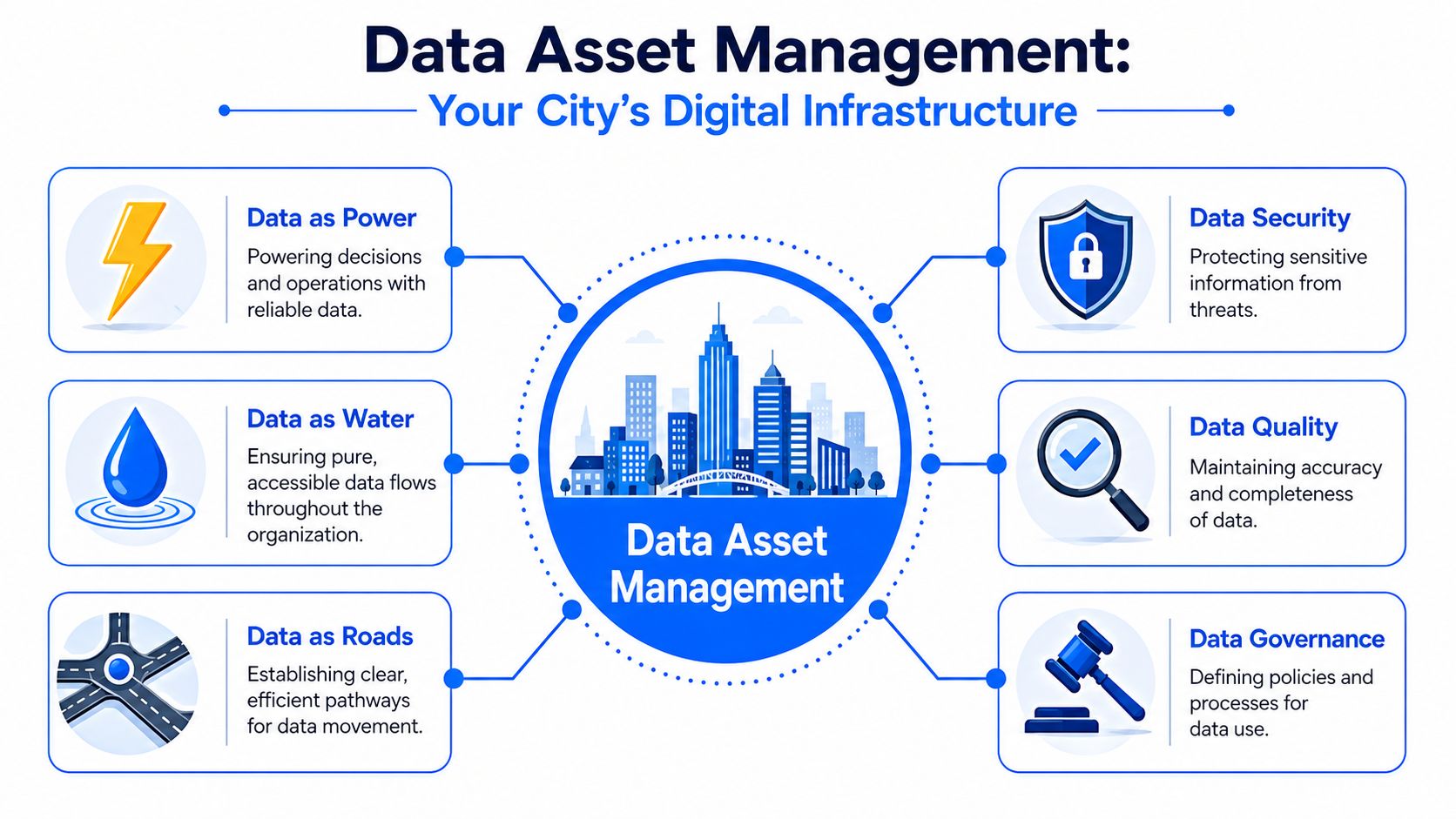
Data asset management is the structured discipline of cataloging, governing, securing, and optimizing an enterprise’s data resources throughout their entire lifecycle. It treats data not merely as a byproduct of business applications,...
Data asset management is the structured discipline of cataloging, governing, securing, and optimizing an enterprise’s data resources throughout their entire lifecycle. It treats data not merely as a byproduct of business applications, but as a formal financial and operational asset designed to minimize regulatory risk, accelerate decision-making, and unlock measurable economic value.
Contents
Understanding Data Asset Management: Core Concepts and Disambiguation
To manage data as an asset, organizations must first establish what constitutes a data asset. A data asset is any identifiable collection of data, metadata, or data pipelines that holds current or future value for an organization. This includes relational databases, data lakes, analytical models, customer profiles, operational logs, and API feeds.
A common point of confusion is the distinction between Data Asset Management (DAM) and Digital Asset Management (also abbreviated as DAM):
- Digital Asset Management: Focuses on rich media files—such as photos, logos, marketing videos, graphics, and brand documentation—organizing them for creative workflow efficiency, rights management, and brand consistency.
- Data Asset Management: Focuses on structured, semi-structured, and unstructured business data across enterprise storage systems. Its primary concerns are data quality, schema evolution, regulatory compliance, data security, provenance, and data monetization.
Traditional data management historically concentrated on system-level storage, database performance, and basic backup routines. In contrast, modern data asset management elevates data to the executive agenda by applying financial stewardship principles to digital information. Under this framework, data assets possess operational costs (storage, ingestion, cleansing), maintenance obligations (governance, privacy compliance), and measurable yield (analytics, machine learning performance, operational speed, and direct data monetization).
Why Data Asset Management Matters to Modern Enterprises
As organizations expand their digital footprints, the volume and complexity of data increase exponentially. Without formal asset management, enterprise data degrades into unstructured "data swamps"—expensive, chaotic repositories that introduce liability rather than value.
- Unmanaged Data (Swamp)
- Shadow IT
- Compliance Fines
- AI Model Bias
- High Storage Costs
- Managed Data (Asset)
- Rapid Analytics
- Audit Readiness
- AI Trustworthiness
- Value Realization
Implementing data asset management addresses several operational and strategic imperatives:
1. Regulatory Compliance and Audit Readiness
Global privacy frameworks such as the General Data Protection Regulation (GDPR), the California Consumer Privacy Act (CCPA), and industry-specific mandates like HIPAA require organizations to know exactly what data they hold, where it resides, who can access it, and how long it is retained. Data asset management provides comprehensive data lineage and cataloging, enabling rapid compliance reporting, fulfilling Subject Access Requests (SARs), and enforcing legal hold policies without manual enterprise-wide searches.
2. Artificial Intelligence and Machine Learning Readiness
Artificial intelligence (AI) and large language models (LLMs) rely entirely on the quality and contextual context of the data used to train and fine-tune them. Poorly managed data leads to hallucinations, biased outputs, and model drift. Data asset management ensures that data feeding into training pipelines is clean, properly classified, ethically sourced, and enriched with authoritative metadata.
3. Cost Optimization and Storage Management
Data storage costs expand rapidly when organizations retain redundant, obsolete, or trivial (ROT) data across multi-cloud environments. By assigning lifecycle rules and tracking asset utilization, organizations can archive or purge low-value historical records, reducing storage footprints while maintaining performance across active analytics platforms.
4. Risk Mitigation and Cybersecurity
Unmapped data creates severe security vulnerabilities. Shadow databases and unmonitored data exports are primary targets for data breaches. A robust data asset management program identifies sensitive elements—such as Personally Identifiable Information (PII) or Intellectual Property (IP)—and ensures appropriate encryption, role-based access control (RBAC), and monitoring are applied uniformly.
The 5 Core Pillars of a Data Asset Management Framework
A complete data asset management program integrates five structural components to transition unstructured enterprise data into managed, discoverable assets.
Data Asset Management Framework:
- Data Cataloging & Metadata Management
- Data Governance & Security Governance
- Data Lineage & Provenance Tracking
- Data Quality & Integrity Assurance
- Lifecycle Management & Retention Rules
1. Data Cataloging and Metadata Management
The foundation of data asset management is the data catalog—a centralized, searchable inventory of all data assets within the organization. Metadata (data about data) is categorized into three key layers:
- Technical Metadata: Describes schemas, table names, data types, primary keys, and physical storage locations.
- Business Metadata: Defines business terminology, domain ownership, data definitions, calculation rules, and operational context.
- Operational Metadata: Tracks creation dates, last-updated timestamps, query execution logs, storage consumption, and pipeline execution status.
2. Data Governance and Access Control
Governance frameworks establish the rules, roles, and responsibilities for managing data assets. This pillar assigns explicit data stewards and data owners across business domains. It defines access control policies using attribute-based access control (ABAC) or role-based access control (RBAC) to ensure that users access only the data necessary for their business function.
3. Data Lineage and Provenance Tracking
Data lineage tracks the end-to-end journey of data from its origin, through transformations, to its final destination in reports or machine learning models. Lineage tools map upstream source tables, transformation logic (such as SQL transformations or ETL pipelines), and downstream dependencies. This transparency allows engineers to assess the impact of schema changes and trace erroneous analytics outputs back to their root cause.
4. Data Quality Management
Data quality is evaluated across six standardized dimensions: accuracy, completeness, consistency, timeliness, validity, and uniqueness. Automated data quality tools monitor ingestion pipelines continuously, flagging anomalies, missing values, or structural deviations before corrupt data reaches downstream reporting engines.
5. Data Lifecycle and Retention Management
Data assets evolve through a predictable lifecycle: creation, storage, maintenance, usage, archiving, and destruction. Asset management policies set clear schedules for data retention and retirement based on regulatory, financial, and operational criteria.
Comparing Data Asset Management Strategies and Frameworks
Organizations adopt different structural models for managing data assets depending on their architecture, governance maturity, and organizational scale.
| Strategy / Framework Model | Structural Approach | Primary Strengths | Core Challenges | Typical Use Case |
|---|---|---|---|---|
| Centralized Data Management | Single corporate team controls all data architectures, catalogs, and policies. | High consistency, standardized governance, strict security enforcement. | Slow request fulfillment, bottlenecks, disconnect from operational business context. | Highly regulated industries (banking, defense, healthcare). |
| Data Mesh (Decentralized) | Data is treated as a product owned by domain-specific business teams. | High agility, deep domain expertise, scalable across large business units. | Risk of inconsistent standards, complex cross-domain lineage tracking. | Large enterprise engineering teams, tech-native organizations. |
| Data Hub & Spoke (Hybrid) | Centralized governance standards paired with domain-specific execution teams. | Balances security oversight with operational speed and business agility. | Requires ongoing alignment between central team and business units. | Mid-to-large enterprise transformations. |
| FAIR Data Framework | Emphasizes making data Findable, Accessible, Interoperable, and Reusable. | Maximizes data utility, promotes inter-system interoperability and open sharing. | Focuses heavily on metadata standard setting rather than operational cost. | Scientific research, public sector, cross-industry collaborative research. |
How to Implement Data Asset Management: Step-by-Step Execution Plan
Establishing a sustainable data asset management framework requires a methodical approach that combines technology deployment with organizational change management.
Step 1: Inventory Existing Systems and Classify Assets
Begin by scanning enterprise environments—including relational databases, cloud object storage, data warehouses, and SaaS tools—to discover existing data repositories.
- Automate discovery using specialized metadata scanners.
- Classify assets based on sensitivity (Public, Internal, Confidential, Restricted).
- Tag systems containing PII, financial metrics, or IP.
Step 2: Establish Governance Structures and Ownership
Data cannot be managed without clear organizational accountability.
- Designate Executive Sponsors to secure budget and enforce policies across business units.
- Assign Domain Owners responsible for business definitions, access approvals, and data utility within specific business units.
- Appoint Technical Data Stewards to maintain data quality rules, schemas, and structural integrity.
Step 3: Implement an Enterprise Data Catalog
Deploy an automated data catalog tool to serve as the single source of truth for your data landscape. Ensure the system integrates directly with existing storage platforms and analytical environments through native connectors and APIs. The catalog should automatically ingest metadata, parse data lineage, and allow technical and non-technical users to search for relevant datasets using standard business terminology.
Step 4: Define Data Quality Benchmarks and Automate Monitoring
Establish baseline quality checks for key data assets. Define validation rules—such as format checking, null value thresholds, and referential integrity constraints—at ingestion points. Implement automated alert mechanisms to notify data stewards when data quality indicators fall below specified operational targets.
Step 5: Establish Lifecycle Rules and Cost Management Metrics
Define clear retention and archival policies for every class of data asset. Track usage metrics to identify underutilized datasets consuming expensive high-performance storage. Transition historical data automatically to lower-cost cold storage tiers or schedule safe deletion in accordance with legal and regulatory guidelines.
Common Pitfalls in Data Asset Management and Solutions
Even well-funded data management initiatives can fail if common operational traps are not recognized and mitigated early.
- Treating Asset Management as a One-Time Project: Data asset management is a continuous operational discipline, not a finite software implementation. Without ongoing oversight, metadata becomes stale, and catalogs quickly lose relevance.
- Over-Governing and Restricting Access: Overly restrictive access policies protect data at the expense of business utility. Effective frameworks implement clear self-service request workflows and automated attribute-based controls, balancing security requirements with efficient business access.
- Ignoring Business Context: Focusing exclusively on technical metadata (table names, column types) without documenting business definitions makes data assets unusable for operational analysts. Involve business analysts directly in defining catalog terms and domain concepts.
- Deploying Tools Without Training: Software tools cannot substitute for organizational alignment. Successful implementations allocate resources to user training, documentation, and internal change management programs.
Frequently Asked Questions
What is the main difference between Data Asset Management and Data Governance?
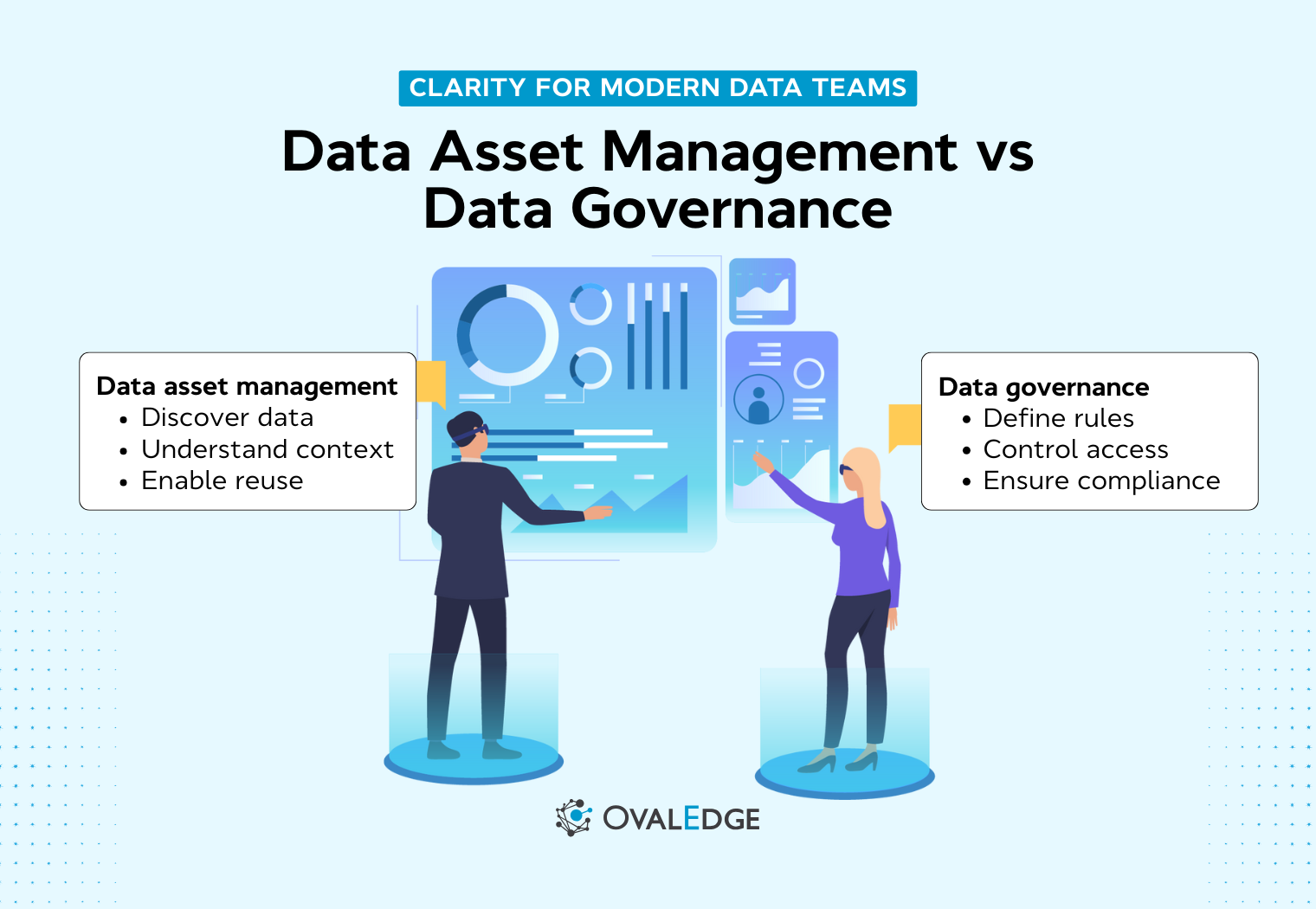
Data Governance is the policy and decision-making framework that establishes rules, roles, and standards for managing enterprise data. Data Asset Management is the broader operational execution that combines data governance, metadata management, technical cataloging, lineage tracking, and lifecycle execution to maximize the tangible financial and operational value of those data assets.
How does Data Asset Management support AI and Machine Learning?
Data Asset Management ensures that AI and machine learning models are trained on validated, high-quality data. By maintaining comprehensive metadata and data lineage, organizations can verify the origin of training datasets, detect structural bias, comply with regulatory AI transparency rules, and prevent model drift caused by compromised data pipelines.
Who is responsible for managing data assets within an enterprise?
Responsibility is divided between executive leaders, business teams, and technical engineers. Executive leadership (such as a Chief Data Officer) oversees overall strategy. Business Domain Owners own the definition and access privileges of specific datasets, while Data Stewards and Data Engineers maintain technical cataloging, metadata pipelines, and platform security.
How do you measure the Financial Value of a Data Asset?
The financial value of a data asset is calculated using direct and indirect valuation methods. Direct approaches measure revenue generated through data monetization, licensing, or API access. Indirect approaches evaluate cost savings from improved operational efficiency, reduced storage overhead, risk mitigation, and the financial impact of analytics-driven decision-making.
What standard frameworks exist for Data Management best practices?
Widely adopted frameworks include the DAMA International Data Management Body of Knowledge (DAMA-DMBOK), the ISO/IEC 38505 standards for governance of data, and the NIST Security and Privacy Frameworks published by the National Institute of Standards and Technology.
Recommended Next Actions
To move your organization toward proactive data asset management, focus on three initial objectives:
- Conduct a Discovery Audit: Perform an automated scan across primary analytical platforms to identify uncataloged data repositories, redundant tables, and unassigned data assets.
- Define Domain Ownership: Identify key business domains (e.g., Finance, Customer Success, Supply Chain) and assign designated business owners responsible for defining data definitions and access policies.
- Evaluate Enterprise Catalog Solutions: Test data catalog platforms that feature automated metadata extraction, native database integration, built-in data lineage mapping, and business glossary capabilities.
Image Gallery