Workers Compensation Insurance in North Carolina: A Complete Guide for 2026
In North Carolina, workers' compensation insurance is a mandatory requirement for most businesses with three or more employees. This no-fault system provides medical care, wage replacement, and disability benefits to workers injured on...
In North Carolina, workers' compensation insurance is a mandatory requirement for most businesses with three or more employees. This no-fault system provides medical care, wage replacement, and disability benefits to workers injured on the job, while simultaneously protecting employers from costly civil litigation stemming from workplace accidents and occupational illnesses.
Contents
The North Carolina Workers’ Compensation Act serves as the legal foundation for the state’s workplace safety net. Administered by the North Carolina Industrial Commission (NCIC), the system is designed to provide a predictable, streamlined process for resolving injury claims without the need for traditional court trials. As we navigate the economic landscape of 2026, understanding the nuances of compliance, cost management, and benefit structures is essential for every business owner operating within the Tar Heel State.
Understanding the Legal Mandate in North Carolina
The primary objective of workers' compensation in North Carolina is to ensure that employees who suffer work-related injuries or illnesses receive necessary medical treatment and financial support. In exchange for these guaranteed benefits, employees generally forfeit the right to sue their employer for negligence.
The Three-Employee Rule
Under North Carolina General Statutes § 97-2, any business that "regularly employs three or more employees" is required by law to carry workers' compensation insurance. This threshold applies to a wide variety of business structures, including corporations, LLCs, partnerships, and sole proprietorships. It is important to note that the term "employee" is interpreted broadly:
- Full-time and Part-time Workers: Both count equally toward the three-person threshold.
- Minors and Undocumented Workers: Legal status or age does not exempt an individual from being counted as an employee.
- Corporate Officers: In a corporation, officers are counted as employees, even if they are the sole owners. However, they may elect to exclude themselves from coverage via specific policy endorsements, though they still count toward the three-person requirement for the business.
Exceptions to the Rule
While the three-employee rule is the standard, certain industries and employment types have different requirements:
- Agricultural Operations: Farmers are only required to carry coverage if they employ 10 or more regular, non-seasonal laborers.
- Domestic Servants: Household workers are generally exempt unless the employer chooses to cover them.
- Certain Railroad Employees: These are often covered under federal statutes rather than state law.
- Sole Proprietors and Partners: These individuals are not automatically counted as employees. They may choose to purchase coverage for themselves, but they do not count toward the "three-employee" trigger unless they have hired staff.
Coverage Requirements for Contractors and Subcontractors
One of the most complex areas of North Carolina workers' compensation law involves the relationship between general contractors and subcontractors. Under N.C.G.S. § 97-19, a principal contractor can be held liable for the injuries of a subcontractor’s employees if the subcontractor does not have the required insurance.
In 2026, the NCIC continues to emphasize the importance of "Certificates of Insurance." Before a general contractor allows a subcontractor to begin work, they must verify that the subcontractor has a valid workers' compensation policy. If a subcontractor is a sole proprietor with no employees, they are not legally required to have insurance; however, many general contractors will still require them to carry a policy to mitigate the risk of the individual being legally reclassified as an "employee" in the event of an injury.
Benefits Provided Under North Carolina Law
Workers’ compensation is more than just a regulatory hurdle; it is a comprehensive benefit package for the workforce. When a claim is approved, the insurance carrier is responsible for several categories of benefits.
Medical Benefits
The employer’s insurance must pay for all "reasonably necessary" medical treatments related to the workplace injury. This includes:
- Emergency room visits and hospital stays.
- Surgeries and specialist consultations.
- Prescription medications.
- Physical therapy and medical equipment (e.g., crutches or wheelchairs).
- Travel reimbursement for medical appointments (if the round trip exceeds 20 miles).
In North Carolina, the employer or their insurance carrier generally has the right to choose the treating physician. If an employee is dissatisfied with the care provided, they must petition the Industrial Commission for a change of physician.
Wage Replacement (Indemnity Benefits)
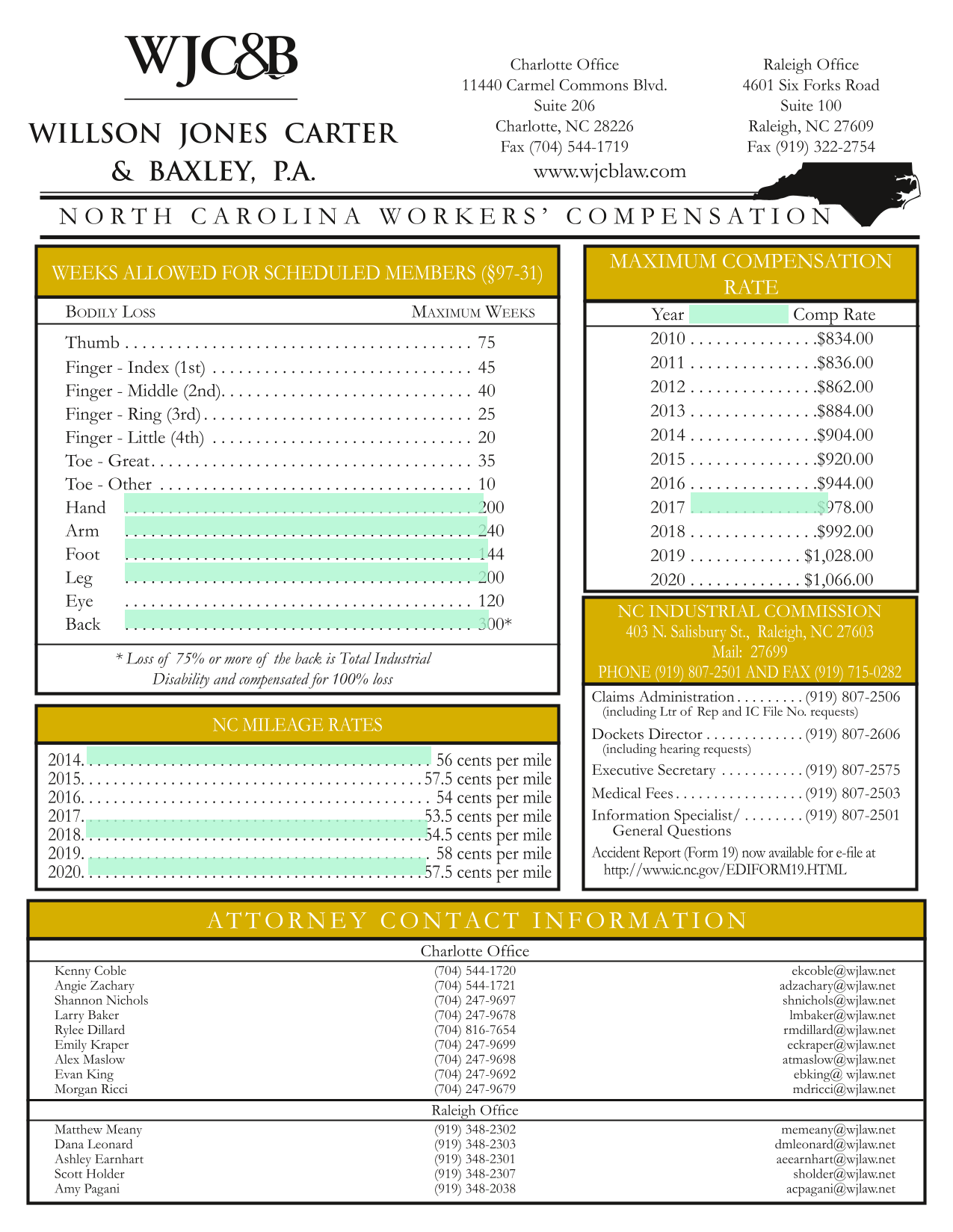
If an injury prevents an employee from working for more than seven days, they are entitled to disability benefits. These are typically calculated at 66.67% of the employee’s average weekly wage, subject to a maximum weekly cap set annually by the state.
- Waiting Period: No compensation is paid for the first seven days of disability unless the disability lasts more than 21 days. If it exceeds 21 days, the employee is retroactively paid for the initial seven-day waiting period.
- Temporary Total Disability (TTD): Paid when the employee is completely unable to work for a temporary period.
- Temporary Partial Disability (TPD): Paid if the employee returns to work at a lower wage due to their injury.
Death Benefits
In the tragic event of a work-related fatality, the insurance provider must pay death benefits to the deceased worker’s dependents (usually a spouse or children). This includes burial expenses up to $10,000 and weekly payments for a minimum of 500 weeks.
| Benefit Type | Description | Duration/Limit |
|---|---|---|
| Medical Expenses | All necessary care for recovery. | No time limit, as long as care is required. |
| TTD (Total Disability) | 2/3 of average weekly wage. | Generally capped at 500 weeks (extensions possible). |
| PPD (Partial Disability) | Payment for permanent impairment to a body part. | Based on NCIC rating schedule. |
| Death Benefits | Support for legal dependents. | 500 weeks + burial expenses. |
| Vocational Rehab | Help returning to the workforce. | If the employee cannot return to their old job. |
Calculating the Cost of Insurance in 2026
The cost of workers' compensation insurance in North Carolina is not a flat fee. It is determined by several variables that reflect the specific risk profile of the business.
NCCI Class Codes and Rates
North Carolina uses the classification system developed by the National Council on Compensation Insurance (NCCI). Each type of job is assigned a four-digit class code representing its risk level. For example, a clerical office worker (Code 8810) has a significantly lower rate than a roofing contractor (Code 5551). The base premium is calculated by multiplying the rate for a specific class code by every $100 of payroll.
The Experience Modification Factor (MOD)
The "MOD" factor is a multiplier that adjusts a business’s premium based on its individual loss history compared to other businesses in the same industry.
- MOD of 1.0: The business is considered "average" for its industry.
- MOD below 1.0: The business has a better-than-average safety record, resulting in a premium discount.
- MOD above 1.0: The business has had more frequent or severe claims than average, resulting in a premium surcharge.
Maintaining a rigorous workplace safety program and an effective "Return-to-Work" initiative are the most impactful ways for North Carolina employers to lower their insurance costs over time.
How to Obtain Coverage
North Carolina businesses generally have three pathways to secure workers' compensation insurance:
- Private Insurance Market: This is the most common route. Business owners can purchase policies through commercial insurance agents from hundreds of licensed carriers.
- Self-Insurance: Large corporations with significant financial assets may apply to the North Carolina Department of Insurance to become self-insured. This requires posting a substantial bond and proving the ability to pay claims directly.
- North Carolina Rate Bureau (NCRB) - Assigned Risk: If a business is denied coverage in the private market due to high risk or a poor claims history, they can obtain coverage through the "Assigned Risk" pool managed by the North Carolina Rate Bureau. This is often more expensive but ensures that every business can find legally required coverage.
Compliance and Penalties for Non-Insurance
Failure to carry workers' compensation insurance in North Carolina is a serious offense. The Industrial Commission’s Criminal Investigation Division actively monitors compliance.
Civil Penalties
If a business is found to be non-compliant, it can face a penalty of $1.00 per employee per day, with a minimum of $50.00 per day and a maximum of $100.00 per day. For a business with 10 employees, a year of non-compliance could result in a fine exceeding $30,000, regardless of whether any injuries occurred.
Criminal Charges
Intentional failure to provide workers' compensation insurance is a crime. Depending on the circumstances, an employer may be charged with a Class H felony or a Class 1 misdemeanor. Furthermore, the employer remains personally liable for all medical bills and lost wages if an employee is injured while the business is uninsured.
Filing a Claim: The Step-by-Step Process
To ensure a smooth process, both employers and employees must follow specific procedures when an injury occurs:
- Notice to Employer: The employee should notify the employer immediately (or within 30 days) in writing.
- Medical Treatment: The employer should direct the employee to an authorized medical provider.
- Form 19: The employer must file "Form 19" (Report of Injury to the Commission) within five days of learning about the injury if the worker is out for more than one day or medical costs exceed $2,000.
- Form 18: The employee should file "Form 18" (Notice of Accident) with the Industrial Commission to formally protect their rights. This must be done within two years of the injury.
Frequently Asked Questions
Does workers' comp cover employees working from home in NC?
Yes. If an employee is injured while performing duties for their employer in a home office, they are generally covered. However, the burden of proof is higher to demonstrate that the injury arose "out of and in the course of" employment rather than a domestic activity.
Can an employee sue an employer instead of taking workers' comp?
Generally, no. Workers' compensation is the "exclusive remedy" for workplace injuries. There are very rare exceptions, such as the Woodson v. Rowland precedent, where an employer’s conduct is "substantially certain" to cause death or serious injury, but these cases are exceptionally difficult to prove.
Are independent contractors covered in North Carolina?
True independent contractors are not covered. However, the NCIC uses the "Right to Control" test to determine if a worker is a contractor or an employee. Many workers labeled as "1099 contractors" are legally considered employees if the employer controls how, when, and where they work.
What happens if an injury was the employee's fault?
Because North Carolina is a no-fault state, employees can still receive benefits even if they were negligent. Benefits may only be denied if the injury was caused by intoxication or the intentional desire to injure oneself or others.
Professional Recommendation for 2026
For North Carolina business owners in 2026, the most effective strategy is proactive risk management. Beyond simply buying a policy, businesses should implement a written safety manual and conduct regular training sessions. Not only does this reduce the likelihood of costly injuries, but it also creates a favorable profile for insurance underwriters, leading to lower premiums. Always consult with a licensed North Carolina insurance professional to ensure your class codes are accurate and your payroll audits are handled correctly.
Image Gallery