How to Use the Cervical Instability ICD-10 Code
In 2026, the primary ICD-10-CM code used for cervical instability is M53.2X2 (Spinal instabilities, cervical region). Selecting the correct code requires identifying whether the instability is chronic, traumatic, or degenerative, as re...
In 2026, the primary ICD-10-CM code used for cervical instability is M53.2X2 (Spinal instabilities, cervical region). Selecting the correct code requires identifying whether the instability is chronic, traumatic, or degenerative, as related conditions like atlantoaxial subluxation (M43.4) or traumatic ligament sprains (S13.4) may be more clinically accurate depending on the etiology.
Contents
Cervical instability is a complex clinical diagnosis characterized by the inability of the cervical spine to maintain its normal patterns of displacement under physiological loads. For medical coders and healthcare providers in 2026, navigating the ICD-10-CM (International Classification of Diseases, 10th Revision, Clinical Modification) manual requires a granular understanding of the patient's pathology. While M53.2X2 is the "go-to" code for general instability of the cervical spine, it is rarely used in isolation. Accurate billing and clinical documentation must reflect the underlying cause—whether it is a result of degenerative changes, inflammatory diseases like rheumatoid arthritis, or acute trauma.
The Primary Code: Understanding M53.2X2
The code M53.2X2 is categorized under "Other dorsopathies, not elsewhere classified." To use this code correctly, it is essential to understand its structure:
- M53: Other and unspecified dorsopathies.
- M53.2: Spinal instabilities.
- X: A placeholder character required to maintain the six-character structure for certain subcategories.
- 2: The specific digit indicating the cervical region.
In 2026, the M53.2X2 code is specifically reserved for cases where the instability is not a primary result of a current injury or a specific degenerative disc disease that has its own more specific code. It is often used for chronic conditions where the structural integrity of the cervical vertebrae (C1 through C7) is compromised, leading to abnormal translation or rotation.
Clinical Indications for M53.2X2
Providers typically document cervical instability when imaging—such as flexion-extension X-rays or upright MRIs—demonstrates excessive movement. Common findings include:
- Translation: Movement of one vertebra over another exceeding 3.5mm.
- Angulation: An angular difference between adjacent vertebrae of more than 11 degrees.
- Clinical Symptoms: Chronic neck pain, neurological deficits, or a "clunking" sensation during head movement.
Navigating Etiology-Based Coding
ICD-10-CM is an etiology-based system. This means if the "instability" is a symptom of a more specific underlying condition, the underlying condition should often be coded instead of, or in addition to, M53.2X2.
Degenerative Instability and Spondylolisthesis
When cervical instability is caused by the gradual wear and tear of the spinal discs and joints, it often manifests as spondylolisthesis (the slipping of one vertebra over another).
- M43.12: Spondylolisthesis, cervical region.
- M47.812: Spondylosis without myelopathy or radiculopathy, cervical region.
If a patient has degenerative instability that has progressed to a physical slip, M43.12 is more specific than the general instability code.
Traumatic Instability (The S-Series)
If the instability is the result of an acute injury, such as a motor vehicle accident or a fall, the coder must look to the S-series codes. These codes require a seventh character to identify the encounter type (A for initial, D for subsequent, or S for sequela).
- S13.4XXA: Sprain of ligaments of cervical spine, initial encounter.
- S12.000A: Unspecified fracture of first cervical vertebra, initial encounter.
Traumatic instability often involves ligamentous "laxity" or tears. In these cases, coding the specific ligament injury is the priority according to the 2026 Official Guidelines for Coding and Reporting.
Craniocervical and Atlantoaxial Instability
Instability occurring at the very top of the spine (the C0-C1 or C1-C2 junctions) requires specialized codes due to the high risk of neurological injury in these areas.
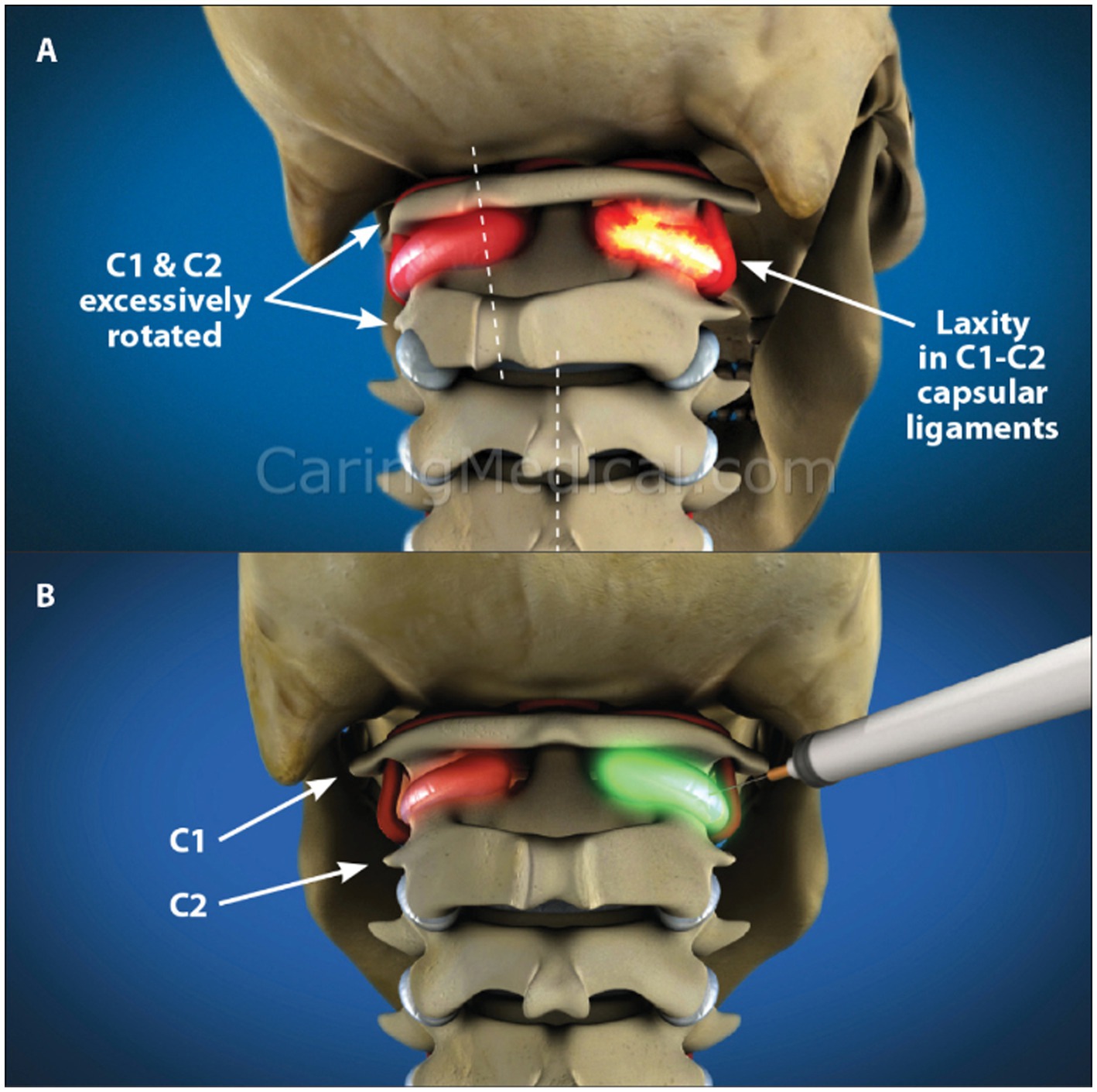
- M43.4: Other recurrent atlantoaxial subluxation. This is frequently used for patients with rheumatoid arthritis or Down syndrome who develop instability between the atlas (C1) and the axis (C2).
- Q76.49: Other congenital malformations of spine, not associated with scoliosis. This is used when the instability is present from birth, such as in cases of Os Odontoideum.
2026 Coding Requirements and Placeholder Rules
A common mistake in using the cervical instability ICD-10 code is omitting the placeholder "X." In the M53.2 subcategory, the sixth character defines the site. However, because the parent code M53.2 does not have a 5th-character subclassification for "spinal instabilities" specifically, the "X" acts as a bridge.
| Code | Description | Purpose |
|---|---|---|
| M53.2X1 | Spinal instabilities, occipito-atlanto-axial region | High cervical (C0-C2) instability. |
| M53.2X2 | Spinal instabilities, cervical region | Subaxial (C3-C7) instability. |
| M53.2X3 | Spinal instabilities, cervicothoracic region | Transition zone (C7-T1) instability. |
| M43.12 | Spondylolisthesis, cervical region | Actual slippage of vertebrae. |
| S13.4XXA | Traumatic cervical ligament sprain | Acute instability due to injury. |
Documentation Requirements for Medical Necessity
In 2026, insurance payers and Medicare Administrative Contractors (MACs) have increased scrutiny on the use of M53.2X2. To ensure reimbursement for treatments such as cervical fusion, prolotherapy, or specialized physical therapy, clinical documentation must be robust.
1. Objective Evidence
The record must contain results from diagnostic imaging. While a standard MRI can show disc herniation, instability is a dynamic diagnosis. Therefore, the documentation should ideally reference dynamic imaging (Flexion/Extension views). If the radiologist notes "hypermobility" but not "instability," the coder must be careful. Hypermobility without clinical symptoms or structural failure may not always support the use of M53.2X2.
2. Functional Limitations
The provider must document how the instability affects the patient's daily life. This includes neurological exams checking for:
- Hyperreflexia (indicative of cord compression).
- Dermatomal sensory loss.
- Muscle weakness (myotomal patterns).
3. Failed Conservative Management
For surgical coding associated with cervical instability, the documentation must show that the patient failed conservative treatments (e.g., bracing, physical therapy, or injections) unless the instability is so severe that it is considered "unstable" and life-threatening.
Common Mistakes and How to Avoid Them
Using "Unspecified" Codes
Avoid using M53.2X9 (Spinal instabilities, site unspecified). In the 2026 reimbursement landscape, unspecified codes often lead to automatic claim denials. If the physician has documented "cervical instability," the coder must map this to the cervical-specific digit (2).
Confusing Instability with Hypermobility
Hypermobility (M35.7) refers to a general increase in joint range of motion, often systemic (like Ehlers-Danlos Syndrome). Cervical instability (M53.2X2) is a structural failure. If a patient has systemic joint laxity that results in cervical instability, both codes should be used to provide a complete clinical picture.
Overlooking the "Code First" Instructions
The ICD-10-CM manual contains "code first" notes for certain conditions. For example, if the cervical instability is due to underlying Rheumatoid Arthritis (M05.-), the arthritis code must be sequenced first, followed by the code for the spinal manifestation.
Billing and Reimbursement Trends in 2026
As of 2026, the shift toward value-based care means that the complexity of the patient is factored into the Hierarchical Condition Category (HCC) coding. While M53.2X2 itself may not always carry a high HCC weight, the comorbid conditions that often accompany it (like myelopathy or radiculopathy) do.
When coding for cervical instability, always check for associated neurological conditions:
- M50.0x: Cervical disc disorder with myelopathy.
- M50.1x: Cervical disc disorder with radiculopathy.
If instability is present alongside these conditions, the myelopathy or radiculopathy codes often take precedence in the hierarchy because they represent a higher level of clinical urgency and resource consumption.
FAQs
Does M53.2X2 require a 7th character for the encounter type?
No. Unlike the S-series codes (trauma), the M-series (musculoskeletal) codes for spinal instability do not use a 7th character for initial or subsequent encounters. The code M53.2X2 is a complete, six-character code.
Can I use M53.2X2 for a patient with a "whiplash" injury?
Generally, no. Whiplash is typically coded as S13.4XXA (Sprain of ligaments of cervical spine). M53.2X2 is reserved for chronic or non-traumatic instability. If the whiplash results in long-term, chronic instability that persists after the acute injury has healed, then M53.2X2 may be appropriate for subsequent follow-ups.
What is the difference between M53.2X1 and M53.2X2?
M53.2X1 refers to the Occipito-atlanto-axial region, which involves the skull base (occiput) and the first two vertebrae (C1 and C2). M53.2X2 refers to the Cervical region, generally interpreted as the subaxial spine (C3 through C7). Using the correct regional code is vital for surgical planning and authorization.
How do I code cervical instability caused by Ehlers-Danlos Syndrome (EDS)?
In this scenario, you would code the underlying systemic condition first (Q87.4 for Marfan syndrome or M35.7 for Hypermobility syndrome/EDS, depending on the specific diagnosis) and then use M53.2X2 as a secondary code to specify the localized manifestation in the cervical spine.
Is cervical instability the same as a subluxation?
Not exactly. A subluxation is a partial dislocation, which is a specific type of instability. If the physician documents "recurrent subluxation," use M43.4 (atlantoaxial) or M43.52 (other recurrent subluxation, cervical). If they use the broader term "instability," use M53.2X2.
Practical Recommendation for Providers
To ensure the highest level of coding accuracy in 2026, providers should move away from the generic term "cervical instability" in their notes. Instead, documentation should specify the vertebral levels involved (e.g., C4-C5), the direction of instability (anterolisthesis or retrolisthesis), and the clinical cause (e.g., degenerative vs. post-traumatic). For medical coders, always verify that the "X" placeholder is included and that the code aligns with the radiological evidence provided in the patient's chart.
Image Gallery