Free Life and Health Insurance Flashcards: A Practical Resource for Exam Success
Free life and health insurance flashcards serve as a practical, high-yield study resource for candidate insurance producers preparing for state licensing exams. By leveraging digital platforms like Anki, Brainscape, and Quizlet, applic...
Free life and health insurance flashcards serve as a practical, high-yield study resource for candidate insurance producers preparing for state licensing exams. By leveraging digital platforms like Anki, Brainscape, and Quizlet, applicants can master complex policy provisions, rider mechanics, tax rules, and regulatory requirements using active recall and spaced repetition.
Contents
Why Flashcards Are Essential for the Life and Health Insurance Licensing Exam
Passing the Life and Health Insurance License Exam is the mandatory first step toward becoming a licensed insurance producer, broker, or agent in the United States. State licensing exams—administered by testing vendors such as Prometric, Pearson VUE, and PSI—assess a candidate's grasp of intricate financial structures, legal contracts, federal health guidelines, and state-specific statutory codes.
The primary challenge of the exam lies in its sheer volume of terminology and technical nuance. Candidates must differentiate between similar-sounding provisions, memorize strict statutory timelines, and apply policy riders across varying scenarios. Passive reading of textbook outlines often leads to recognition memory rather than recall memory—a candidate recognizes a term when reading it, but struggles to retrieve the definition independently during a high-stakes, timed multiple-choice exam.
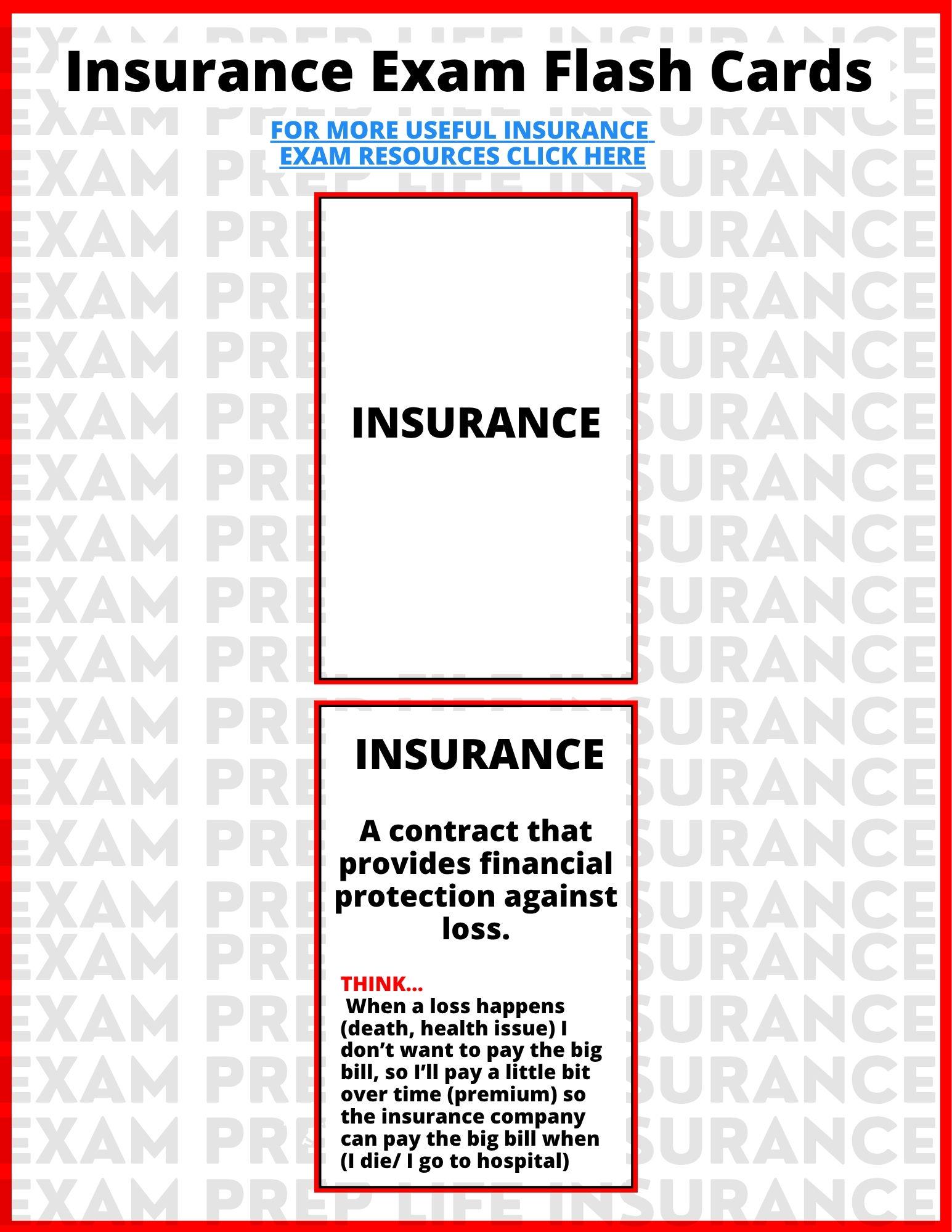
Flashcards directly solve this problem through active recall. When looking at the front of a flashcard, your brain works to retrieve the stored answer from memory before revealing the back. Combining active recall with spaced repetition—the practice of reviewing concepts at expanding time intervals—ensures that critical rules and definitions move from short-term working memory into long-term retention.
Disclaimer: This guide is intended solely for educational and test-preparation purposes. Insurance licensing rules, state-specific statutes, and exam outlines are governed by individual state insurance departments and may change over time. Candidates should always cross-reference their flashcard decks with their state's official candidate handbook.
Core Knowledge Domains Covered in Life and Health Flashcard Decks
To pass the licensing exam on your first attempt, your flashcard deck must comprehensively address both the national general knowledge section and state-specific statutory requirements. Most state exams split questions between general life insurance concepts, health/disability insurance structures, and state laws.
Life & Health Insurance Exam Domains:
- Life Insurance & Annuities
- Term vs Whole
- Universal/Var
- Riders & Opts
- Tax Rules
- Health & Health Plans
- HMO, PPO, POS
- Disability
- LTC & Medigap
- Provisions
- State Laws & Regulations
- Licensing Rules
- Fiduciary Duty
- Unfair Trade
- State Codes
1. Life Insurance Fundamentals and Policy Types
Flashcards in this category focus on contract structures, death benefits, cash value growth, and premium flexibility:
- Term Life Insurance: Level term, decreasing term (often used for mortgage protection), and increasing term policies. Flashcards should highlight convertible and renewable provisions without requiring evidence of insurability.
- Whole Life Insurance: Traditional permanent insurance with fixed premiums, guaranteed cash value accumulation, and coverage extending to age 100 or 121. Key card topics include Ordinary Whole Life, Limited-Pay (e.g., 20-Pay Life), and Single Premium Whole Life.
- Flexible Premium Policies: Universal Life (UL) and Variable Universal Life (VUL). Cards must clarify the distinction between Option A (level death benefit) and Option B (increasing death benefit), as well as separate account investment risks regulated under securities law via FINRA.
- Annuities: Immediate vs. deferred annuities, fixed vs. variable payouts, accumulation vs. annuitization phases, and surrender charge schedules.
2. Policy Provisions, Options, and Riders
Exam questions frequently test the specific conditions under which insurance contracts modify coverage or pay out benefits:
- Mandatory Uniform Provisions: Incontestability clause (typically 2 years), Grace Period (30-31 days), Reinstatement clause (requires proof of insurability and back-pay of premiums), and the Entire Contract clause.
- Policy Options: Nonforfeiture options (Cash Surrender, Reduced Paid-Up, Extended Term), Dividend options (Cash, Reduction of Premium, Accumulate at Interest, Paid-Up Additions, One-Year Term), and Settlement options (Lump Sum, Fixed Period, Fixed Amount, Life Income).
- Policy Riders: Disability riders (Waiver of Premium, Waiver of Monthly Deductible), benefit-increasing riders (Guaranteed Insurability, Accidental Death and Dismemberment, Cost of Living), and living benefit riders (Accelerated Death Benefit, Long-Term Care rider).
3. Health, Disability, and Long-Term Care Insurance
Health insurance content requires candidates to memorize managed care network designs, benefit triggers, and government-sponsored programs:
- Managed Care Structures: Health Maintenance Organizations (HMOs with primary care physician gatekeepers and capitation pricing), Preferred Provider Organizations (PPOs with out-of-network coverage options), and Point of Service (POS) plans.
- Disability Income Insurance: Key definitions of total disability (Own Occupation vs. Any Occupation), Presumptive Disability, Elimination Period (the time-based deductible), and Benefit Period.
- Medical Expense Terms: Deductibles, Coinsurance split (e.g., 80/20), Out-of-Pocket Maximums, and Copayments.
- Senior and Special Coverage: Medicare Parts A, B, C, and D, Medicare Supplement (Medigap) standardized plans, and Long-Term Care (LTC) benefit triggers (inability to perform Activities of Daily Living or cognitive impairment). Federal program updates and guidelines are maintained by the Centers for Medicare & Medicaid Services (CMS).
4. Federal Tax Laws and State Regulations
Understanding how tax law applies to premium payments, cash value growth, and policy distributions is vital:
- Taxation Principles: Life insurance death benefits paid to named beneficiaries are generally income-tax-free under Internal Revenue Code Section 101(a). Cash value grows on a tax-deferred basis.
- Modified Endowment Contracts (MECs): Policies that fail the 7-Pay Test lose tax-advantaged withdrawal status, subjecting distributions to First-In, First-Out (FIFO) or Last-In, First-Out (LIFO) taxation rules plus a 10% penalty prior to age 59½.
- Regulatory & Ethical Standards: Insurance producer licensing requirements, continuing education (CE) obligations, fiduciary responsibilities, rebating prohibitions, misrepresentation, and unfair trade practices defined by individual state insurance commissioners and guided nationally by the National Association of Insurance Commissioners (NAIC).
Top Platforms for Free Life and Health Insurance Flashcards
Candidates can access pre-made decks or create custom cards across several digital platforms and physical media. Each platform offers unique study advantages depending on your learning style.
| Study Platform / Format | Cost | Spaced Repetition Algorithm | Offline Access | Best For | Key Advantage |
|---|---|---|---|---|---|
| Anki | Free (Desktop/Android) | Advanced (SuperMemo SM-2 variation) | Yes | Long-term memory retention & detailed decks | Maximum customization of interval decay and deck formatting |
| Quizlet | Free basic tier | Limited in free tier | Mobile app sync | Fast initial vocabulary drilling | Massive library of user-submitted life & health decks |
| Brainscape | Free basic tier | Confidence-Based Repetition (CBR) | Yes (via app) | Targeted focus on weak concepts | Rating system (1-5 scale) dynamically controls card frequency |
| Printable PDF Decks | Free | Manual (Leitner Box system) | 100% offline | Tactile learners & tactile review | Zero screen fatigue; easy physical sorting |
Utilizing Pre-Made vs. Custom-Built Decks
While downloading a pre-made deck from Quizlet or Anki saves preparation time, constructing your own digital or physical flashcards delivers superior learning outcomes. The process of analyzing a state exam content outline, distilling long paragraphs into concise question-and-answer prompts, and typing out definitions engages deep cognitive processing before you even begin drilling.
High-Yield Sample Flashcards for Your Study Deck
To build an effective deck, structure your cards with single-concept questions on the front and unambiguous, concise answers on the back. Avoid putting multiple complex rules on a single card.
Sample Deck: Life Insurance & Provisions
Card 1
- Front: What nonforfeiture option provides the highest amount of insurance protection for a temporary duration?
- Back: Extended Term Option. It uses the policy's accumulated cash value to purchase term insurance in the same face amount as the original policy for as long a period as the cash value will buy.
Card 2
- Front: Explain the Incontestability Clause in a life insurance contract.
- Back: A mandatory provision stating that after a policy has been in force for 2 years during the insured's lifetime, the insurer cannot contest statements made in the application to void coverage or deny a claim, except for nonpayment of premiums.
Card 3
- Front: How are cash value withdrawals taxed in a non-MEC Whole Life insurance policy?
- Back: Withdrawals are taxed on a First-In, First-Out (FIFO) basis. Withdrawals up to the total amount of premiums paid (cost basis) are tax-free income. Any amount withdrawn above the cost basis is taxable as ordinary income.
Sample Deck: Health, Disability & Long-Term Care
Card 4
- Front: What is the difference between an Elimination Period and a Probationary Period in disability insurance?
- Back:
- Elimination Period: A period of time (acting as a time deductible) following a disability during which no benefits are paid.
- Probationary Period: A period at policy inception (usually 15–30 days) during which losses arising from sickness are not covered. (Accidents are covered immediately).
Card 5
- Front: What are the six standard Activities of Daily Living (ADLs) used to trigger Long-Term Care (LTC) insurance benefits?
- Back:
- Bathing
- Dressing
- Eating
- Transferring (moving in/out of bed or chair)
- Toileting
- Continence(Note: Most LTC policies trigger benefits when the insured cannot perform at least 2 of the 6 ADLs).
Card 6
- Front: What defines a Noncancellable health insurance policy structure?
- Back: The insurer cannot cancel the coverage, cannot alter any policy provisions, and cannot increase premiums above the schedule specified in the policy up to a specified age (usually age 65), provided premiums are paid on time.
Sample Deck: Regulations & Policy Mechanics
Card 7
- Front: What is an Insuring Clause, and where is it located in the policy?
- Back: The foundational clause (usually on the first/face page) stating the insurer's promise to pay benefits upon the occurrence of a covered loss, defining the scope of coverage and identifying the parties to the contract.
Card 8
- Front: What is the primary purpose of a Section 1035 Exchange under the Internal Revenue Code?
- Back: Allows the tax-free transfer of cash values from an existing life insurance, endowment, or annuity contract to a new contract of like kind, without triggering immediate gain recognition or income taxation.
How to Build an Effective Spaced Repetition Study Routine
Simply flipping through flashcards randomly is inefficient. To maximize memory retention and pass your state exam on the first attempt, adopt a structured study methodology based on cognitive science.
The 4-Week Flashcard Mastery Protocol:
WEEK 1: Foundation & Card Creation
- Read state exam content outline & provider study text
- Create 150-200 core flashcards covering general life & health concepts
- Conduct initial daily review (100% deck exposure)
WEEK 2: Categorization & Leitner Box Sorting
- Separate master deck into 3 boxes based on recall confidence
- Review Box 1 (Weak) Daily | Box 2 (Moderate) Every 3 Days | Box 3 (Strong) Weekly
- Add 50-75 state-specific regulatory flashcards
WEEK 3: Targeted Weakness & Distraction Drilling
- Isolate cards continuously missed during practice exams
- Drill high-yield numeric triggers (e.g., grace periods, ADLs, contestability timelines)
- Run randomized SRS sessions on Anki or Brainscape
WEEK 4: Final Exam Readiness & Simulation
- Conduct high-speed active recall passes (5 seconds per prompt)
- Review state regulation cards 24-48 hours before test date
- Rest card deck 12 hours before exam to prevent mental fatigue
The Leitner Box System for Physical Cards
If using printed physical flashcards, implement the Leitner System:
- Box 1 (Daily Review): Place all newly created cards here. Every card answered incorrectly stays in or returns to Box 1.
- Box 2 (Every 3 Days): When you answer a Box 1 card correctly, promote it to Box 2. If you miss it during review, demote it back to Box 1.
- Box 3 (Weekly Review): When you answer a Box 2 card correctly, promote it to Box 3.
- Box 4 (Exam Eve Review): Cards that are consistently answered correctly in Box 3 reach Box 4. Review this box once right before your exam date.
Common Flashcard Mistakes to Avoid
- Overcrowding Front Prompts: Putting an entire textbook paragraph on the front of a card makes retrieval impossible. Keep prompts focused on single questions or single term definitions.
- Relying Solely on Recognition: Do not turn the card over after a brief glance and say, "I knew that." Force yourself to vocalize or write down the answer before checking the back.
- Ignoring State-Specific Rules: National concepts account for a large portion of the exam, but failing the state-law section can cause an overall fail score. Ensure 25-30% of your flashcards focus strictly on your state's administrative codes, producer licensing laws, and commissioner duties.
Supplementary Exam Preparation Tools and Next Steps
Flashcards are an exceptional tool for memory retention, but they should be integrated into a complete study plan:
- State Candidate Information Bulletin: Download the candidate handbook from your testing provider (Prometric, Pearson VUE, or PSI). Review the exact weighting of exam domains for your state.
- Full-Length Practice Exams: Practice tests assess test-taking endurance, stem analysis, and your ability to choose the best answer among multiple correct-sounding options. Use practice test errors directly to create new target flashcards.
- Glossary Review: Perform a final audit of your knowledge by running through an alphabetized insurance glossary to identify remaining blind spots.
Frequently Asked Questions
Are free online flashcards enough to pass the Life and Health Insurance exam?
Free flashcards are an effective tool for terminology and rule memorization, but they should be paired with practice exams and comprehensive study manuals. Practice tests are necessary to learn how state licensing vendors phrase complex scenario-based questions.
How long should I study flashcards before taking the state insurance test?
Most successful candidates dedicate 35 to 50 total hours of preparation over a 2-to-4-week window. Spending 30 to 45 minutes daily on spaced-repetition flashcard sessions alongside practice questions delivers high pass rates.
What is the difference between an elimination period and a probationary period?
An elimination period is a period of time following an injury or illness during which no disability benefits are paid (acting as a time deductible). A probationary period occurs at policy inception, during which coverage for sickness (not accidents) is temporarily excluded to protect the insurer against adverse selection.
How do spaced repetition systems (SRS) improve insurance exam retention?
SRS algorithms track how easily you recall individual flashcards. Concepts you struggle with are shown more frequently, while cards you know well are spaced out over longer intervals, maximizing study efficiency and preventing memory decay before exam day.
Where can I verify state-specific insurance regulations for my exam deck?
Always cross-reference state-specific regulatory flashcards against your state's Department of Insurance website or the official Candidate Information Bulletin issued by testing vendors like Pearson VUE, Prometric, or PSI.
EDITORIAL CATEGORY METADATA:
Image Gallery