Navigating the Reality That Group Term Life Insurance Coverage Ends When Employment Termination Occurs
Group term life insurance coverage typically ends when employment terminates, leaving former employees without active death benefits unless they act quickly to exercise policy continuation rights like portability or conversion. When in...
Group term life insurance coverage typically ends when employment terminates, leaving former employees without active death benefits unless they act quickly to exercise policy continuation rights like portability or conversion. When individuals leave a job—whether through resignation, layoff, retirement, or termination—the group policy issued to the employer generally ceases protection within 31 days or immediately upon the final day of work. This structural limitation means that millions of American workers face an immediate insurance gap during career transitions, requiring a clear understanding of contract provisions, statutory grace periods, and alternative personal life insurance strategies to maintain financial security for their dependents.
Contents
Understanding the Mechanics of Employer-Sponsored Group Life Insurance
Employer-sponsored group term life insurance represents a foundational employee benefit designed to provide affordable financial protection. Unlike individual policies purchased independently through a broker, group policies are master contracts held by the employer, with employees receiving certificates of insurance.
These plans rely on economies of scale. Insurance carriers underwrite the entire workforce as a single entity rather than evaluating each worker's individual health profile, medical history, or lifestyle habits. Because administrative costs are low and risk is pooled across active healthy and unhealthy workers alike, premiums are frequently subsidized entirely or partially by the company.
However, this architecture ties coverage directly to active employment status. The master contract stipulates that insurance is an active benefit reserved for current personnel. When an individual ceases to meet the definition of an active employee—due to job loss, career pivots, long-term disability, or retirement—the employer ceases paying premiums for that worker, and the insurer terminates the risk exposure. Understanding this dependence is critical for financial planning, as relying exclusively on employer-provided protection creates a vulnerable single point of failure in a family's safety net.
The Critical Timeline: Grace Periods, Termination Dates, and Continuation Rights
When employment terminates, coverage does not always vanish instantly at the stroke of midnight, though the exact timeline depends heavily on the employer's master contract and state insurance regulations. Most group policies include a continuation window or a conversion privilege, but strict deadlines govern these options.
Typically, active group term coverage expires either on the final day of active employment or at the end of the calendar month in which the termination occurs. Following this cessation, standard group policies incorporate a 31-day grace period. During this window, the former employee remains technically eligible to exercise conversion or portability privileges without undergoing fresh medical underwriting, provided they submit the required paperwork and initial premium payments within the statutory window.
| Feature | Portability | Conversion |
|---|---|---|
| Eligibility | Available if leaving the company and the group plan offers a portability rider. | Available under almost all group life policies regulated by state insurance laws. |
| Medical Exam | Generally not required; rates are based on age brackets. | Not required; however, rates are based on attained age and are typically much higher. |
| Duration | Temporary or term-based continuation, often expiring at a specific age (e.g., 65 or 70). | Permanent lifetime coverage, such as whole life or universal life. |
| Cost | Usually more affordable than conversion, but more expensive than active group rates. | Significantly higher cost because it transitions term risk into permanent insurance. |
Failing to act within this 31-day window typically results in the absolute forfeiture of these rights. Once the deadline passes, the insurer is under no legal obligation to reinstate the group policy terms, forcing the individual to apply for individual coverage from scratch, subject to full medical underwriting.
Portability vs. Conversion: Protecting Your Coverage Post-Employment
Former employees navigating the reality that group term life insurance coverage ends when employment terminates generally encounter two primary contractual remedies: portability and conversion. Each mechanism operates under distinct rules, carries different cost structures, and leads to divergent long-term insurance outcomes.
Portability Provisions
Portability allows a departing employee to "port" or transfer their existing group term coverage into an individual policy.
- Cost Structure: Rates under a portable plan are generally higher than what the employee paid while actively working—since the employer subsidy is gone—but they are usually lower than individual rates for someone of the same age with health complications.
- Duration Limitations: Portable term insurance is rarely permanent. Policies often mandate that coverage steps down or expires entirely when the insured reaches a certain age, such as 65 or 70.
- Underwriting: Medical exams are typically waived, making this an attractive option for individuals who have developed health conditions during their employment tenure.
Conversion Privileges
Conversion allows the former employee to convert their group term insurance certificate into an individual permanent life insurance policy, such as whole life or universal life.
- Permanent Nature: Unlike term insurance, converted policies build cash value and remain active for the rest of the insured's life, provided premiums are paid.
- Financial Reality: Conversion premiums are notoriously expensive. Because the insurer must absorb the risk of underwriting an individual without a medical exam at an advanced age, rates reflect the high actuarial risk.
- Strategic Use: Conversion is typically utilized as an emergency bridge for individuals facing severe health diagnoses who cannot qualify for a standard commercial term policy on the open market.
Assessing Financial Impact and Evaluating Alternative Solutions
Relying solely on group life insurance—which typically offers a flat multiple of salary, such as one or two times annual earnings—is rarely sufficient for comprehensive family protection. When that coverage evaporates upon job termination, it exposes gaps in income replacement, debt fulfillment, and future education funding.
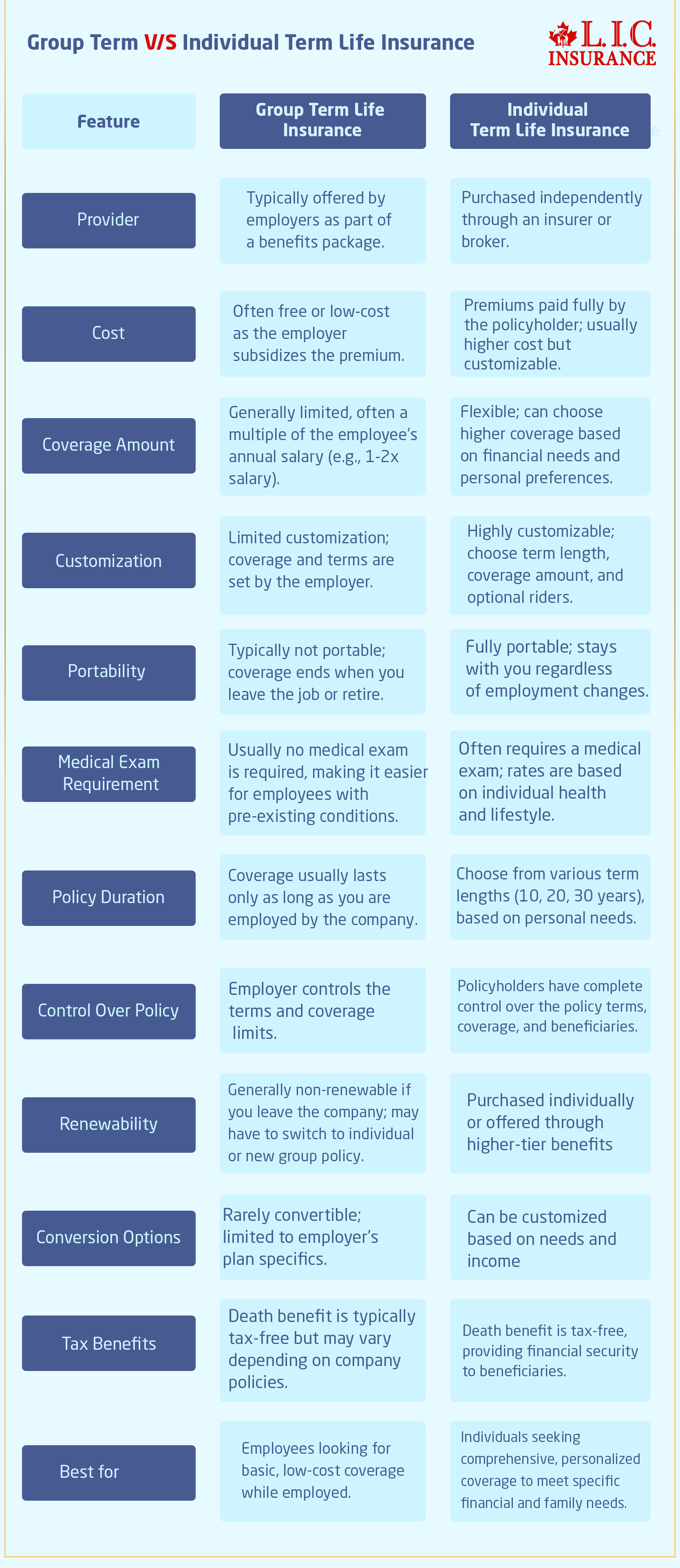
Evaluating personal insurance needs requires looking beyond workplace benefits. Independent individual term life insurance policies offer significant advantages that employer-sponsored plans cannot match:
- Ownership and Portability: An individual policy is entirely owned by the policyholder. Changing jobs, retiring, or shifting industries has zero impact on coverage validity or premium rates.
- Level Premium Guarantees: Private term policies lock in level premiums for 10, 20, or 30 years, protecting the budget from sudden inflationary rate adjustments common in age-banded group plans.
- Customized Face Amounts: Group plans cap coverage limits (often requiring evidence of insurability for amounts over $50,000 or $100,000, which are subject to taxable imputed income under IRS rules). Individual policies can be tailored precisely to match family liabilities, mortgages, and long-term financial goals.
Common Misconceptions Regarding Post-Employment Life Insurance
Misunderstandings surrounding employer-provided benefits frequently lead to lapsed coverage and unprotected families. Clarifying these myths helps departing employees make informed choices during stressful career transitions.
- Myth: Group coverage extends automatically for severance periods. Severance pay extends payroll processing, but it does not legally extend insurance master contracts. Insurers strictly evaluate active employment status rather than payroll continuation.
- Myth: The HR department will automatically enroll me in a continuation plan. Human resources administrators provide notification packets regarding rights and deadlines, but the legal burden of completing, signing, and submitting conversion or portability paperwork rests entirely on the former employee.
- Myth: I am too healthy to worry about conversion deadlines. Even if an individual is young and physically fit, skipping the conversion or portability window forfeits the only guaranteed-issue coverage available without medical underwriting. Securing an independent policy takes weeks, creating a dangerous uninsured gap if done reactively after termination.
Frequently Asked Questions
Does group term life insurance have any cash value when employment ends?
No. Group term life insurance is pure insurance protection without an investment or savings component. When employment terminates and the policy expires or is not converted, it retains zero cash value, and no payouts or refunds are issued for premiums previously paid by the employer or employee.
Can I keep my supplemental or optional group life insurance?
Many employers offer voluntary or supplemental group life insurance that employees purchase via payroll deductions. Like basic employer-paid term insurance, supplemental coverage generally terminates upon job separation. However, most master contracts extend portability and conversion rights to supplemental coverage as well, subject to the same strict 31-day application windows.
What happens if I become disabled before my employment terminates?
If an employee becomes totally and permanently disabled while actively employed and covered under the group plan, many policies include a "Waiver of Premium" rider. This provision keeps the group life insurance active without requiring further premium payments from the employer or employee, provided the disability is properly documented and approved by the insurance carrier.
How soon after leaving a job should I apply for an individual term life policy?
It is advisable to secure an individual term life insurance policy while still employed, ensuring overlapping coverage before leaving a position. If that is impossible, application for private coverage should begin immediately upon notice of termination to mitigate the risk of going uninsured during the underwriting approval process.
Strategic Next Steps for Departing Employees
Facing the termination of group term life insurance requires proactive management rather than passive reliance on corporate HR departments. Workers anticipating or experiencing a job transition should immediately request a copy of the summary plan description (SPD) from their employer's benefits administrator to identify exact policy expiration dates, carrier contact numbers, and conversion forms.
Simultaneously, evaluating the independent term life insurance market through an independent insurance broker provides a comprehensive view of private rates and underwriting requirements. By securing an independent policy early in one's career, professionals insulate themselves from the volatility of corporate restructuring, ensuring that family protection remains intact regardless of employment status.
Image Gallery