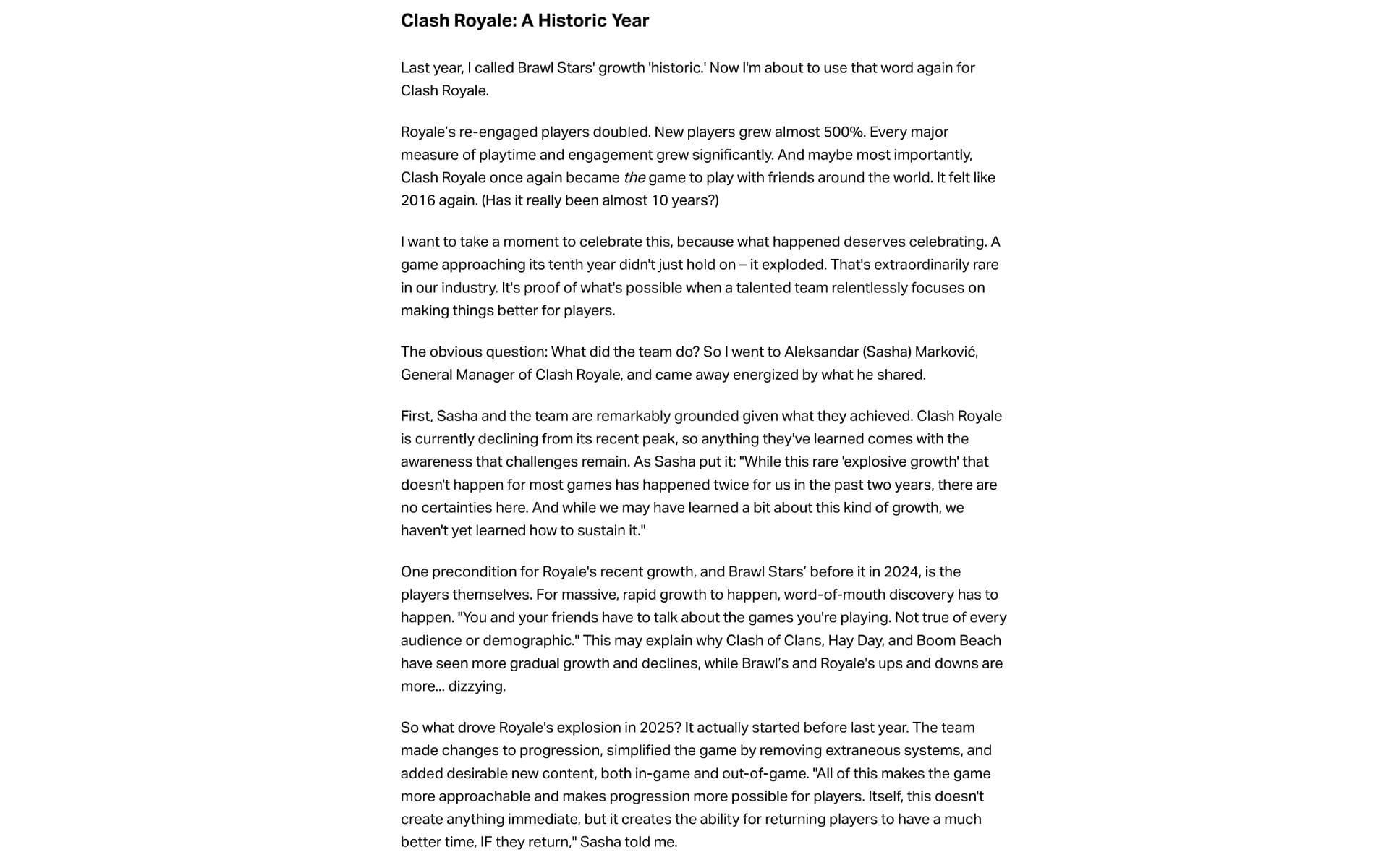
Supercell Company Worth Explained: Valuation, Revenue, and Ownership in 2026
Supercell is currently valued at approximately $11 billion to $14 billion. This valuation is driven by its consistent annual revenue of nearly $2 billion, its portfolio of multi-billion-dollar "evergreen" titles like Clash of Clans and...
Supercell is currently valued at approximately $11 billion to $14 billion. This valuation is driven by its consistent annual revenue of nearly $2 billion, its portfolio of multi-billion-dollar "evergreen" titles like Clash of Clans and Brawl Stars, and its highly efficient "small cell" operational model under majority owner Tencent.
Contents
Understanding the worth of Supercell requires looking beyond simple balance sheets. As a titan of the mobile gaming industry, the Finnish company has redefined how digital entertainment is produced and monetized. Unlike traditional developers that churn out dozens of titles, Supercell’s value is built on the extreme longevity of a few high-performance games. By the start of 2026, the company remains a cornerstone of Tencent’s global gaming portfolio, maintaining a unique corporate structure that prioritizes creative independence over rapid expansion.
The Evolution of Supercell’s Market Valuation
Supercell’s financial journey is one of the most successful trajectories in the history of the software industry. Founded in 2010 by Ilkka Paananen and five others in Helsinki, the company began with a radical vision: to create a "flat" organization where small teams (cells) could operate as independent startups. This philosophy has directly influenced the company’s valuation by keeping overhead low and output quality exceptionally high.
The SoftBank and Tencent Milestones
The first major valuation benchmark occurred in 2013 when SoftBank and GungHo Online Entertainment acquired a 51% stake for $1.53 billion, valuing the company at approximately $3 billion. Just three years later, in 2016, Chinese tech giant Tencent led a consortium to acquire an 84.3% stake from SoftBank in a deal valued at $8.6 billion. This transaction pegged Supercell’s total valuation at approximately $10.2 billion.
In the years leading up to 2026, Supercell’s valuation has fluctuated based on the performance of its live-service games and the reception of new launches. While the company is not publicly traded, analysts estimate its current worth by applying industry-standard EBITDA (Earnings Before Interest, Taxes, Depreciation, and Amortization) multiples. Given Supercell's high profit margins—often exceeding 35%—its valuation remains robust even during periods of broader market volatility.
Revenue Streams and Financial Performance
Supercell’s worth is fundamentally rooted in its ability to generate massive, recurring revenue from a small number of assets. As of the 2024 and 2025 fiscal cycles, the company has consistently reported annual revenues in the range of $1.7 billion to $2 billion.
The "Evergreen" Strategy
The primary driver of this revenue is the company's "evergreen" strategy. Supercell does not measure success by the first month of a game's release but by its ability to retain players for a decade or more.
- Clash of Clans: Over 12 years since its launch, this title continues to be a top-grosser, contributing hundreds of millions of dollars annually through seasonal passes and in-game cosmetics.
- Brawl Stars: Following a major progression overhaul in 2023, Brawl Stars saw a massive resurgence in 2024 and 2025, reaching new peaks in monthly active users (MAU) and revenue.
- Squad Busters: Released in mid-2024, this title served as a critical test for the company’s ability to launch new IP. Its successful stabilization by 2026 has added a significant layer of "future-proofing" to the company’s valuation.
Monetization Excellence
Supercell utilizes a "Freemium" model, where the core game is free, but players can purchase virtual currency to speed up progression or acquire exclusive aesthetics. The shift toward Battle Passes (such as the Gold Pass in Clash of Clans) has stabilized monthly cash flows, making the company more attractive to investors who prize predictable earnings over "hit-or-miss" game cycles.
Ownership Structure: Who Owns Supercell in 2026?
The ownership of Supercell is a unique arrangement within the tech world. While Tencent is the majority owner, Supercell operates with a level of autonomy rarely seen in major acquisitions.
Tencent holds its stake through a Luxembourg-based consortium called Halti S.A. Since the initial 2016 acquisition, Tencent has increased its effective control, but the Finnish founders and employees still retain significant equity. This "ownership-led" culture is vital to the company's worth; it ensures that the talent—the developers themselves—have a direct financial interest in the long-term health of the games.
| Stakeholder | Estimated Ownership % | Role/Influence |
|---|---|---|
| Tencent (via Halti S.A.) | ~84% | Majority owner; provides infrastructure and access to the Chinese market. |
| Supercell Employees/Founders | ~15-16% | Retain creative control and operational independence. |
| Institutional Investors | < 1% | Minor legacy interests or secondary market participants. |
This structure is a major reason why Supercell has not pursued an Initial Public Offering (IPO). With Tencent’s deep pockets, Supercell has no immediate need for public capital, allowing them to avoid the quarterly pressure of the stock market and focus on game quality.
Operational Efficiency: Revenue per Employee
A defining factor in "Supercell company worth explained" is the company’s legendary efficiency. As of 2026, Supercell employs fewer than 600 people. When you compare this to competitors like Ubisoft or Electronic Arts, which employ thousands or tens of thousands, the revenue-per-employee metric is staggering.
Supercell generates roughly $3 million to $4 million in revenue per employee. This efficiency is possible because the company kills games that do not show the potential to become "top ten" hits. For every game that reaches global launch, dozens are canceled in the "soft launch" or prototype phase. This "fail fast" mentality ensures that the company does not waste resources on mediocre products, keeping the brand prestigious and the profit margins high.
Why Supercell’s Valuation Fluctuates
Despite its success, Supercell’s valuation is not static. Several factors influence how the market perceives its worth in 2026:
- Market Saturation: The mobile gaming market has become increasingly crowded. High user acquisition costs (the price of advertising to get a new player) can eat into profits.
- Platform Fees: Both Apple (App Store) and Google (Play Store) take a significant cut (up to 30%) of all in-app purchases. Any regulatory changes or legal battles regarding these fees directly impact Supercell’s bottom line.
- The "Hit" Dependency: While the "evergreen" games are stable, the market expects growth. If Supercell goes too many years without a successful new global launch, its valuation multiple may shrink as investors fear the portfolio is aging.
- Regulatory Environment: As a Tencent-owned entity, Supercell is sometimes caught in the crosshairs of geopolitical tensions or strict gaming regulations in China. However, their primary revenue comes from Western markets, providing a buffer against localized downturns.
Industry Comparison: Supercell vs. Competitors
To put Supercell's valuation in perspective, it is helpful to compare it to other major players in the mobile and social gaming space.
| Company | Estimated Value (2026) | Primary Revenue Source | Staff Size (Approx.) |
|---|---|---|---|
| Supercell | $11B - $14B | Clash of Clans, Brawl Stars | 550 |
| King (Activision Blizzard) | $12B - $15B | Candy Crush Saga | 2,500+ |
| Playrix | $8B - $10B | Homescapes, Gardenscapes | 3,000+ |
| Roblox Corp | $25B - $30B | User-generated content / Platform | 2,000+ |
Supercell maintains a valuation similar to King despite having a much smaller workforce, highlighting the premium placed on their brand and operational efficiency.
FAQ: Supercell Company Worth and Business Model
Is Supercell a public company?
No, Supercell is a private company. The majority of its shares are owned by the Chinese conglomerate Tencent. Because it is private, it does not trade on any stock exchange, and its valuation is determined by private transactions and analyst estimates based on revenue.
What is Supercell’s most profitable game?
Historically, Clash of Clans is Supercell’s highest-grossing game, having generated over $10 billion in lifetime revenue. However, in the 2024-2026 period, Brawl Stars has frequently surpassed it in terms of monthly active users and growth rate.
How does Supercell maintain such a high valuation with so few games?
Supercell focuses on "games that people will play for years and remember forever." By focusing on deep social mechanics and competitive gameplay, they create high "switching costs" for players. Once a player has spent years building a clan or climbing the ranks in Brawl Stars, they are unlikely to leave, ensuring a stable, long-term revenue stream that investors value highly.
Will Tencent ever sell Supercell?
As of 2026, there is no indication that Tencent intends to sell its stake. Supercell is one of Tencent’s most successful international investments and serves as a key pillar of its "Global Expansion" strategy. Supercell provides Tencent with a massive footprint in Western markets.
What happened to Supercell’s canceled games like Clash Mini?
Supercell is famous for its "kill list." Games like Clash Mini, Hay Day Pop, and Everdale were canceled because they did not meet the internal criteria for long-term scalability. While this might seem like a loss, it actually protects the company’s worth by ensuring that resources are only spent on games with the potential to generate billions of dollars.
Practical Recommendation for Stakeholders
For those tracking Supercell's worth—whether as industry analysts, potential employees, or competitors—the key metric to watch is EBITDA growth relative to user acquisition (UA) costs. In 2026, the mobile gaming landscape is more competitive than ever. Supercell’s ability to maintain its valuation depends on its "Live Ops" (the ability to constantly update and refresh existing games) rather than just the release of new titles.
If you are looking to understand the company's financial health, monitor the Supercell official blog for their annual "Year in Review," which is typically released in February. This report is the most transparent look into the company's revenue and the CEO's vision for the following year. Additionally, tracking Tencent’s Investor Relations provides indirect insights into Supercell's contribution to its parent company's quarterly earnings.
Image Gallery