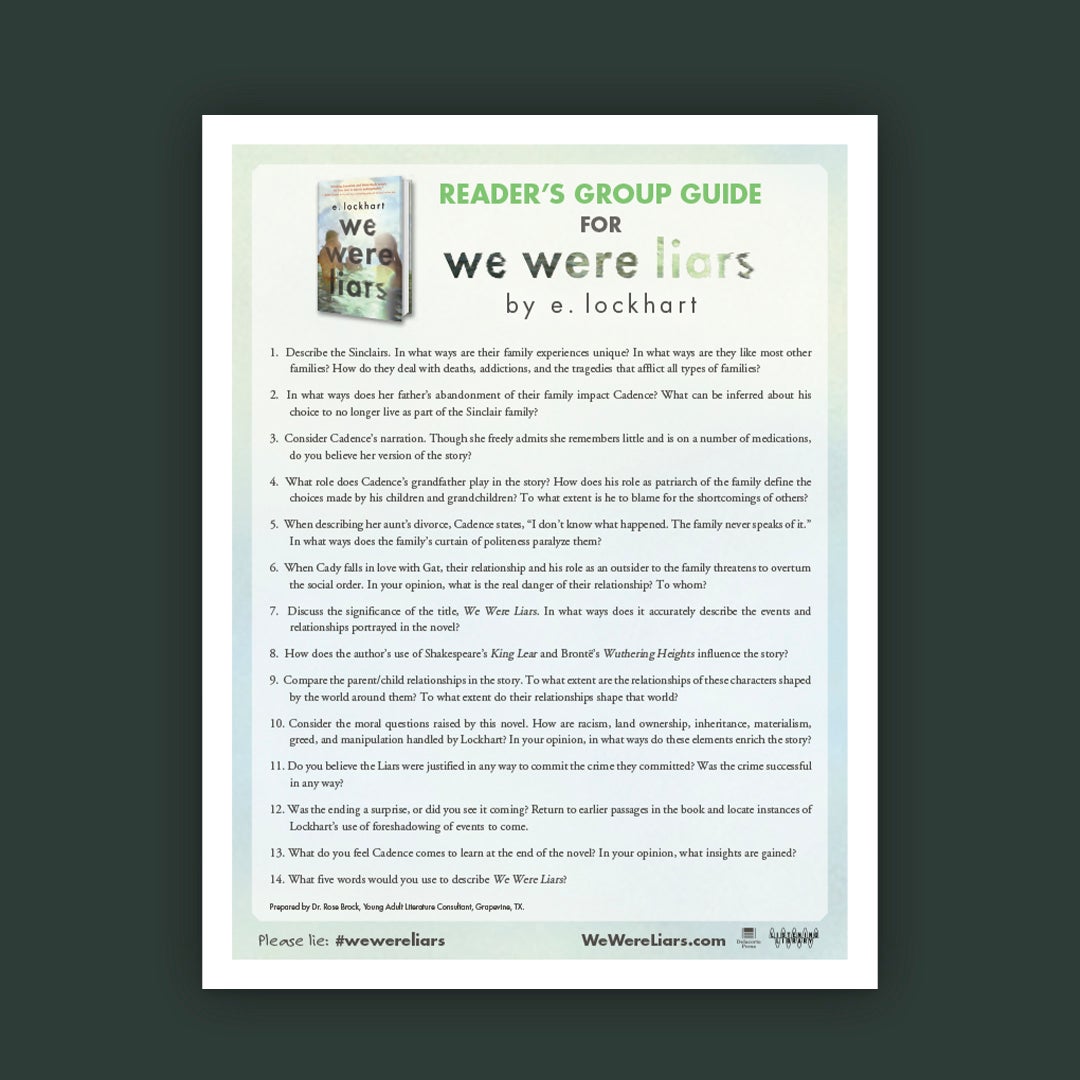
We Were Liars: Shifting Labels and the Ongoing Genre Debate
E. Lockhart's 2014 bestseller We Were Liars remains a central touchstone in publishing discussions surrounding genre categorization, narrative manipulation, and target audience framing. Originally marketed as a Young Adult (YA) psychol...
E. Lockhart's 2014 bestseller We Were Liars remains a central touchstone in publishing discussions surrounding genre categorization, narrative manipulation, and target audience framing. Originally marketed as a Young Adult (YA) psychological mystery, its evolving shelf labels, viral social media resurgence, and dark thematic resolution continue to provoke debate among literary critics, educators, and readers regarding how modern fiction is classified.
Contents
The Evolution of We Were Liars in Commercial Publishing
When Delacorte Press, an imprint of Random House Children's Books, published We Were Liars in May 2014, the book was framed primarily as a contemporary Young Adult thriller. Its promotional campaign emphasized mysterious family secrets, elite social settings, and a high-stakes summer romance. The narrative follows Cadence Sinclair Eastman, the eldest grandchild of a wealthy, seemingly perfect New England family that spends every summer on their private island, Beechwood. Following a traumatic incident during her fifteenth summer ("Summer Fifteen"), Cadence suffers from selective amnesia, debilitating migraines, and severe psychological distress, spending "Summer Seventeen" attempting to reconstruct what actually occurred.
While the book enjoyed immediate critical acclaim and commercial success—reaching the top of The New York Times Bestseller list—its positioning within retail and institutional environments began to shift over the subsequent decade. The traditional boundary dividing Young Adult literature from Adult Fiction began to blur significantly as adult readers increasingly consumed YA titles.
The primary catalyst for the novel's second wave of commercial redefinition arrived around 2020 through BookTok, the book-focused subculture on TikTok. Viral videos focused less on the book's mystery mechanics and more on the emotional devastation of its climactic plot twist. Readers filmed their visceral reactions to the ending, reframing We Were Liars not merely as a YA mystery, but as an emotional ordeal or "trauma fiction." This user-led movement led bookstores and digital platforms to display the novel alongside adult psychological thrillers and emotional dramas, demonstrating how reader communities can actively alter a text's market classification independently of its original publisher metadata.
The release of E. Lockhart's prequel, Family of Liars, in 2022 further solidified this shifting perspective. By expanding the history of the Sinclair family's older generation and detailing prior instances of addiction, grief, and cover-ups, the prequel reframed the original novel as part of a multi-generational tragedy rather than a standalone teen mystery.
Genre Reclassification: Why the Novel Defies Simple Labels
The ongoing debate over how to label We Were Liars stems from its hybrid structural elements. The novel combines conventions from several distinct literary traditions, making single-label categorization difficult for librarians, booksellers, and literary scholars.
1. The Psychological Thriller vs. Coming-of-Age Drama
At its core, the novel operates as a psychological puzzle. Cadence's post-traumatic amnesia creates a classic unreliable narrator framework. However, traditional thrillers focus primarily on external investigation, procedural clues, or tangible threats. We Were Liars concentrates heavily on internal emotional landscapes, identity formation, and romantic longing—core elements of the Bildungsroman (coming-of-age story). Critics frequently debate whether the book's emotional resolution overshadows its thriller mechanics, leading some metadata databases to reclassify it from "Mystery/Suspense" to "General Contemporary Fiction."
2. Modern Gothic and Aristocratic Tragedy
The setting of Beechwood Island, combined with the Sinclair family's obsessive maintenance of an immaculate Anglo-Saxon Protestant façade, draws heavily from Gothic literary conventions. The island acts as a closed, haunted domain where patriarchal authority dictates behavior, and secrets are buried to preserve social status. The four "Liars"—Cadence, her cousins Johnny and Mirren, and Gat, an outsider of South Asian descent—attempt to break free from this toxic dynamics through a radical, misguided act of arson. The tragic outcome aligns structural tropes with classical Greek tragedy or Gothic horror, genres that sit uncomfortably within traditional mainstream YA marketing parameters.
3. Crossover Fiction and "New Adult"
Publishing industry analysts frequently cite We Were Liars as an early baseline for crossover fiction—books written for teenagers that achieve massive readership among adults aged 25 to 54. The emergence of the informal "New Adult" category, which targets readers aged 18 to 30, further complicated the book's status. Because the protagonists navigate themes of intergenerational wealth, systemic privilege, arson, and horrific loss, many readers argue the book addresses themes more aligned with adult fiction than traditional middle-grade or early-YA reading lists.
Core Themes Driving Literary Discourse
The debate surrounding We Were Liars extends beyond bookstore placement into thematic interpretation and ethical evaluation. Literary critics and educators frequently analyze three central axes of the text.
The Critique of Wealth and Privilege
A dominant topic in academic discussions of the novel is its portrayal of patriarchal capitalism and white privilege. Grandfather Harris Sinclair uses his wealth to manipulate his adult daughters, who fight over heirlooms, real estate, and financial support. Cadence and her cousins recognize the moral decay of their family, viewing their grand gesture—burning down the family mansion, Clairmont—as a heroic purge of materialism.
However, the tragic irony of their action underscores the ignorance born of their privilege. In their attempt to destroy physical property, they fail to account for the lives inside the house, resulting in the accidental deaths of Johnny, Mirren, and Gat, as well as the family dogs. Critics debate whether Lockhart's narrative effectively critiques elite privilege or merely romanticizes the tragic downfall of wealthy youth.
Unreliable Narration and Memory Reconstruction
Cadence's narration is deliberately fragmented. Lockhart incorporates fairy-tale allegories at regular intervals—reinterpreting classic stories of kings and three daughters—to reflect Cadence's distorted processing of her family dynamics. The revelation that Cadence has been hallucinating her dead cousins throughout "Summer Seventeen" forces the reader to re-evaluate every interaction described in the book.
This structural choice has sparked debate regarding narrative fairness. While proponents argue that the hallucination construct vividly captures severe psychological trauma and grief-induced dissociation, detractors contend that the narrative mechanism relies on withholding vital information from the reader rather than planting fair-play clues.
Comparative Overview of Classification Perspectives
To understand how different industry stakeholders interpret and categorize We Were Liars, the following matrix outlines the primary classifications, target audiences, and rationale used across the literary ecosystem.
| Classification Label | Primary Stakeholder | Key Defining Characteristics | Marketing & Practical Impact |
|---|---|---|---|
| Young Adult (YA) Mystery | Original Publisher / Retailers | Protagonists aged 15–17; themes of identity, first love, and rebellion; coming-of-age setting. | Placed in teen sections (ages 12–18); cataloged under young adult fiction in public libraries. |
| Psychological Thriller | Trade Reviewers / Mystery Readers | Unreliable narrator; selective amnesia; plot-twist structure; underlying suspense. | Shelved alongside mystery/suspense titles; appeals to adult mystery enthusiasts. |
| Crossover / New Adult | BookTok / Digital Reading Communities | High emotional intensity; themes of grief, trauma, and moral complexity; dark resolutions. | Positioned in viral recommendation lists; drives high sales volume among adult readers. |
| Modern Gothic Tragedy | Literary Critics / Scholars | Isolated private island setting; toxic family dynastic pressures; destructive hubris leading to fatal loss. | Subject of academic papers and literary analysis regarding wealth critique and tragic structure. |
The Ongoing Ethical and Educational Debates
As We Were Liars continues to be assigned in high school English curricula and selected for community reading programs, several practical and ethical debates persist among educators, parents, and literary analysts.
Content Warnings versus Plot Integrity
One of the most active debates concerns the implementation of content warnings. The novel addresses heavy themes, including severe grief, drug abuse (prescription painkiller dependency), house fires, tragic loss of life, and traumatic brain injury.
Educators and mental health advocates often argue that potential readers should be forewarned about these intense subjects. Conversely, literary purists and purveyors of suspense fiction argue that detailed content warnings inevitably spoil the pivotal twist that fuels the novel's second half. Balancing reader safety and psychological comfort against narrative surprise remains an unresolved tension in recommendations for teenage audiences.
Age Appropriateness in Institutional Settings
Determining the appropriate reading age for We Were Liars remains a source of discussion for library collection managers. While the prose style features short, accessible sentences and poetic formatting that can appeal to younger teenagers (ages 12–14), the underlying psychological complexity, moral ambiguity, and tragic consequences of arson present mature themes. Most public library systems categorize the book for ages 14 and up (High School), though middle-school educators frequently deliberate over whether younger readers possess the emotional maturity to process the climax.
Guidance for Readers, Educators, and Discussion Groups
For those planning to read, teach, or lead a book club discussion on We Were Liars, navigating its shifting labels requires a multi-faceted approach:
- Contextualize the Setting and Privilege: Before reading, analyze how private spaces (like Beechwood Island) isolate characters from broader social realities. Examine how economic insulation shapes the decisions made by both the adult Sinclairs and the teenagers.
- Track Narrative Allegories: Pay close attention to the fairy-tale chapters interspersed throughout Cadence’s recount. These segments offer symbolic clues regarding her internal emotional state and her subconscious awareness of the truth before the formal twist is revealed.
- Analyze Narrative Ethics: When conducting group discussions, evaluate whether Cadence's actions—and those of her cousins—are framed as understandable youthful rebellion or negligent criminal behavior. Explore how the novel presents accountability versus tragedy.
- Compare with Evolving Metadata: Examine how different platforms (e.g., Goodreads, school libraries, retail sites) tag the book. Use these differences to spark discussions on how marketing categories shape reader expectations.
Frequently Asked Questions
Why is We Were Liars categorized under multiple genres?
We Were Liars blends elements from several distinct genres, including Young Adult coming-of-age fiction, psychological thrillers, and Gothic family tragedies. Because its structural mechanics rely on an unreliable narrator while its emotional core focuses on teen identity and grief, publishers, booksellers, and readers classify it differently based on their specific analytical focus.
How did BookTok affect the public perception of the novel?
Starting around 2020, BookTok creator videos reframed We Were Liars from a standard YA summer mystery into a viral "emotional trauma" experience. This organic marketing surge reached an older demographic, solidifying the novel's status as a crossover hit and shifting reader expectations toward its emotional impact rather than its mystery elements.
Is We Were Liars suitable for middle-school readers?
While the text is written in an accessible style, most educational institutions and library systems recommend the book for ages 14 and older (grades 9+). The climax involves arson, fatal consequences, severe psychological trauma, and drug dependency, which may require a level of emotional maturity more typical of high school students.
What is the primary controversy surrounding content warnings for this book?
The central controversy involves a conflict between preserving plot integrity and providing readers with necessary psychological context. Because the climax hinges on sudden, catastrophic loss and trauma, adding specific content warnings can inadvertently spoil the novel's primary plot twist, creating a dilemma for librarians and teachers.
How does the prequel Family of Liars impact the reading of the original book?
Published in 2022, Family of Liars focuses on the previous generation of Sinclairs during their youth. It reveals long-standing patterns of secrecy, addiction, and cover-ups on Beechwood Island, shifting the narrative framework of the original novel from an isolated teenage mistake to the culmination of an intergenerational family curse.
Final Summary and Practical Recommendation
We Were Liars demonstrates how a literary work's identity can evolve far beyond its initial publishing categorization. Rather than fitting neatly into a single box, E. Lockhart's novel functions simultaneously as a YA drama, a psychological puzzle, and a critique of dynastic privilege.
For educators and book club leaders, the text is best approached not merely as a twist-driven thriller, but as a case study in unreliable narration and structural tragedy. Readers approaching the novel for the first time should evaluate it through both lenses: as an engaging coming-of-age mystery and as a deliberate exploration of how denial, privilege, and unaddressed trauma can shatter lives.
Image Gallery