The Complete History of Original Baywatch: From NBC Cancellation to Global Phenomenon
The original Baywatch television series debuted on NBC in 1989, suffered cancellation after just one season, and subsequently transformed into the most-watched syndicated television drama in global broadcast history. Created by Michael...
The original Baywatch television series debuted on NBC in 1989, suffered cancellation after just one season, and subsequently transformed into the most-watched syndicated television drama in global broadcast history. Created by Michael Berk, Douglas Schwartz, and Gregory J. Bonann, the show ran for 11 seasons and 242 episodes between 1989 and 2001, defining 1990s pop culture and establishing a revolutionary model for international television distribution.
Contents
The Origins and NBC Launch (1989–1990)
The concept for Baywatch originated from the real-life experiences of co-creator Gregory J. Bonann, who worked as a Los Angeles County lifeguard while pursuing a career in television production. Bonann recognized that the daily operations of beach rescue teams—combining high-stakes physical saves, coastal environmental hazards, and interpersonal team dynamics—offered an ideal setting for an episodic action drama.
Bonann partnered with veteran television writers and producers Michael Berk and Douglas Schwartz to develop the concept into a network pilot. In March 1989, NBC broadcast the television film pilot, Baywatch: Panic at Malibu Pier. The pilot introduced lead character Mitch Buchannon, portrayed by David Hasselhoff, a senior lifeguard overseeing a team of full-time and seasonal rescues at Will Rogers State Beach and Malibu.
NBC picked up the series for its 1989–1990 fall lineup. The initial regular cast featured:
- David Hasselhoff as Lieutenant Mitch Buchannon
- Parker Stevenson as Craig Pomeroy, a lawyer and part-time lifeguard
- Shawn Weatherly as Jill Riley, a veteran lifeguard mentor
- Billy Warlock as Eddie Kramer, a troubled rookie lifeguard
- Erika Eleniak as Shauni McClain, an idealist rookie from a wealthy background
- Brandon Call as Hobie Buchannon, Mitch’s young son (later replaced by Jeremy Jackson)
Despite strong production values and real-world ocean footage supervised by professional Los Angeles County lifeguards, the show struggled in network television ratings. NBC placed Baywatch in a competitive time slot opposite established top-rated series. Furthermore, the show's co-production company, GTG Entertainment (a joint venture between Grant Tinker and Gannett Company), suffered severe financial troubles, leading to its liquidation. Facing weak domestic ratings and the collapse of its primary production studio, NBC officially canceled Baywatch after its 21-episode first season in the spring of 1990.
The Syndication Gamble and Hasselhoff's Vision (1990–1991)
The cancellation of Baywatch could have ended the series permanently had it not been for an unprecedented business maneuver led by David Hasselhoff, creators Berk and Schwartz, and distribution executive Syd Vinnedge of All American Television.
Hasselhoff, who had previously experienced immense international success with Knight Rider, recognized that while Baywatch failed to secure a massive broadcast audience in the United States, foreign broadcast buyers expressed immense interest in the show's sun-drenched Southern California aesthetic and accessible action storytelling.
- NBC Cancellation (1990)
- Rights Acquisition & Financial Restructuring
- First-Run Syndication Launch (1991)
To revive the series for first-run syndication—a distribution model where shows are sold directly to individual local stations rather than broadcast networks—the producers had to dramatically reduce production costs while retaining high visual standards:
- Executive Restructuring: David Hasselhoff agreed to take a significant reduction in his upfront acting salary in exchange for taking on an active role as Executive Producer and securing royalties along with backend equity.
- Budget Streamlining: Production costs were reduced from approximately $1.2 million per episode on NBC to roughly $800,000 per episode in syndication. The crew optimized exterior beach shoots by using natural sun lighting, lighter camera setups, and shooting multiple episodes concurrently on location.
- International Pre-Sales: All American Television secured distribution agreements across Europe, Latin America, and Asia prior to filming, effectively financing production through guaranteed international license fees rather than relying solely on domestic US ad revenue.
The revised series returned to the airwaves in September 1991 in first-run syndication. The gamble succeeded immediately: local stations across the United States slotted Baywatch into prime weekend time slots, while international markets embraced the program at an unprecedented scale.
The Peak Golden Era and Global Dominance (1992–1998)
By 1992, Baywatch entered its most commercially successful era. The series developed an instantly recognizable visual grammar characterized by montage sequences, pop-rock soundtracks, dynamic water-rescue sequences, and trademark slow-motion running shots along the shoreline.
While criticized by television academics for light narrative structures, the show's emphasis on visual storytelling made it uniquely adaptable for global dubbed markets. Viewers in non-English speaking countries could follow the physical action and emotional beats without complex contextual nuances losing meaning in translation.
Key Milestone: Guiness World Records recognized Baywatch as the most-watched television series in the world, reaching an estimated weekly audience of over 1.1 billion viewers across 142 countries at its peak.
The Arrival of Iconic Cast Members
The second and third seasons introduced major cast shifts that elevated the show to global cultural phenomenon status. The arrival of Pamela Anderson in 1992 as Casey Jean "C.J." Parker redefined the show's image, driving magazine covers, global media coverage, and skyrocketing ratings.
- 1989 (NBC Season 1)
- David Hasselhoff
- Parker Stevenson
- Shawn Weatherly
- Erika Eleniak
- 1992 (Syndication Peak)
- David Hasselhoff
- Pamela Anderson
- Alexandra Paul
- Yasmine Bleeth
- 1999 (Hawaii Rebrand)
- David Hasselhoff
- Jason Momoa
- Stacy Kamano
- Simmone Jade Mackinnon
Key cast additions during the prime syndication years included:
- Pamela Anderson (C.J. Parker): Joined in Season 3 (1992), becoming the worldwide face of the franchise until her departure in Season 7 (1997).
- Alexandra Paul (Stephanie Holden): Joined in Season 3 as a lieutenant, bringing grounded authority and dramatic depth until Season 7.
- Yasmine Bleeth (Caroline Holden): Introduced in Season 4 (1993) after guest appearances, fast becoming one of the show's primary breakout stars through Season 7.
- David Chokachi (Cody Madison): Joined in Season 6 (1995), filling the lead male heartthrob role through Season 9.
- Gena Lee Nolin (Neely Capshaw) & Carmen Electra (Lani McKenzie): Featured prominently in Seasons 6 through 8, reinforcing the show's late-1990s visual aesthetic.
Technical Production Realism
Despite its reputation for glamour, the production maintained a strict operational relationship with real marine safety professionals. Gregory J. Bonann insisted that all water sequences follow realistic ocean rescue protocols.
The production employed actual Los Angeles County lifeguards as technical advisors, stunt doubles, and background extras. Real equipment—including red rescue cans (the iconic torpedo buoys), Boston Whaler rescue boats, and Yamaha WaveRunner personal watercraft—was used extensively. Cast members underwent mandatory ocean swim, paddling, and CPR training before filming water rescues, ensuring that physical movements in surf zones mirrored actual lifeguard techniques.
Production Timeline and Financial Evolution
The following table summarizes the key structural periods of the original Baywatch TV series across its 12-year run:
| Era / Phase | Years Active | Broadcast Network / Model | Primary Filming Locations | Key Executive Producer(s) | Peak Global Reach |
|---|---|---|---|---|---|
| NBC Network Run | 1989–1990 | NBC Network (US) | Will Rogers State Beach, CA | Michael Berk, Douglas Schwartz, Gregory J. Bonann | ~10–12 million US viewers |
| Early Syndication Era | 1991–1993 | First-Run Syndication | Santa Monica & Malibu, CA | Hasselhoff, Berk, Schwartz, Bonann | ~500 million international viewers |
| Peak Global Phenomenon | 1993–1998 | First-Run Syndication | Will Rogers Beach & Los Angeles Coast | Hasselhoff, Berk, Schwartz, Bonann | 1.1+ Billion weekly viewers across 140+ nations |
| Baywatch Hawaii Era | 1999–2001 | First-Run Syndication | Oahu, Hawaii (Hanauma Bay & North Shore) | Hasselhoff, Bonann, April Masini | ~300–400 million international viewers |
The Rebrand: Baywatch Hawaii (1999–2001)
By 1998, production in Los Angeles faced growing financial pressures. Rising labor costs, location permits, and declining domestic syndication revenues led producers to search for alternative filming locations. Australia was initially considered, but local union disputes halted plans.
Local business promoter April Masini and the state government of Hawaii pitched an extensive financial incentive package to secure the production, aimed at boosting local tourism. In 1999, the production relocated to the island of Oahu, and the series was officially retitled Baywatch Hawaii for Seasons 10 and 11.
- Los Angeles Production Costs Rise (1998)
- Location Search
- Relocation to Oahu & Rebrand to Baywatch Hawaii (1999)
The rebrand overhauled both setting and story context:
- The narrative shifted from Southern California county lifeguards to an elite international training center for ocean rescue professionals based at Haleiwa on Oahu's North Shore.
- David Hasselhoff returned for Season 10 to oversee the transition before leaving the series, leaving a leadership vacuum that altered the show's core dynamic.
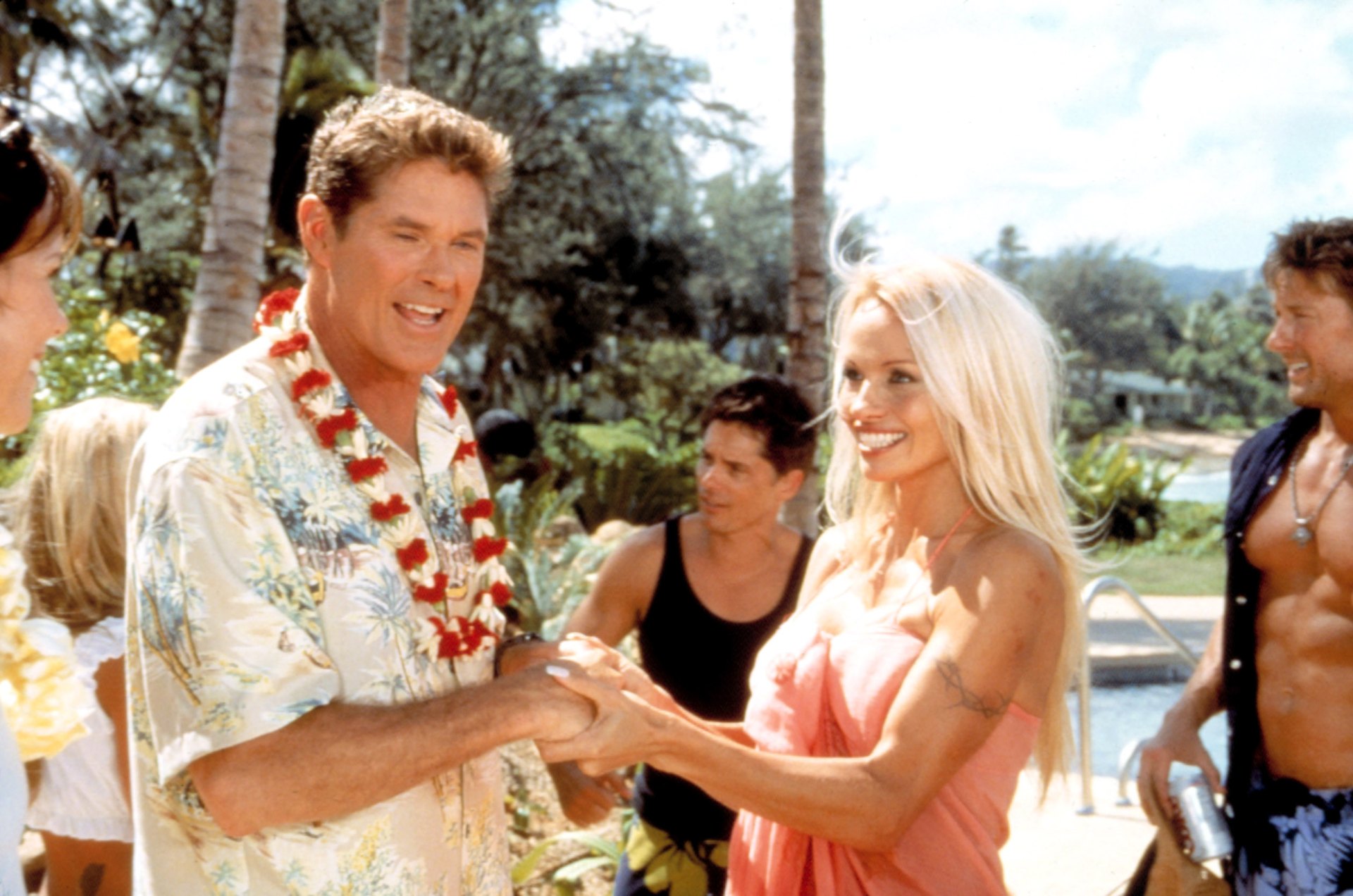
- A new, younger cast was brought in, introducing Jason Momoa in his screen debut as Jason Ioane, alongside Stacy Kamano (Kekoa Tanaka) and Simmone Jade Mackinnon (Allie Reese).
While Baywatch Hawaii delivered visually striking surf cinematography—showcasing massive North Shore winter swells and authentic Hawaiian culture—ratings continued to drop globally. Changing television consumption trends, competition from cable networks, and the departure of Hasselhoff led to the show's permanent cancellation in May 2001.
The Franchise Legacy and Modern Remastering
The impact of the original Baywatch extended well beyond its initial 242-episode run. It pioneered business models and spin-offs that altered TV industry practices:
Spin-offs and Television Films
- Baywatch Nights (1995–1997): A detective/sci-fi spin-off starring David Hasselhoff as Mitch Buchannon running a private investigation agency by night, running concurrently with the main series for two seasons.
- Baywatch: Hawaiian Wedding (2003): A made-for-television reunion movie brought back Hasselhoff, Pamela Anderson, Yasmine Bleeth, Alexandra Paul, and Carmen Electra to resolve long-running character arcs.
Full HD and 4K Digital Remastering
In 2018, rights holder Fremantle completed a massive technical restoration of all 242 episodes. The original 35mm film negatives were scanned in High Definition and re-scanned for 4K broadcast standards.
Because the original series was shot on 35mm film but edited on standard-definition tape, editors went back to the original camera negative, color-corrected every scene, and re-edited the entire series into a widescreen 16:9 aspect ratio. Due to music licensing expirations, hundreds of original pop songs featured in background montages were replaced with modern compositions recorded by contemporary indie artists, preserving the show for current global streaming platforms like Amazon Prime Video, Pluto TV, and Roku Channel.
- Original 35mm Film (1989-2001)
- Scanned & Digitized
- 16:9 Widescreen & 4K Remastering (2018)
- Global Streaming
Frequently Asked Questions
Why was original Baywatch canceled after its first season?
NBC canceled Baywatch in 1990 due to low domestic ratings in its time slot and the financial failure of its co-production studio, GTG Entertainment. It was rescued when David Hasselhoff and the show's creators bought back the rights to produce it directly for first-run syndication.
Who created the original Baywatch series?
The show was created by Gregory J. Bonann, Michael Berk, and Douglas Schwartz. Bonann brought direct authenticity to the project from his real-world job as a Los Angeles County lifeguard.
How many total episodes and seasons were produced?
The original Baywatch universe produced 11 seasons and 242 episodes in total. Seasons 1 through 9 were set in California (1989–1999), while Seasons 10 and 11 were set in Hawaii and titled Baywatch Hawaii (1999–2001).
Why did the production move from California to Hawaii in 1999?
High production costs in Los Angeles and shrinking domestic syndication revenues prompted producers to move. The state of Hawaii offered tax incentives, logistical support, and dedicated filming facilities on Oahu to promote international tourism, leading to the Baywatch Hawaii rebrand.
Is the original Baywatch available to watch in high definition today?
Yes. Fremantle restored all 242 episodes from the original 35mm film negatives into 1080p HD and 4K widescreen formats. These restored versions are available across global streaming and ad-supported platforms like Pluto TV, Samsung TV Plus, and Amazon Prime Video.
Practical Viewing Takeaway
For media historians and fans looking to experience the original Baywatch, the restored 16:9 HD version offers the best entry point. To appreciate the evolution of the series, view Season 1 (the original NBC drama run) to understand its traditional action-drama roots, followed by Seasons 3 through 5 to experience the show at the height of its international cultural popularity and commercial production quality.
Image Gallery