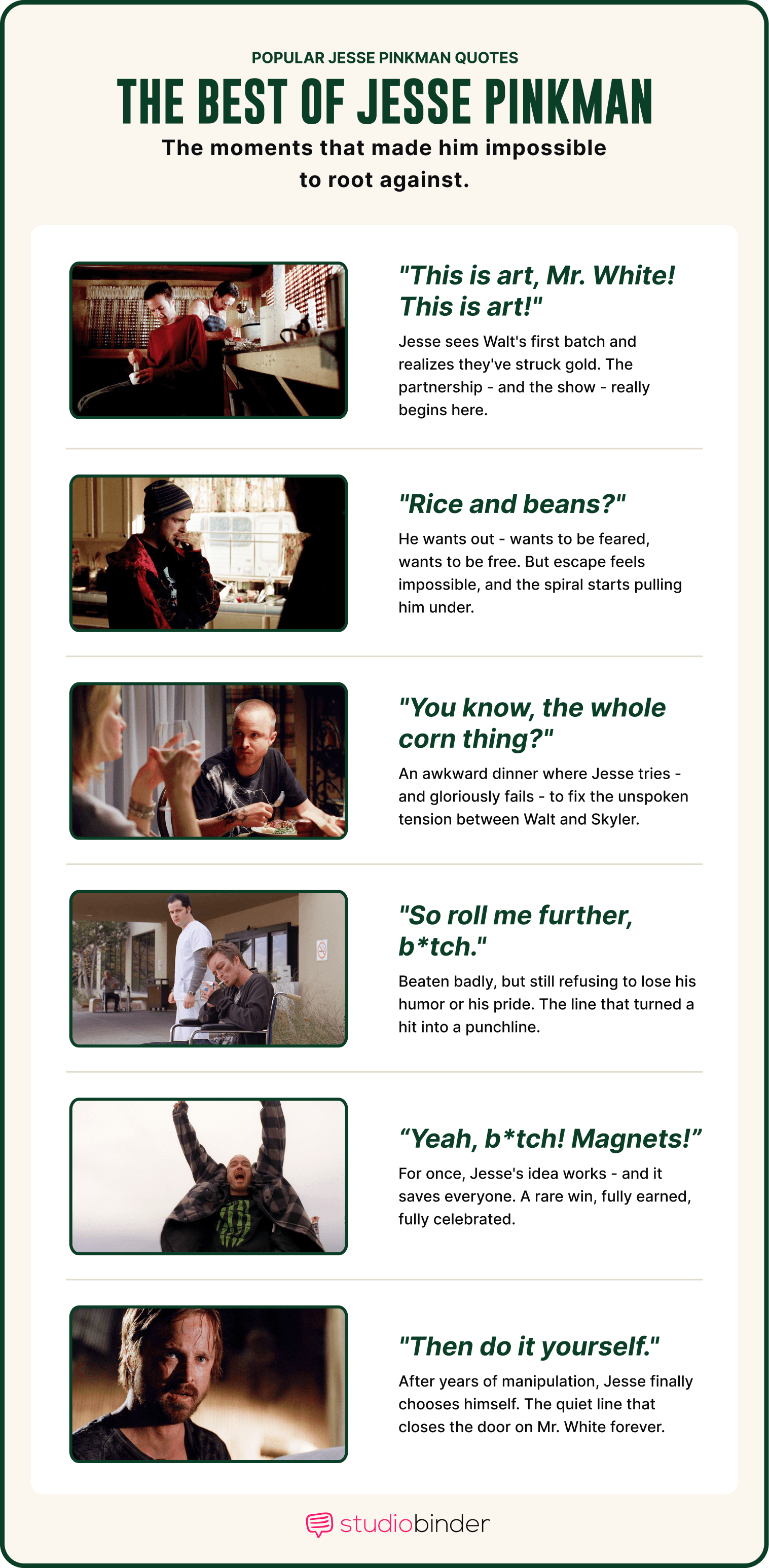
Jesse Pinkman’s Most Notable Lines and Quotes from Breaking Bad
Jesse Pinkman’s dialogue in Breaking Bad serves as the emotional heartbeat of the series, documenting his transformation from a misguided street dealer to a deeply traumatized survivor. His most notable lines, ranging from his iconic u...
Jesse Pinkman’s dialogue in Breaking Bad serves as the emotional heartbeat of the series, documenting his transformation from a misguided street dealer to a deeply traumatized survivor. His most notable lines, ranging from his iconic use of "Bitch!" to profound moral outcries like "He can't keep getting away with it," highlight his complex relationship with Walter White and his status as the show's moral compass.
Contents
The Evolution of Jesse Pinkman Through Dialogue
To understand Jesse Pinkman’s lines, one must look at the trajectory of his character. In the early seasons, Jesse’s speech is heavily influenced by Albuquerque street slang and a desperate desire to project a "tough guy" persona. As the series progresses and the stakes shift from financial gain to literal survival, his dialogue becomes sparser, heavier, and more reactionary.
By 2026, television scholars and fans alike still point to Jesse’s dialogue as a masterclass in character development through linguistics. Unlike Walter White, whose speech becomes more theatrical and villainous (e.g., "I am the one who knocks"), Jesse’s voice moves toward a raw, unfiltered honesty. He often says what the audience is thinking, acting as a surrogate for the viewer's conscience in an increasingly dark world.
The "Bitch" Phenomenon: More Than a Catchphrase
It is impossible to discuss Jesse Pinkman without his most famous linguistic quirk. Across five seasons, Jesse uses the word "bitch" approximately 54 times. However, its usage is rarely repetitive in meaning. It serves as a comma, an exclamation point, a shield, and eventually, a weapon.
- As a Punctuation Mark: In the early episodes, Jesse uses the term to establish dominance in situations where he feels powerless. It is his way of claiming space in a criminal underworld where he is a "small fry."
- As Comic Relief: Lines like "This is my private domicile and I will not be harassed... bitch!" (Season 3, Episode 6) became instant cultural touchstones. In this specific scene, Jesse uses a legal script provided by Walt but adds his own signature flair to reclaim his agency during a tense standoff with Hank Schrader.
- As a Term of Endearment or Excitement: The viral (though often misquoted) "Yeah, science!" moment showcases Jesse’s genuine, almost childlike enthusiasm. While many remember it as "Science, bitch!", he actually says, "Yeah, Mr. White! Yeah, science!"
Iconic Quotes and Their Narrative Significance
"He can't keep getting away with it!"
This line, delivered in Season 5, Episode 12, "Rabid Dog," marks the final breaking point for Jesse. After discovering that Walter White poisoned Brock Cantillo to manipulate him, Jesse’s realization isn't just about his own betrayal—it is a realization about the nature of evil. This quote resonates because it addresses the audience’s own frustration with Walter White’s seemingly infinite plot armor. It is a raw, agonizing scream for justice in a narrative that had, up to that point, rewarded Walt's cruelty.
"You don’t need a criminal lawyer. You need a criminal lawyer."
While Jesse says this in Season 2 to convince Walt to hire Saul Goodman, it represents a pivotal shift in the series' tone. It acknowledges the transition from "amateur hour" to professional-grade criminality. Jesse, despite his outward appearance of being a "junkie," often displays a more practical understanding of the underworld's mechanics than the theoretically brilliant Walter White.
"Magnets, yo!"
In the Season 5 premiere, "Live Free or Die," Jesse provides the solution to destroying Gus Fring’s laptop inside a police evidence room. This line is significant because it flips the dynamic between teacher and student. Throughout the series, Walt treats Jesse as intellectually inferior. However, Jesse’s "outside-the-box" thinking—driven by a mix of pop culture and basic intuition—proves to be the key to their survival. It is one of the last moments of levity before the series enters its final, darkest chapter.
"I’m a manufacturer. I’m not a dealer. I’m not some street-level chump."
This line from Season 3 shows the corruptive influence of Walter White’s ego on Jesse. Early in the show, Jesse was content with small-scale dealing. By mid-series, he has adopted Walt’s language of "empire-building." This quote illustrates the tragedy of Jesse’s arc: he is a fundamentally sensitive person who is forced to adopt the posture of a kingpin to stay relevant in Walt's orbit.
The Moral Weight: The "Problem Dog" Monologue
One of Aaron Paul’s most critically acclaimed performances occurs in Season 4, Episode 7, "Problem Dog." During a 12-step meeting, Jesse delivers a monologue that strips away the bravado of the "meth cook" persona.
"I killed a person. I'm not talking about some guy in a dark alley. I’m talking about a person. And for what? For what? ... I'm a 'problem dog.' That's what I am. I'm the guy who killed the guy."
This speech is essential because it highlights the fundamental difference between Jesse and Walt. While Walt justifies every murder as "necessary" for his family or his legacy, Jesse is destroyed by his guilt. He refuses to accept the counselor’s philosophy of "self-acceptance," arguing that some actions are truly unforgivable. This line solidified Jesse as the emotional anchor of Breaking Bad, proving he was never a villain, but a victim of his own choices and Walt’s manipulation.
Technical Comparison: Jesse’s Verbal Evolution
The following table tracks how Jesse’s dialogue shifted across the series' timeline, reflecting his internal state and his relationship with the chemistry of his life.
| Season | Primary Linguistic Style | Key Theme | Notable Example |
|---|---|---|---|
| Season 1 | Slang-heavy, AAVE-influenced. | Bravado & Inexperience | "Yo, yo, yo! 1-4-8-3 to the 3 to the 6 to the 9..." |
| Season 2 | Defensive, questioning. | Fear & Partnership | "You’re like my second dad... except you’re a dick." |
| Season 3 | Subservient but growing resentful. | Professionalism & Guilt | "I’m the bad guy." |
| Season 4 | Sparse, numb, reactionary. | Trauma & Disillusionment | "I'm a problem dog." |
| Season 5 | Aggressive, desperate, then silent. | Betrayal & Survival | "He can't keep getting away with it!" |
| El Camino | Practical, determined, quiet. | Closure & Freedom | "I've gone where the universe takes me." |
The "Mr. White" Honorific
Throughout the entire series, including his final moments of confrontation, Jesse almost exclusively refers to Walter as "Mr. White." This is one of the most important aspects of his dialogue. Even when Jesse is pointing a gun at Walt, or when they are equal partners in a multi-million dollar enterprise, the use of "Mr. White" maintains the power dynamic of a teacher and a student.
It suggests that Jesse, who came from a middle-class background but felt neglected, was always looking for a father figure. Walt exploited this psychological need by using the "mentor" persona to keep Jesse loyal. The persistence of this honorific underscores the tragedy of their bond—it was a relationship built on a foundation of authority that Jesse could never quite shake, even as he realized Walt was a monster.
Jesse Pinkman in El Camino (2019)
In the sequel film El Camino, Jesse’s dialogue undergoes its final transformation. Having been held captive by Jack Welker’s gang, Jesse is no longer the fast-talking "yo-yo" dealer. He is a man of few words. His lines in the film are focused on the "how" of survival rather than the "why" of his circumstances.
His final letter to Brock (though the contents are not fully read aloud) serves as his ultimate "line" in the franchise—a silent acknowledgment of the pain he caused and his desire to finally leave the "Pinkman" persona behind for a chance at a new life in Alaska.
Frequently Asked Questions
Did Jesse Pinkman actually say "Science, bitch!"?
No. This is a common example of the Mandela Effect. In the Season 1 episode "A No-Rough-Stuff-Type-Deal," Jesse says, "Yeah, Mr. White! Yeah, science!" While he uses "bitch" as a suffix in many other scenes, he does not combine it with his praise for science in that specific iconic moment.
Why does Jesse use "Yo" and "Bitch" so frequently?
These terms act as linguistic "crutches" that Jesse uses to project confidence. Culturally, his speech reflects the influence of early 2000s hip-hop culture on suburban youth in the Southwest. As he matures and suffers more trauma, the frequency of these terms decreases, replaced by more direct and somber language.
What is Jesse Pinkman's last line in Breaking Bad?
Jesse’s last "line" in the series finale, "Felina," is actually a primal scream of joy and relief as he drives away from the compound in an El Camino. His last spoken words to Walt are: "Then do it yourself," refusing to kill Walt on Walt's terms and finally breaking the cycle of manipulation.
How does Jesse's dialogue change in El Camino?
In El Camino, Jesse is much more taciturn. His dialogue is utilitarian, focused on his escape to Alaska. The "bravado" of his earlier years is entirely gone, replaced by the weary, calculated speech of a man who has seen the worst of humanity.
Next Actions for Fans and Researchers
To truly appreciate the depth of Jesse Pinkman's character, viewers should re-watch the series focusing specifically on the Season 4 "Problem Dog" monologue and the Season 5 "Confession" tape. These two scenes provide the most significant contrast to his "street-level" persona in Season 1. For those interested in the craft of screenwriting, comparing the scripts of the pilot episode to the finale, "Felina," reveals how the writers intentionally stripped Jesse's vocabulary to mirror his loss of innocence.
Image Gallery