How Does Canada Have Free Healthcare?
Canada's healthcare system, commonly referred to as medicare, is publicly funded and provides universal access to medically necessary hospital and physician services without direct out-of-pocket costs at the point of service. This fram...
Canada's healthcare system, commonly referred to as medicare, is publicly funded and provides universal access to medically necessary hospital and physician services without direct out-of-pocket costs at the point of service. This framework is not a single national program, but rather a decentralized network of thirteen provincial and territorial health insurance plans, each operating under federal standards established by the Canada Health Act of 1984.
Contents
The Foundations of Canadian Medicare: The Canada Health Act
To understand how Canada's healthcare system functions, one must examine the legal and financial bedrock upon which it is built: the Canada Health Act (CHA). Enacted by Parliament in 1984, the CHA replaced and consolidated two previous federal funding statutes—the Hospital Insurance and Diagnostic Services Act of 1957 and the Medical Care Act of 1966. The primary objective of the CHA is to protect, promote, and restore the physical and mental well-being of residents of Canada and to facilitate reasonable access to health services without financial or other barriers.
Rather than managing hospitals or employing doctors directly, the federal government uses its spending power to set national criteria that provinces and territories must meet to receive federal financial contributions through the Canada Health Transfer (CHT). These criteria are codified as five core pillars:
- Public Administration: The provincial and territorial health care insurance plans must be administered and operated on a non-profit basis by a public authority. This authority is accountable to the provincial or territorial government and is subject to public audits of its accounts and financial transactions.
- Comprehensiveness: All medically necessary services provided by hospitals, physicians, and surgical-dentists must be insured under the provincial or territorial plan. While the definition of "medically necessary" has evolved, it broadly encompasses essential hospital care and doctor visits.
- Universality: All eligible residents of a province or territory must be entitled to public health insurance coverage on uniform terms and conditions. There can be no discrimination based on income, age, health status, or gender.
- Portability: Residents remain covered when they travel within Canada or move to another province or territory. Furthermore, provincial plans must provide a minimum level of coverage for necessary emergency medical services when a resident temporarily travels outside of Canada.
- Accessibility: Eligible residents must have reasonable access to insured health services without financial or other barriers, such as user fees or extra-billing by physicians. This ensures that a patient's ability to pay does not dictate their ability to receive care.
Funding Mechanisms: Taxes, Transfers, and Budgets
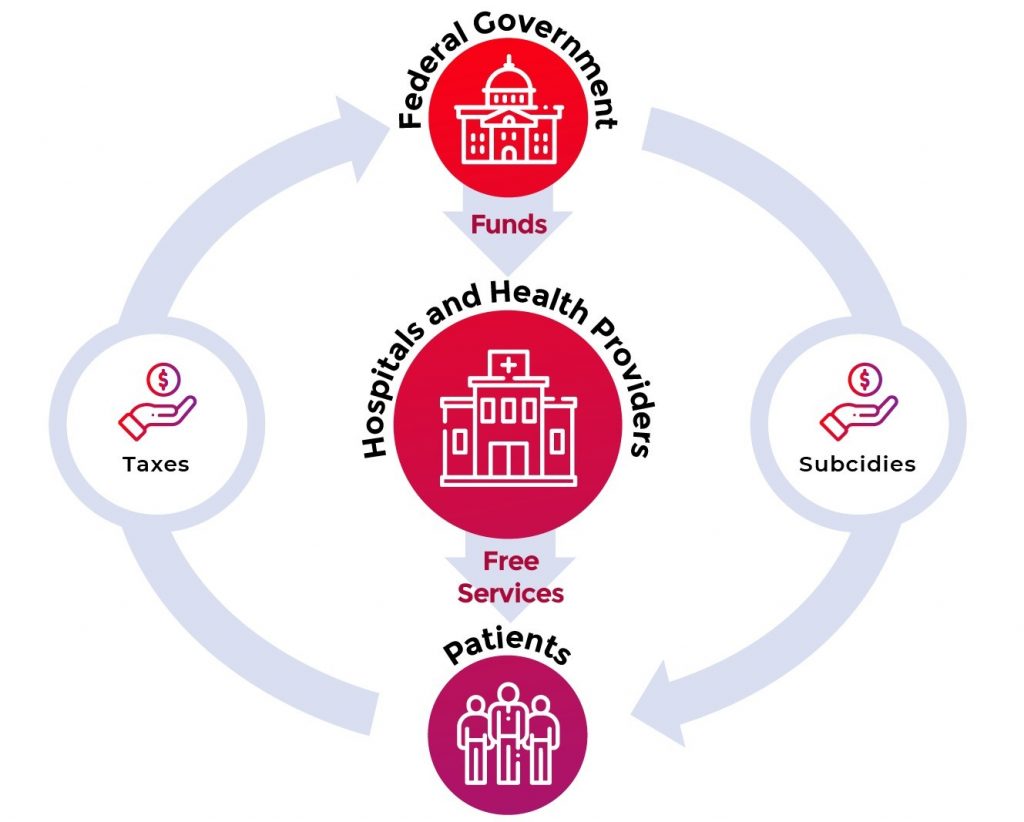
Despite the popular label of "free" healthcare, the Canadian system is entirely funded through public revenue. There are no direct fees at the clinic or hospital counter for covered services, but the system is supported by general taxation collected at both the federal and provincial levels.
The financing architecture relies on two primary streams:
- Federal Transfers: The federal government transfers funds to the provinces and territories primarily through the Canada Health Transfer (CHT), which combines cash payments and tax points (a transfer of federal tax room to the provinces). The CHT provides long-term, predictable funding for healthcare, though provinces frequently argue that the federal share does not match the rising cost of modern medical delivery.
- Provincial and Territorial Revenues: Provinces and territories cover the remainder of their healthcare budgets—often the substantial majority—through their own general tax revenues, which include personal income taxes, corporate taxes, sales taxes, and, in some jurisdictions, health-specific payroll taxes or premiums.
Because healthcare is funded out of general public revenues, individuals contribute according to their financial capacity rather than their individual health risks. A high-earning citizen and a low-income worker both access the same standard of hospital and physician care, financed by a progressive taxation structure.
| Funding Source | Mechanism | Purpose in the Healthcare Ecosystem |
|---|---|---|
| Federal Government | Canada Health Transfer (CHT) | Provides cash and tax transfers to provinces, conditional on adherence to the Canada Health Act criteria. |
| Provincial/Territorial Governments | General Revenues (Income, Sales, Corporate Taxes) | Covers the bulk of operational hospital costs, physician remuneration, and regional program expansions. |
| Out-of-Pocket / Private Insurance | Direct Payments or Employer-Sponsored Plans | Covers services excluded from public medicare, such as outpatient prescription drugs, dental care, and optometry. |
Delivery and Administration: Provincial and Territorial Jurisdiction
While the federal government sets the rules through the CHA, the constitutional authority for organizing, managing, and delivering health services rests with the provinces and territories under the Constitution Act, 1867. Consequently, Canada has thirteen distinct healthcare systems, coordinated through intergovernmental forums like the Canadian Institute for Health Information (CIHI).
Each provincial or territorial ministry of health negotiates fee schedules with medical associations, establishes hospital budgets, and determines which specialized services receive public funding. For instance, the organization of healthcare in Ontario (managed via the Ontario Health Insurance Plan, or OHIP) differs administratively from Quebec's Régie de l'assurance maladie du Québec (RAMQ) or British Columbia's Medical Services Plan (MSP).
Within these provincial jurisdictions, healthcare delivery is typically decentralized further into regional health authorities or boards. These regional bodies manage hospitals, community care facilities, long-term care homes, and public health programs within their designated geographic zones, balancing budgets and resource allocation to match local population needs.
What is Covered Versus What Is Excluded
A common misconception is that Canada's healthcare system covers every single medical expense a resident might incur. In reality, the legal mandate of the Canada Health Act applies strictly to insured health services: hospital care, physician services, and surgical-dentist services performed in a hospital setting.
Services outside this mandatory scope are subject to varying degrees of public coverage, private insurance, or direct out-of-pocket payment:
- Prescription Medications: Outpatient prescription drugs are not universally covered under the federal CHA framework. While provinces run distinct pharmacare programs providing targeted coverage for seniors, low-income residents, and individuals with specific high-cost diseases, millions of Canadians rely on employer-sponsored private insurance or pay out of pocket.
- Dental Care: Routine and specialized dental care has historically been excluded from public medicare, except for surgical procedures performed in hospitals. However, the introduction of the federal Canadian Dental Care Plan (CDCP) has expanded public support for uninsured Canadian residents meeting specific income thresholds.
- Optometry and Vision Care: Routine eye examinations and corrective lenses are generally not covered for adults aged 20 to 64 under most provincial plans, though children and seniors frequently retain partial or full coverage.
- Long-Term Care and Home Care: While medically necessary care in a hospital is fully covered, institutional long-term care and home care services often involve user fees for accommodation, meals, and personal support services, which vary significantly across provinces.
Eligibility Requirements and Enrollment
To access publicly funded healthcare in Canada, an individual must be an eligible resident. Eligibility rules are established by provincial and territorial governments, generally adhering to the Interprovincial Agreement on Eligibility and Portability.
To qualify for a provincial health card, an individual must:
- Be a Canadian citizen or hold a recognized immigration status (such as permanent residency or a valid work/study permit meeting specific duration thresholds).
- Make their primary home in that province or territory.
- Be physically present in the province for at least 153 days out of any 12-month period, depending on the jurisdiction.
Newcomers moving from another country or returning from extended stays abroad typically face a waiting period—often up to three months—before provincial health coverage takes effect. During this interim window, new residents are advised to secure private travel or expatriate medical insurance to cover unexpected health emergencies.
Challenges, Criticisms, and Ongoing Reforms
Despite its foundational commitment to equity, the Canadian healthcare system faces significant structural pressures. Lengthy wait times for elective surgeries, specialist appointments, and diagnostic imaging (such as MRIs and CT scans) remain a persistent source of public debate and policy reform.
Furthermore, a shortage of primary care physicians has left millions of Canadians without a regular family doctor, forcing reliance on walk-in clinics and hospital emergency departments for routine care. Demographic shifts, notably an aging population with increasingly complex chronic conditions, continue to strain provincial healthcare budgets and workforce capacity.
In response, federal and provincial authorities routinely negotiate targeted funding agreements focusing on mental health services, digital health infrastructure, primary care retention, and healthcare data interoperability, aiming to modernize medicare for future generations while preserving its foundational principles.
Frequently Asked Questions
Is Canadian healthcare completely free?
No. While there are no out-of-pocket costs for medically necessary hospital and physician visits, the system is financed through progressive taxation. Additionally, services such as outpatient prescription drugs, dental care, optometry, and ambulance fees are frequently paid for privately or through employer-sponsored insurance plans.
Can non-residents or tourists use Canadian healthcare for free?
No. Public health insurance plans are reserved for eligible residents of Canada. Tourists, international visitors, and temporary workers without valid provincial coverage must pay out of pocket for medical services or rely on private travel insurance to cover hospital and physician fees.
What happens if I travel to another province within Canada?
Under the portability criterion of the Canada Health Act, your home province's health plan will cover most emergency and medically necessary hospital and physician services if you fall ill while visiting another part of Canada. Most provinces bill each other directly behind the scenes, so patients rarely face billing paperwork.
How do doctors get paid in Canada?
The vast majority of Canadian physicians operate as independent private contractors or small-business owners rather than government employees. They bill the provincial or territorial health insurance plan on a fee-for-service basis according to a negotiated fee schedule, though alternative funding models—such as capitation and salaried positions—are increasingly common in primary care clinics and community health centers.
Who oversees the rules of the healthcare system?
Responsibility is shared. The federal government establishes national principles and standards through the Canada Health Act and provides financial support via transfer payments. Meanwhile, the provincial and territorial governments hold direct constitutional authority for planning, organizing, and delivering healthcare services within their respective borders.
What is the Canada Dental Care Plan?
The Canadian Dental Care Plan is a federal initiative designed to help ease financial barriers to oral healthcare for eligible Canadian residents who do not have access to private dental insurance and fall below specific adjusted family net income thresholds.
Next Actions and Further Verification
If you are planning to move to Canada, verify the specific residency requirements and waiting periods of the provincial or territorial health ministry where you intend to settle. To explore detailed administrative guidelines, statistical reports, and policy frameworks, consult official federal resources via Health Canada or review provincial health authority portals directly.
Image Gallery