What MSTR Means for Investors: A Guide to the Bitcoin Treasury Strategy
For investors, MSTR (MicroStrategy Incorporated) represents a unique "Bitcoin Treasury Company" that functions as a leveraged proxy for the price of Bitcoin. Unlike traditional stocks, its valuation is primarily driven by its massive d...
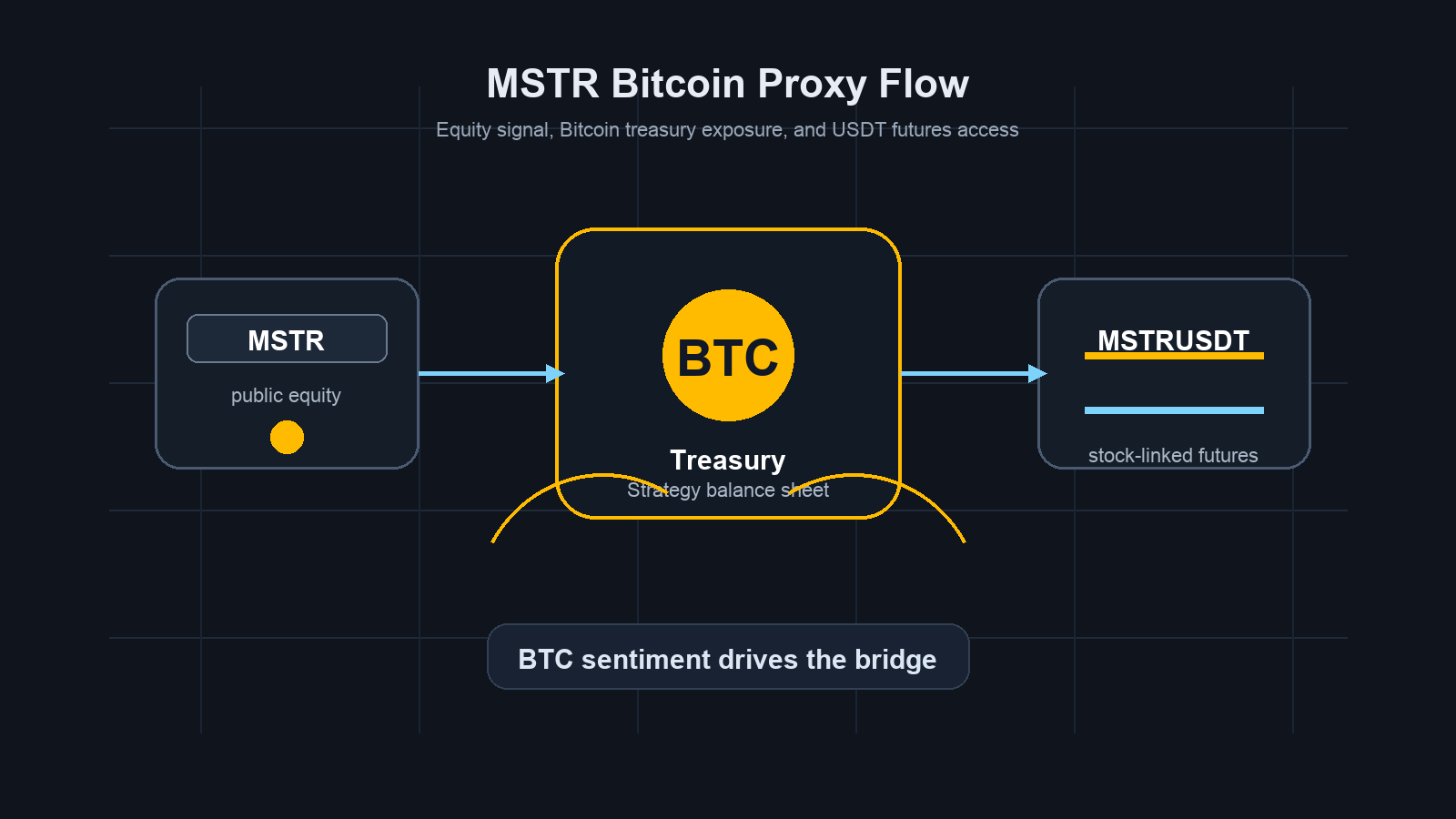
For investors, MSTR (MicroStrategy Incorporated) represents a unique "Bitcoin Treasury Company" that functions as a leveraged proxy for the price of Bitcoin. Unlike traditional stocks, its valuation is primarily driven by its massive digital asset holdings rather than its legacy software earnings, offering capital-market-accessible exposure to cryptocurrency with embedded financial engineering.
Contents
The Transformation: From Software to Bitcoin Standard
To understand what MSTR means for investors in 2026, one must first look back at the pivot that redefined the company's identity. Founded in 1989 as a business intelligence (BI) firm, MicroStrategy operated for decades as a steady, if unremarkable, enterprise software provider. However, in August 2020, under the leadership of then-CEO Michael Saylor, the company adopted Bitcoin as its primary treasury reserve asset.
This move was not merely a diversification of cash; it was a fundamental shift in corporate strategy. By 2026, MicroStrategy has solidified its position as the largest corporate holder of Bitcoin in the world. For an investor, buying MSTR is no longer a bet on business analytics software alone. Instead, it is an investment in a company that uses its software cash flows and its ability to tap into debt and equity markets to aggressively accumulate Bitcoin.
This "Bitcoin Standard" means that the stock’s price movements are highly correlated with the cryptocurrency market. When Bitcoin rallies, MSTR frequently outperforms due to its leveraged nature. Conversely, when Bitcoin enters a bearish cycle, MSTR often experiences deeper drawdowns than the underlying asset.
The Mechanics of "Intelligent Leverage"
The primary reason MSTR is a distinct tool for investors is its use of financial engineering to increase its Bitcoin-per-share ratio. While a Bitcoin Exchange-Traded Fund (ETF) provides a 1:1 exposure (minus management fees), MicroStrategy uses several instruments to amplify its holdings:
- Convertible Senior Notes: The company frequently issues low-interest or even zero-coupon convertible debt. They use the proceeds of these loans to buy more Bitcoin. If Bitcoin's price rises faster than the interest rate of the debt, the value accrues to the equity shareholders.
- At-the-Market (ATM) Equity Offerings: MicroStrategy often sells new shares of MSTR when the stock is trading at a premium to its Net Asset Value (NAV). If the stock price is higher than the value of the Bitcoin it represents, the company can sell shares and buy more Bitcoin than the dilution would otherwise suggest, effectively increasing the "Bitcoin per share" for existing holders.
- Software Cash Flow: While the BI business is secondary to the treasury strategy, it remains a functional enterprise. The cash generated from software licenses and cloud subscriptions helps service the company’s debt, reducing the need to sell Bitcoin to pay interest.
For the investor, this means MSTR offers a "yield" on Bitcoin that is unavailable through direct ownership or ETFs. The company refers to this as "Bitcoin Yield," a Key Performance Indicator (KPI) describing the percentage change in the ratio between the company’s Bitcoin holdings and its assumed diluted shares outstanding.
MSTR vs. Spot Bitcoin ETFs: A Comparison for 2026
With the maturation of the spot Bitcoin ETF market by 2026, investors often ask why they should choose a volatile stock like MSTR over a regulated fund. The answer lies in the structure of the investment.
An ETF is a passive vehicle; it holds Bitcoin and charges a management fee (expense ratio). MSTR is an active corporate entity; it has no management fee for the Bitcoin it holds and actually uses its balance sheet to acquire more Bitcoin over time.
| Feature | MicroStrategy (MSTR) | Spot Bitcoin ETF | Direct Bitcoin Ownership |
|---|---|---|---|
| Primary Exposure | Leveraged Bitcoin | 1:1 Bitcoin Price | 1:1 Bitcoin Price |
| Management Fees | 0% (Internalized) | 0.20% - 1.50% | 0% (Network fees apply) |
| Leverage | Yes (Corporate Debt) | No | Optional (via Exchanges) |
| Cash Flow Support | Yes (Software Business) | No | No |
| Custody Risk | Corporate/Institutional | Institutional | Personal (Self-custody) |
| Regulatory Access | Standard Equity | Standard Equity | Crypto Exchanges/Wallets |
| Valuation | Often trades at a Premium/Discount to NAV | Trades at NAV | Market Price |
For institutional investors, MSTR provides a way to gain Bitcoin exposure through a traditional brokerage account without the constraints sometimes placed on "commodity" ETFs. For retail investors, the attraction is the potential for outsized gains during bull markets, though this comes with the risk of higher volatility.
Assessing the Risks: Dilution, Debt, and Volatility
While the upside of MSTR is significant, the risks for investors are equally pronounced. Understanding what MSTR means involves acknowledging the "double-edged sword" of its strategy.
1. Market Volatility and Margin Calls
MicroStrategy’s strategy relies on the long-term appreciation of Bitcoin. If Bitcoin were to experience a prolonged, multi-year decline, the company’s ability to service its debt or roll over convertible notes could be impaired. While the company has historically maintained a low "Loan-to-Value" (LTV) ratio, extreme market events could force the liquidation of assets, though the company has structured its debt to minimize immediate "margin call" risks.
2. Shareholder Dilution
To buy more Bitcoin, MicroStrategy frequently issues more shares. While this is often "accretive" (meaning it increases Bitcoin per share), it still increases the total supply of MSTR stock. If the company fails to acquire Bitcoin at prices that justify the dilution, the share price may suffer even if the total Bitcoin treasury grows.
3. The "Premium to NAV" Risk
MSTR often trades at a price that is higher than the actual market value of the Bitcoin it owns. This premium exists because investors value the company’s ability to use debt to buy more Bitcoin. However, this premium is not guaranteed. If the market decides that a 1:1 ETF is a better option, the premium on MSTR could collapse, causing the stock to underperform Bitcoin even if the price of the cryptocurrency is rising.
The Role of the Legacy Software Business
Investors should not entirely ignore the "MicroStrategy Cloud" and the business intelligence segment. In 2026, the company has integrated artificial intelligence (AI) into its analytics platform, attempting to remain competitive in a crowded enterprise software market.
The software business serves two roles for investors. First, it provides the operational "skin in the game" that allows the company to remain listed on major exchanges like the Nasdaq as an operating company rather than an investment fund. Second, the revenue provides a safety net for operational expenses. If the software business were to fail, the company would become a "zombie" entity solely dependent on Bitcoin price appreciation, which would likely reduce the premium investors are willing to pay for the stock.
How to Approach MSTR as an Investor
When evaluating MSTR, it is helpful to view it as a high-performance vehicle in a portfolio. It is generally not seen as a "widow-and-orphan" stock or a conservative retirement holding. Instead, it is used by:
- Aggressive Growth Investors: Those who want to maximize their returns during a crypto bull cycle.
- Institutional Hedgers: Funds that cannot hold "digital gold" directly but can hold "technology stocks."
- Strategic Allocators: Investors who believe the "Bitcoin Yield" model is a superior way to outpace inflation and currency debasement.
In 2026, the consensus among analysts is that MSTR is a "reflexive" asset. When Bitcoin is popular, the premium expands, and the company buys more Bitcoin, which drives the stock higher. When Bitcoin is unpopular, the process reverses.
FAQ
Does MicroStrategy pay a dividend?
No, MicroStrategy does not pay a cash dividend. The company reinvests its cash flow into its operations and its Bitcoin acquisition strategy. For investors, the "return" is realized through potential capital appreciation of the stock price rather than periodic income.
What happens if Michael Saylor leaves the company?
While Michael Saylor stepped down as CEO to become Executive Chairman in 2022, he remains the visionary behind the Bitcoin strategy and holds significant voting power through Class B shares. A departure could lead to uncertainty regarding the company's commitment to the Bitcoin Standard, though the strategy is currently deeply embedded in the corporate charter and balance sheet.
How is MSTR different from a Bitcoin mining stock?
Bitcoin miners (like Riot or Marathon) earn Bitcoin by processing transactions and securing the network. Their profitability depends on electricity costs, hardware efficiency, and the "hash rate" competition. MicroStrategy does not mine Bitcoin; it simply buys it. MSTR is generally considered less sensitive to energy prices and hardware cycles than mining stocks.
Is MSTR a good hedge against inflation?
Investors often use MSTR as a proxy for Bitcoin, which is frequently cited as a hedge against fiat currency debasement. Because MSTR uses debt to acquire a finite asset (Bitcoin), it can be seen as a "leveraged inflation hedge." However, its high volatility means it may not act as a stable store of value in the short term.
Can MicroStrategy be forced to sell its Bitcoin?
The company's debt is largely structured as long-term convertible notes that do not require Bitcoin as collateral for daily price fluctuations. While a total collapse in Bitcoin's value could eventually jeopardize the company's solvency, the current debt structure is designed to weather significant market volatility without triggering forced sales.
Final Recommendation for Investors
For those looking to integrate MSTR into their 2026 investment strategy, the key is position sizing. Because MSTR typically exhibits 1.5x to 2.5x the volatility of Bitcoin itself, even a small allocation can significantly impact portfolio performance. Investors should monitor the Premium to NAV (Net Asset Value) to ensure they are not buying at a historical peak and should treat the stock as a long-term play on the institutional adoption of Bitcoin.
Image Gallery