Who Invented the McFlurry Spoon? The History of a Fast-Food Engineering Icon
The McFlurry spoon was invented by Bert Aguirre, a design engineer and former owner of the company Flurry International. Patented in the mid-1990s, the spoon's unique hollow, square-handle design allows it to attach directly to a mixer...
The McFlurry spoon was invented by Bert Aguirre, a design engineer and former owner of the company Flurry International. Patented in the mid-1990s, the spoon's unique hollow, square-handle design allows it to attach directly to a mixer, functioning as the blending blade before being handed to the customer as a utensil.
Contents
Since its introduction in the late 1990s, the McFlurry spoon has become one of the most recognizable examples of functional engineering in the fast-food industry. While many customers initially mistook the hollow handle for a straw, the design was actually a brilliant solution to a significant operational bottleneck: the need to clean blending equipment between every serving. By 2026, while the traditional plastic version has been largely phased out in favor of sustainable alternatives, the legacy of Aguirre’s design remains a case study in efficiency and cross-contamination prevention.
The Engineering Genius of Bert Aguirre
To understand who invented the McFlurry spoon, we must look at the specific problem it was designed to solve. Before the specialized spoon existed, mixing soft-serve ice cream with toppings required a stationary metal blade. After every use, the employee would have to detach and clean the blade to avoid cross-contamination between different toppings (such as Oreos and M&Ms) and to maintain hygiene standards.
Bert Aguirre, through his company Flurry International, recognized that this process was too slow for the high-volume environment of a McDonald’s kitchen. He developed a "disposable mixing spoon" that doubled as the machine's agitator.
The Patent and Design Mechanics
Aguirre’s design (often cited under various patent filings including U.S. Patent No. 5,727,876) focused on a hollow, square-shaped handle. This handle featured a specific internal geometry that allowed it to "click" onto the spindle of a high-speed mixer.
When the machine is turned on, the spoon spins rapidly, blending the toppings into the ice cream. Once the mixing is complete, the employee unclips the spoon from the machine and hands it to the customer. This innovation meant that the machine itself never touched the food, eliminating the need for cleaning between every order and drastically increasing the speed of service.
The Origin of the McFlurry Dessert
While Bert Aguirre invented the spoon, he did not invent the McFlurry itself. That honor belongs to Ron McLellan, a McDonald’s franchisee in Bathurst, New Brunswick, Canada.
In 1995, McLellan was experimenting with ways to differentiate his dessert menu. He realized that blending candy and cookies into soft-serve ice cream created a unique texture and flavor profile that customers loved. After testing the product locally, McDonald's corporate caught wind of the success. The McFlurry was officially rolled out across Canada in 1997 and reached the United States and other global markets by 1998.
The pairing of McLellan’s dessert concept with Aguirre’s spoon design created a "perfect storm" of product-market fit and operational efficiency. Without Aguirre’s spoon, the McFlurry likely would have been too labor-intensive to become a permanent global staple.
Why the McFlurry Spoon Is Not a Straw
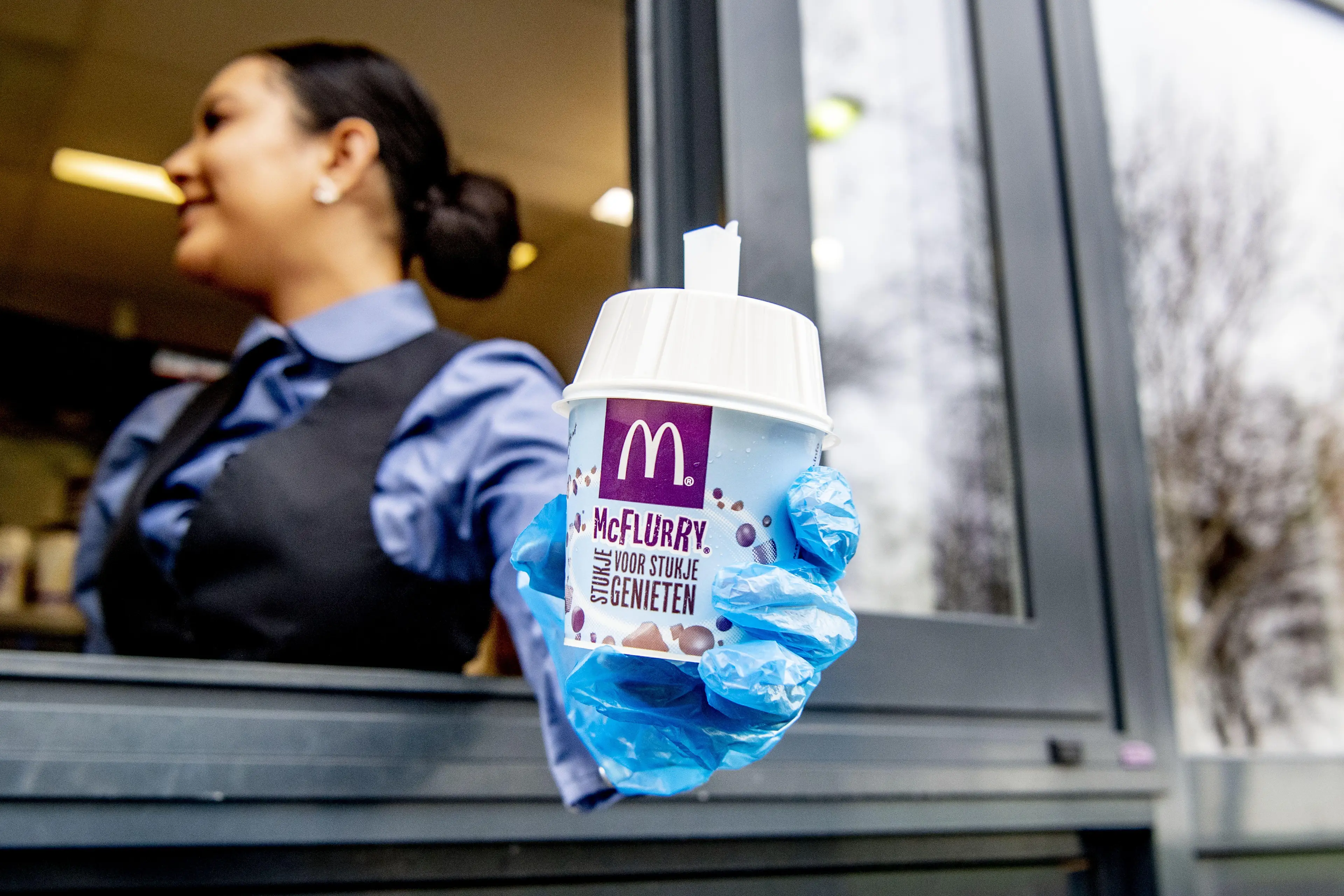
Perhaps the most common question surrounding the McFlurry spoon is: "Why can't I drink through it?" Because the handle is hollow and features a square opening at the top, millions of customers have attempted to use it as a straw, only to find that the bottom of the spoon is solid.
The hollow design is strictly for mechanical engagement. The square shape provides the torque necessary for the mixer to spin the spoon through thick, cold ice cream without the handle stripping or snapping. If the handle were a solid round stick, it would be much harder to secure to a motorized spindle. The hole at the top is the "female" end of the coupling, where the "male" end of the mixer motor inserts.
Materials and Durability
The original Aguirre design used a heavy-duty, food-grade polypropylene. This plastic needed to be rigid enough to withstand the centrifugal force of a high-RPM motor and the resistance of frozen dairy. This is why the McFlurry spoon always felt significantly sturdier than a standard plastic soda spoon; it wasn't just a utensil—it was a piece of industrial machinery equipment intended for one-time use.
The Shift Toward Sustainability in 2026
As of 2026, the landscape of the McFlurry spoon has changed significantly. For decades, the Aguirre-designed plastic spoon was the gold standard. However, as global pressure to reduce single-use plastics increased, McDonald’s began a massive transition.
Starting around 2023 and reaching near-total implementation by 2025/2026, McDonald’s moved to a new system. This system involves a reusable metal spindle that is cleaned regularly, paired with a much smaller, flatter spoon (often made of wood or compostable plastic) that is given to the customer.
While this shift reduces plastic waste by thousands of tons annually, it marks the end of an era for the iconic hollow-handle design in many territories. In some regions, a refined version of the Aguirre design persists, using biodegradable polymers that maintain the "spoon-as-blade" functionality while meeting 2026 environmental standards.
Comparison: Original Design vs. Modern 2026 Standards
| Feature | Original Aguirre Design (1997-2023) | Modern Sustainability System (2024-2026) |
|---|---|---|
| Inventor/Origin | Bert Aguirre / Flurry International | McDonald’s Global Sustainability Team |
| Primary Material | Heavy-duty Polypropylene (Plastic) | Wood, Paper-fiber, or Recycled Plastic |
| Mixing Method | Spoon acts as the blender blade | Reusable metal spindle blends the dessert |
| Customer Experience | Large, square, hollow handle | Smaller, traditional flat-profile spoon |
| Cleaning Requirement | Zero (Spoon is discarded) | Spindle must be cleaned/sanitized |
| Environmental Impact | High single-use plastic waste | Significantly reduced plastic footprint |
Technical Specifications of the Classic Design
For those interested in the industrial design aspects of Aguirre's invention, the spoon was a marvel of injection molding.
- The Hook: A small clip on the side of the handle ensured the spoon didn't fly off the machine during the high-speed "flurry" process.
- The Taper: The handle slightly tapered toward the base, providing ergonomic comfort for the user while maintaining structural integrity near the "stress point" where it joined the spoon head.
- The Head: The spoon head was wider and deeper than average to allow for the efficient folding of toppings into the soft-serve.
Operational Impact on McDonald's Growth
The invention of the McFlurry spoon is a primary reason why McDonald's was able to compete with dedicated ice cream chains like Dairy Queen (which uses the Blizzard). While Dairy Queen uses a similar mixing process, the specialized engineering of the Aguirre spoon allowed McDonald's—a brand built on speed—to serve blended desserts without the massive time penalty of equipment washing.
In the late 1990s, this gave McDonald's a competitive edge in the "snack" category, leading to billions of dollars in incremental revenue over the following three decades.
Frequently Asked Questions
Was the McFlurry spoon ever intended to be a straw?
No. Despite its hollow appearance, the design was purely for attachment to a mixing machine. The solid base of the spoon makes it impossible to use as a straw. McDonald's has confirmed this multiple times in response to decades of customer confusion.
Why did McDonald's stop using the original McFlurry spoon?
The primary reason is environmental sustainability. The original spoon required a significant amount of plastic to remain rigid enough for mixing. By switching to a reusable metal spindle and a smaller, thinner spoon, the company significantly reduces its total plastic output per serving.
Is Bert Aguirre still involved with McDonald's?
Bert Aguirre's company, Flurry International, provided the technology for years. However, as patents expired and McDonald's moved toward in-house sustainable designs, the direct partnership evolved. Aguirre remains recognized in the engineering community for this specific contribution to food-service technology.
Can you still find the original square spoon in 2026?
In 2026, the original plastic square spoon is becoming a rarity. Most markets in North America, Europe, and Australia have transitioned to the reusable spindle system. However, some international markets or independent franchisees may still use existing stock or localized versions of the Aguirre design.
Who invented the machine that the spoon attaches to?
While Bert Aguirre designed the spoon and the coupling mechanism, the specialized high-torque mixing motors were developed in collaboration with various food-service equipment manufacturers to meet McDonald’s specific "speed of service" requirements.
Final Recommendation for Enthusiasts
If you happen to visit a McDonald's location that still utilizes the classic Bert Aguirre design, take a moment to appreciate the engineering. It represents a specific era of fast-food history where "disposable" meant "functional tool." For those looking to learn more about food service engineering, studying the U.S. Patent and Trademark Office records for "Mixing Spoon" and "Flurry International" provides a fascinating look at the mechanical drawings that changed how the world eats dessert.
Image Gallery