Mastering GDPR Compliance Cookie Management in 2026: A Technical and Regulatory Guide
GDPR compliance cookie management is the process of ensuring that a website's use of cookies and tracking technologies adheres to the General Data Protection Regulation. This requires obtaining prior, granular, and freely given consent...
GDPR compliance cookie management is the process of ensuring that a website's use of cookies and tracking technologies adheres to the General Data Protection Regulation. This requires obtaining prior, granular, and freely given consent from users before non-essential scripts execute, providing a clear withdrawal mechanism, and maintaining an accurate, time-stamped audit trail of all consent preferences.
Contents
For organizations operating in or serving residents of the European Union and the United Kingdom, cookie management is no longer a simple "set and forget" banner implementation. In 2026, the intersection of evolving ePrivacy regulations, aggressive enforcement by Data Protection Authorities (DPAs), and the technical shift toward privacy-preserving browser environments has made compliant cookie handling a core requirement of digital governance. This guide provides an exhaustive breakdown of the legal requirements, technical implementation steps, and operational strategies necessary to maintain 100% compliance.
The Legal Foundation: GDPR and the ePrivacy Directive
To understand cookie management, one must distinguish between the ePrivacy Directive (the "Cookie Law") and the GDPR. While the ePrivacy Directive specifically dictates when consent is required for storing or accessing information on a user’s device, the GDPR defines the standard of that consent. In 2026, the regulatory landscape remains a "lex specialis" arrangement, where the specific rules of ePrivacy take precedence over the general rules of GDPR for cookie-specific issues, though the strict GDPR definition of consent applies to both.
Under these frameworks, cookies are generally categorized into two legal groups:
- Strictly Necessary Cookies: Those essential for the website to function (e.g., security, load balancing, or remembering items in a shopping cart). These do not require user consent.
- Non-Essential Cookies: This includes statistics, marketing, personalization, and social media tracking. These require valid, affirmative consent before they are placed on the user's browser.
The European Data Protection Board (EDPB) and various national regulators have clarified that "legitimate interest" is almost never an acceptable legal basis for non-essential tracking. This distinction is critical for risk management; miscategorizing a marketing pixel as "necessary" is one of the most frequent triggers for regulatory fines.
Essential Requirements for GDPR-Compliant Cookie Management
Achieving compliance requires more than just a pop-up window. The following four pillars constitute the "gold standard" of consent management as enforced in 2026.
Prior Consent and the "No-Zero" Rule
The most fundamental requirement is that no non-essential cookies may be set before the user has interacted with the consent banner. Technically, this means all tracking scripts must be held in a "pending" state. If a website fires a Google Analytics or Meta pixel the moment the landing page loads—before the user clicks "Accept"—it is in immediate violation. This "prior consent" rule is often the hardest to implement because it requires deep integration between the Consent Management Platform (CMP) and the site’s tag management system.
Granular Control and Purpose Specification
Users must be given the choice to accept some categories of cookies while rejecting others. A binary "Accept All" or "Reject All" is acceptable only if the user also has the option to customize their preferences. Consent must be "specific" to the purpose; you cannot bundle consent for "Analytics" and "Personalized Advertising" into a single checkbox. Each category must be clearly defined, explaining what data is collected, who the third-party providers are, and how long the data is retained.
Affirmative Action and Dark Patterns
In 2026, regulators have intensified their crackdown on "dark patterns"—manipulative UI designs that nudge users toward consenting. Compliant banners must:
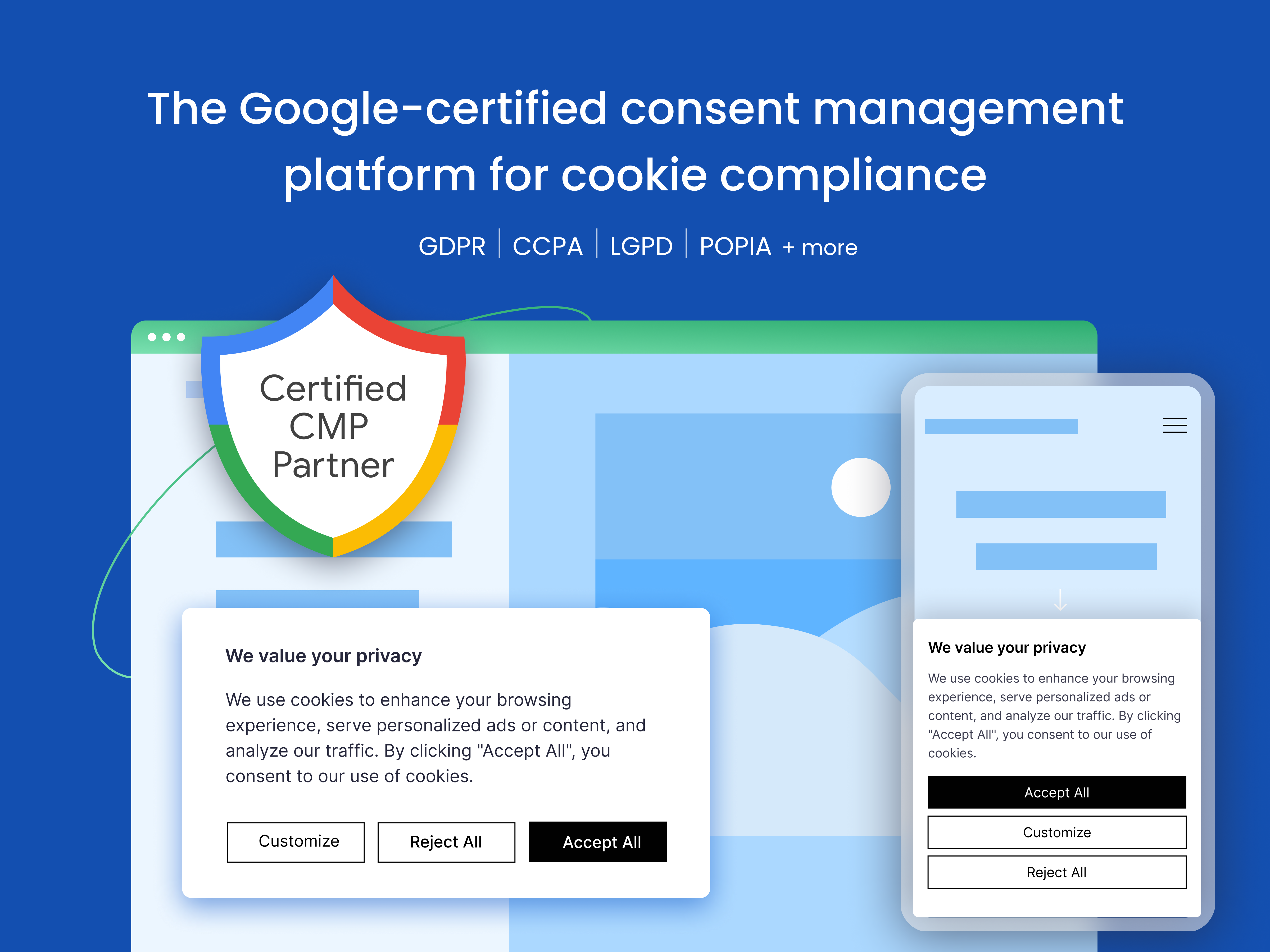
- Give "Reject All" the same visual prominence as "Accept All" (same color, size, and font).
- Avoid pre-ticked boxes for non-essential categories.
- Prohibit "Cookie Walls" that block access to content if consent is denied (unless the service is specifically exempt under narrow circumstances).
- Ensure that scrolling or navigating the site is not interpreted as "implied consent."
Ease of Withdrawal
The GDPR mandates that it must be as easy to withdraw consent as it was to give it. This is typically achieved through a "persistent" icon or link (often in the footer) that allows users to reopen the consent settings at any time. When a user withdraws consent, the CMP must not only stop future tracking but also actively signal to the integrated scripts to cease data collection for that session.
Technical Implementation: A Step-by-Step Framework
Implementing a compliant system involves a workflow that bridges the gap between legal policy and front-end execution.
Step 1: Comprehensive Cookie Auditing
You cannot manage what you have not identified. Use a deep-scanning tool to crawl your website and identify every script, pixel, and local storage item being used. This audit should be performed monthly, as marketing teams often add new tools without informing the technical compliance team. The audit should result in a Cookie Declaration that lists the name, provider, purpose, and expiration of every cookie.
Step 2: Categorization and Script Blocking
Once identified, every script must be mapped to a category (Necessary, Functional, Analytics, or Advertising). You must then configure your site—typically through a Tag Manager like Google Tag Manager (GTM) or Tealium—to fire these scripts only when the corresponding consent variable is "true."
For example, a GTM trigger for a LinkedIn Insight Tag should be modified to fire only when the cookie_consent_marketing variable equals granted.
Step 3: Deploying a Consent Management Platform (CMP)
While it is possible to build a custom solution, most enterprises utilize a certified CMP to handle the complexities of geo-location (showing different banners to EU vs. US users), language localization, and secure logging. A compliant CMP in 2026 must support the Global Privacy Control (GPC) signal, allowing users to communicate their privacy preferences via their browser settings automatically.
Step 4: Maintaining the Consent Log
If a regulator audits your site, you must be able to prove that a specific user gave consent on a specific date. This log should be anonymized (using hashed IDs) but must include:
- The timestamp of the consent.
- The IP address (truncated for privacy).
- The version of the banner/policy shown.
- The specific categories accepted.
Comparing Top Consent Management Platforms (CMPs) in 2026
Choosing the right tool depends on your traffic volume, technical stack, and jurisdictional needs.
| Feature | OneTrust | Cookiebot | Usercentrics |
|---|---|---|---|
| Target Audience | Global Enterprise | SMB & Mid-Market | Multi-Brand Corporations |
| GPC Support | Native / Advanced | Native | Native |
| Scanning Frequency | Daily / On-Demand | Monthly (Standard) | Daily / On-Demand |
| Integration Complexity | High (Requires setup) | Low (Plug & Play) | Moderate |
| Reporting/Analytics | Deep Compliance BI | Simplified Dashboard | Cross-Domain Reporting |
| Google Consent Mode v3 | Fully Supported | Fully Supported | Fully Supported |
Common Compliance Pitfalls
Even with a CMP in place, many organizations fall into "accidental non-compliance."
- Tag Leakage: This occurs when a script is added directly to the website's
instead of through the Tag Manager. Because the script isn't "wrapped" in a consent condition, it fires regardless of the user's choice. - Incorrect Geo-Targeting: Failing to show a GDPR-compliant banner to a French citizen accessing your ".com" site from a VPN can lead to localized legal trouble with the CNIL (the French DPA).
- Vague Purpose Descriptions: Using phrases like "to improve your experience" is no longer sufficient. Descriptions must be explicit, such as "to track your movements across websites to serve personalized jewelry advertisements."
- Failure to Update: Cookie policies often become outdated. In 2026, regulators expect real-time synchronization between your CMP's scanner and your published Cookie Policy.
The Intersection of GDPR and Emerging Privacy Tech
As we move through 2026, cookie management is evolving beyond the banner. Two major developments are currently shaping the field:
Google Consent Mode v3: This API allows websites to communicate the user's consent status to Google’s tags. If a user denies consent, Google tags will send "pings" instead of setting cookies. These pings provide basic functional data without identifying the user, which Google then uses for conversion modeling to fill data gaps. While technically complex, this is a vital tool for balancing compliance with data-driven marketing.
Global Privacy Control (GPC): This is a browser-level setting that acts as a "do not track" signal. Under recent interpretations of GDPR and various US state laws (like the CCPA/CPRA), websites are increasingly required to treat a GPC signal as a valid request to opt-out of non-essential tracking by default, without the user needing to interact with a banner.
Frequently Asked Questions
Do I need a cookie banner if I only use Google Analytics?
Yes. Google Analytics (unless configured in a very specific, restricted "cookieless" mode that has been vetted by local DPAs) uses cookies to track user behavior across sessions. This falls under "Analytics" and requires prior, affirmative consent under the GDPR and ePrivacy Directive.
How long does cookie consent last?
There is no fixed expiration date in the GDPR, but the EDPB suggests that consent should be refreshed at reasonable intervals. Most industry standards in 2026 recommend re-asking for consent every 6 to 12 months, or whenever there is a material change to your cookie usage or privacy policy.
Can I block users who refuse cookies?
Generally, no. This is known as a "cookie wall." For most websites, access to content cannot be made conditional on the user consenting to non-essential tracking. Limited exceptions exist for some media publishers who offer a "pay or consent" model, but this is subject to strict scrutiny regarding the fairness of the price.
What are the penalties for non-compliant cookie management?
Under the GDPR, fines can reach up to €20 million or 4% of a company’s global annual turnover, whichever is higher. For cookie-specific violations, DPAs often issue "compliance orders" first, followed by tiered fines based on the number of users affected and the duration of the non-compliance.
Is "implied consent" still valid in 2026?
No. The standard of consent must be "unambiguous" and involve a clear affirmative action. Phrases like "by continuing to use this site, you agree to cookies" have been legally invalid for several years and are a primary target for enforcement actions.
Practical Recommendation for 2026
To ensure long-term compliance, organizations should adopt a Privacy-by-Design approach to their web development. Start by conducting a full audit of your current script environment and transitioning all tracking to a centralized Tag Manager integrated with a Tier-1 Consent Management Platform.
Prioritize transparency: ensure your "Reject All" button is as visible as your "Accept" button. Not only does this mitigate legal risk, but it also builds brand trust with a modern consumer base that is increasingly sensitive to data privacy. Finally, configure your system to respect Global Privacy Control (GPC) signals automatically, as this is becoming the benchmark for proactive compliance in 2026.
Image Gallery