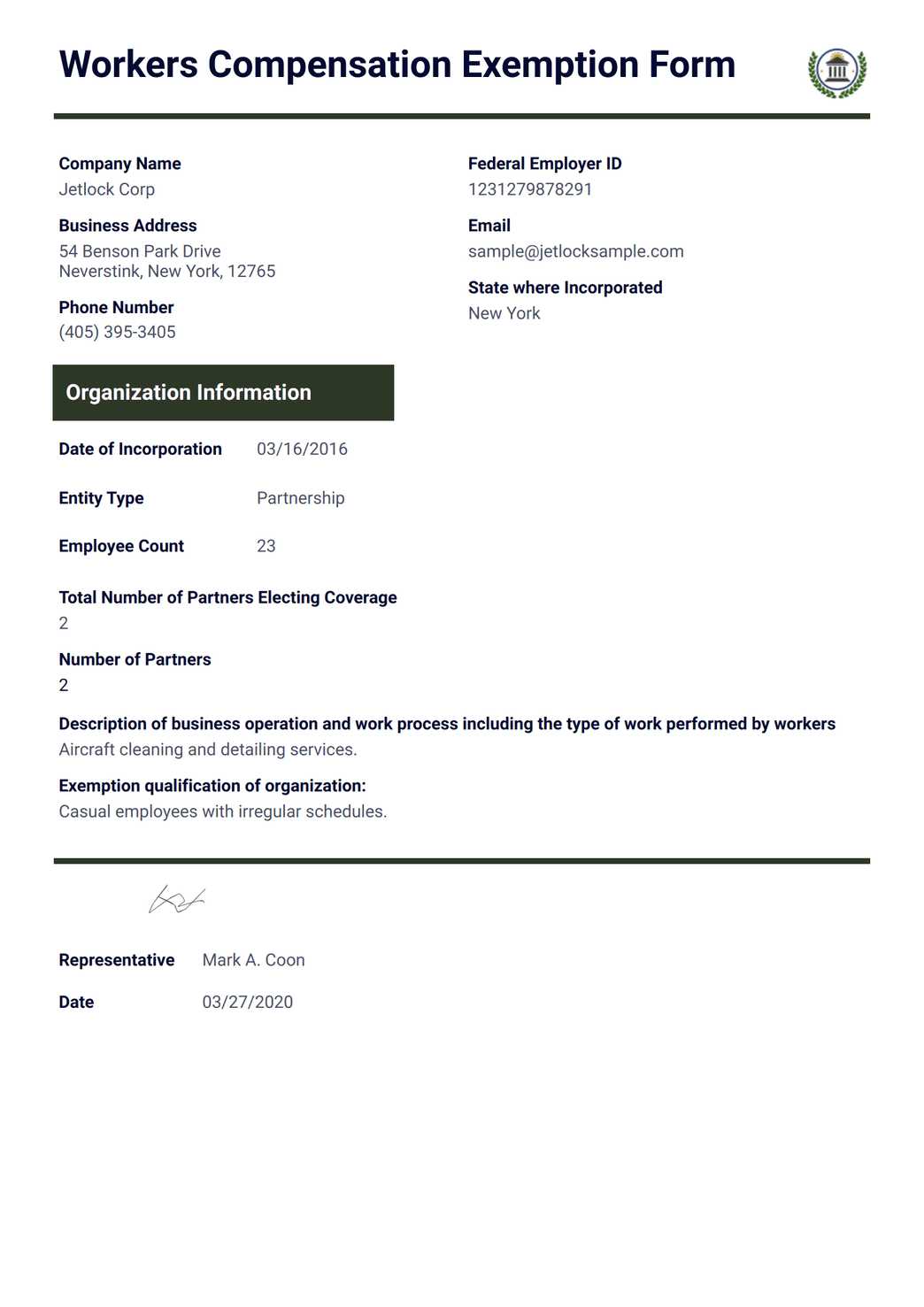
How to File the Florida Workers Compensation Owner Exemption Form
To file the Florida workers' compensation owner exemption form in 2026, you must submit an application through the Florida Department of Financial Services (DFS) online portal. Applicants must be corporate officers or LLC members ownin...
To file the Florida workers' compensation owner exemption form in 2026, you must submit an application through the Florida Department of Financial Services (DFS) online portal. Applicants must be corporate officers or LLC members owning at least 10% of the business, registered with the Division of Corporations, and pay a $50 fee if in the construction industry.
Contents
Understanding the Florida Workers’ Compensation Exemption
In the state of Florida, workers' compensation insurance is generally mandatory for businesses with employees. However, business owners—specifically corporate officers and members of limited liability companies (LLCs)—have the legal right to "opt-out" of this coverage. This process is formally known as filing a Notice of Election to be Exempt from Florida Workers' Compensation Law (Form DWC-250).
As of 2026, the Division of Workers' Compensation continues to manage these exemptions to allow small business owners to reduce overhead costs. When an owner is "exempt," they are not counted as an employee for the purpose of calculating workers' compensation premiums. Consequently, they are also not entitled to benefits from the company’s workers' compensation policy if they sustain a work-related injury. This decision is a significant financial strategy for many, but it carries inherent risks that must be weighed against the savings.
The exemption is not a blanket waiver for the entire company; it applies only to the specific individual named on the certificate. For many independent contractors and subcontractors in the Florida construction industry, holding a valid exemption certificate is often a prerequisite for winning contracts, as it proves to the general contractor that the subcontractor does not need to be covered under the general contractor's policy.
Eligibility Requirements for Business Owners
Before beginning the filing process, it is vital to determine if you meet the state's strict eligibility criteria. The Florida Department of Financial Services (DFS) enforces these rules to prevent fraud and ensure that only legitimate stakeholders are exempted.
Ownership Stakes and Corporate Status
To qualify for an exemption, you must be listed as an officer of a corporation or a member of an LLC on the records of the Florida Department of State, Division of Corporations (Sunbiz).
- The 10% Rule: You must own at least 10% of the business entity.
- Officer/Member Status: For corporations, you must be a President, Vice President, Secretary, or Treasurer. For LLCs, you must be a Manager or a Member.
- Active Status: Your business entity must have an "Active" status on Sunbiz. If your company has been administratively dissolved for failing to file an annual report, your exemption application will be denied immediately.
Industry-Specific Limits
The rules vary significantly depending on whether your business is classified as being in the construction industry or a non-construction industry.
- Construction Industry: To prevent large firms from exempting their entire workforce, Florida law limits construction companies to a maximum of three exempt officers or members. Each person must meet the 10% ownership threshold.
- Non-Construction Industry: There is currently no limit on the number of officers who can be exempt in non-construction businesses, provided each individual meets the ownership and title requirements.
Pre-Filing Checklist: What You Need
Preparation is key to avoiding delays in the approval of your DWC-250 form. Before logging into the DFS portal, gather the following information:
- Federal Employer Identification Number (FEIN): This is the nine-digit number assigned by the IRS. The name associated with the FEIN must match the name on your Sunbiz filing exactly.
- Social Security Number: The DFS uses this to verify your identity and ownership through state databases.
- Sunbiz Documentation: Ensure your records are updated. If you recently changed officers or ownership percentages, wait for the Sunbiz database to reflect these changes (usually 2-3 business days) before filing for the exemption.
- Payment Method: If you are in the construction industry, have a credit card or electronic check information ready for the $50 application fee.
- Workers' Compensation Carrier Information: You may be asked to provide the name of your current insurance carrier if the business already has a policy for other employees.
Step-by-Step Instructions to File Form DWC-250
The Florida Department of Financial Services requires that all exemption applications be submitted electronically through their official online portal. Follow these steps to complete your filing in 2026.
Step 1: Access the DFS Online Portal
Navigate to the Division of Workers' Compensation "Exemption Search and Online Application" page. In 2026, the portal is designed to be mobile-friendly, but using a desktop computer is recommended for uploading any necessary documentation. Click on "Apply for or Renew an Exemption."
Step 2: Identification and Business Selection
You will be prompted to enter your Social Security Number and the FEIN of your business. The system will perform a real-time "Screening" by checking the Florida Division of Corporations database. If the data matches, you will see a list of officers or members associated with the FEIN. Select your name from the list.
Step 3: Verify Ownership and Title
Confirm that you own at least 10% of the stock (for corporations) or 10% of the membership interest (for LLCs). You will also need to select your industry classification. Be accurate here; selecting "Non-Construction" when you perform construction work is considered insurance fraud, which carries heavy penalties in Florida.
Step 4: Submit Payment (Construction Industry Only)
If your business is classified under the construction industry, the system will redirect you to a secure payment gateway. As of 2026, the fee remains $50.00. Non-construction applicants are not required to pay a fee for the exemption.
Step 5: Final Review and Submission
Review the "Affidavit of Applicant." By submitting the form, you are swearing under penalty of perjury that the information provided is true. Once submitted, the system will provide a confirmation number.
Processing Times and Receiving Your Certificate
In most cases, if there are no discrepancies between your application and the Sunbiz records, the system will issue a Certificate of Election to be Exempt almost immediately. You can download and print the certificate directly from the portal.
If your application is flagged for manual review—which can happen if ownership percentages are not clearly listed on Sunbiz—it may take up to 30 days for the Division to process the request. During this period, you are not considered exempt. It is wise to file your renewal or new application at least a month before you need the certificate to be active.
Comparison of Exemption Types (2026)
| Feature | Construction Industry | Non-Construction Industry |
|---|---|---|
| Application Fee | $50.00 | $0.00 (Free) |
| Exemption Limit | Max 3 per company | No limit |
| Ownership Requirement | Minimum 10% | Minimum 10% |
| Validity Period | 2 Years | 2 Years |
| Primary Form | DWC-250 | DWC-250 |
| Requirement to List on Sunbiz | Mandatory | Mandatory |
Critical Compliance and Renewal Rules
An exemption is not a "set it and forget it" document. Maintaining compliance is essential to avoid being fined by the state during an audit.
The Two-Year Renewal Cycle
All Florida workers' compensation exemptions expire exactly two years from the date of issuance. The DFS does not always send out paper reminders. It is the responsibility of the officer to log back into the portal and file a renewal application. In 2026, the renewal process is identical to the initial filing, including the $50 fee for construction officers.
Impact on Subcontracting
If you are a subcontractor, you must provide a copy of your active certificate to the general contractor. If your certificate expires while you are on a job site, the general contractor is legally required to "pick you up" on their own workers' compensation policy and will likely deduct the cost of that premium (which can be as high as 15-25% of your pay) from your check.
Revocation of Exemption
The state can revoke an exemption if it is discovered that the holder no longer meets the ownership requirements or if the business status becomes "Inactive." Additionally, if an exempt officer is found to be performing work that falls outside the scope of their corporate duties without having proper coverage for other employees, the exemption may be voided.
Common Pitfalls to Avoid
- Sunbiz Mismatches: The most common cause of denial is a mismatch between the name on the application and the name on Sunbiz. If your name is "Robert" on Sunbiz, do not type "Bob" on the DFS portal.
- Lapsed Annual Reports: If you forget to file your Sunbiz annual report by May 1st, your company may be dissolved in September. This automatically invalidates your workers' compensation exemption.
- The "Three Officer" Limit: In the construction industry, if a company attempts to file a fourth exemption, the system will reject it. If an officer leaves the company, you must file a Notice of Revocation for that person before a new officer can apply for an exemption.
- Misclassification: Filing as a non-construction entity to save the $50 fee when you are actually a contractor is a crime. Florida’s Bureau of Workers’ Compensation Compliance regularly audits job sites to verify these classifications.
Frequently Asked Questions
Can a sole proprietor or partner in a non-construction business file for an exemption?
In 2026, sole proprietors and partners in non-construction industries are automatically excluded from the definition of "employee" under Florida law and do not need to file for an exemption. However, if they wish to be included in a policy, they must file a different form (DWC-251). Construction industry sole proprietors, however, must file the DWC-250 and pay the fee to be exempt.
How do I check if my exemption is still active?
You can use the "Search Exemptions" feature on the DFS website. You can search by name, certificate number, or business name. This is a public record, and many general contractors use this tool to verify the status of their subcontractors before issuing payments.
If I have an exemption, do I still need to buy workers' comp for my employees?
Yes. An exemption only covers the individual named on the certificate. If your business has employees (even part-time or day laborers), you are still required by Florida law to carry a workers' compensation policy for them once you reach the employee threshold (one or more for construction, four or more for non-construction).
What happens if I get injured while I am exempt?
Because you have elected to be exempt, you have waived your right to workers' compensation benefits. Your company’s insurance policy will not pay for your medical bills, lost wages, or disability. You would need to rely on private health insurance or disability insurance, though many private health policies have exclusions for work-related injuries.
Can I change my industry classification on an existing exemption?
No. If your business switches from non-construction to construction, or vice versa, you must revoke your current exemption and file a new Form DWC-250 reflecting the correct industry and paying the appropriate fees.
Recommendation for Next Actions
If you are ready to file, your first step should be to visit the Florida Division of Corporations to verify that your business is active and your name is correctly listed as an officer or member with the correct ownership percentage. Once confirmed, proceed to the Florida Department of Financial Services portal to complete the DWC-250. Remember to set a calendar reminder for 23 months from today to ensure you renew your exemption before it lapses, preventing any disruptions in your ability to work on contracted job sites.
Image Gallery