Why Cloud Storage Is Susceptible to Security Threats
Cloud storage is susceptible to security threats because its centralized architecture creates a high-value target for attackers, while its accessibility via the public internet provides a vast attack surface. Vulnerabilities typically...
Cloud storage is susceptible to security threats because its centralized architecture creates a high-value target for attackers, while its accessibility via the public internet provides a vast attack surface. Vulnerabilities typically arise from complex misconfigurations, insecure Application Programming Interfaces (APIs), the inherent risks of multitenancy, and a persistent misunderstanding of the shared responsibility model between providers and users.
Contents
The Architecture of Centralization and Public Accessibility
The primary reason cloud storage remains a target for cybercriminals in 2026 is its inherent centralization. By consolidating massive amounts of sensitive data—ranging from intellectual property to personal identifiable information (PII)—cloud providers create "honey pots" that offer high rewards for a single successful breach. Unlike on-premises storage, where data is often siloed behind localized firewalls, cloud data is designed to be accessible from any geographic location.
This accessibility is a double-edged sword. To facilitate seamless remote work and global collaboration, cloud storage must remain reachable via the public internet. This exposes the storage infrastructure to constant automated scanning by malicious actors. Even with robust perimeter defenses, the sheer volume of entry points increases the statistical likelihood of a vulnerability being discovered. Furthermore, the reliance on the Domain Name System (DNS) and standard web protocols means that cloud storage is vulnerable to traditional web-based attacks such as Distributed Denial of Service (DDoS) and Man-in-the-Middle (MitM) interceptions if encryption protocols are outdated or improperly implemented.
The Shared Responsibility Model: A Major Point of Failure
A significant portion of cloud security breaches stems from a fundamental misunderstanding of the shared responsibility model. In this framework, the Cloud Service Provider (CSP) is responsible for the security of the cloud (the physical hardware, data centers, and foundational networking), while the customer is responsible for security in the cloud (the data, identity management, and configuration).
In 2026, many organizations still operate under the false assumption that moving data to a reputable provider like AWS, Azure, or Google Cloud automatically secures that data. This "set it and forget it" mentality leads to critical gaps. For example, if a user uploads sensitive files to a storage bucket but fails to enable encryption or sets the access permissions to "public," the CSP has fulfilled its duty by providing the tools, but the user has failed to use them. This gap between provider capability and user execution remains the leading cause of data exposure.
Technical Vulnerabilities: Misconfigurations and Insecure APIs
Misconfiguration is arguably the most prevalent technical vulnerability in cloud storage. As cloud environments become more complex—often involving hybrid or multi-cloud strategies—the sheer number of settings for access control, logging, and encryption increases the margin for human error. Common misconfigurations include:
- Open S3 Buckets or Blobs: Leaving storage containers accessible to anyone with the URL.
- Permissive IAM Roles: Granting broad "Administrative" or "Root" permissions to users or automated services that only require read-only access.
- Disabled Logging: Failing to activate audit trails, making it impossible to detect or investigate a breach after it occurs.
Furthermore, cloud storage is managed and accessed through Application Programming Interfaces (APIs). These APIs are the "front doors" to the data. If an API has weak authentication, lacks rate limiting, or contains coding flaws (such as broken object-level authorization), attackers can bypass standard user interfaces and extract data directly from the backend. As organizations integrate more third-party tools and automated workflows, the number of API calls increases, expanding the potential for exploitation.
The Inherent Risks of Multitenancy
Cloud storage is built on the concept of multitenancy, where multiple customers (tenants) share the same underlying physical hardware. While CSPs use logical isolation and virtualization to keep data separate, this environment introduces unique security risks.
One such risk is the "side-channel attack." In this scenario, a malicious tenant might attempt to exploit vulnerabilities in the CPU or system memory to "bleed" data from a neighboring tenant on the same physical server. Although CSPs have implemented significant hardware-level mitigations for flaws like Meltdown and Spectre, new variations of these architectural vulnerabilities continue to emerge.
There is also the risk of virtual machine (VM) escape or container breakouts. If an attacker can break out of their isolated environment and gain access to the hypervisor (the software that manages the virtual machines), they could potentially gain access to the data of every other tenant on that host. While extremely difficult to execute, the impact of such an event makes it a critical concern for high-security environments.
Human Factors and the Evolution of Social Engineering
Technical defenses are only as strong as the people who manage them. In 2026, credential theft remains a primary vector for cloud storage breaches. Phishing attacks have become significantly more sophisticated, often using AI-generated content to perfectly mimic corporate communications.
If an attacker obtains the credentials of a cloud administrator, they effectively hold the "keys to the kingdom." With those credentials, they can disable security features, delete backups, and exfiltrate data without triggering traditional "hacking" alarms. The rise of Shadow IT—where employees use unauthorized cloud storage accounts to bypass corporate restrictions—further complicates the landscape, as this data exists outside the view and protection of the organization's security team.
Comparing Cloud Storage Threat Vectors
The following table summarizes the primary categories of threats and their technical implications for cloud storage security.
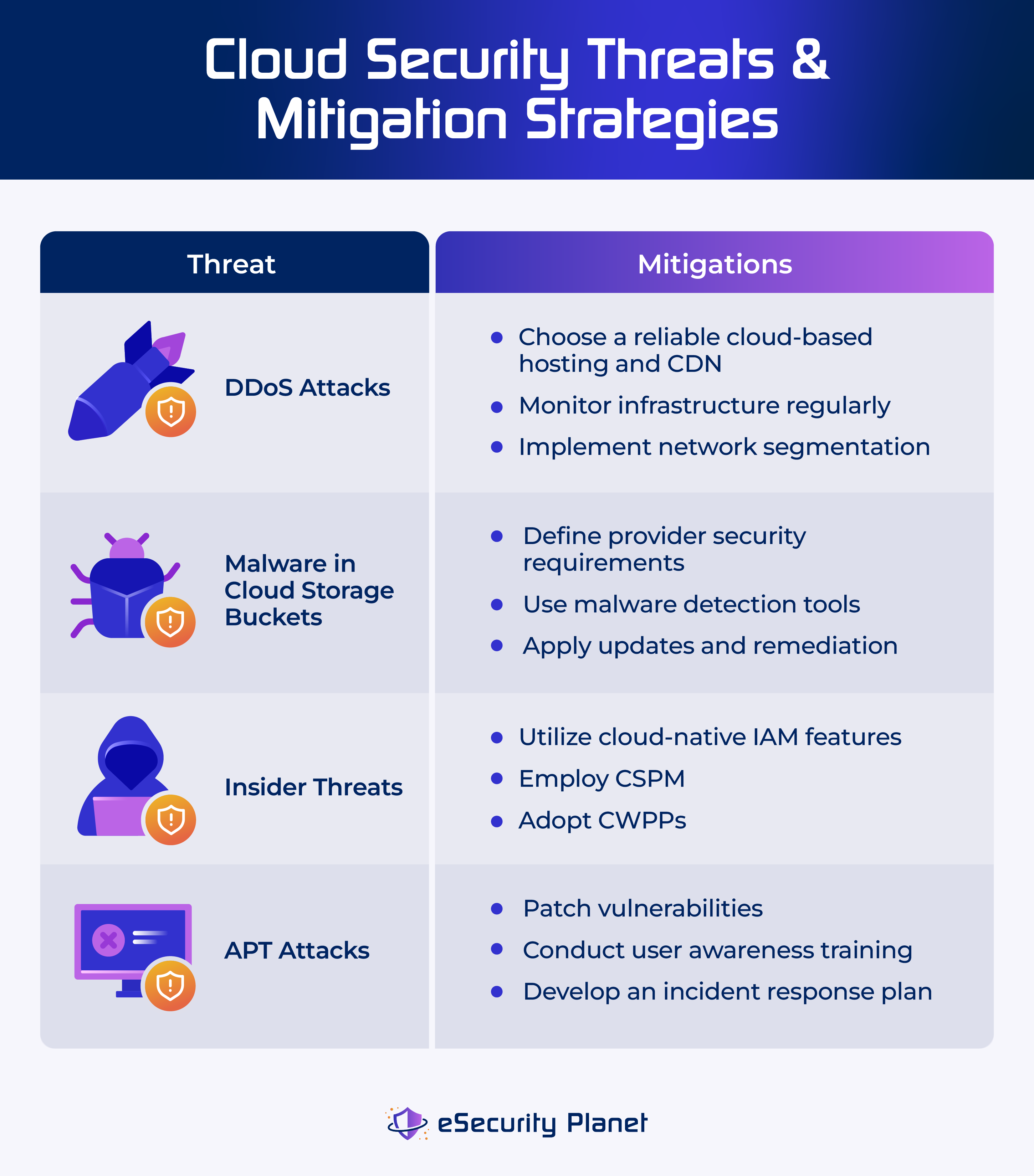
| Threat Category | Primary Root Cause | Impact Level | Key Mitigation Strategy |
|---|---|---|---|
| Misconfiguration | Human error in setting permissions | Critical | Automated configuration auditing and IaC scanning |
| Credential Theft | Phishing, weak passwords, lack of MFA | High | Multi-Factor Authentication (MFA) and Zero Trust |
| Insecure APIs | Poor coding practices, weak auth | High | Regular API penetration testing and OAuth 2.0 |
| Insider Threats | Malicious or negligent employees | Moderate to High | User Entity Behavior Analytics (UEBA) and Least Privilege |
| DDoS Attacks | Intentional flood of traffic | Moderate | CSP-native DDoS protection and CDN integration |
| Supply Chain Risks | Vulnerabilities in 3rd-party apps | High | Software Bill of Materials (SBOM) and vendor audits |
Emerging Threats and the AI Factor in 2026
As we navigate through 2026, the role of Artificial Intelligence in cloud security has become a double-edged sword. Malicious actors are now using automated exploit generation to scan cloud infrastructures for zero-day vulnerabilities at a speed no human analyst could match. These AI tools can detect subtle misconfigurations in real-time, often exploiting them before the organization is even aware a new resource has been provisioned.
Additionally, ransomware-as-a-service (RaaS) has evolved to specifically target cloud backups. Modern ransomware does not just encrypt local files; it seeks out cloud synchronization tokens and storage buckets to encrypt the off-site copies, rendering standard recovery plans useless unless the backups are "immutable" (cannot be changed or deleted for a set period).
Best Practices for Enhancing Cloud Security
To mitigate these vulnerabilities, organizations must move beyond basic password protection and adopt a comprehensive security posture.
- Implement Zero Trust Architecture: Never trust any user or device by default, even if they are inside the network perimeter. Every request for access to cloud storage must be authenticated, authorized, and continuously validated.
- Encryption at Rest and in Transit: Ensure that data is encrypted before it ever leaves the local environment and remains encrypted while stored. Managing your own encryption keys (Bring Your Own Key - BYOK) provides an additional layer of safety against CSP-level access.
- Principle of Least Privilege (PoLP): Assign the minimum level of access required for a user or service to perform its job. If a service only needs to write files, it should not have "Delete" or "List" permissions.
- Regular Auditing and Automation: Use automated tools to scan for misconfigurations daily. In the cloud, "configuration drift" happens quickly; automation is the only way to maintain a consistent security baseline.
Frequently Asked Questions
Is cloud storage more or less secure than on-premises storage?
Cloud storage is generally more secure in terms of physical infrastructure and hardware redundancy, as major providers invest billions in security. However, it is more susceptible to remote attacks and configuration errors. The security of the cloud depends almost entirely on how the user configures the access controls.
Can cloud providers see my data?
Technically, CSP employees could access data unless it is encrypted with keys that the provider does not control. Most reputable providers have strict internal controls and "Zero Knowledge" options where even the provider cannot decrypt the user's data.
What is the most common cause of cloud data breaches?
Misconfiguration of cloud settings remains the most common cause. This includes leaving storage buckets open to the public or using default passwords for management consoles.
Does Multi-Factor Authentication (MFA) prevent cloud breaches?
MFA is highly effective at preventing breaches caused by credential theft, but it does not protect against technical vulnerabilities like insecure APIs, misconfigurations, or side-channel attacks. It should be one part of a multi-layered strategy.
What are immutable backups in cloud storage?
Immutable backups are files that are locked for a specific duration. Once written, they cannot be modified, overwritten, or deleted—even by an administrator account. This is a critical defense against ransomware that targets cloud storage.
Practical Recommendation
To secure your cloud storage in 2026, begin by conducting a comprehensive permissions audit. Identify every storage bucket and container within your environment and apply the Principle of Least Privilege. Transition your organization toward a Zero Trust framework, ensuring that Multi-Factor Authentication (MFA) is mandatory for all access points. Finally, utilize automated security posture management tools to detect and automatically remediate misconfigurations in real-time, as manual oversight is no longer sufficient against AI-driven threats.
Image Gallery