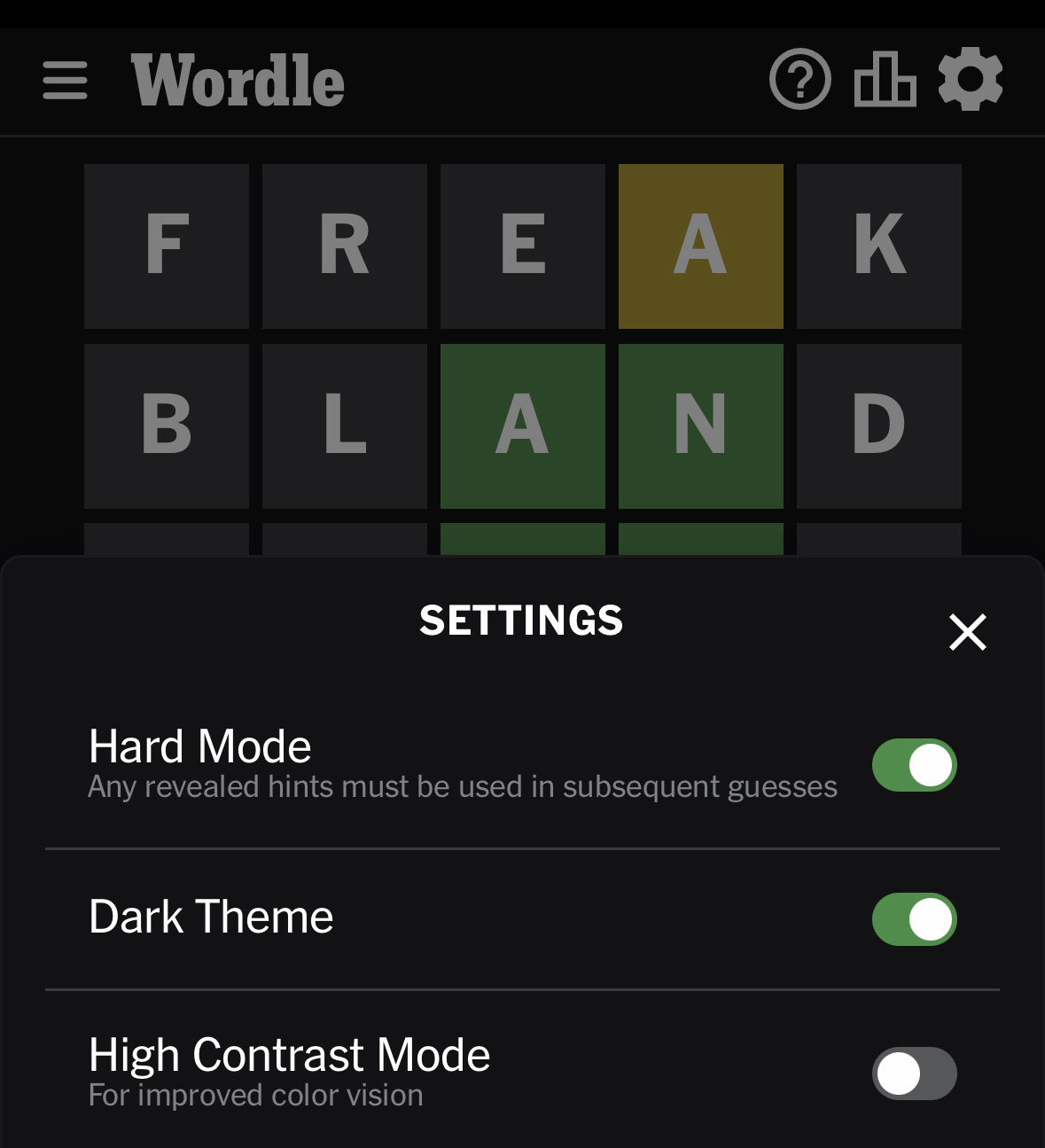
Why the Wordle Hard Mode Feels Tougher
Wordle’s Hard Mode feels tougher because it strictly prohibits the use of "burner words"—strategic guesses used to eliminate multiple letters at once. By forcing players to use every revealed hint in all subsequent attempts, the game r...
Wordle’s Hard Mode feels tougher because it strictly prohibits the use of "burner words"—strategic guesses used to eliminate multiple letters at once. By forcing players to use every revealed hint in all subsequent attempts, the game restricts information gathering and can trap players in "letter clusters" where they mathematically run out of turns before finding the solution.
Contents
Wordle, the daily word game acquired by The New York Times in 2022, remains a staple of digital routines in 2026. While the basic premise is simple—guess a five-letter word in six tries—the toggle for "Hard Mode" in the settings menu fundamentally alters the game's logic. To an observer, the rules seem like a minor adjustment, but for the player, it represents a shift from a logic puzzle to a high-stakes survival game.
The Mechanics of Mandatory Hints
In the standard version of Wordle, players are free to guess any five-letter word in the dictionary at any time. This flexibility is the cornerstone of advanced Wordle strategy. If a player has identified three letters but faces five or six possible solutions, they can use their fourth guess to input a "burner" word—a word designed specifically to test the remaining possible consonants, even if it ignores the letters already found.
Hard Mode removes this safety net. The rules are clear:
- Green hints must be used in the same position in all following guesses.
- Yellow hints must be included somewhere in all following guesses.
This restriction means you cannot "waste" a turn to narrow down the field. You are forced to pursue the solution directly, even when you know you lack sufficient information to distinguish between multiple similar words. This creates a bottleneck in the decision-making process that does not exist in the standard game.
The "Death Trap" Phenomenon: Why Patterns Kill
The primary reason Hard Mode feels significantly more difficult is the existence of "word families" or "letter clusters." These are groups of words that share four out of five letters in the same positions. Common examples include:
- —IGHT: LIGHT, NIGHT, FIGHT, SIGHT, MIGHT, RIGHT, TIGHT, WIGHT.
- —ATCH: BATCH, CATCH, HATCH, MATCH, PATCH, WATCH.
- —OUND: BOUND, FOUND, HOUND, MOUND, POUND, ROUND, SOUND, WOUND.
In Normal Mode, if you discover the pattern is —IGHT on guess two, you have four remaining guesses. You can use guess three to play a word like FORMS. This single guess tests "F" (FIGHT), "O" (no match), "R" (RIGHT), "M" (MIGHT), and "S" (SIGHT). By the fourth guess, you have eliminated four of the most likely candidates.
In Hard Mode, this is impossible. If you have —IGHT in green, your next guess must end in —IGHT. You are forced to guess LIGHT, then NIGHT, then FIGHT, one by one. If there are seven possible words and you only have four guesses left, you are statistically likely to lose the game through no fault of your logic, but simply because the "luck of the draw" didn't favor your specific sequence of guesses.
Information Theory and Entropy Reduction
To understand why this feels tougher, we can look at the game through the lens of information theory. In game theory, each guess in Wordle is intended to maximize "entropy reduction"—that is, to narrow down the number of possible remaining words as much as possible.
According to research on Wordle's mathematical optimal play, the best guesses are those that divide the remaining word pool into the smallest possible buckets. In Normal Mode, you can always choose the word that provides the most information. In Hard Mode, you are often forced to choose a word that provides very little information.
When you are forced to use a green "A" in the second position, you might only be able to choose from a pool of words that all contain "A" in that spot. If those words also share other letters, your guess won't help you distinguish between them effectively. You are essentially "guessing in the dark" rather than "solving by elimination."
Strategic Shifts: Starting Words in 2026
By 2026, the meta-strategy for Wordle has stabilized, but Hard Mode requires a completely different approach to the "starting word" debate. In Normal Mode, players often favor words with high-frequency consonants like STARE, ROATE, or CRANE.
In Hard Mode, starting with a high-frequency word can actually be a liability. If STARE yields a green —ARE, you have immediately entered one of the most dangerous traps in the game (SHARE, BARE, CARE, DARE, FARE, HARE, PARE, RARE, WARE).
Advanced Hard Mode players often pivot toward "safe" starters or words that test "trap-heavy" letters early. The goal in Hard Mode isn't just to find correct letters, but to avoid finding too many correct letters before you've eliminated the possibility of a cluster trap. This counter-intuitive approach—where getting four greens early is actually a terrifying prospect—is why the mode feels psychologically taxing.
Comparison: Normal Mode vs. Hard Mode Strategy
The following table breaks down the fundamental differences in how a player must approach the game based on the selected difficulty.
| Feature | Normal Mode Strategy | Hard Mode Strategy |
|---|---|---|
| Guess Flexibility | High; any valid word allowed. | Low; must follow all previous hints. |
| Information Gathering | Active; uses "burner words" to eliminate. | Passive; information comes only from direct attempts. |
| Risk Management | Low; traps can be bypassed via logic. | High; traps are often unavoidable. |
| Primary Goal | Minimize guesses to find the word. | Survive the "word family" bottleneck. |
| Ideal Starting Word | High-entropy (e.g., SLATE, CRANE). | Low-risk/Broad-coverage (e.g., ADIEU, AUDIO). |
| End-Game Tactics | Narrow down 5+ options with 1 guess. | Guess the most frequent word first and pray. |
The Psychological Friction of "Loss Aversion"
Beyond the math, there is a psychological component to why Hard Mode feels tougher. In Normal Mode, a loss feels like a failure of strategy—you didn't use your "burner" word correctly, or you missed a logical connection.
In Hard Mode, a loss often feels like an "inevitable defeat." When you realize on guess four that you are in a six-word cluster with only two guesses left, a sense of powerlessness sets in. This is known as the "illusion of control" being shattered. Players feel the game is "tougher" because their agency is reduced; they are no longer solving a puzzle so much as navigating a minefield where some mines are invisible and unavoidable.
Furthermore, the New York Times Wordle Editor, a role that has become more prominent in recent years, occasionally selects words that lean into these clusters. While the word list is predetermined, the daily selection can influence the perceived difficulty. When a "trap word" appears, the "Hard Mode" community on social media often sees a massive spike in broken "streaks," further cementing the mode's reputation for difficulty.
How to Survive Hard Mode
If you choose to play on Hard Mode, your mindset must shift from "finding the letters" to "managing the possibilities."
- Delay the Greens: It sounds counter-productive, but if your first guess gives you two or three yellows, don't immediately try to turn them green if they belong to a common suffix like "-ING" or "-ED." Try to use your second guess to find the remaining consonants first.
- Evaluate the Pool: Before making your third guess, mentally list all the words that fit your current hints. If there are more than three, and they differ by only one letter (the "cluster"), you must prioritize the most common letters among those options.
- Use Rare Letters Early: If you suspect a word might be "JUDGE," don't wait until guess six to test the "J." In Hard Mode, the earlier you identify a rare letter, the less likely you are to get stuck in a "BADGE/MADGE/LEDGE" trap later.
Frequently Asked Questions
Does Hard Mode actually change the word of the day? No. The word of the day is the same for everyone, regardless of the difficulty setting. Hard Mode only changes the rules regarding which words you are allowed to input as guesses.
Can I switch to Hard Mode mid-game? In the current 2026 interface, you can usually toggle Hard Mode on at the start of a session, but the game prevents you from turning it off once you have made a guess that violates the Hard Mode rules. Conversely, if you start in Normal Mode and make a guess that would have been valid in Hard Mode, you can sometimes toggle it on.
Why do some people say Hard Mode is easier? A small subset of players find that Hard Mode prevents them from overthinking or getting "too clever" with burner words. By forcing them to stick to the letters they have, it narrows their focus. However, from a mathematical probability standpoint, Hard Mode is objectively more restrictive and carries a higher risk of failure.
What is the "Trap of the Year" in 2026? While subjective, many players point to the "-IGHT" and "-ATCH" families as the perennial "streak killers." Any word family with more than six common variations is technically "unsolvable" in Hard Mode if the player identifies the pattern too early and doesn't have enough guesses to brute-force the remaining options.
Is there a way to "cheat" the traps in Hard Mode? There is no "cheat" within the rules, but the best defense is a "broad" second guess. If your first guess reveals a yellow 'A' and 'E', your second guess should try to place those vowels while also testing high-value consonants like 'R', 'S', and 'T' to see if you are heading into a cluster.
Final Recommendation
To master Hard Mode, you must accept that luck plays a larger role than in Normal Mode. The difficulty isn't just in finding the word, but in navigating the restrictions imposed by your own previous success. If you value a perfect streak above all else, Normal Mode provides the tools to ensure a win through logic. If you prefer a game that requires careful "possibility management" and a bit of daring, Hard Mode is the superior experience. For those looking to improve their 2026 stats, the best action is to practice "vowel-heavy" starters that avoid common consonant-cluster endings until the second or third guess.
Image Gallery