Salesforce Financial Services Cloud for Life, Annuity, and Retirement Insurance: A 2026 Comprehensive Guide
Salesforce Financial Services Cloud (FSC) provides a specialized data model and toolset designed specifically for life insurance, annuity, and retirement providers. It centralizes policyholder data, beneficiary relationships, and finan...
Salesforce Financial Services Cloud (FSC) provides a specialized data model and toolset designed specifically for life insurance, annuity, and retirement providers. It centralizes policyholder data, beneficiary relationships, and financial goals into a single "Customer 360" view, enabling insurers to streamline claims, automate suitability reviews, and provide personalized financial advice.
Contents
The life insurance and retirement industry has undergone a radical shift. As of 2026, the traditional siloed approach to managing policyholders—where life insurance sat in one database and annuities in another—is no longer viable. Modern consumers expect their insurers to understand their entire financial trajectory, from the birth of a child to the distribution phase of a 401(k) or a complex variable annuity. Salesforce Financial Services Cloud (FSC) has evolved to meet these demands, offering a dedicated platform that bridges the gap between back-office policy administration systems (PAS) and front-office agent productivity.
The Strategic Importance of the L&A Platform in 2026
For life, annuity, and retirement (L&A) carriers, the primary challenge remains the longevity of the customer relationship. Unlike property and casualty (P&C) insurance, which often operates on annual renewal cycles, L&A products can span several decades. The Salesforce FSC platform is designed to manage these multi-generational relationships by tracking not just the primary policyholder, but the entire household, including contingent beneficiaries and legal entities like trusts.
In 2026, the platform’s integration with Salesforce Data Cloud has become the industry standard. This allows carriers to ingest trillions of data points from legacy mainframe systems and external market feeds to create a real-time profile of the policyholder. This is critical for retirement planning, where market fluctuations directly impact the value of sub-accounts in variable products, requiring immediate advisor intervention or automated rebalancing alerts.
Bridging Legacy Gaps
Most L&A carriers still rely on legacy systems for core policy administration. Salesforce FSC does not replace these systems; instead, it acts as an "engagement layer." Through robust APIs and the MuleSoft Accelerator for Financial Services, carriers can surface complex policy details—such as death benefit amounts, surrender values, and loan balances—directly within the CRM. This prevents agents from having to toggle between different green-screen applications, significantly reducing "average handle time" and improving the accuracy of the information provided to the client.
Core Capabilities for Life and Annuity Providers
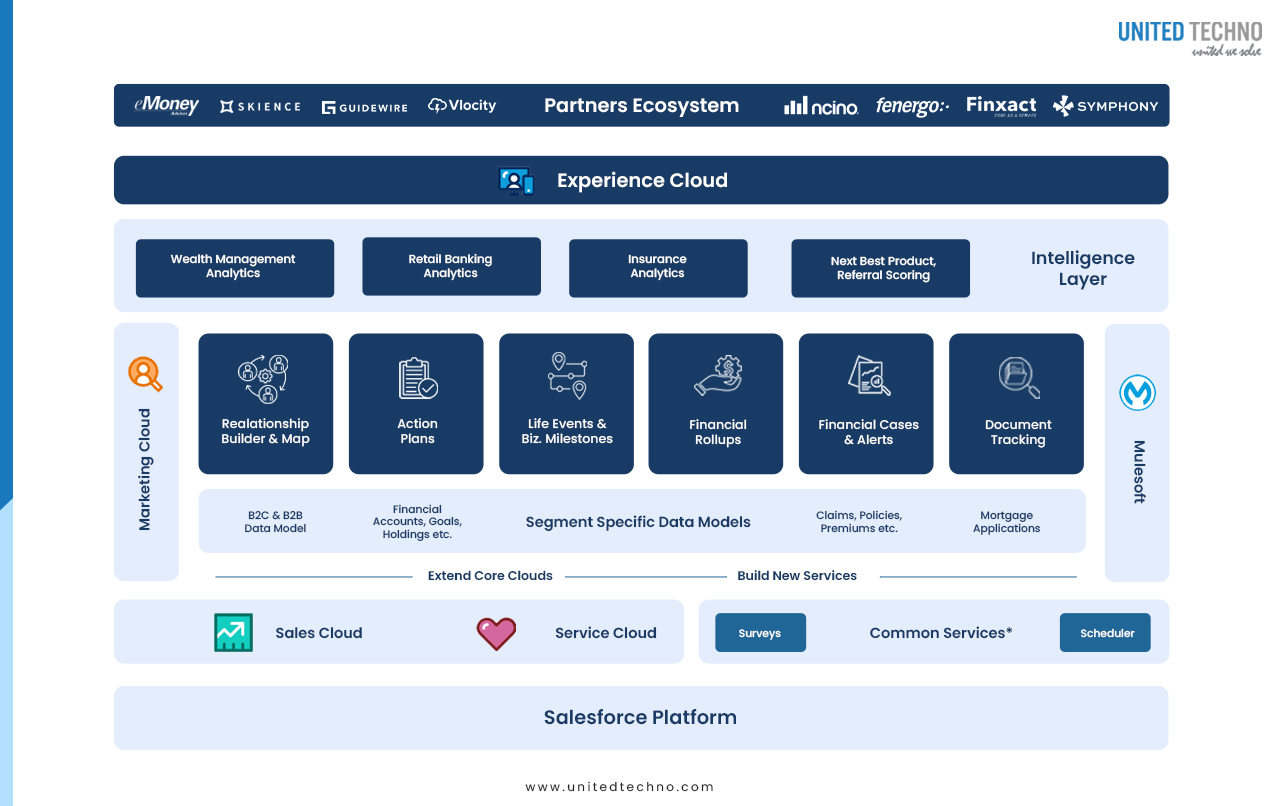
The platform offers several out-of-the-box features tailored to the unique complexities of life and retirement products. These tools are built on the foundational Financial Services Cloud data model, which includes objects for Financial Accounts, Assets and Liabilities, and Life Events.
1. Unified Policyholder and Beneficiary Management
Understanding "who is who" in a life insurance contract is legally and operationally complex. FSC allows users to distinguish between the owner, the insured, the payor, and the beneficiaries. In 2026, this visibility is essential for proactive "orphan policy" management—where an agent has left the firm, and a new advisor must quickly understand the client's historical context to prevent a lapse in coverage.
2. Automated Suitability and Compliance Workflows
Annuities and retirement products are subject to rigorous regulatory oversight, such as the SEC’s Regulation Best Interest (Reg BI) and various Department of Labor (DOL) fiduciary standards. Salesforce FSC includes Action Plans and Document Tracking and Approvals to ensure that every recommendation is backed by a documented suitability review. These workflows can be configured to require specific disclosures or signatures before an application can be submitted to the back office.
3. Life Events and Financial Goals
The "Life Events" component is perhaps the most valuable tool for L&A agents. By capturing milestones such as marriage, the birth of a child, a career change, or a home purchase, the platform triggers automated "Next Best Action" (NBA) recommendations. For example, if a client reports a new child, the system can prompt the agent to discuss increasing the face value of a term life policy or opening a 529 college savings plan.
Technical Specifications and Integration
Implementing Salesforce FSC for L&A requires a deep understanding of the insurance data model. The platform utilizes a specific set of objects to manage the complexity of retirement products:
- Financial Account Object: Used to track annuities, 401(k)s, and IRAs. It includes fields for account status, tax qualification (Roth vs. Traditional), and current balance.
- Insurance Policy Object: Stores details of life insurance contracts, including policy type (Whole, Universal, Term), premium payment frequency, and riders.
- Claim Object: Managed via the Life Insurance Claims flow, this handles the intake of death claims or accelerated benefit requests, ensuring sensitive data is handled with the appropriate privacy controls.
Data Model Comparison: Standard CRM vs. FSC for L&A
| Feature | Standard Sales Cloud | FSC for Life & Annuity |
|---|---|---|
| Primary Object focus | Leads & Opportunities | Financial Accounts & Life Events |
| Household Relationship | Manual Linking | Native Household/Group Object |
| Policy Tracking | Custom Objects Required | Native Insurance Policy Objects |
| Beneficiary Management | Basic Contact Roles | Multi-tiered Relationship Mapping |
| Compliance Tools | Third-party Add-ons | Native Action Plans & Audit Trails |
| Integration Pattern | General API | Insurance-specific ACORD Standards |
Enhancing the Retirement Planning Experience
Retirement planning in 2026 is no longer a static "once-a-year" conversation. With the Salesforce Financial Services Cloud for Retirement, advisors can provide dynamic updates on income streams and withdrawal strategies.
Managing Annuity Distributions
For clients in the "distribution phase," managing Required Minimum Distributions (RMDs) is a critical service. The platform can calculate RMD deadlines based on the policyholder's age and account balance, sending automated reminders to both the client and the advisor. Furthermore, for variable annuities, the platform can monitor sub-account performance against the client's stated risk tolerance, flagging accounts that require rebalancing to stay within compliance.
Integration with Financial Planning Software
Most L&A carriers use third-party tools like Envestnet | MoneyGuide or eMoney for deep financial modeling. Salesforce FSC serves as the "hub" for these tools. Bi-directional integration ensures that the data gathered during a discovery session in Salesforce flows seamlessly into the planning software, and the resulting financial plan (PDF or digital dashboard) is saved directly to the client's Salesforce record for future reference.
Security, Privacy, and Regulatory Compliance
In the life insurance sector, the handling of Personally Identifiable Information (PII) and Protected Health Information (PHI) is governed by strict laws such as HIPAA in the United States and GDPR in Europe. Salesforce FSC addresses these through:
- Salesforce Shield: Provides Field-Level Encryption, Event Monitoring, and an expanded Audit Trail. This is essential for tracking who accessed a policyholder’s medical underwriting data.
- Compliant Data Sharing: Allows administrators to control which users can see specific data points. For example, an agent might see a policy’s face value, but only a specialized claims adjuster can see the specific health history or cause-of-death documentation.
- Financial Services Cloud Permission Sets: Pre-configured roles for "Insurance Agent," "Claims Adjuster," and "Customer Service Rep" ensure that users only have access to the tools and data relevant to their specific job function.
Implementation Roadmap and Best Practices
Deploying a platform of this magnitude is a multi-phase endeavor. Successful carriers in 2026 generally follow a structured path to ensure adoption and ROI.
- Discovery and Data Mapping: Identify all source systems (PAS, Billing, Underwriting) and map them to the FSC Insurance Data Model. Standardizing data formats according to ACORD standards is highly recommended for interoperability.
- Minimum Viable Product (MVP): Start with a "Customer 360" view for a specific line of business, such as Individual Term Life. This allows the team to refine the UI and data flows before scaling to more complex products like Variable Universal Life or Indexed Annuities.
- Agent Enablement: The greatest risk to any CRM implementation is lack of adoption. Use Salesforce Enablement (formerly myTrailhead) to create custom learning paths that show agents how the platform helps them sell more and spend less time on administration.
- Continuous Optimization: Use Tableau for CRM to analyze which agents are using the Life Events feature most effectively. Correlate platform usage with sales growth to identify and replicate winning behaviors across the organization.
Frequently Asked Questions
How does Salesforce FSC handle complex annuity riders?
Annuity riders (such as Guaranteed Minimum Withdrawal Benefits) are typically stored as child records to the main Financial Account or Insurance Policy object. In 2026, many carriers use custom components to display the real-time value of these riders, pulling data directly from the valuation engine via API to ensure the agent sees the most current "benefit base" or "step-up" value.
Can the platform manage group retirement plans (401k)?
Yes. While FSC is often discussed in an individual context, it has a robust "Business and Group" data model. This allows carriers to manage the employer (the plan sponsor) as a business account, while simultaneously tracking the individual plan participants and their respective balances and investment elections.
Is the platform compliant with the latest DOL Fiduciary rules?
Salesforce FSC provides the infrastructure for compliance, such as time-stamped audit trails, mandatory document checklists, and suitability workflows. However, the specific rules and logic must be configured by the carrier's legal and compliance teams to ensure they align with the current 2026 regulatory environment and the Department of Labor’s latest interpretations.
How does AI improve the life insurance claims process?
In 2026, Einstein AI is used to categorize incoming claim documents (like death certificates or physician statements) using Optical Character Recognition (OCR). It can automatically flag discrepancies in the data and prioritize claims based on complexity or policy value, ensuring that simple claims are fast-tracked for payment, which is a major driver of beneficiary satisfaction.
Practical Recommendations for 2026
To maximize the value of the Salesforce Financial Services Cloud for Life, Annuity, and Retirement, organizations should prioritize Data Cloud integration immediately. The ability to harmonize data from disparate legacy systems into a single stream is no longer a luxury—it is the prerequisite for the personalized, proactive service that modern retirement planning demands. Furthermore, carriers should invest in "Agent Desktops" that emphasize the "Life Events" and "Financial Goals" features, moving the conversation away from product features and toward holistic financial wellness.
Image Gallery