Iowa Minimum Auto Insurance Coverage: 2026 Requirements and Legal Standards
In the state of Iowa, all drivers are required by law to demonstrate financial responsibility to cover damages or injuries resulting from a motor vehicle accident. As of 2026, the minimum liability insurance requirements follow the "20...
In the state of Iowa, all drivers are required by law to demonstrate financial responsibility to cover damages or injuries resulting from a motor vehicle accident. As of 2026, the minimum liability insurance requirements follow the "20/40/15" rule, which includes $20,000 for bodily injury per person, $40,000 per accident, and $15,000 for property damage.
Contents
Understanding Iowa’s Financial Responsibility Law
Iowa operates under a "tort" or "at-fault" system regarding automobile accidents. This means that the driver determined to be at fault for a collision is legally responsible for the resulting damages, including medical expenses, lost wages, and property repairs. To ensure that victims can be compensated, the Iowa Motor Vehicle Financial Responsibility Act (Iowa Code Chapter 321A) mandates that vehicle owners maintain a minimum level of insurance or provide an alternative form of financial security.
Unlike "no-fault" states, where drivers turn to their own insurance regardless of who caused the accident, Iowa requires the liable party’s insurance to pay for the other party's losses. Consequently, carrying insurance is not just a regulatory hurdle for registration; it is a critical safeguard against personal litigation. If you are found at fault in an accident and your insurance limits are insufficient to cover the total damages, the injured parties may pursue your personal assets, including your home, savings, and future wages.
It is important to distinguish between "compulsory insurance" and "financial responsibility." While most drivers satisfy the law through an insurance policy, Iowa technically allows for other methods, such as posting a bond or depositing cash/securities with the state treasurer. However, for the vast majority of Iowans in 2026, a standard auto insurance policy remains the only practical and affordable way to comply with the law.
The 20/40/15 Rule: A Detailed Breakdown
The state-mandated minimums are often expressed as a series of three numbers: 20/40/15. These represent the maximum amounts an insurance provider will pay out for a covered claim under a basic policy.
Bodily Injury Liability: $20,000 per Person
This portion of the policy covers medical expenses, funeral costs, and legal fees associated with an injury to or the death of another person in an accident where you are at fault. In 2026, a $20,000 limit is considered exceptionally low. Given the rising costs of emergency room visits, surgery, and rehabilitation, a single overnight hospital stay can easily exceed this amount. If the victim's medical bills total $50,000, your insurance will pay the first $20,000, leaving you personally liable for the remaining $30,000.
Bodily Injury Liability: $40,000 per Accident
This is the total aggregate limit the insurance company will pay for all injuries sustained by all people involved in a single accident. For example, if you collide with a vehicle carrying four passengers and all four are injured, the $40,000 must be split among them. No single person can receive more than $20,000, and the total payout cannot exceed $40,000. If total medical claims reach $100,000, you are responsible for the $60,000 deficit.
Property Damage Liability: $15,000 per Accident
This coverage pays for damage to another person’s property. While this usually refers to the other driver’s vehicle, it also covers damage to buildings, fences, utility poles, or any other physical property. In 2026, the average cost of a new vehicle in the United States has risen significantly, with many entry-level sedans exceeding $30,000 and electric vehicles (EVs) often costing much more. A $15,000 limit is frequently insufficient to replace or even repair a modern vehicle equipped with advanced sensor technology and specialized materials.
Optional but Critical Coverages in Iowa
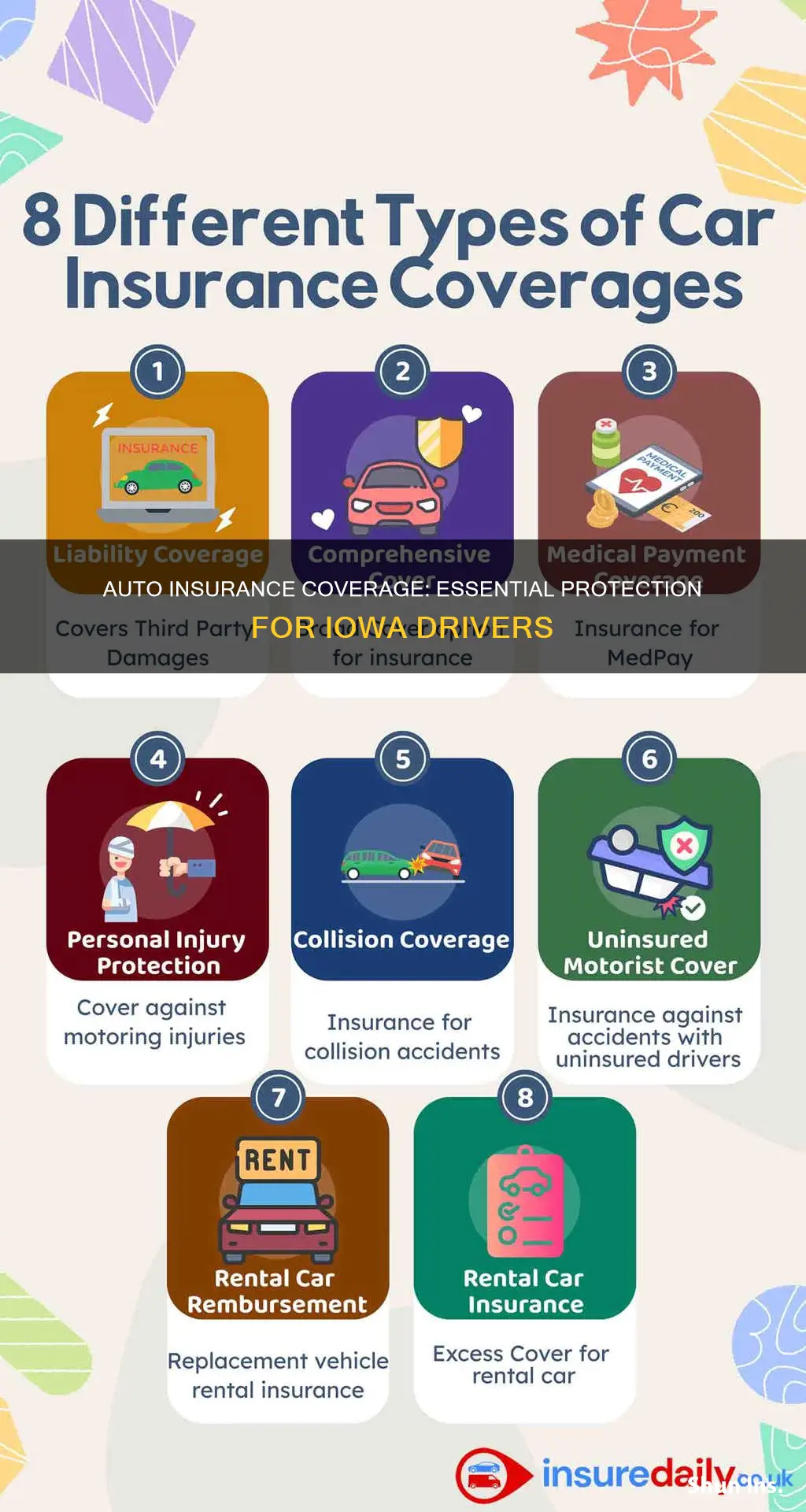
While the 20/40/15 limits are the only ones strictly required by law to avoid penalties, several other coverage types are highly relevant to Iowa drivers.
Uninsured and Underinsured Motorist Coverage (UM/UIM)
Iowa law requires insurance companies to offer Uninsured Motorist (UM) and Underinsured Motorist (UIM) coverage with every liability policy. While you have the right to reject these coverages in writing, doing so is generally discouraged by experts.
- Uninsured Motorist (UM): Protects you if you are hit by a driver who has no insurance at all.
- Underinsured Motorist (UIM): Protects you if the at-fault driver has insurance, but their limits (like the state minimum 20/40/15) are too low to cover your actual medical expenses.
Medical Payments (MedPay)
MedPay is an optional coverage that pays for medical or funeral expenses for you and your passengers, regardless of who caused the accident. This is particularly useful for immediate expenses like ambulance fees or health insurance deductibles.
Physical Damage (Collision and Comprehensive)
The state-mandated minimums do not cover damage to your own vehicle. To protect your own investment, you must purchase:
- Collision: Covers damage to your car resulting from a crash with another vehicle or object.
- Comprehensive: Covers non-collision events, such as deer strikes (very common in Iowa), hail, theft, or fire. If you are financing or leasing a vehicle in 2026, your lender will almost certainly require these coverages.
Comparing Minimum Requirements vs. Recommended Coverage
The following table illustrates the gap between what the state of Iowa requires and what insurance professionals typically recommend for adequate protection in 2026.
| Coverage Type | Iowa State Minimum (2026) | Recommended "Safe" Level |
|---|---|---|
| Bodily Injury (Per Person) | $20,000 | $100,000 - $250,000 |
| Bodily Injury (Per Accident) | $40,000 | $300,000 - $500,000 |
| Property Damage | $15,000 | $50,000 - $100,000 |
| Uninsured Motorist | Optional (Must be offered) | Match Liability Limits |
| Underinsured Motorist | Optional (Must be offered) | Match Liability Limits |
| Medical Payments | Not Required | $5,000 - $10,000 |
Penalties for Non-Compliance in Iowa
Driving without the required financial responsibility in Iowa carries significant legal and financial consequences. Law enforcement officers may request proof of insurance during any traffic stop or at the scene of an accident.
- Citations and Fines: Operating a vehicle without insurance is a simple misdemeanor. Fines typically range from $250 to $500, but these can increase with surcharges and court costs.
- License and Registration Suspension: If you are caught driving without insurance, the Iowa Department of Transportation (DOT) may suspend your driver’s license and vehicle registration. To reinstate them, you must provide proof of insurance and pay a reinstatement fee.
- Vehicle Impoundment: In some jurisdictions, officers have the authority to impound a vehicle if the driver cannot provide proof of financial responsibility on the spot.
- SR-22 Requirement: Following a conviction for driving without insurance or certain other serious offenses, you may be required to file an SR-22 certificate. This is a document issued by your insurance company to the DOT certifying that you carry at least the minimum required liability insurance. SR-22 filings are usually required for three years, and they significantly increase your insurance premiums.
- Civil Liability: If you cause an accident while uninsured, the other party can sue you directly. Iowa’s "Modified Comparative Fault" rule (Iowa Code § 668.3) means that even if the other driver was partially at fault, you could still be liable for a majority of the damages if your fault exceeds 50%.
The Risk of Minimum Coverage in 2026
The primary subject of concern for Iowa drivers in 2026 is the growing disparity between statutory minimums and real-world costs. When the 20/40/15 limits were established, they were designed to cover typical medical and repair costs of that era. However, inflation in the healthcare and automotive sectors has rendered these figures largely obsolete for comprehensive protection.
Medical Cost Inflation
In 2026, medical technology and pharmaceutical costs have driven the price of trauma care to new heights. A moderate injury requiring surgery and physical therapy can easily cross the $100,000 threshold. Carrying a $20,000 limit leaves a $80,000 exposure that the driver must cover out-of-pocket.
The Complexity of Modern Vehicles
Modern cars are no longer just metal and glass; they are mobile computers. A minor fender-bender that used to cost $2,000 to fix now often involves replacing lidar sensors, recalibrating cameras, and sourcing specialized carbon-fiber components. If you total a high-end SUV or a mid-range EV, a $15,000 property damage limit will cover less than half of the replacement cost.
How to Verify and Maintain Coverage
To remain compliant with Iowa law, you must carry proof of insurance in your vehicle at all times. Iowa allows for both physical insurance cards and electronic proof of insurance. Most major insurers provide mobile apps that display a digital ID card, which is legally valid during traffic stops.
When shopping for a policy, ensure that the "Dec Page" (Declarations Page) clearly states that your limits meet or exceed the 20/40/15 requirement. If you are moving to Iowa from another state, you must update your policy to reflect Iowa's specific legal standards and notify your insurer of your new garaging address. Failure to update your address can lead to a denial of claims if an accident occurs.
Frequently Asked Questions
Is Iowa a "no-fault" state?
No, Iowa is an "at-fault" (tort) state. This means the person who causes the accident is responsible for paying the damages. If you are injured in an accident caused by someone else, you typically file a claim against their insurance company or sue them directly for compensation.
Can I get a car registration without insurance in Iowa?
While you are not always required to show proof of insurance to initially register a vehicle or renew tags at the County Treasurer's office, you are legally required to have insurance to operate that vehicle on any public roadway. Furthermore, if you are involved in an accident or receive a citation, the lack of insurance will trigger immediate penalties from the Iowa DOT.
What happens if I am hit by an uninsured driver in Iowa?
If you have Uninsured Motorist (UM) coverage, your own insurance company will pay for your medical expenses up to your policy limits. If you do not have UM coverage and the other driver has no assets, you may be forced to rely on your own health insurance for medical bills and pay for your car repairs out of pocket (unless you have Collision coverage).
Does Iowa minimum insurance cover my own car?
No. Minimum liability insurance (20/40/15) only covers the other person's injuries and property. It provides zero dollars for your own medical bills or vehicle repairs. To cover your own vehicle, you need to add Collision and Comprehensive coverages.
What is an SR-22 and do I need one?
An SR-22 is not insurance; it is a certificate of financial responsibility. You only need one if the Iowa DOT orders it, usually following a DUI/OWI, driving without insurance, or having a high number of points on your license. It proves to the state that you are maintaining the required 20/40/15 coverage.
Practical Recommendation
While the state of Iowa allows you to drive with 20/40/15 limits, doing so in 2026 is a significant financial gamble. For most drivers, increasing limits to 100/300/100 provides a vastly superior level of protection for a relatively modest increase in monthly premiums. At a minimum, every driver should verify their policy includes Uninsured and Underinsured Motorist coverage to protect themselves from the estimated 10-15% of drivers on the road who remain uninsured despite legal requirements.
Disclaimer: This article provides general information regarding Iowa insurance laws as of 2026 and does not constitute legal or financial advice. For specific legal questions or policy evaluations, consult with a licensed insurance agent or a qualified attorney in the state of Iowa.
Image Gallery