The Largest Alligator Gar Ever Recorded: World Records, Measurements, and Biology
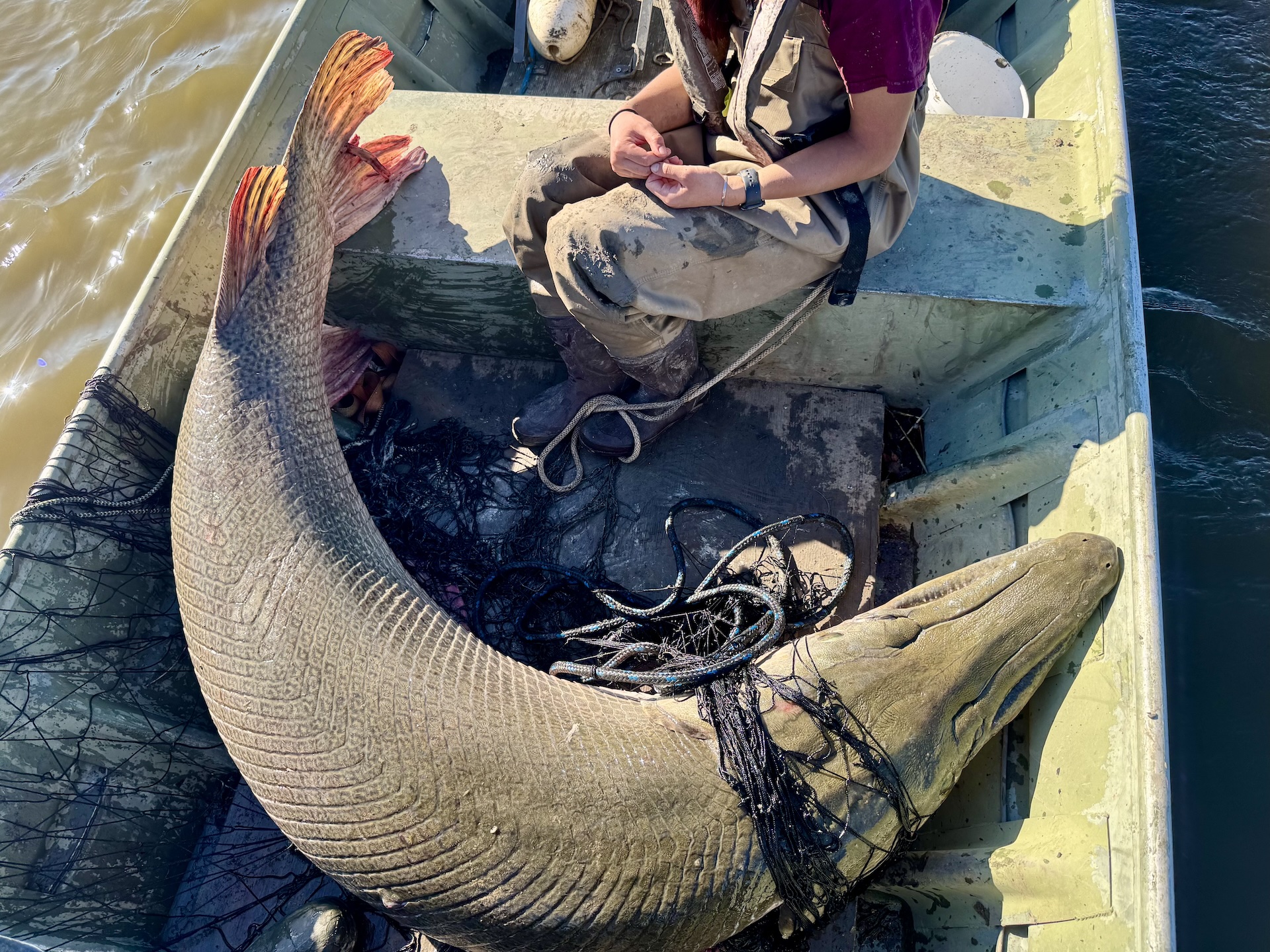
The largest officially recorded alligator gar (Atractosteus spatula) weighed 327 pounds (148.3 kg) and measured 8 feet 5.125 inches (257 cm) in length with a 47-inch girth. Commercial fisherman Kenny Williams accidentally netted this g...
The largest officially recorded alligator gar (Atractosteus spatula) weighed 327 pounds (148.3 kg) and measured 8 feet 5.125 inches (257 cm) in length with a 47-inch girth. Commercial fisherman Kenny Williams accidentally netted this giant specimen in Mississippi’s Chotard Lake in February 2011. State biologists estimated the historic female fish was between 95 and 100 years old.
Contents
The Absolute Record: The 327-Pound Chotard Lake Catch
On February 14, 2011, commercial fisherman Kenny Williams was hauling nets on Chotard Lake—an oxbow lake connected to the Mississippi River northwest of Vicksburg, Mississippi—when he discovered an exceptionally large fish entangled in his commercial buffalo net. Upon pulling the creature aboard his 16-foot boat, Williams realized he had captured a colossal alligator gar far exceeding standard commercial catches.
Williams contacted the Mississippi Department of Wildlife, Fisheries, and Parks (MDWFP) to report the specimen. Official measurements taken on certified scales verified the staggering dimensions of the fish:
- Weight: 327.0 pounds (148.32 kg)
- Total Length: 8 feet 5.125 inches (257 cm)
- Girth: 47.0 inches (119.4 cm)
Because the fish did not survive the net entanglement, Williams donated the body to the state. Biologists extracted the otoliths (tiny calcium carbonate structures within the inner ear used to age fish) to determine its age. Analysis revealed that the specimen was a mature female between 95 and 100 years old, indicating it hatched in the early 1910s.
Today, a full-body taxidermy mount of this 327-pound gar is permanently preserved and displayed at the Mississippi Museum of Natural Science in Jackson, Mississippi. It remains the largest scientifically authenticated alligator gar ever recorded in modern history.
Official Sport Fishing Records: Rod-and-Reel and Bowfishing
While the 327-pound Mississippi catch holds the record for the largest specimen ever measured, it was taken incidentally in a commercial net rather than on sport fishing tackle. State agencies and international record-keeping bodies separate catch categories based on the method of capture.
Top Alligator Gar Records by Method
| Method | Record |
|---|---|
| Net Catch | 327 lbs (Chotard Lake, MS, 2011) |
| Bowfishing | 290 lbs (Lake Corpus Christi, 2011) |
| Rod & Reel | 283 lbs (Sam Rayburn, TX, 2023) |
The IGFA Rod-and-Reel All-Tackle World Record
For over seven decades, the International Game Fish Association (IGFA) rod-and-reel record stood at 279 pounds (126.5 kg), caught by Bill Valverde in the Rio Grande River in Texas on December 2, 1951.
That long-standing record was broken in September 2023 when angler Art Weston, guided by veteran captain Kirk Kirkland, landed a monster alligator gar at Sam Rayburn Reservoir in East Texas. Using a 6-pound test line, Weston battled the giant fish before landing, measuring, and weighing it on an IGFA-certified scale.
- Weight: 283 pounds 0 ounces (128.36 kg)
- Length: 100 inches (8 feet 4 inches / 254 cm)
- Girth: 48 inches (121.9 cm)
- Certification: IGFA All-Tackle World Record & Line Class Record
Following official measurements and photographic verification, Weston and Kirkland released the fish back into Sam Rayburn Reservoir alive.
Bowfishing Records
Bowfishing accounts for several of the heaviest landed alligator gar on record due to the specialized heavy equipment used in archery tactics:
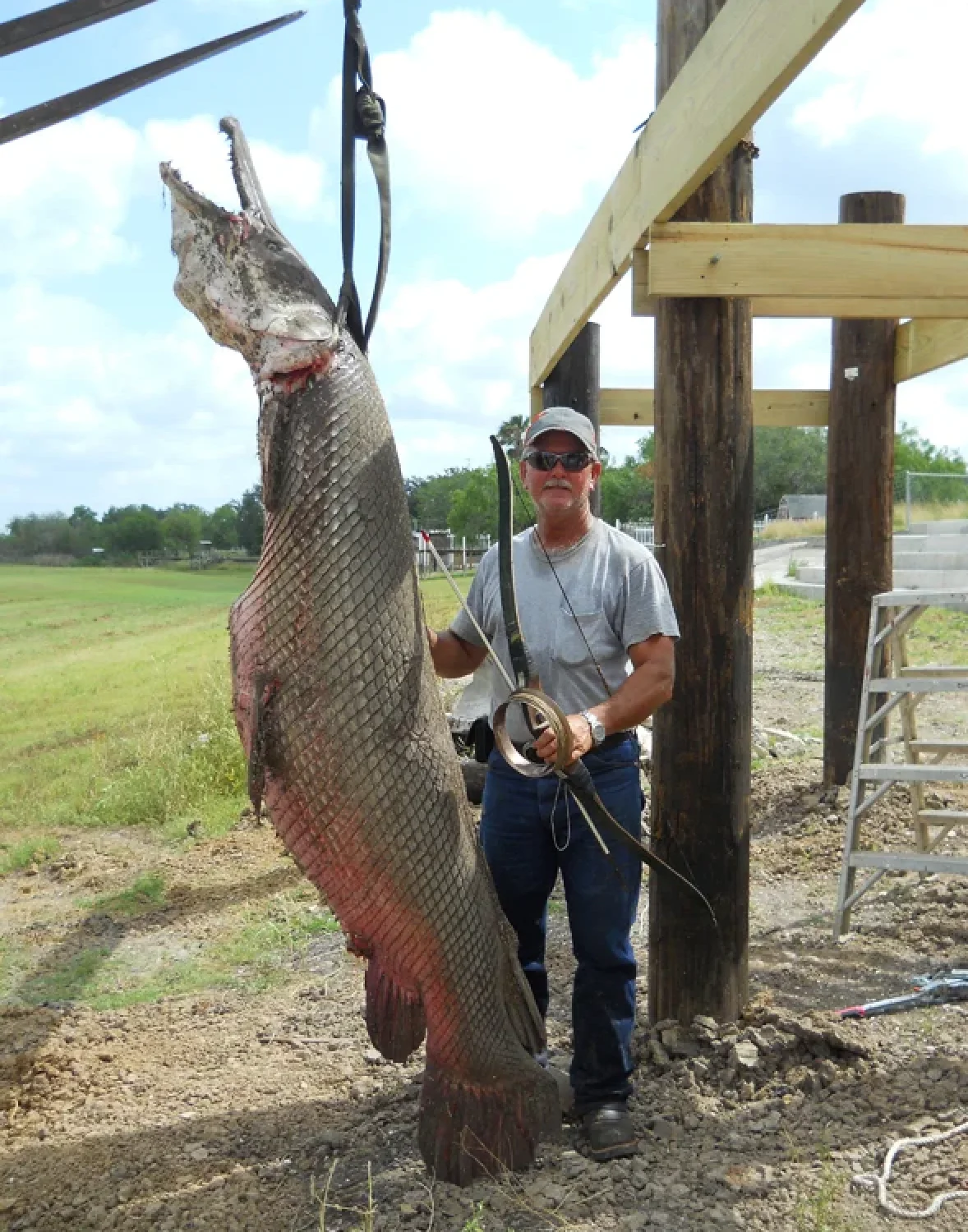
- Brent Crawford (2011): Shot a 290-pound (131.5 kg) alligator gar measuring 8 feet 2 inches in Lake Corpus Christi, Texas. This stands as one of the largest bowfishing catches ever recorded.
- Bryan Baker (2021): Arrowed a 262-pound (118.8 kg) gar measuring 8 feet 4 inches at Sam Rayburn Reservoir, Texas.
Historical Unverified Reports
19th and early 20th-century accounts from riverboat captains and anglers along the Mississippi, Red, and Trinity rivers describe alligator gar exceeding 300 to 350 pounds and reaching lengths of 9 to 10 feet. While biologically plausible given historical habitat conditions, these early reports lack verified scale measurements, photo documentation, or preserved biological samples.
Comparative Overview of Record Alligator Gar
The table below outlines the top verified alligator gar specimens documented across different record categories:
| Angler / Collector | Weight | Length | Location | Year | Capture Method / Category |
|---|---|---|---|---|---|
| Kenny Williams | 327 lbs (148.3 kg) | 8 ft 5.125 in (257 cm) | Chotard Lake, MS | 2011 | Commercial Net (Incidental) |
| Brent Crawford | 290 lbs (131.5 kg) | 8 ft 2 in (249 cm) | Lake Corpus Christi, TX | 2011 | Bowfishing State Record |
| Art Weston | 283 lbs (128.4 kg) | 8 ft 4 in (254 cm) | Sam Rayburn Reservoir, TX | 2023 | IGFA All-Tackle Rod & Reel |
| Bill Valverde | 279 lbs (126.5 kg) | 7 ft 9 in (236 cm) | Rio Grande River, TX | 1951 | Historical Rod & Reel Record |
| Bryan Baker | 262 lbs (118.8 kg) | 8 ft 4 in (254 cm) | Sam Rayburn Reservoir, TX | 2021 | Bowfishing Record |
Biology and Growth Dynamics of Atractosteus spatula
Understanding how alligator gar reach weights approaching 300 pounds requires examining their unique evolutionary adaptations, reproductive strategy, and growth biology.
ALLIGATOR GAR DIMORPHISM & AGING
| Category | Details |
|---|---|
| Females | Grow up to 300+ lbs, live 80–100+ years |
| Males | Rarely exceed 100 lbs, live 30–40 years |
Extreme Sexual Dimorphism
In alligator gar populations, females grow vastly larger and live substantially longer than males. Scientific sampling across the Gulf Coast drainage basin shows:
- Male Gar: Rarely exceed 5 to 6 feet in length or 100 pounds in weight. They mature faster (around 6 to 8 years) and have shorter lifespans, typically under 40 years.
- Female Gar: Reach sexual maturity late (around 10 to 14 years old) and continue growing incrementally throughout their multi-decade lifespans. Virtually every documented gar weighing over 200 pounds is an old-growth female.
Growth Rates and Lifespan
Alligator gar display rapid growth during their first few years of life, often reaching 3 feet in length within 2 to 3 years if food sources are abundant. However, once maturity is reached, annual length increments slow down to fractions of an inch per year, while girth and weight continue to accumulate steadily.
Because growth slows dramatically in older fish, an alligator gar measuring 7 feet might be 30 years old, whereas a specimen measuring 8 feet 5 inches—like the 327-pound Chotard Lake specimen—can be nearly a century old.
Physiological Adaptations
Alligator gar are living fossils whose lineage extends back over 100 million years to the Early Cretaceous period. Key physical traits include:
- Ganoid Scales: Heavy, interlocking, diamond-shaped scales coated with an enamel-like substance (ganoin). This outer layer provides armor against predators and environmental hazards.
- Dual Respiration: A highly vascularized swim bladder functions as a lung, allowing gar to gulp atmospheric air. This enables them to thrive in warm, stagnant, low-oxygen waters where other large predatory fish cannot survive.
- Dual Rows of Teeth: Unlike other gar species (such as longnose or spotted gar), the alligator gar features two prominent rows of sharp, conical teeth on its upper jaw, designed to trap large prey.
Habitat Requirements and Geographic Range
Historical native ranges for alligator gar encompassed the lower Mississippi River basin and major river drainages flowing into the Gulf of Mexico, extending north into Illinois, Indiana, and Ohio, and west into Oklahoma and Texas.
Historical vs Current Range
- Historical: Great Lakes Basin / Midwest / Lower Mississippi / Gulf Coast
- Current: Lower Mississippi River / Coastal Texas / Louisiana / Arkansas
During the 20th century, habitat fragmentation, flood-plain alterations, channelization, and targeted eradication campaigns reduced their northern range. Today, large-growth populations are primarily concentrated in:
- Texas: The Trinity River, Sam Rayburn Reservoir, Choke Canyon Reservoir, and coastal bays.
- Mississippi & Louisiana: The Mississippi River floodplain, Atchafalaya Basin, and connected oxbow lakes.
- Alabama & Florida: Coastal rivers flowing into the Gulf of Mexico (such as the Choctawhatchee and Escambia rivers).
Floodplain Spawning Dependency
Alligator gar are inundation spawners. They require seasonal spring flooding to push water over river banks into vegetation-rich floodplains. Eggs stick to submerged vegetation in shallow, warm water, where larvae hatch away from main-river predators.
Because major dams and levees prevent natural seasonal flooding, successful recruitment (year-class survival) may only occur once or twice a decade in regulated river systems. This makes old-growth populations vulnerable to over-harvest.
Conservation, Management, and Angling Best Practices
In the mid-20th century, state agencies and commercial fisheries viewed alligator gar as a destructive "trash fish" that harmed game populations like bass and crappie. Research has debunked this myth: alligator gar act as vital apex predators that balance ecosystems by consuming abundant gizzard shad, carp, drum, and catfish.
State wildlife agencies now strictly regulate alligator gar fisheries to preserve trophy-sized specimens:
Management Regulations
- Texas: Imposed a statewide daily bag limit of one alligator gar per day. On specific river stretches, such as portions of the Trinity River, strict draw lotteries and seasonal bans protect spawning aggregations. Texas also requires mandatory harvest reporting via the Texas Parks and Wildlife Department (TPWD) mobile app.
- Mississippi & Louisiana: Enforced commercial gear restrictions and strict daily limits to prevent over-harvesting mature females.
- Restoration Programs: Agencies including the U.S. Fish and Wildlife Service (USFWS) reintroduce hatchery-reared alligator gar into historical northern waters in Illinois, Tennessee, and Missouri to restore ecological balance.
Catch-and-Release Guidelines for Trophy Gar
Anglers targeting giant alligator gar should use heavy-duty tackle and low-stress handling protocols to ensure fish survival:
- Tackle Selection: Use heavy conventional reels, 80–100+ lb braided mainlines, and thick steel leaders to prevent line breakage during long fights.
- Hook Placement: Circle hooks or single barbless hooks help prevent deep-hooking in the esophagus or stomach.
- Water-Based Handling: Keep large gar supported in shallow water whenever possible. Lifting a 200+ pound fish out of the water by its head or tail can break its spine or crush internal organs that rely on water buoyancy.
- Tail Ropes and Stretcher Cradles: Use soft fabric cradles or cushioned tail ropes to restrain the fish safely for hook removal and quick measurements before release.
Frequently Asked Questions
How old was the largest alligator gar ever recorded?
The largest alligator gar ever recorded—the 327-pound catch from Chotard Lake, Mississippi, in 2011—was estimated by state fisheries biologists to be between 95 and 100 years old. Biologists calculated its age by counting annual growth rings on its otoliths (inner ear bones).
What is the official IGFA rod-and-reel record for an alligator gar?
The official IGFA All-Tackle world record for an alligator gar caught on rod and reel is 283 pounds (128.36 kg). Angler Art Weston caught the 8-foot-4-inch specimen on a 6-pound test line at Sam Rayburn Reservoir in Texas in September 2023, alongside guide Kirk Kirkland.
Are alligator gar dangerous to humans?
Despite their formidable size and rows of sharp teeth, alligator gar pose no documented threat to humans. There are no verified reports of alligator gar attacking swimmers or anglers. They are slow-moving, opportunistic feeders that target fish, waterfowl, and small mammals. However, caution is required when handling landed gar, as their tooth-filled jaws and razor-sharp scales can cause severe scrapes or cuts.
How do scientists determine the age of a massive alligator gar?
Scientists age alligator gar primarily by removing and sectioning the fish's otoliths (ear bones) or pectoral fin rays. Similar to counting tree rings, biologists count the microscopic translucent and opaque annuli (growth rings) under a microscope to calculate the exact number of years the fish has lived.
Where are the biggest alligator gar found today?
The highest concentration of giant alligator gar (exceeding 7 feet and 200 pounds) is found in the lower Mississippi River basin and the river systems of East Texas, particularly the Trinity River and Sam Rayburn Reservoir. These areas provide the expansive river-floodplain habitats and warm climates necessary for gar to live several decades and reach record sizes.
Practical Recommendations for Anglers and Observers
Anglers seeking to catch or observe trophy alligator gar should follow these operational steps:
- Verify State Licensing and Reporting: Review current state harvest rules before fishing. In jurisdictions like Texas, mandatory reporting through state wildlife apps is required for any harvested or retained gar.
- Book Specialized Local Guides: If targeting trophy gar on rod and reel, hire experienced charter captains equipped with landing cradles, certified scales, and proper heavy-tackle rigs designed for catch-and-release fishing.
- Visit Conservation Displays: To see the world-record 327-pound specimen in person, visit the Mississippi Museum of Natural Science in Jackson, Mississippi, where the original specimen is preserved and displayed with educational biological exhibits.
Image Gallery