2025 Schedule 1 (Form 1040) Instructions: Additional Income and Adjustments Explained
IRS Schedule 1 is used to report types of income not listed on the front of Form 1040 and to claim "above-the-line" adjustments that reduce your Adjusted Gross Income (AGI). For the 2025 tax year, filed in early 2026, it remains the pr...
IRS Schedule 1 is used to report types of income not listed on the front of Form 1040 and to claim "above-the-line" adjustments that reduce your Adjusted Gross Income (AGI). For the 2025 tax year, filed in early 2026, it remains the primary tool for calculating your final taxable income footprint.
Contents
Understanding the Role of Schedule 1 in 2025
Schedule 1, titled "Additional Income and Adjustments to Income," serves as a critical bridge between your gross earnings and your Adjusted Gross Income (AGI). While Form 1040 captures primary income sources like wages (W-2) and standard interest, Schedule 1 captures everything else—from side-hustle profits to student loan interest deductions.
The form is split into two distinct parts. Part I: Additional Income lists various types of taxable income that do not have a dedicated line on the main 1040. Part II: Adjustments to Income lists deductions you can take regardless of whether you choose the standard deduction or itemize your deductions on Schedule A. These "above-the-line" deductions are highly valuable because they lower your AGI, which can often qualify you for other tax credits and benefits that are income-restricted.
For the 2025 tax year, taxpayers must ensure they are using the correct version of the form, as inflation-adjusted limits for items like educator expenses and health savings account (HSA) contributions have changed. Proper completion of Schedule 1 is essential; errors here directly affect the tax math on your primary return.
Part I: Reporting Additional Income (Lines 1–9)
Part I of Schedule 1 is where you disclose supplemental income. In the eyes of the IRS, almost all income is taxable unless specifically excluded by law. If you received money that wasn't a gift or a loan, it likely belongs here if it isn't already on your W-2.
Taxable Refunds and Alimony (Lines 1–2)
Line 1 handles state and local income tax refunds. If you itemized your deductions in the previous year (2024) and received a refund from your state in 2025, that refund might be taxable. However, if you took the standard deduction in 2024, this refund is generally not taxable.
Line 2 covers alimony received. Due to the Tax Cuts and Jobs Act (TCJA), alimony rules depend on when the divorce or separation agreement was executed. For agreements finalized after December 31, 2018, alimony received is not taxable income, and alimony paid is not deductible. If your agreement was finalized on or before that date, you must report the income here.
Business and Investment Income (Lines 3–6)
- Line 3 (Business Income): If you are a sole proprietor or a single-member LLC, you calculate your profit or loss on Schedule C and transfer the result to this line.
- Line 4 (Other Gains/Losses): Used for the sale of business property, reported via Form 4797.
- Line 5 (Rental, Royalty, Partnership, S-Corp): This is the "pass-through" line. If you own rental property or are a partner in a business, the summary from Schedule E flows into this line.
- Line 6 (Farm Income): Calculated on Schedule F and reported here.
Unemployment and Other Income (Lines 7–8)
Line 7 is for unemployment compensation. All unemployment benefits received in 2025 are fully taxable at the federal level and must be reported using the amounts found on Form 1099-G.
Line 8, "Other Income," is a catch-all for various specific categories. This section expanded significantly in recent years and includes:
- Gambling winnings (Form W-2G).
- Jury duty pay.
- Prizes and awards.
- Canceled debts (unless excluded by IRS Publication 4681).
- Hobby income (though hobby expenses are generally not deductible).
Part II: Adjustments to Income (Lines 11–26)
Part II is often the favorite section for taxpayers because it contains deductions that lower your tax bill without requiring you to "itemize." These adjustments are subtracted from your total income to arrive at your AGI.
Educator Expenses and Business Costs (Lines 11–13)
For the 2025 tax year, the Educator Expense Deduction remains at $300 for single filers. If two teachers are married and filing jointly, the limit is $600. This applies to K-12 teachers, instructors, counselors, or principals who work at least 900 hours in a school year and spend their own money on classroom supplies.
Line 12 covers certain business expenses for reservists, performing artists, and fee-basis government officials, while Line 13 is for contributions to a Health Savings Account (HSA). HSAs are a powerful tool; for 2025, the contribution limits increased to $4,300 for individuals and $8,550 for families, with an additional $1,000 catch-up for those 55 and older.
Self-Employed Adjustments (Lines 15–17)
Self-employed individuals receive several specific adjustments to help level the playing field with W-2 employees:
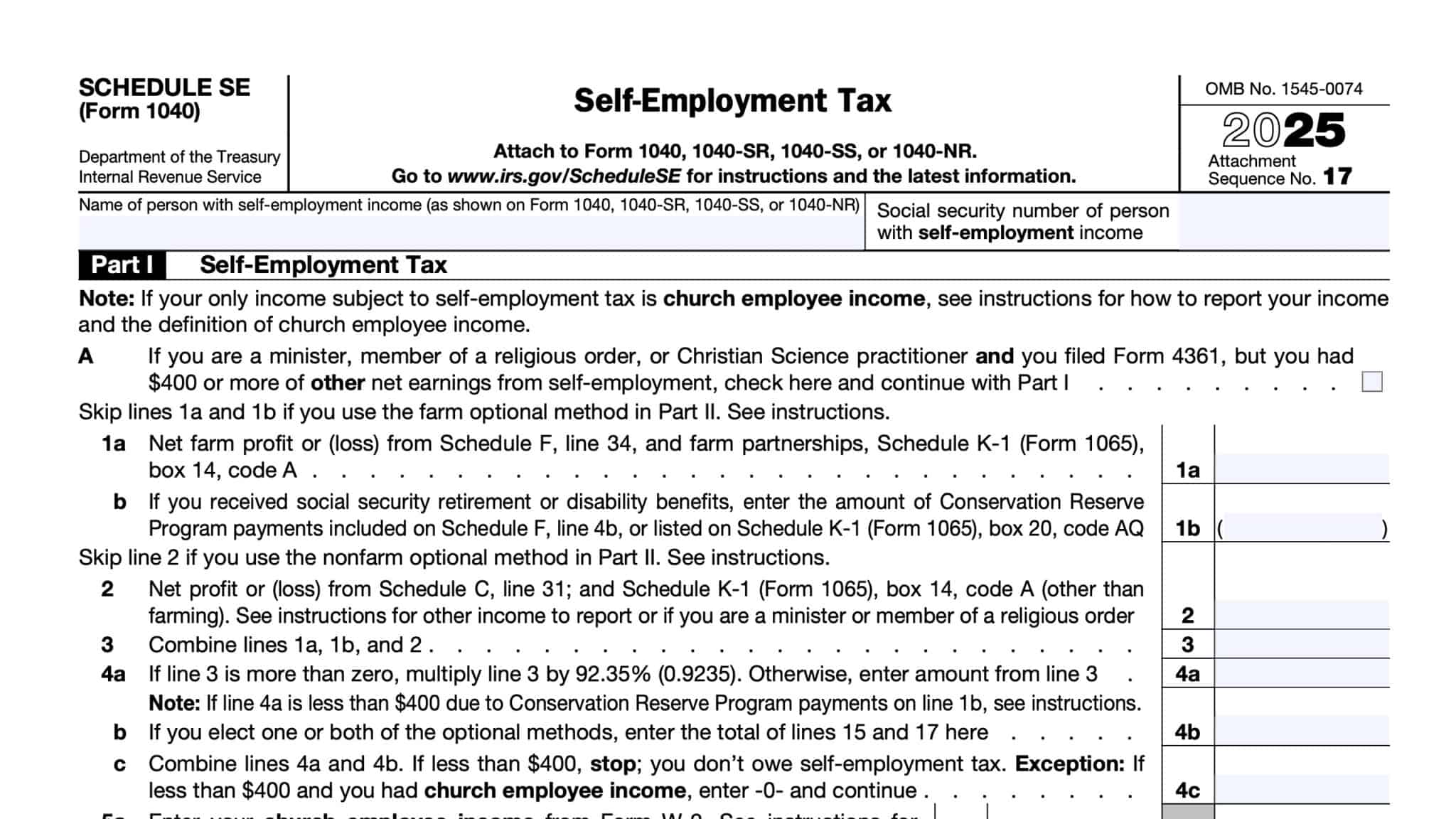
- Deductible part of self-employment tax (Line 15): You can deduct 50% of the self-employment tax calculated on Schedule SE.
- Retirement plans (Line 16): Contributions to SEP, SIMPLE, and other qualified plans.
- Self-employed health insurance deduction (Line 17): You may be able to deduct 100% of the premiums paid for yourself, your spouse, and your dependents, provided you had net profit from your business.
Education and IRA Deductions (Lines 20–21)
Line 20 is for Traditional IRA deductions. For 2025, the contribution limit is $7,000 ($8,000 if age 50 or older). However, your ability to deduct these contributions may be limited if you or your spouse are covered by a retirement plan at work and your income exceeds certain thresholds.
Line 21 handles Student Loan Interest. You can deduct up to $2,500 of interest paid on qualified student loans. This deduction begins to phase out once your Modified AGI exceeds specific 2025 limits, typically starting around $80,000 for single filers and $165,000 for joint filers.
| Adjustment Type | 2025 Limit/Threshold | Requirement |
|---|---|---|
| Educator Expenses | $300 per teacher | K-12 professional, 900+ hours |
| HSA Contribution (Self) | $4,300 | Must have High Deductible Health Plan |
| HSA Contribution (Family) | $8,550 | Must have High Deductible Health Plan |
| Student Loan Interest | $2,500 | Paid on qualified higher education loans |
| IRA Contribution | $7,000 ($8,000 if 50+) | Must have earned income |
| Self-Employed Health Ins. | 100% of premiums | Must have net business profit |
Key Changes for the 2025 Tax Year
As we look at the 2025 tax year from our current 2026 perspective, several specific changes in Schedule 1 instructions should be noted. These are largely driven by annual inflation adjustments and the continued phase-in of provisions from the SECURE 2.0 Act.
First, the phase-out ranges for the IRA deduction and the student loan interest deduction have shifted upward. This allows slightly higher-income earners to still claim these "above-the-line" benefits compared to previous years.
Second, the definition of "Other Income" on Line 8 continues to be scrutinized by the IRS regarding digital assets. While the main "Yes/No" question about digital assets (cryptocurrency) remains on Form 1040, the actual reporting of income from rewards, staking, or airdrops often flows through Schedule 1, Line 8z.
Finally, for those who are self-employed, the 2025 mileage rates (used to calculate the business income that eventually lands on Line 3) were adjusted mid-year. Taxpayers must ensure their Schedule C calculations reflect the correct 2025 rates before transferring the totals to Schedule 1.
Common Mistakes and Troubleshooting
Filing Schedule 1 incorrectly can lead to an IRS notice or a delayed refund. One of the most frequent errors is failing to transfer totals. The total from Part I (Line 10) must be moved to Form 1040, Line 8. The total from Part II (Line 26) must be moved to Form 1040, Line 10. Modern tax software handles this automatically, but paper filers often skip these steps.
Another common pitfall involves the Self-Employed Health Insurance Deduction. Taxpayers often try to claim this on Schedule A as a medical expense. While you can do that, it is almost always more beneficial to claim it on Schedule 1, Line 17. Doing so reduces your AGI, whereas Schedule A only helps if you itemize and your total medical expenses exceed 7.5% of your AGI.
Regarding Student Loan Interest, remember that you cannot claim this deduction if you are "Married Filing Separately" or if someone else claims you as a dependent. Furthermore, you can only deduct interest on loans used for your own education, your spouse's, or your dependents'.
Step-by-Step Completion Guide
- Gather Documentation: Collect your 1099-G (Unemployment), 1099-INT (Interest), 1098-E (Student Loan Interest), and records of business income or HSA contributions.
- Complete Supporting Schedules First: If you have business income (Schedule C), rental income (Schedule E), or farm income (Schedule F), complete those forms before touching Schedule 1.
- Address Additional Income (Part I): Review each line from 1 to 8z. If you received any miscellaneous income, such as a prize or jury duty pay, list it on Line 8.
- Calculate Total Additional Income: Add lines 1 through 9 and enter the result on Line 10. Transfer this to Form 1040, Line 8.
- Address Adjustments (Part II): Go through lines 11 through 25. Check your eligibility for the educator deduction, IRA deduction, and student loan interest.
- Calculate Total Adjustments: Add lines 11 through 25 and enter the result on Line 26. Transfer this to Form 1040, Line 10.
- Verification: Compare your AGI on Form 1040 to your records. If it seems unexpectedly high, re-check Part II of Schedule 1 to see if you missed an adjustment.
Frequently Asked Questions
Can I claim the educator deduction if I work at a preschool?
No, the IRS instructions for Schedule 1 specifically state that you must be an eligible educator in a school that provides elementary or secondary education as determined under state law. This generally covers Kindergarten through 12th grade. Preschool teachers do not qualify for this specific "above-the-line" deduction unless the preschool is considered part of the state's elementary education system.
Do I need Schedule 1 if I only have W-2 income?
If your only income is from a W-2 and you do not have any adjustments to income (like student loan interest or HSA contributions), you likely do not need to file Schedule 1. However, many "standard" taxpayers still use it for the student loan interest deduction or for reporting small amounts of miscellaneous income.
What is the difference between Schedule 1 and Schedule A?
Schedule 1 is for "Adjustments to Income" (above-the-line), which reduces your AGI regardless of whether you take the standard deduction. Schedule A is for "Itemized Deductions" (below-the-line), such as mortgage interest and charitable gifts. You only use Schedule A if the total of those deductions is higher than the standard deduction for your filing status. You can use Schedule 1 even if you do not use Schedule A.
How do I report cryptocurrency staking rewards on Schedule 1?
Staking rewards and airdrops are considered "Other Income" by the IRS. You should report the fair market value of the digital assets at the time you received them on Schedule 1, Line 8z. This is distinct from selling crypto for a profit, which is reported as a capital gain on Schedule D.
Is unemployment income still taxable in 2025?
Yes, unemployment compensation remains fully taxable at the federal level for the 2025 tax year. You will receive Form 1099-G from your state showing the total amount paid to you, which you must enter on Line 7 of Schedule 1.
Final Recommendation
When filing your 2025 taxes in 2026, treat Schedule 1 as a checklist for your financial health. Beyond just reporting income, Part II offers several opportunities to lower your tax liability through IRA contributions and student loan interest deductions. Before finalizing your return, double-check that every "above-the-line" deduction you are eligible for has been captured on Part II. If you are self-employed, pay particular attention to the health insurance and self-employment tax adjustments, as these are frequently overlooked but provide significant tax relief. For complex scenarios involving pass-through entities or alimony, consulting with a tax professional or using updated tax software is highly encouraged to ensure compliance with the latest IRS regulations.
Image Gallery