Mastering Trailer Tire Rotation: Essential Maintenance for Longevity and Safety
Trailer tire rotation is a critical maintenance practice that involves changing the position of tires on a trailer to ensure even tread wear, extend tire lifespan, and maintain optimal handling characteristics. While often overlooked c...
Trailer tire rotation is a critical maintenance practice that involves changing the position of tires on a trailer to ensure even tread wear, extend tire lifespan, and maintain optimal handling characteristics. While often overlooked compared to vehicle tire rotation, rotating trailer tires is essential for preventing irregular wear patterns caused by specific axle configurations, load distribution, and the unique tracking behaviors of towed equipment.
Contents
Understanding the Necessity of Trailer Tire Rotation
Most drivers are familiar with rotating tires on a standard automobile, where steering inputs and front-wheel drive components dictate specific wear patterns. Trailers, however, present a different set of challenges. Because trailer tires are usually non-steering, they often experience "scrubbing" during tight turns, particularly on multi-axle trailers.
When a multi-axle trailer—such as a tandem or triple-axle utility or travel trailer—executes a sharp turn, the tires on the furthest axle from the pivot point are forced to drag sideways across the road surface. Over thousands of miles, this lateral scrubbing creates uneven tread wear that can lead to premature failure. Furthermore, trailers are frequently loaded with uneven weight distributions, causing one side or specific corners to bear more load than others. Regular rotation acts as a corrective measure, distributing these stressors across all tires in the set, thereby extending the service life of the entire fleet.
Factors Influencing Tire Wear Patterns on Trailers
Before initiating a rotation schedule, it is vital to identify why your specific trailer tires are wearing. Recognizing these patterns can determine whether rotation will solve the problem or if a more serious mechanical issue exists.
Load Distribution and Center of Gravity
Trailers often carry heavy, static loads. If the load is consistently positioned toward one side or the front of the trailer, the tires in that position will suffer from heat buildup and accelerated tread loss. While rotation helps, addressing the root cause—balanced loading—is paramount for tire health.
Axle Alignment Issues
If you notice "feathering," where the tread ribs feel smooth in one direction but sharp in the other, this is frequently a sign of toe-in or toe-out alignment issues. Rotating tires will not fix an alignment problem; in fact, it may simply spread the uneven wear to other positions. Always inspect your suspension components, bushings, and axle alignment before assuming rotation is the only requirement.
Under-inflation and Overloading
Trailer tires—often designated as "ST" (Special Trailer) tires—are designed for high load capacities at specific pressures. Driving with low pressure causes the sidewalls to flex excessively, generating immense heat that can lead to structural failure, commonly known as a blowout. Consistent under-inflation results in wear on the outer shoulders of the tire.
How to Establish a Rotation Schedule
As a general rule of thumb for most recreational and utility trailers, you should rotate your tires every 5,000 to 7,000 miles. However, because many trailers lack odometers, a more practical approach for seasonal users is to rotate tires every six to twelve months, or whenever you perform other routine maintenance such as repacking wheel bearings or inspecting the brake assembly.
Recommended Rotation Patterns
The rotation pattern depends heavily on the trailer's configuration:
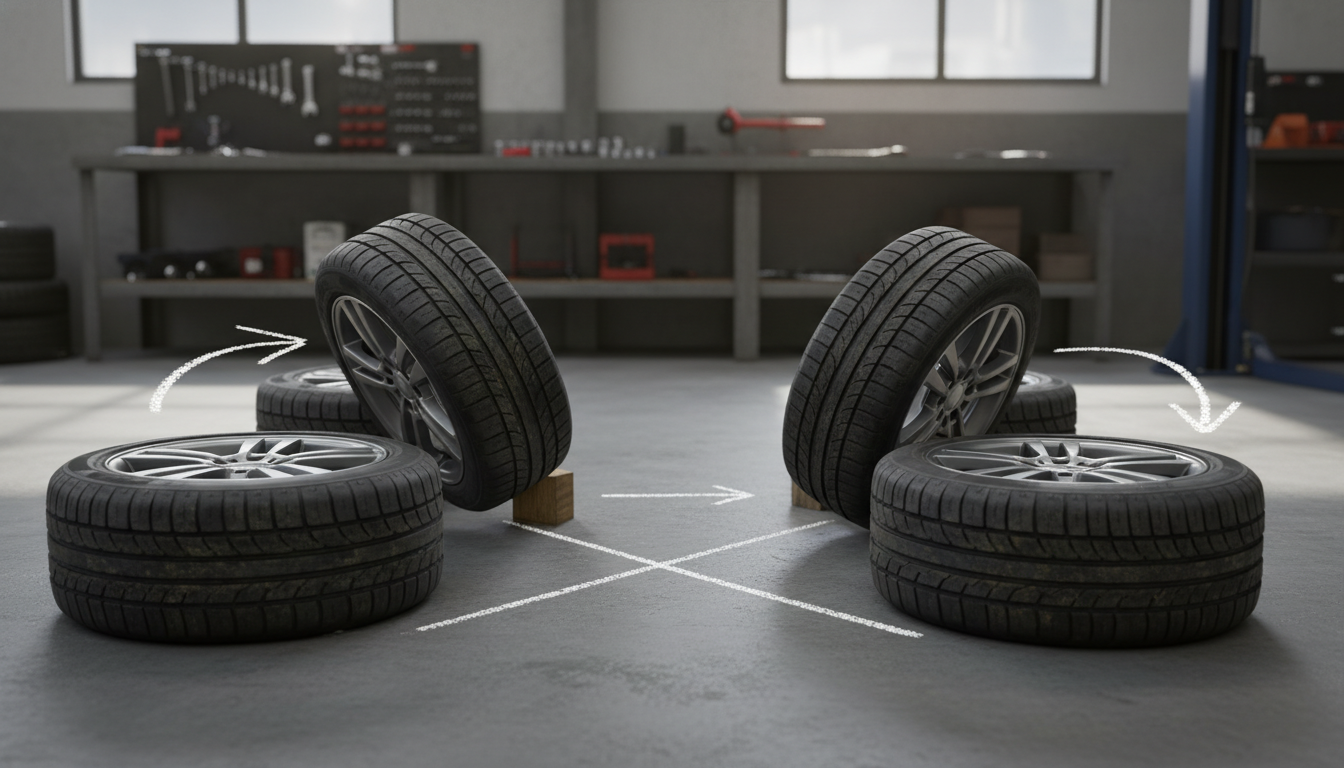
- Single-Axle Trailers: For these, rotation is often limited to a simple side-to-side swap. Because there is no second axle to share the wear, this helps mitigate uneven wear caused by road crowning (the slight slope of the road surface, which often causes the curb-side tires to wear faster).
- Tandem-Axle Trailers: These provide more flexibility. The standard method involves moving the front tires to the rear positions on the same side and moving the rear tires to the front, or performing a cross-rotation if the tire manufacturer permits it. Note: Always check your tire sidewall for directional arrows. If the tires are directional, you must move them only front-to-back on the same side.
| Trailer Type | Frequency | Primary Goal |
|---|---|---|
| Single-Axle | Every 5,000 miles | Even out road-crown wear |
| Tandem-Axle | Every 5,000–6,000 miles | Correct side-drag and scrub patterns |
| Triple-Axle | Every 5,000 miles | Manage varying load-bearing points |
Step-by-Step Execution: Safely Rotating Trailer Tires
Safety is the highest priority when lifting a trailer. Unlike a vehicle, a trailer does not have an engine or transmission to hold it in place while parked, and its center of gravity can be deceptive.
- Preparation: Park the trailer on a level, hard surface. Chock the wheels that remain on the ground to prevent rolling.
- Lifting: Use a jack rated for the weight of your trailer. Consult the owner’s manual for the designated jacking points. Never jack the trailer by the axle tube, as this can bend the axle and ruin your alignment. Always use the frame or specific jacking pads.
- Support: Once lifted, secure the trailer on high-quality jack stands. Do not rely on the hydraulic jack to hold the weight of the trailer while you are removing wheels.
- Removal and Inspection: Remove the lug nuts and the wheel. This is the ideal time to inspect the brake drums, magnet assembly, and grease seals. Check for any debris embedded in the tread.
- Rotation: Move the wheels to their new positions according to your plan. Ensure that you do not mix tire sizes or load ratings.
- Installation: Tighten the lug nuts in a star pattern to ensure even pressure. Once the trailer is lowered, use a torque wrench to set the lug nuts to the manufacturer's specified foot-pounds. This is critical to prevent wheel separation.
Identifying When to Replace Rather than Rotate
There are conditions where rotation is no longer effective or safe. Tires have a finite lifespan regardless of tread depth. The Rubber Manufacturers Association and most trailer tire manufacturers recommend inspecting tires for age-related degradation. Even if the tread looks new, a tire that is six years or older should be carefully evaluated for sidewall dry rot, cracking, or rubber hardening.
If you find that your tires exhibit "cupping" or "scalloping," this is often indicative of loose wheel bearings or worn suspension components. Attempting to rotate cupped tires will not improve performance; it will only mask the underlying mechanical failure until a catastrophic component break occurs. Always address the mechanical health of the suspension before investing in tire maintenance.
Frequently Asked Questions
Does a trailer need a spare tire included in the rotation cycle? Including your spare in the rotation cycle is an excellent practice. It ensures that the rubber on the spare is not aging prematurely while sitting idle. If your spare is the same size and type as your road tires, it should be rotated into the mix every other cycle.
Can I rotate radial and bias-ply tires on the same trailer? No. You should never mix radial and bias-ply tires on the same axle or even on the same trailer. They have different structural characteristics and heat-dissipation rates. Mixing them can lead to unpredictable handling and trailer swaying.
Should I rotate trailer tires if they are directional? Yes, but you must respect the directional arrows printed on the sidewall. If a tire is directional, it must rotate in one direction only. You are limited to moving these tires forward or backward on the same side of the trailer.
How do I know if my lug nuts are tightened correctly? Always use a calibrated torque wrench. Over-tightening can stretch the lug bolts, while under-tightening can cause the wheel to become loose during travel. Refer to your trailer or axle manufacturer’s specifications, as these vary by bolt pattern and stud size.
Is there a specific way to store tires if I remove them for the winter? If you remove your tires for winter storage, store them in a cool, dry, and dark place. Keep them away from electrical motors (which produce ozone) and ensure they are not resting on a concrete floor if possible, as the moisture can accelerate degradation.
Final Guidance and Best Practices
To ensure the safety of your trailer and your vehicle, treat trailer tire maintenance with the same urgency as your primary tow vehicle. Start by creating a logbook to track the mileage of your rotation intervals. If your trailer lacks an odometer, estimate your mileage based on trips and keep the log in your glove box.
If you are uncomfortable performing the lifting and inspection steps yourself, seek out a professional service center that specializes in trailer or RV repair. They possess the heavy-duty equipment necessary to handle the weight and alignment checks that standard automotive shops may not be equipped to perform. Proper maintenance is not just about extending the life of your equipment—it is about ensuring that you, your cargo, and those sharing the road with you remain safe during every mile of your journey.
Image Gallery