Certification of Formation Texas: Essential Guide to Registering Your Business Entity
Filing a certification of formation in Texas is the mandatory legal step required by the Texas Secretary of State to officially establish a new domestic business entity, such as a limited liability company, corporation, or professional...
Filing a certification of formation in Texas is the mandatory legal step required by the Texas Secretary of State to officially establish a new domestic business entity, such as a limited liability company, corporation, or professional association. Without this approved foundational document, a business cannot legally operate as a recognized corporate entity or secure the liability protections standard for modern enterprises.
Contents
Understanding the Texas Certification of Formation
The certification of formation is the primary legal document that brings a business entity into existence under the Texas Business Organizations Code (TBOC). When entrepreneurs or corporate legal teams draft and submit this document, they establish the structural parameters of the organization, setting forth its legal name, registered agent, governing structure, and purpose.
In Texas, this filing applies to multiple entity types, though the requirements, mandatory clauses, and statutory fees differ depending on whether the business is structured as a for-profit corporation, a nonprofit organization, a professional corporation, or a limited liability company. The filing transforms a private business concept into an independent legal person capable of entering into contracts, holding property, suing, and being sued in a court of law.
Operating without completing this statutory formation process exposes business owners to profound personal liability. Without a legally recognized entity, sole proprietors or informal partnerships find their personal assets—such as homes, savings accounts, and personal vehicles—vulnerable to business creditors, lawsuits, and operational liabilities. Completing the certification of formation erects a legal shield between personal wealth and business activities, preserving the personal financial security of the founders.
Entity Types and Governing Statutes in Texas
Before completing a certification of formation, founders must select the appropriate corporate structure. Each structure is governed by specific chapters of the Texas Business Organizations Code, which dictates the internal governance rules, management configurations, and structural obligations of the entity.
- Limited Liability Company (LLC): Governed primarily by Title 3, Chapter 101 of the TBOC. LLCs offer flexible management structures and pass-through taxation while shielding owners (members) from personal liability.
- For-Profit Corporation: Governed by Title 2, Chapters 20 and 21 of the TBOC. Corporations feature a rigid tripartite structure consisting of shareholders, a board of directors, and corporate officers, making them ideal for businesses seeking venture capital or public investment.
- Nonprofit Corporation: Governed by Title 2 and Chapter 22 of the TBOC. These entities are organized for charitable, educational, or scientific purposes and must include specific language regarding tax-exempt status if they intend to apply for 501(c)(3) recognition with the Internal Revenue Service.
- Professional Entity (PLLC or PC): Governed by Title 7, Chapter 301 of the TBOC. These are reserved for licensed professionals such as attorneys, physicians, accountants, and architects who require professional corporate structures.
Step-by-Step Filing Requirements and Prerequisites
Successfully filing a certification of formation requires careful preparation and adherence to strict statutory guidelines mandated by the state. Rushing through this phase often results in administrative rejections, filing delays, and unnecessary processing expenses.
- Verify Name Availability via SOSDirect / SOSUpload
- Appoint a Texas Registered Agent with a Physical Address
- Determine Management Structure (Manager vs. Member)
- Draft Form 205 (LLC) or Form 201 (Corporation)
- Submit via SOSDirect / Mail with Statutory Fee
1. Business Name Availability and Distinguishability
Under Texas law, every filing entity must have a name that is distinguishable upon the records of the Texas Secretary of State from any existing, reserved, or registered business name. Business owners can perform a preliminary search using the state's online portal to verify availability. If a desired name is available, founders have the option to formally reserve it by filing an application for reservation of name prior to submitting the certification of formation.
2. Appointment of a Registered Agent
Every domestic entity formed in Texas must continuously maintain a registered agent and a registered office address located within the state. The registered agent is legally designated to receive official government correspondence, legal notices, and service of process if the business becomes involved in litigation. The registered agent can be an individual resident of Texas or a registered business organization authorized to transact business in the state. Post office boxes are strictly prohibited as registered office addresses; a physical street address is required.
3. Defining Purpose and Duration
The certification of formation requires a clear statement of the entity's purpose. While for-profit entities often elect a broad statement allowing the company to engage in any lawful business activity permitted under the TBOC, certain regulated industries require specific statutory purpose clauses. Additionally, the filing must specify whether the entity has a perpetual existence or a specific dissolution date.
Completing and Submitting State Forms
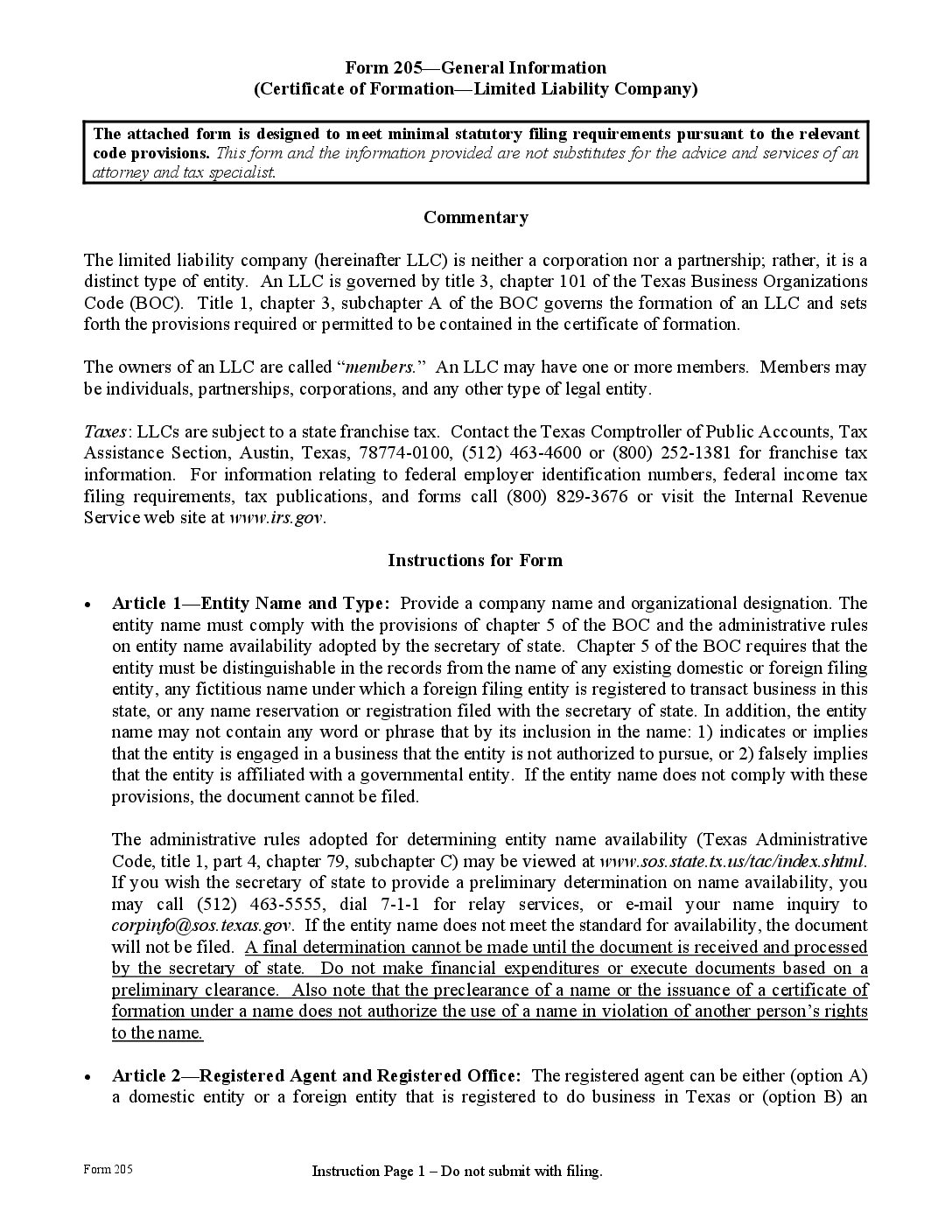
The Texas Secretary of State provides standardized forms for each entity type to streamline the filing process. For example, Form 205 is utilized for Limited Liability Companies, while Form 201 is used for For-Profit Corporations.
| Entity Type | Standard Texas Form | Primary Governing Statute | Typical Filing Fee (2026) |
|---|---|---|---|
| Limited Liability Company (LLC) | Form 205 | TBOC Chapter 101 | $300 |
| For-Profit Corporation | Form 201 | TBOC Chapters 20 & 21 | $300 |
| Professional Limited Liability Company | Form 206 | TBOC Chapters 101 & 301 | $300 |
| Nonprofit Corporation | Form 202 | TBOC Chapter 22 | $25 |
Filings can be submitted electronically through the state's online portal, SOSDirect or SOSUpload, or delivered via postal mail or hand delivery to the office of the Texas Secretary of State in Austin. Electronic filing significantly accelerates processing times, often returning approved documents within a few business days, whereas physical mail submissions face extended processing queues.
Post-Formation Obligations and Ongoing Compliance
Securing an approved certification of formation is only the initial phase of establishing a fully operational business in Texas. Once the state issues the acknowledgment of filing and certificate, founders must execute several critical follow-up actions to ensure regulatory compliance and operational readiness.
- Obtain an Employer Identification Number (EIN): Issued by the Internal Revenue Service, this federal tax identification number is required to open business bank accounts, hire employees, and file federal tax returns.
- Draft Internal Governance Documents: LLCs must execute a comprehensive company agreement, while corporations must adopt bylaws and issue initial shares of stock to shareholders. These internal documents supersede default statutory rules and govern the day-to-day operation of the enterprise.
- Register for State Taxes: Depending on the industry, businesses must register with the Texas Comptroller of Public Accounts for franchise tax reporting, sales and use tax permits, or employer withholding taxes.
- File the Texas Franchise Tax Public Information Report: Texas imposes a franchise tax on taxable entities, requiring annual filings and public information reports even for companies with zero tax liability due to revenue thresholds.
Common Pitfalls and Troubleshooting Filing Rejections
Errors during the drafting or submission phase frequently result in rejection letters from the Secretary of State, which delays business launch timelines. Understanding common compliance errors prevents costly setbacks.
One frequent mistake is listing an invalid registered agent address, such as a private mailbox or a location outside of Texas. Another common issue involves selecting a business name that fails the state's strict distinguishability standards, often because the chosen name too closely mimics an existing entity with only minor variations in punctuation or suffix descriptors.
Furthermore, omitting mandatory organizer signatures or failing to include specific statutory language required for professional or nonprofit entities will trigger an immediate administrative rejection. If a filing is rejected, the Secretary of State provides a correction notice outlining the deficiencies, allowing founders to resubmit the corrected document without forfeiting the filing fee if processed within statutory cure windows.
Frequently Asked Questions
What is the difference between a certification of formation and articles of incorporation?
While both terms describe foundational formation documents, terminology varies by jurisdiction and entity type. In Texas, the statutory term under the Texas Business Organizations Code is "certification of formation" for all entities. "Articles of incorporation" is an older or alternate term primarily used in other states or specifically for corporations.
Can I file a certification of formation in Texas on my own?
Yes, business founders can draft and submit forms directly through the Texas Secretary of State website without retaining legal counsel. However, complex ownership structures, multi-class stock issuances, or specialized professional entities often benefit from review by a licensed corporate attorney to ensure long-term structural alignment.
How long does it take the Texas Secretary of State to process a certification of formation?
Online filings submitted through SOSDirect or SOSUpload typically process within 2 to 5 business days, depending on current volume. Expedited processing options are sometimes available for an additional statutory fee, while mail-in paper applications require significantly longer processing windows.
Do I need a company agreement if I form an LLC in Texas?
Yes. Although the Texas Business Organizations Code does not require a company agreement to be filed with the state, Chapter 101 mandates that every LLC must have a company agreement governing internal affairs, member voting rights, and profit distributions. Failing to draft one leaves the company subject to rigid default statutory rules.
Does the certification of formation expire?
No. Unless the document explicitly specifies a limited duration or dissolution date upon initial drafting, a Texas certification of formation grants the entity perpetual existence, provided the business maintains compliance with state reporting and franchise tax obligations.
Conclusion and Next Action
Successfully securing a certification of formation in Texas is the definitive milestone that launches a legally protected business enterprise. To proceed, verify your desired business name availability on the Texas Secretary of State portal, secure a qualified local registered agent, complete the appropriate statutory form, and submit the filing along with the required fee to establish your corporate foundation securely.
Image Gallery