What a Dental Crown Post Does: Purpose, Types, and Procedure
A dental crown post anchors a core buildup inside a severely damaged tooth that has undergone root canal treatment. When insufficient natural enamel and dentin remain to hold a crown, the post fits directly into the prepared root canal...
A dental crown post anchors a core buildup inside a severely damaged tooth that has undergone root canal treatment. When insufficient natural enamel and dentin remain to hold a crown, the post fits directly into the prepared root canal space, providing the mechanical retention necessary to keep the artificial crown securely attached.
Contents
Understanding the Purpose of a Dental Crown Post
When a tooth suffers from extensive decay, trauma, or repeated dental procedures, it often loses a significant portion of its natural structure. If the damage extends into the pulp—the innermost layer containing nerves and blood vessels—endodontic treatment (a root canal) is required to remove infected tissue and seal the root canal system.
Once root canal therapy is complete, the remaining tooth structure must be restored to normal function and appearance. In cases where a substantial portion of the original tooth crown is missing, standard filling materials alone cannot reliably support a full-coverage dental crown. This is where a dental post (often referred to as a root canal post or post-and-core system) becomes necessary.
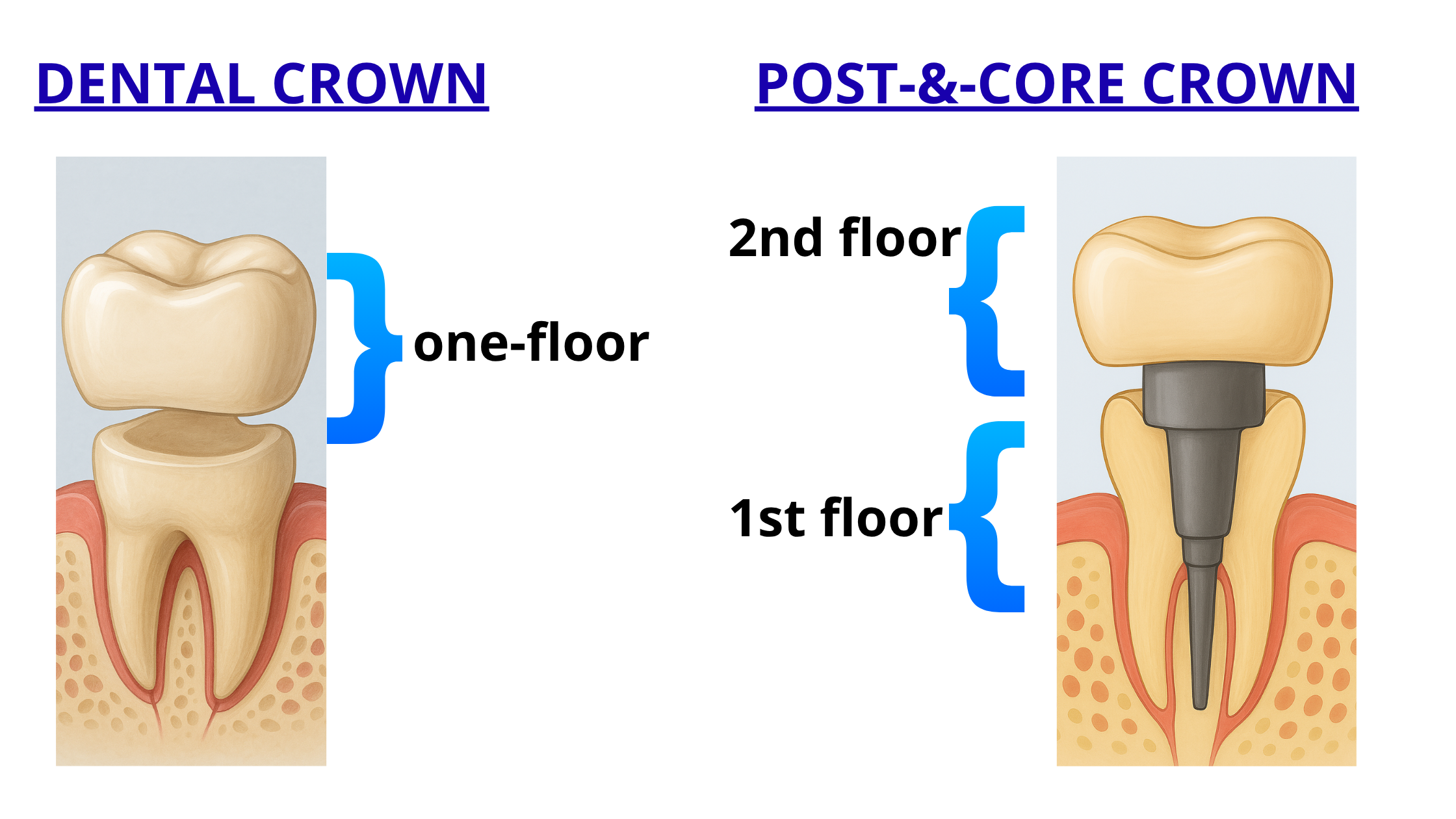
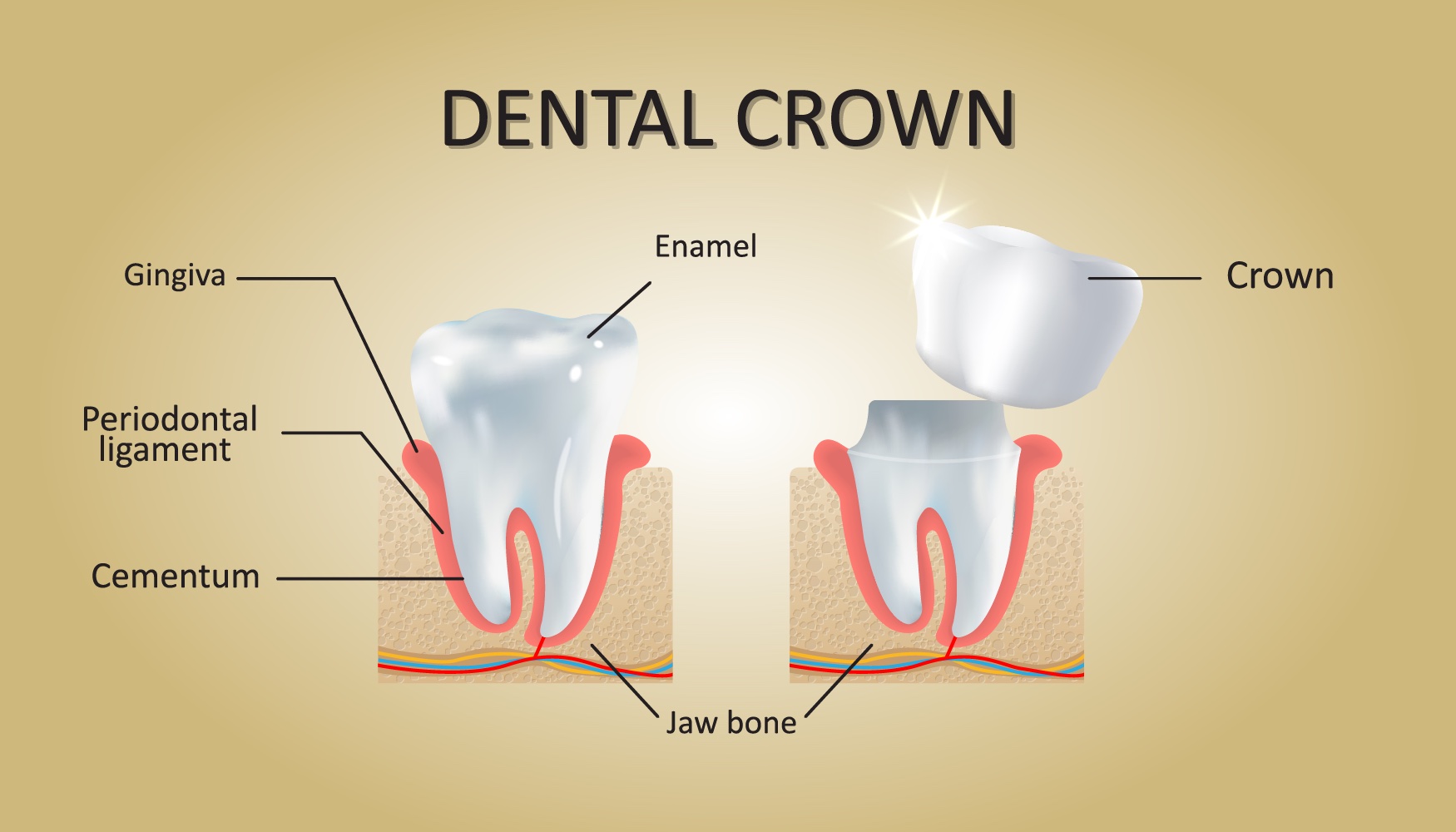
- Artificial Crown (Restores tooth shape and chewing surface)
- Core Buildup (Restorative resin replacing missing dentin)
- Dental Post (Anchor seated into the prepared root canal space)
- Natural Root (Anchored within the surrounding bone)
The Primary Function: Retaining the Core
The central function of a dental crown post is to provide mechanical retention for the core buildup. The core buildup is a foundation of composite resin, glass ionomer, or metal alloy placed in the upper portion of the tooth to replace lost dentin.
Without a post, a core buildup on a severely broken-down tooth would easily dislodge under normal chewing forces. The post extends down into the disinfected root canal space, anchoring the core buildup tightly to the remaining tooth structure. The artificial crown is then cemented over this reinforced core foundation.
Common Misconceptions: Does a Post Strengthen the Tooth?
A widespread misconception among patients is that a dental post reinforces or strengthens a weak tooth. In clinical endodontics, research has established that placing a post does not strengthen the root or increase its resistance to fracture.
In fact, preparing the root canal space to accept a post requires removing a small amount of internal root dentin, which can slightly reduce the physical strength of the root. Dentists only place a post when retention of the core cannot be achieved through other means. The post exists purely to keep the core buildup attached to the tooth, not to fortify the root itself.
The Ferrule Effect and Clinical Indications
Before deciding to place a post and crown, a dentist evaluates whether the remaining tooth structure can support a long-term restoration. The single most important biomechanical factor in predicting the success of a crowned tooth is the ferrule effect.
What Is the Ferrule Effect?
A ferrule is a continuous ring of natural sound tooth structure (dentin) that extends coronal to the crown margin around the full circumference of the tooth.
- Optimal Height: Dental research indicates that a ferrule height of 1.5 to 2.0 millimeters of solid dentin is essential.
- Function: The artificial crown hugs this band of natural dentin like a metal hoop around a wooden barrel. This mechanical encasement distributes functional loads, prevents root fracture, and prevents the post from leverage-induced debonding during chewing.
If a tooth lacks an adequate ferrule because decay or fracture extends down to or below the gumline, placing a post alone will not guarantee success. In such situations, additional procedures like surgical crown lengthening or orthodontic extrusion may be needed to expose sound dentin before crown fabrication.
When Is a Dental Post Required?
A post is indicated when:
- More than 50% of the coronal tooth structure is lost: There is inadequate natural tooth structure remaining to retain a core buildup through adhesive bonding alone.
- High functional load is expected: The tooth experiences heavy masticatory (chewing) forces, particularly on molars or premolars, or lateral shear forces on anterior (front) teeth.
- The tooth has already received a complete root canal treatment: A post can only be placed in a tooth that has had its pulp removed and the root canal filled.
Types of Dental Posts: Materials and Techniques
Modern dentistry utilizes two main categories of posts: prefabricated posts and custom-cast posts. The choice depends on the anatomical shape of the root canal, the tooth location, and aesthetic requirements.
- Dental Crown Posts
- Prefabricated Posts (Sized to standard drills)
- Non-Metallic (Fiber Glass, Carbon)
- Metal (Titanium, Stainless)
- Custom-Cast Posts (Fabricated in a lab)
- Gold Alloy
- Base Metal (Co-Cr, Ni-Cr)
- Prefabricated Posts (Sized to standard drills)
1. Prefabricated Fiber Posts (Non-Metallic)
Prefabricated fiber posts consist of continuous glass or carbon fibers embedded in a polymer resin matrix. Today, glass-fiber posts are the standard choice for most routine restorative cases.
- Modulus of Elasticity: Fiber posts have a flexural rigidity (modulus of elasticity) very close to that of natural dentin. When subjected to heavy bending forces, a fiber post flexes slightly alongside the tooth root, distributing stress evenly and reducing the risk of irreversible vertical root fractures.
- Aesthetics: Because glass-fiber posts are translucent or tooth-colored, they do not create dark shadows beneath translucent ceramic or porcelain crowns.
- Adhesive Bonding: Fiber posts are bonded using resin-based dental cements, creating a unified chemical and mechanical bond between the post, core, and dentin walls.
2. Prefabricated Metal Posts
Prefabricated metal posts are made from titanium alloys, stainless steel, or gold-plated materials.
- Characteristics: Metal posts are rigid and strong, making them easy to seat.
- Drawbacks: Metal has a significantly higher modulus of elasticity than natural dentin. Under severe lateral stress, a rigid metal post can concentrate forces at the tip of the post or along the canal walls, which increases the risk of vertical root fracture. Metal posts can also show through clear ceramic restorations, giving the translucent crown a grayish hue.
3. Custom-Cast Post and Cores
A custom-cast post and core is manufactured as a single, unified piece in a dental laboratory using precious (gold) or non-precious alloys.
- Indications: Cast posts are used when the remaining root canal space is extremely wide, irregularly shaped, or severely flared due to extensive decay. In these anatomical variations, standard prefabricated posts will not fit snugly.
- Procedure: The dentist takes an impression of the inside of the root canal using a plastic burner pattern or impression material. The lab then casts a custom metal post and core that perfectly matches the internal contour of the root space.
The Step-by-Step Procedure for Placing a Post and Core
Placing a post and core is a precise procedure performed after root canal treatment is complete. The procedure typically follows these clinical steps:
- Step 1: Root Canal Space Preparation (Gutta-percha Removal)
- Step 2: Post Hole Shaping & Trial Fitting
- Step 3: Post Etching, Priming & Cementation (Bonding)
- Step 4: Core Buildup Application & Curing
- Step 5: Tooth Preparation for Final Crown Impression
Step 1: Preparing the Root Canal Space
The dentist isolates the tooth using a rubber dam to maintain a sterile, dry field. Using specialized rotary instruments (such as Gates-Glidden drills or post space reamers), the dentist carefully removes a portion of the root canal filling material (gutta-percha) from the upper two-thirds of the canal.
At least 4 to 5 millimeters of gutta-percha must remain at the apex (tip) of the root to preserve the apical seal and prevent oral bacteria from re-contaminating the root tip.
Step 2: Post Selection and Trial Fit
The canal space is shaped to match the dimensions of the selected prefabricated post. The dentist places the post into the canal space and takes an X-ray (radiograph) to verify that the post reaches the correct depth, fits tightly against the canal walls, and leaves adequate apical filling intact.
Step 3: Etching and Cementation
The canal walls are disinfected and treated with a bonding agent or acid-etch gel. The post is coated with a dual-cure or self-adhesive resin cement and inserted smoothly into the canal. The cement is cured using a high-intensity curing light to lock the post into place.
Step 4: Core Buildup
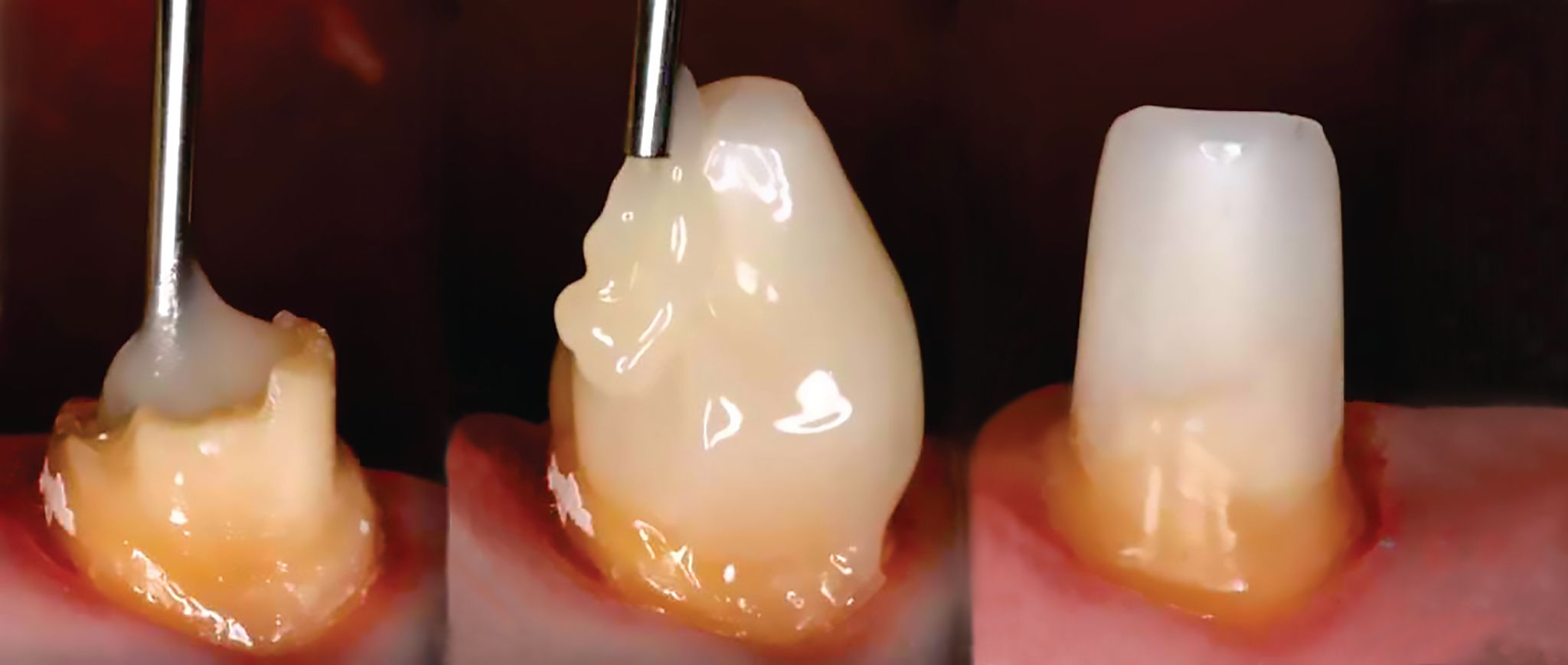
With the post seated securely and protruding slightly into the coronal space, the dentist applies a composite resin core material around the post. The resin is built up layer by layer and light-cured until it completely replaces the missing internal tooth structure.
Step 5: Shaping for the Crown
The dentist uses high-speed diamond burs to shape the hardened composite core and remaining natural tooth walls into a smooth, tapered preparation. This shape allows a custom dental crown to slide over the core and seat evenly along the margin. An optical digital scan or traditional putty impression is taken and sent to a dental laboratory to fabricate the final crown.
Dental Post vs. Dental Implant: Understanding the Difference
Patients often confuse a dental post with a dental implant. While both serve as anchors in restorative dentistry, they are used in entirely different clinical scenarios.
- Dental Post: Used when the natural root remains in place. The root must be healthy, well-sealed by a root canal, and firmly anchored in the jawbone.
- Dental Implant: Used when the natural root is completely missing or must be extracted. An implant is a biocompatible titanium screw surgically placed directly into the jawbone to replace the root entirely.
| Feature / Aspect | Dental Post and Core System | Dental Implant System |
|---|---|---|
| Natural Tooth Root | Preserved (Must be present and healthy) | Removed / Completely missing |
| Placement Location | Inside the prepared root canal space | Directly into the alveolar jawbone |
| Primary Function | Retains core material to support a crown | Replaces a missing root to support a crown |
| Surgical Requirement | Non-surgical (Restorative clinical procedure) | Minor oral surgical procedure |
| Ferrule Requirement | Requires 1.5–2.0 mm of sound dentin | Not applicable (Crown attaches to an abutment) |
| Healing Time | Immediate (Completed in 1–2 visits) | 3 to 6 months for osseointegration |
| Material Types | Glass-fiber, Carbon-fiber, Cast metal, Titanium | Commercial Grade 4 Titanium or Zirconia |
Potential Risks, Complications, and Success Rates
When performed with proper diagnostic evaluation and precise clinical technique, post-and-core restorations have high long-term success rates. However, like any medical or dental procedure, potential complications can arise over time.
1. Post Debonding (Loosening)
If moisture contamination occurs during cementation, or if the remaining tooth lacks an adequate ferrule, the adhesive bond holding the post to the root canal walls can fail. This causes the post, core, and crown unit to become loose. In many cases, a debonded post can be removed, the canal cleaned, and a new post rebonded if the underlying root remains intact.
2. Vertical Root Fracture
A vertical fracture along the length of the root is one of the most serious complications of post placement. It can occur if:
- Excess dentin was removed during canal preparation, leaving the root walls thin.
- A rigid metal post transmitted severe lateral biting forces directly to the root apex.
- The tooth lacked a protective 1.5–2.0 mm ferrule.
Unfortunately, a tooth with a vertical root fracture cannot be repaired and usually requires extraction.
3. Recurrent Decay or Root Infection
If micro-leakage develops around the margins of the dental crown, bacteria can enter the core space, causing recurrent tooth decay beneath the restoration or re-infecting the root canal space (apical periodontitis). This typically requires removing the crown and post to perform endodontic retreatment, or replacing the tooth with a dental implant.
How to Care for a Tooth with a Post and Crown
Maintaining a post-and-core supported crown requires consistent oral hygiene and preventative care:
- Brush Twice Daily: Use a fluoride toothpaste to keep the gumline and crown margins free of bacterial plaque.
- Floss Daily: Clean between teeth daily to protect the surrounding gum tissue and prevent decay along the margin where the crown meets the natural tooth root.
- Wear a Nightguard if You Grind Your Teeth: Bruxism (teeth grinding) exerts extreme lateral forces on teeth. If you grind your teeth at night, a custom-fitted nightguard protects the post and crown from mechanical overload.
- Avoid Chewing Exceedingly Hard Objects: Refrain from chewing ice, hard candies, popcorn kernels, or opening packaging with your teeth, as these actions create stress spikes that can fracture restorative materials or root dentin.
- Maintain Regular Dental Checkups: Routine professional cleanings and examinations allow your dentist to monitor the health of the crown margins and evaluate the underlying root using periodic X-rays.
Frequently Asked Questions
Does getting a dental post hurt?
No, getting a dental post does not hurt. The procedure is performed on a tooth that has already undergone a root canal, meaning the living nerve tissue inside the root canal space has been removed. The dentist will also administer local anesthesia to numb the surrounding gum tissue and jawbone during the procedure to ensure complete comfort.
Can a dental post fall out, and what should I do if it does?
Yes, a dental post can loosen or fall out if the adhesive cement breaks down or if biting forces cause debonding. If your post and crown come loose, store the dislodged piece in a clean container and contact your dentist promptly. Do not attempt to glue the post back into your tooth using household adhesives, as this can cause toxic chemical damage to your tissues and prevent your dentist from properly restoring the tooth.
Is a fiber post better than a metal post?
In modern restorative dentistry, glass-fiber posts are generally preferred over traditional metal posts for most routine applications. Fiber posts match the natural flexibility (elastic modulus) of root dentin, which reduces the concentration of internal stresses and minimizes the risk of catastrophic root fractures. Additionally, fiber posts offer superior aesthetics under tooth-colored ceramic crowns. Metal posts, however, remain valuable for custom-cast applications in irregularly shaped root canals.
How long does a tooth with a post and crown last?
A well-placed post-and-core supported crown can last anywhere from 10 to 20 years or longer with proper oral hygiene and regular dental care. The ultimate lifespan depends on the amount of remaining natural tooth structure (ferrule), the quality of the root canal seal, your chewing habits, and how effectively you protect the crown margins from decay.
Can a crown be replaced if it has a post underneath it?
Yes, a worn or damaged crown can often be replaced without removing the underlying post and core, provided the post remains firmly anchored in the root canal and there is no recurrent decay or root infection. If the post is stable, the dentist can reshape the existing core and place a new crown over it.
Next Actions and Professional Advice
If your dentist or endodontist has recommended a root canal, core buildup, and crown, ask them about the remaining natural tooth structure and whether a post is necessary for your specific case.
- Consult a Restorative Specialist: For complex restorations with significant structural loss, seek an evaluation from a prosthodontist or experienced general dentist to discuss whether a post and core or an alternative restoration (such as a dental implant) offers the best long-term prognosis for your smile.
- Review Diagnostic Radiographs: Ask your dental professional to review your X-rays with you to verify that adequate root length and healthy surrounding bone exist to support the proposed restoration.
Medical Advice Limitation: This article is for informational purposes only and does not constitute formal medical or dental advice, diagnosis, or treatment planning. Always consult a licensed dentist, endodontist, or prosthodontist for individualized clinical recommendations regarding your dental health.
Image Gallery