What Is Düsseldorf Known For? A Comprehensive Guide to Germany’s Fashion and Cultural Capital
Düsseldorf is internationally renowned as Germany’s capital of high fashion, art, and global commerce. The city is famous for its luxury shopping boulevard Königsallee, a vibrant historic Old Town (Altstadt) nicknamed "the longest bar...
Düsseldorf is internationally renowned as Germany’s capital of high fashion, art, and global commerce. The city is famous for its luxury shopping boulevard Königsallee, a vibrant historic Old Town (Altstadt) nicknamed "the longest bar in the world," its unique top-fermented Altbier brewing culture, Europe’s most authentic Japanese enclave, and modern waterfront architecture along the MedienHafen.
Contents
1. High Fashion and Luxury Shopping: The Legacy of Königsallee
Düsseldorf holds an undisputed reputation as the fashion capital of Germany. At the heart of this identity is Königsallee—known locally as the "Kö"—one of Europe’s most prestigious luxury shopping boulevards. Designed in the early 19th century, the street is defined by a central canal fed by the Düssel River, bordered by centuries-old chestnut trees and grand bridges.
The Kö hosts an unparalleled concentration of high-end flagship boutiques, including Chanel, Hermès, Gucci, Prada, Louis Vuitton, and Cartier. Beyond retail, the street serves as an urban runway where luxury fashion, haute couture, and automotive engineering intersect daily.
Königsallee Layout:
- West Bank: Luxury Retail & Financial Institutions
- Landwehr Canal
- East Bank: Flagship Fashion Boutiques & Grand Hotels
Düsseldorf's fashion prominence extends beyond retail into global supply chains and trade exhibitions. The city hosts major industry events, such as Düsseldorf Fashion Days (formerly CPD - Collections Premieren Düsseldorf), where thousands of buyers, designers, and brand representatives gather twice a year to define upcoming retail collections. Numerous international apparel brands maintain their European corporate showrooms or German headquarters within the city's fashion districts.
2. The Altstadt: "The Longest Bar in the World"
Despite covering less than half a square kilometer, Düsseldorf’s Altstadt (Old Town) packs over 250 pubs, bars, restaurants, and microbreweries into its narrow pedestrian lanes. This remarkable density earned the district its world-famous moniker, “Die längste Theke der Welt” (the longest bar in the world).
Altstadt Highlights:
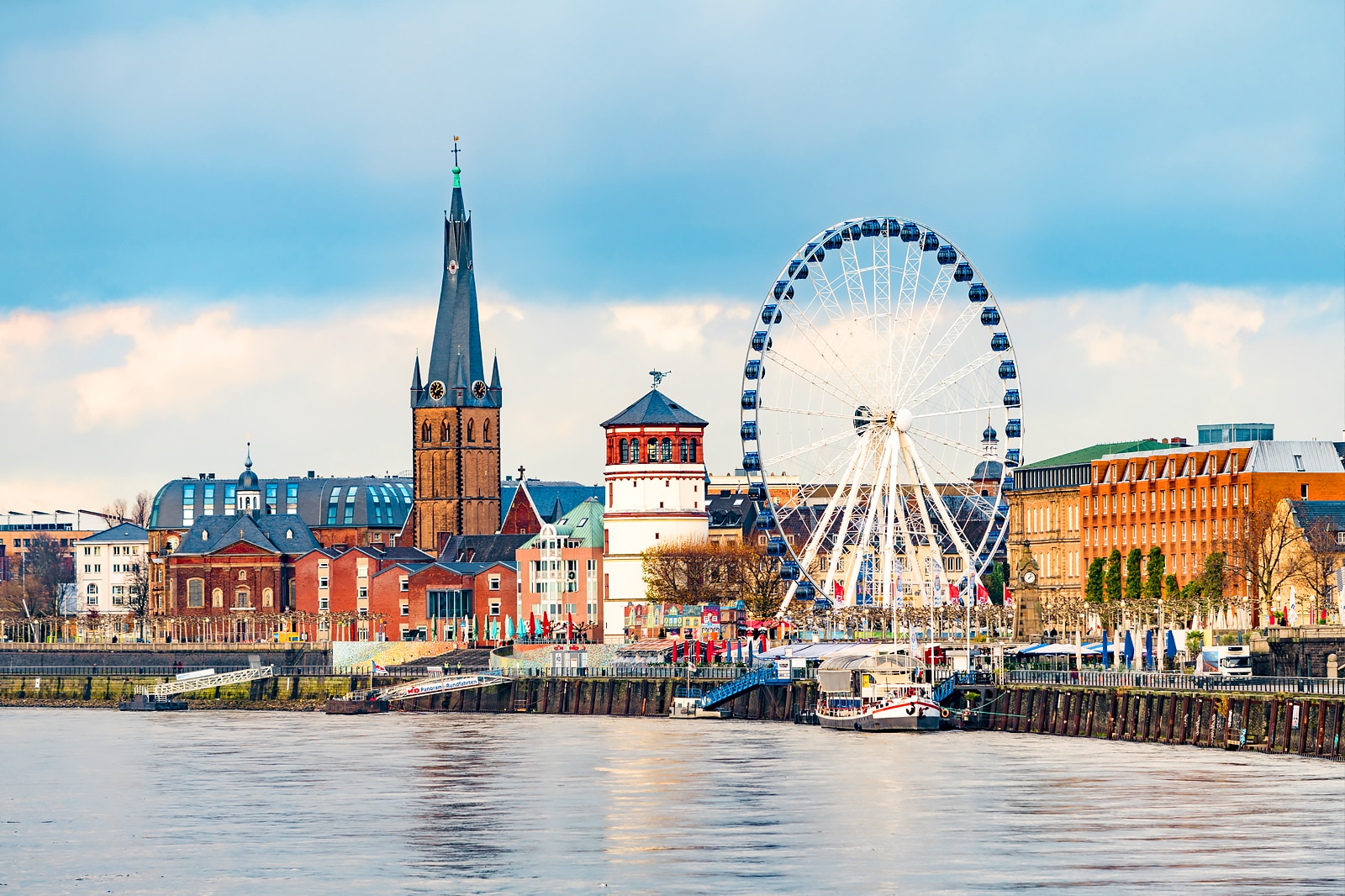
- Burgplatz & Schlossturm (Historic Riverside Square)
- Bolkerstraße & Wallstraße (High-Density Tavern Lanes)
- Historic Microbreweries (Uerige, Füchschen, Schlüssel, Schumacher)
- St. Lambertus Basilica (Twisted Spire Landmark)
The Altstadt is not merely a nightlife destination; it represents centuries of urban heritage. Historic highlights located within the district include:
- Burgplatz: A historic square on the banks of the Rhine featuring the Schlossturm (Castle Tower), the sole surviving element of the 16th-century ducal palace, which now houses the Maritime Museum (Schifffahrtmuseum).
- St. Lambertus Basilica: Famous for its distinctive twisted wooden spire, which warped over time due to damp timber used during its 19th-century reconstruction.
- The Historic City Hall (Rathaus): A Renaissance structure dating back to 1570, overlooking the central marketplace dominated by the equestrian statue of Elector Jan Wellem.
During evening hours and weekends, the Altstadt becomes a social gathering place where locals (Düsseldorfer), business travelers, and tourists mix along the pedestrian avenues and spilled-out tavern seating.
3. Altbier Culture and Brewery Customs
Düsseldorf is one of the few global brewing hubs defined by a single signature beer style: Altbier (literally "old beer"). Altbier is a top-fermented dark ale brewed at cool temperatures, yielding a copper-colored beverage that balances rich maltiness with a crisp, hop-forward finish. It stands in direct contrast to the bottom-fermented lagers popular in southern Germany and the Pilsners of the north.
Traditional Altbier Service Flow:
- Patron sits at table with a fresh coaster (Bierdeckel).
- Köbes delivers a 0.2L Stange glass and marks a tally line on the coaster.
- As the glass empties, Köbes automatically replaces it with a fresh cold glass.
- Process repeats automatically until patron places the coaster OVER the glass.
- Köbes totals the tallies on the coaster for final payment.
Sampling Altbier involves experiencing a tightly guarded set of cultural traditions unique to the city's historic brewpubs (Brauhäuser):
- The Traditional Brewpubs: The core of Altbier culture resides in five classic Altstadt microbreweries: Brauerei Uerige, Brauerei Füchschen, Brauerei zum Schlüssel, Brauerei Schumacher, and Brauerei Kürzer. Each brews its own proprietary recipe on-site.
- The Glass (Stange): Altbier is strictly served in cylindrical 0.2-liter glasses known as Stangen. The small glass volume ensures the beer stays cold and freshly carbonated from first sip to last.
- The Köbes: Traditional waiters, known as Köbes, wear traditional blue linen shirts or waistcoats and leather aprons. They operate with direct, dry humor and proactive service standards.
- The Continuous Refill System: A Köbes will automatically replace an empty Stange with a fresh, cold beer without being asked, marking a single pencil line on the guest's cardboard coaster (Bierdeckel) to tally the tab. The only way to stop the service is to place the coaster flat over the top of an empty glass.
4. Little Tokyo: Europe’s Premier Japanese Cultural Hub
Düsseldorf contains the third-largest Japanese population in Europe, trailing only London and Paris. Centered around Immermannstraße—just steps from the central train station—the district known as Little Tokyo offers an authentic slice of East Asian culture, cuisine, and commerce.
Little Tokyo Key Destinations:
- Immermannstraße (Central corridor for authentic ramen, sushi, & bakeries)
- Specialty Asian Supermarkets (Shochiku, Hanaro Market)
- Hotel Nikko Düsseldorf (Corporate & cultural hospitality anchor)
- EKŌ-Haus (Traditional Japanese temple & garden in Niederkassel)
The origin of Little Tokyo dates back to the 1950s and 1960s, when Japanese industrial corporations selected Düsseldorf as their European headquarters due to its proximity to the coal and steel producing companies of the Ruhr Valley and its access to major river transportation networks.
Today, Little Tokyo features:
- Authentic Gastronomy: Dozens of specialized restaurants offering regional Japanese dishes, including authentic tonkotsu and miso ramen (at institutions like Takumi and Naniwa), izakaya-style small plates, fresh sushi, okonomiyaki, and Japanese bakeries like Bakery My Heart.
- Cultural Retail: Specialty supermarkets, Japanese bookshops (such as Takagi), ceramic importers, and anime/manga specialty shops line the streets.
- The EKŌ-Haus: Located across the river in the Niederkassel district, the EKŌ-Haus includes a traditional Japanese house, a Buddhist temple, and manicured Japanese gardens, serving as a center for cultural exchange, tea ceremonies, and calligraphic arts.
- Japan-Tag (Japan Day): Held annually in late spring, this international cultural festival attracts over 600,000 visitors. The event features Japanese martial arts demonstrations, musical performances, cosplay gatherings, and culminates in a spectacular Japanese fireworks display over the Rhine.
5. Architectural Modernity: The MedienHafen and Rhine Promenade
While Düsseldorf maintains deep historic roots, it is equally celebrated for groundbreaking modern architecture and urban renewal. The prime showcase of this modern vision is the MedienHafen (Media Harbor).
Formerly a commercial port district (Wirtschaftshafen) that fell into decline in the late 20th century, the city chose not to demolish the area. Instead, it commissioned world-renowned international architects to convert the harbor into a design hub for tech, media, fashion, and consulting firms.
MedienHafen Architecture Highlights:
- Neuer Zollhof (Frank O. Gehry - Asymmetrical leaning towers)
- Port Event Center (Claude Vasconi - Cantilevered steel design)
- Capricorn House (Gatermann + Schossig - Energy-efficient glass facade)
- Rheinturm (Horst H. Baumann / Harald Deilmann - 240m radio tower & digital clock)
The Neuer Zollhof (Gehry Buildings)
Designed by Canadian-American architect Frank O. Gehry, the Neuer Zollhof complex consists of three distinct asymmetrical towers completed in 1999. The buildings feature dramatic slanting lines, curving walls, and contrasting facade materials: red brick, reflective stainless steel, and white plaster. The reflective middle building mirrors the brick and plaster structures on either side, creating an ever-shifting visual interaction.
Rheinturm (Rhine Tower)
Standing 240 meters tall at the edge of the harbor, the Rheinturm is Düsseldorf's tallest structure. It features an observation deck and revolving restaurant offering 360-degree views of the Rhine region. The tower's shaft displays the Lichtzeitpegel (light time level), designed by Horst H. Baumann—recognized as the world’s largest digital clock, which uses illuminated portholes to display hours, minutes, and seconds.
The Rhine Promenade (Rheinuferpromenade)
Connecting the historic Altstadt to the modern MedienHafen, the Rheinuferpromenade is a pedestrian avenue running along the riverbank. Constructed in the mid-1990s by routing the multi-lane B1 highway underground via the Rheinufertunnel, the promenade reclaimed the waterfront for pedestrians, cyclists, and outdoor cafés.
6. Fine Arts, Museums, and the Düsseldorf School
Düsseldorf ranks among Europe’s major art centers, driven largely by the influence of the Kunstakademie Düsseldorf (Academy of Fine Arts). Founded in the 18th century, the academy gained international fame in the 19th century through the Düsseldorf School of Painting.
In the 20th century, the academy produced some of the world's most influential contemporary artists, including:
- Joseph Beuys: Pioneering avant-garde performance artist and sculptor.
- Gerhard Richter: Globally recognized master of abstract and photo-realistic painting.
- Bernd and Hilla Becher: Founders of the Düsseldorf School of Photography, whose students include world-famous photographers such as Andreas Gursky, Thomas Struth, and Candida Höfer.
Major Cultural Institutions:
- Kunstsammlung NRW - K20 (Focus on 20th-century modern classics)
- Kunstsammlung NRW - K21 (Focus on contemporary 21st-century installations)
- Kunstpalast (Fine arts spanning classical antiquity to contemporary glass work)
- NRW-Forum (Focus on photography, pop culture, and digital art)
The city's major art museum network includes:
- K20 (Grabbeplatz): Part of the Kunstsammlung Nordrhein-Westfalen, featuring a dark granite facade and housing masterpieces of 20th-century art, including works by Paul Klee, Pablo Picasso, Henri Matisse, and Jackson Pollock.
- K21 (Ständehaus): Housed in the historic former parliament building, K21 displays post-1980 contemporary art. Its central glass dome houses In Orbit, a massive walk-in wire net installation by artist Tomás Saraceno suspended high above the floor.
- Kunstpalast: Located in the historic Ehrenhof complex, this museum contains extensive collections ranging from medieval sculptures and glass art to modern paintings.
7. Global Business, Trade Fairs, and Economic Influence
Beyond culture, art, and fashion, Düsseldorf is a commercial heavyweight. As the state capital of North Rhine-Westphalia (NRW)—Germany's most populous and economically productive state—the city serves as a hub for international business, management consulting, telecommunications, and trade shows.
Corporate & Business Landscape:
- Global Headquarters: Henkel, Vodafone Germany, Trivago, Uniper
- Messe Düsseldorf: Major international trade center (250,000+ m² exhibit space)
- Financial Sector: Banking institutions, corporate legal firms, venture consulting
Messe Düsseldorf
Düsseldorf hosts one of the world's premier international trade fair grounds, Messe Düsseldorf. Operating over 250,000 square meters of indoor exhibition space, the complex hosts global events that dictate market trends:
- boot Düsseldorf: The world’s largest indoor boat and yacht show.
- MEDICA: The globe's leading medical technology trade fair.
- Drupa: The world's largest exhibition for print and cross-media solutions.
- Interpack: The leading international trade fair for packaging machinery and processing.
The city’s economic ecosystem is supported by major corporate offices, including Henkel (consumer goods), Vodafone Germany (telecommunications), Trivago (travel tech), and Uniper (energy), as well as Düsseldorf Airport (DUS), Germany’s fourth-largest international transport hub.
Key Districts of Düsseldorf: A Practical Comparison
The table below outlines the primary districts that define Düsseldorf's reputation, detailing their key features, target visitor appeal, and primary attractions:
| District / Area | Primary Appeal | Target Visitor | Key Attractions & Experiences |
|---|---|---|---|
| Altstadt | Nightlife, historic pubs, classic architecture | Tourists, beer enthusiasts, evening socializers | Traditional Altbier brewpubs (Uerige, Füchschen), Burgplatz, Schlossturm, St. Lambertus |
| Stadtmitte (Königsallee) | High-end luxury retail, haute couture, business | Luxury shoppers, fashion buyers, business travelers | Königsallee canal, luxury flagships, international design showrooms |
| Stadtmitte (Little Tokyo) | Authentic East Asian dining, Japanese culture | Foodies, culture seekers, manga/anime fans | Immermannstraße ramen shops, Asian bakeries, specialty grocery markets, Hotel Nikko |
| MedienHafen | Post-modern architecture, high-end dining, waterfront views | Architecture fans, design professionals, evening diners | Frank Gehry’s Neuer Zollhof, Rheinturm observation tower, dynamic architectural walking tours |
| Carlstadt | Antiques, art galleries, boutique shopping, fine dining | Art collectors, couples, leisure strollers | Carlsplatz open-air market, antique dealers, historic townhouses, film museum |
| Niederkassel | Serene traditional Japanese culture & architecture | Culture enthusiasts, garden visitors | EKŌ-Haus of Japanese Culture, traditional temple, authentic tea house & gardens |
Frequently Asked Questions
Why is Düsseldorf’s Altstadt called "the longest bar in the world"?
The moniker "the longest bar in the world" (Die längste Theke der Welt) comes from the dense concentration of drinking establishments packed into the small historic district. Over 250 pubs, bars, microbreweries, and clubs operate side by side within half a square kilometer. The term was further popularized across Germany by a famous 1978 hit song by the Düsseldorf-based punk-rock band Die Toten Hosen.
What makes Düsseldorf’s Altbier different from other German beers?
Altbier is a copper-colored ale produced using top-fermenting yeast at cooler temperatures, followed by a cold conditioning period similar to lagers. This historic brewing technique predates modern bottom-fermented lagers (like Pilsners). The result is a beer that combines the malt complexity and subtle fruitiness of an ale with the clean, crisp, hoppy finish of a lager. It is exclusively served in small 0.2-liter straight glasses (Stangen).
Why does Düsseldorf have such a large Japanese community?
Following World War II, during Germany's economic recovery (Wirtschaftswunder), Düsseldorf established itself as a commercial hub for heavy industry and trade. Japanese corporations selected the city as their central European headquarters due to its location within the industrial Rhine-Ruhr area and its transport connections. Over decades, this corporate presence fostered an infrastructure of Japanese schools, banks, supermarkets, and cultural centers.
How many days are recommended to visit Düsseldorf?
A two-to-three-day stay allows visitors to experience Düsseldorf's key attractions. Day one typically focuses on the Altstadt, Burgplatz, the Rhine Promenade, and an evening in Little Tokyo. Day two can be dedicated to luxury shopping on Königsallee, exploring the architecture of the MedienHafen, and visiting the Rheinturm. A third day provides ample time to tour art museums such as K20 or K21 and visit the EKŌ-Haus.
What is the rivalry between Düsseldorf and Cologne?
Düsseldorf and Cologne share a long-standing regional rivalry anchored in the neighboring Rhineland area. Key friction points include beer culture (Düsseldorf’s dark Altbier versus Cologne’s light Kölsch), competing regional Carnival traditions, historical economic rivalries, and local sports rivalries. While lighthearted today, locals take pride in their respective city's unique cultural distinctions.
Navigating Düsseldorf: Practical Guidance for Visitors
To experience the best of Düsseldorf, plan your itinerary around distinct thematic walks:
- For Fashion and Luxury: Begin at the north end of Königsallee near the Hofgarten park, strolling south along the west bank canal to admire the architectural flagships before crossing to explore the boutique galleries in neighboring Carlstadt.
- For Gastronomy and Nightlife: Walk through Little Tokyo along Immermannstraße for lunch, then head toward the Altstadt by late afternoon. Visit historic microbreweries like Uerige or Füchschen to sample authentic Altbier alongside traditional Rhenish dishes such as Rheinischer Sauerbraten (marinated roast) or Halve Hahn (rye roll with aged cheese and mustard).
- For Architecture and Modern Culture: Walk the waterfront Rheinuferpromenade from Burgplatz south toward the MedienHafen. Take the elevator up the Rheinturm for aerial views of the Rhine valley, then take a self-guided architectural walk around Frank Gehry’s Neuer Zollhof towers.
Public Transit Note: Düsseldorf features an efficient light rail (Stadtbahn), tram, and bus network operated by Rheinbahn. A 24-hour transit pass or DüsseldorfCard offers unlimited travel across the city zone, providing easy access from Düsseldorf Central Station (Hauptbahnhof) to all major cultural districts.
Image Gallery