Maxine Waters Net Worth Before and After Being Elected: A Financial Breakdown
Representative Maxine Waters entered public service in the 1970s with a modest middle-class background rooted in education and community development. Over her decades in the California State Assembly and the U.S. House of Representativ...
Representative Maxine Waters entered public service in the 1970s with a modest middle-class background rooted in education and community development. Over her decades in the California State Assembly and the U.S. House of Representatives, her estimated household net worth expanded into the multi-million-dollar range, driven primarily by long-term Los Angeles real estate appreciation and combined marital assets.
Contents
Early Life and Pre-Political Financial Standing
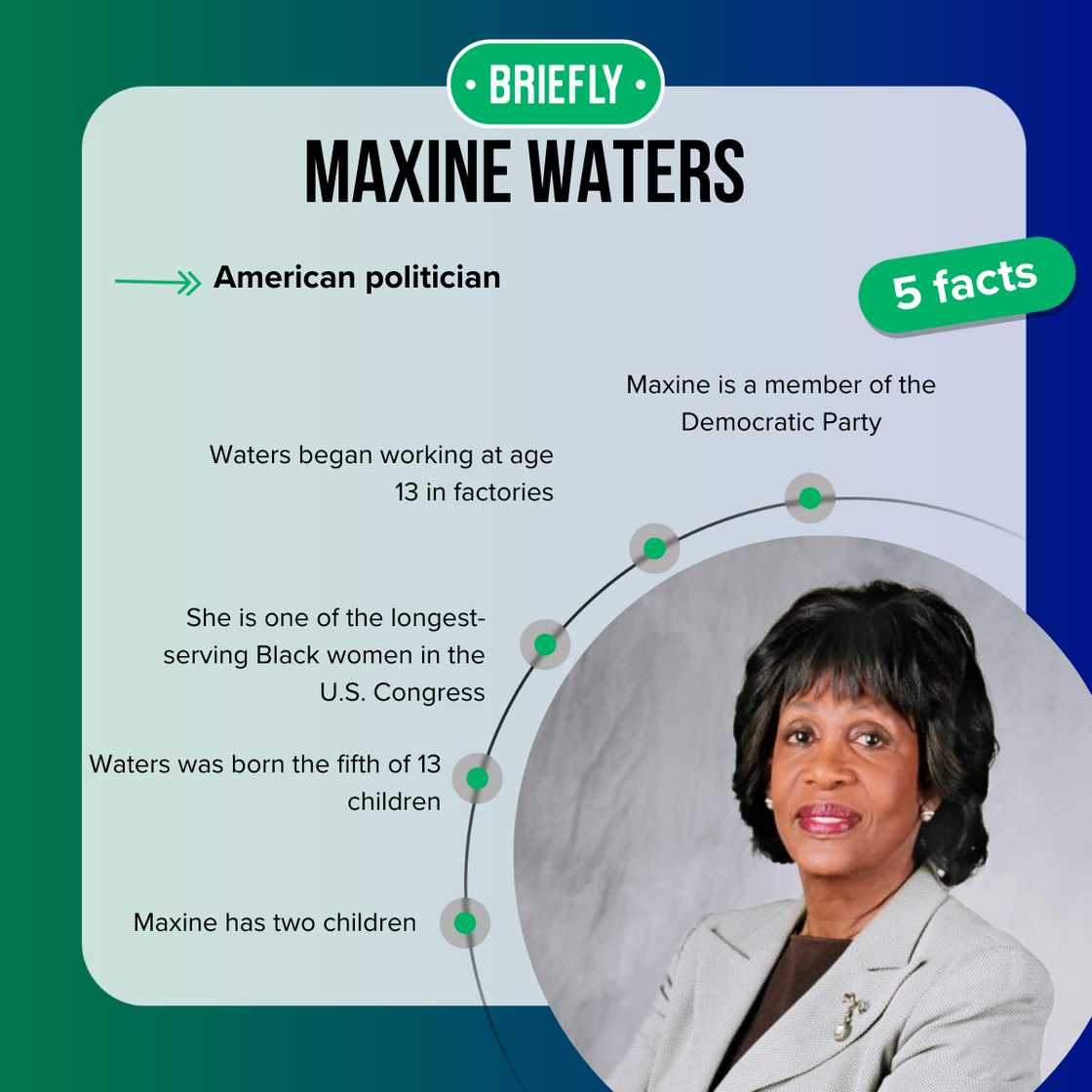
Maxine Waters (née Moore) was born in St. Louis, Missouri, in 1938, as one of 13 children raised by a single mother. Her early financial circumstances reflected those of a working-class family. After moving to Los Angeles, California, in 1961, Waters worked entry-level jobs in garment factories and as a telephone operator while raising her family.
In the late 1960s, she enrolled at California State University, Los Angeles, earning a Bachelor of Arts in Sociology. During this period, she accepted a position as a teacher and coordinator with the newly established Head Start program, a federal initiative focused on early childhood education for low-income families. Before entering elective politics, her income was tied entirely to public education and municipal community action programs.
Her financial profile began to evolve after her 1977 marriage to Edward "Sid" Williams, a former professional football player in the National Football League (NFL) who played for teams including the Cleveland Browns, Washington Redskins, and Baltimore Colts. Following his athletic career, Williams transitioned into commercial business, automotive dealership management, and political appointments, bringing private-sector compensation and pension assets into their joint household profile.
Transition to Elected Office: California State Assembly (1976–1990)
Waters stepped into full-time public service upon her election to the California State Assembly in 1976, representing the 48th District. State legislative salaries during the late 1970s and 1980s provided a steady, comfortable income, but were not inherently high-yield wealth generators.
During her 14-year tenure in Sacramento, the couple’s financial baseline expanded through dual household earnings and early investments in Southern California residential real estate. California's expanding real estate market during the 1980s provided foundational equity growth that laid the groundwork for future property acquisitions. By the end of her state legislative career in 1990, Waters and her husband had established a upper-middle-class financial footing characterized by public salaries, corporate consulting income, and growing real estate equity.
Entry into the U.S. House of Representatives (1990–Present)
In November 1990, Waters was elected to represent California's 29th Congressional District (later redistricted to the 35th and currently the 43rd District). She took office in January 1991, entering the federal legislative system where base salaries were substantially higher than state legislative pay at the time.
1991 Congressional Base Salary: $125,100 2000 Congressional Base Salary: $141,300 2009–Present Congressional Base: $174,000
Congressional salaries are established by federal statute. Since 2009, the base annual salary for rank-and-file members of the House of Representatives has remained frozen at $174,000. Although Waters has served in key leadership positions—most notably as Chair and Ranking Member of the House Financial Services Committee—committee leadership roles do not grant supplemental salary beyond the standard congressional rate, unlike the Speaker of the House or House Majority/Minority Leaders.
Consequently, official compensation alone accounts for a stable, high-income stream, but does not fully explain the multi-million-dollar valuation attributed to her household in contemporary financial profiles.
Key Drivers of Household Wealth Accumulation
The accumulation of household wealth over Representative Waters' multi-decade tenure in federal office can be categorized into three distinct primary vehicles: primary real estate holdings, spousal business income, and market investments.
1. Los Angeles Real Estate Value Growth
The single largest contributor to the financial profile of Maxine Waters and Sid Williams is residential real estate appreciation in Southern California.
In 2004, the couple purchased a 6,000-square-foot luxury home in the historic Hancock Park neighborhood of Los Angeles for approximately $1.4 million. Hancock Park is an affluent area situated outside the boundaries of the 43rd Congressional District, which Waters represents (federal law requires representatives to reside in the state they represent, but not necessarily within the specific district boundaries).
Over two decades, property values across Los Angeles experienced dramatic upward trajectories. Independent real estate valuations estimate the current market value of the Hancock Park residence between $4.5 million and $6 million+. Because real estate equity compounds independently of congressional compensation, this single asset accounts for a substantial portion of the high-end net worth estimates published by independent research bodies.
2. Spousal Income and Diplomatic Tenure
Sid Williams enjoyed a varied career that significantly influenced joint financial disclosures:
- NFL Pension: Pension benefits accrued from his professional football career.
- Diplomatic Service: From 1994 to 1998, Williams served as the U.S. Ambassador to the Bahamas under President Bill Clinton, a Senate-confirmed diplomatic position that provided executive-level federal compensation.
- Consulting and Business: Following his diplomatic appointment, Williams operated as an international business consultant and held interests in commercial ventures, including executive roles and representation for automotive dealerships.
3. Investment Portfolios and Disclosed Assets
Federal financial disclosures show that the couple maintains investments across broad-based mutual funds, money market accounts, and traditional retirement vehicles. Unlike some members of Congress who engage in active individual stock trading, Waters' disclosures reflect a more conservative asset structure primarily weighted toward cash reserves, standard funds, real estate equity, and deferred compensation plans.
Financial Disclosures vs. Public Net Worth Estimates
Evaluating the net worth of any federal elected official requires understanding the limitations of official government disclosure mechanisms established by the Ethics in Government Act of 1978.
Under House Ethics rules, members of Congress are required to file annual Financial Disclosure Reports detailing outside income, liabilities, and assets held by themselves, their spouses, and dependent children. However, these forms report values within broad broad ranges rather than precise dollar amounts:
- Range 1: $1,001 to $15,000
- Range 2: $15,001 to $50,000
- Range 3: $50,001 to $100,000
- Range 4: $100,001 to $250,000
- Range 5: $250,001 to $500,000
- Range 6: $500,000 to $1,000,000
- Range 7: $1,000,001 to $5,000,000
- Range 8: Over $50,000,000
Furthermore, House reporting rules explicitly exclude non-income-producing personal residences from mandatory disclosure listings. As a result, non-partisan transparency organizations like OpenSecrets (the Center for Responsive Politics) compute net worth estimates by calculating the midpoint of disclosed financial asset ranges and adding verified public record data for real estate holdings.
| Era / Career Phase | Primary Roles | Estimated Net Worth / Asset Baseline | Primary Wealth Drivers |
|---|---|---|---|
| Pre-1976 (Before Politics) | Head Start Teacher, Community Organizer | Modest (Working-class baseline) | Educator salary, personal savings |
| 1976–1990 (State Assembly) | CA State Assembly Member | Moderate Upper-Middle Class | Dual income (Assembly pay + NFL/business earnings), regional real estate equity |
| 1991–2003 (Early US Congress) | U.S. Representative | $500,000 – $1.5 Million | Congressional salary ($125K–$150K), diplomatic service income, investment growth |
| 2004–2018 (Mid/Late Congress) | U.S. Representative, Committee Leader | $2.0 Million – $4.5 Million | Hancock Park real estate acquisition (2004), market appreciation, spousal pensions |
| Contemporary Status | Senior U.S. Representative | $3.5 Million – $7.0 Million+ (Market adjusted) | Los Angeles real estate equity ($4M+ property value), liquid investments, federal/NFL retirement accounts |
Ethics Oversight, Inquiries, and Public Scrutiny
Throughout her decades in public office, Waters' financial activities and asset growth have faced political scrutiny and regulatory review.
The most notable inquiry occurred following the 2008 financial crisis. In 2010, the House Committee on Standards of Official Conduct (now the House Ethics Committee) investigated whether Waters had improperly assisted OneUnited Bank—a minority-owned financial institution in which her husband held stock valued between $250,000 and $500,000—in obtaining federal bailout funds through the Troubled Asset Relief Program (TARP).
Waters maintained that her actions were consistent with her broad advocacy for minority-owned financial institutions and that she had requested meetings on behalf of an association of banks rather than OneUnited specifically. After an extensive multi-year investigation involving an independent counsel, the House Ethics Committee cleared Waters of all ethics violations in 2012, concluding that she believed in good faith she was acting on behalf of small banks generally and that her Chief of Staff had handled specific inquiries without her direct authorization.
Critics often point to the location and value of her Hancock Park home to contrast her personal wealth with the economic conditions of her congressional district, which includes communities such as Watts, Inglewood, and Gardena. Supporters and independent analysts counter that geographic real estate trends in Southern California affect all long-term property owners similarly and that her financial trajectory reflects standard long-term real estate equity accumulation rather than improper financial gain.
How to Verify Federal Financial Disclosures
Citizens interested in auditing the financial disclosures of Representative Maxine Waters or any other member of Congress can access official records directly through federal databases and independent transparency tools:
- U.S. House of Representatives Financial Disclosure Database: The Office of the Clerk hosts searchable PDF files of all annual disclosures, amendments, and periodic transaction reports filed under the Stop Trading on Congressional Knowledge (STOCK) Act.
- OpenSecrets (Center for Responsive Politics): Maintains a non-partisan database compiling congressional net worth trends, calculating minimum, maximum, and average estimates based on statutory report brackets.
- Office of Congressional Ethics (OCE): Provides public reports regarding completed ethics reviews, board findings, and referral documentation.
Summary of Financial Trajectory
Maxine Waters' financial profile demonstrates a clear transition from working-class educator before entering public office in 1976 to a multi-millionaire member of Congress in contemporary disclosures. This growth was not instantaneous upon taking office. Instead, it occurred over nearly five decades of continuous dual-earner income, federal executive and legislative salaries, private business activities of her spouse, and, most significantly, the appreciation of historic Los Angeles residential real estate.
Frequently Asked Questions
What was Maxine Waters' net worth before entering politics?
Before her 1976 election to the California State Assembly, Maxine Waters maintained a modest working-class financial background. She worked as an educator and volunteer coordinator with the Head Start program. Her household baseline began rising following her 1977 marriage to Sid Williams, a former NFL player who transitioned into commercial business management.
What is Maxine Waters' current estimated net worth?
Independent estimates place Representative Maxine Waters' household net worth between $3.5 million and $7 million. The wide range is due to federal reporting rules, which categorize assets in broad monetary bands rather than exact amounts, and variations in real estate market evaluations for her personal home.
How much does Maxine Waters earn as a member of Congress?
Representative Waters earns a standard base salary of $174,000 per year as a member of the U.S. House of Representatives. Congressional salaries for rank-and-file members and committee leaders have remained set at this level by federal law since 2009.
Does Maxine Waters live in the congressional district she represents?
Her primary residence is located in Hancock Park, an affluent neighborhood in Los Angeles situated outside the geographic borders of California's 43rd Congressional District. The U.S. Constitution requires members of the House of Representatives to reside in the state they represent, but does not legally mandate that they live within their specific district boundaries.
Did Maxine Waters make her money from stock trading?
No. Unlike some members of Congress who actively trade individual equities while in office, financial disclosures for Maxine Waters and her husband show a conservative investment strategy primarily focused on cash accounts, mutual funds, federal pensions, NFL retirement benefits, and real estate.
Image Gallery