Navigating the Landscape of Expert iOS Developers in 2026
Building modern, high-performance applications for Apple's ecosystem requires specialized engineering talent capable of leveraging advanced frameworks, strict security protocols, and evolving hardware capabilities. As the mobile landsc...
Building modern, high-performance applications for Apple's ecosystem requires specialized engineering talent capable of leveraging advanced frameworks, strict security protocols, and evolving hardware capabilities. As the mobile landscape standardizes around Swift, SwiftUI, and advanced on-device machine learning through CoreML, hiring expert iOS developers demands a precise understanding of technical depth, architecture patterns, and lifecycle management. Whether scaling an enterprise application or launching a venture-backed startup product, identifying top-tier engineering talent is the single most critical factor in achieving seamless performance, App Store approval, and long-term maintainability.
Contents
The Evolution of iOS Engineering Standards
Modern iOS development has moved far beyond basic UIKit implementations. In 2026, the baseline expectation for an expert developer includes deep proficiency in declarative UI frameworks, asynchronous programming paradigms, and resource-efficient memory management. Apple silicon optimization requires engineers who understand low-level hardware interactions to ensure that applications remain responsive while conserving battery life and minimizing thermal throttling.
- Swift and SwiftUI Mastery: Complete fluency in modern Swift language features, including actors, async/await concurrency, macros, and advanced generics, combined with declarative UI state management in SwiftUI.
- Architecture Patterns: Rigorous application of scalable design patterns such as MVVM, TCA (The Composable Architecture), and Clean Architecture to ensure testability and modularity.
- Performance Profiling: Expert utilization of Instruments to detect memory leaks, retain cycles, excessive main-thread work, and rendering bottlenecks.
- Security Compliance: Implementation of secure data storage via Keychain, biometric authentication using LocalAuthentication, and robust network security configurations via App Transport Security (ATS) and Certificate Pinning.
Evaluating Technical Competencies and Specializations
When assessing engineering talent, technical interviews must go beyond basic syntax questions to evaluate system design capabilities and practical problem-solving in complex codebases. Expert iOS developers distinguish themselves through their ability to integrate native APIs seamlessly while maintaining clean, decoupled code architectures.
Technical Assessment Focus: Senior engineers must demonstrate a thorough comprehension of memory management mechanics, specifically ARC (Automatic Reference Counting) and the avoidance of strong reference cycles in closures and delegates. Furthermore, they should exhibit deep familiarity with Combine and modern concurrency models to handle complex data streams gracefully.
Core Technical Pillars Matrix
| Technical Area | Junior/Mid-Level Focus | Expert iOS Developer Standard |
|---|---|---|
| UI Frameworks | Basic UIKit layouts and storyboards. | Advanced SwiftUI state flows, custom property wrappers, and UIKit interoperability. |
| Concurrency | Completion handlers and basic Grand Central Dispatch (GCD). | Structured concurrency, actors, async/await, and thread-safe data isolation. |
| Data Persistence | Simple UserDefaults and basic CoreData usage. | Optimized CoreData stack design, SwiftData migrations, and encrypted local databases. |
| Testing Strategies | Basic unit tests for view controllers. | Comprehensive test suites including XCTest, UI testing, snapshot testing, and mock service layers. |
Alternative Engagement Models for iOS Talent
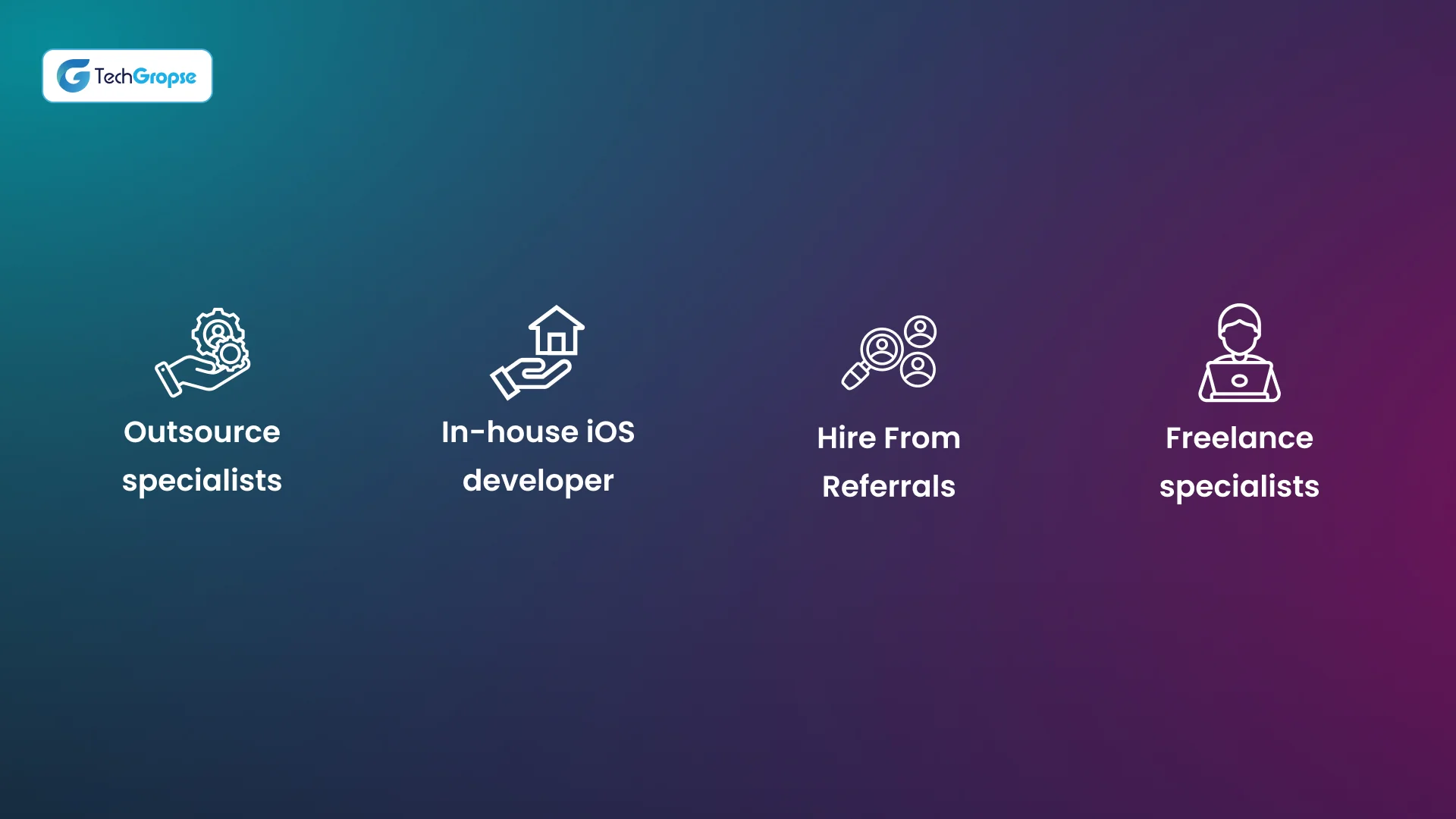
Organizations seeking elite mobile engineering resources must choose between hiring full-time internal staff, engaging specialized software development agencies, or contracting elite independent consultants. Each engagement model carries distinct financial, operational, and structural implications.
- In-House Engineering Teams: Best for long-term product roadmaps, deep institutional knowledge retention, and continuous iterative development. However, recruitment cycles can be lengthy and expensive.
- Specialized Development Agencies: Ideal for rapid time-to-market execution, fixed-scope modernization projects, or instances requiring multidisciplinary teams including UI/UX design and QA automation.
- Independent Senior Contractors: Offers flexible scaling for specific architectural overhauls or migration projects, though it requires robust internal technical leadership to manage deliverables effectively.
Step-by-Step Guide to Hiring and Onboarding Elite iOS Talent
Securing top-tier engineering talent requires a structured evaluation pipeline that measures both raw technical capability and cultural alignment. Rushing the hiring process often leads to architectural debt that becomes exponentially expensive to refactor later.
- Define Scope and Technical Stack: Outline the exact framework requirements, third-party integrations, and performance benchmarks necessary for the application before drafting job descriptions.
- Conduct Code Review Assessments: Instead of abstract whiteboard algorithm tests, evaluate candidates on real-world pull request reviews or architectural refactoring exercises.
- Evaluate System Design Capabilities: Require candidates to design a complete client-server application architecture, addressing edge cases such as offline synchronization, push notification handling, and secure token refresh mechanisms.
- Verify App Store Track Record: Inspect previously shipped applications on the App Store to evaluate user interface fluidity, crash rates, and adherence to Apple Human Interface Guidelines.
- Establish Onboarding and Sandbox Projects: Provide new hires with a controlled environment to build a small feature module, ensuring they adhere to the team's style guides, CI/CD pipelines, and testing protocols.
Pros and Cons of In-House Hiring vs. External Agencies
| Approach | Advantages | Disadvantages |
|---|---|---|
| In-House Full-Time Hiring | Deep dedication to product vision; direct control over priorities; institutional memory retention. | High overhead costs (benefits, hardware, taxes); lengthy recruitment timelines. |
| External Specialist Agency | Immediate availability; diverse skill sets (design, QA, backend); flexible scaling. | Potential communication overhead; dependency on external vendor management. |
Frequently Asked Questions
What programming languages and frameworks are essential for expert iOS developers today?
Expert iOS developers must have deep mastery of modern Swift and SwiftUI, alongside legacy proficiency in Objective-C and UIKit for older enterprise codebases. They must also be fluent in Combine, SwiftData, and advanced asynchronous programming APIs.
How do expert iOS developers ensure optimal app performance and battery efficiency?
They utilize Xcode Instruments to monitor CPU usage, memory allocations, and network overhead, ensuring that background tasks are properly scheduled and UI rendering remains consistently at 60 or 120 frames per second.
What is the difference between hiring a freelance iOS developer and an engineering agency?
Freelancers offer dedicated focus on a per-project or hourly basis, best suited for targeted feature work, whereas agencies provide complete multidisciplinary teams capable of end-to-end product delivery from design to deployment.
How do senior developers handle App Store submission and review rejections?
Senior engineers maintain strict adherence to Apple Human Interface Guidelines and privacy protocols, utilizing automated CI/CD pipelines to manage provisioning profiles, certificates, and metadata to streamline the review process.
Why is architectural pattern selection critical in large-scale iOS applications?
Proper architectural patterns like MVVM or TCA prevent massive view controller bloat, isolate business logic from UI rendering, and make unit testing significantly easier as the codebase scales.
Partnering with seasoned engineering professionals ensures your mobile product remains secure, performant, and aligned with Apple's latest technological advancements. Secure elite iOS development talent today to transform your digital vision into a robust, scalable market reality.
Image Gallery