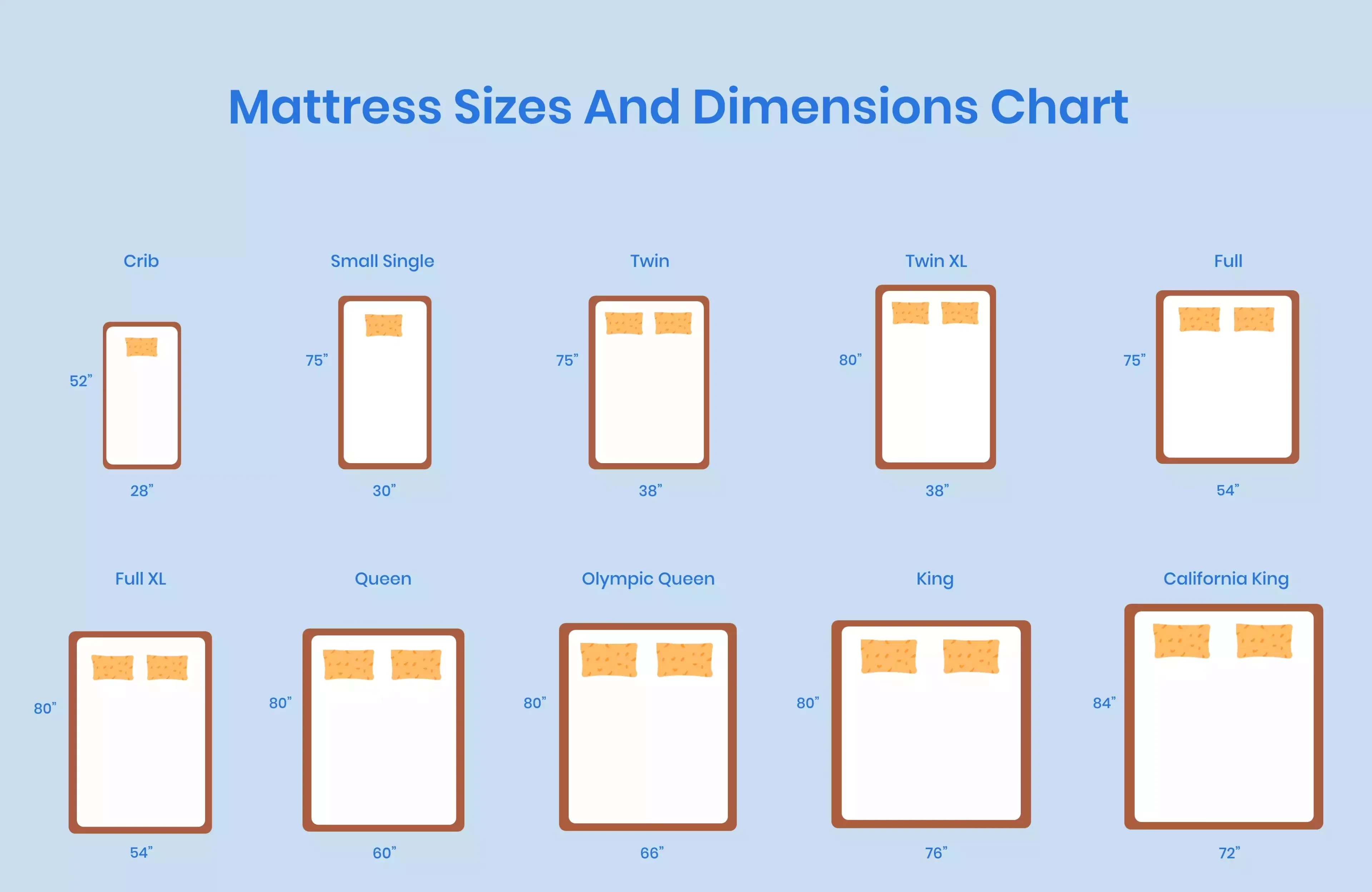
Standard US King Size Mattress Dimensions and Sizing Guide
A standard US king size mattress measures 76 inches wide by 80 inches long (193 cm wide by 203 cm long). Often referred to as an Eastern King, it offers 6,080 square inches of surface area, giving couples 38 inches of individual sleepi...
A standard US king size mattress measures 76 inches wide by 80 inches long (193 cm wide by 203 cm long). Often referred to as an Eastern King, it offers 6,080 square inches of surface area, giving couples 38 inches of individual sleeping space each—the exact width of a standard Twin XL mattress.
Contents
Standard US King Mattress Dimensions
When evaluating mattress dimensions in the United States, the standard king size represents the widest traditional option available on the residential market. It is engineered to accommodate couples, co-sleeping families, or individuals who require maximum personal space during sleep.
| Measurement Unit | Width | Length | Total Surface Area |
|---|---|---|---|
| Inches | 76 in | 80 in | 6,080 sq in |
| Feet | 6 ft 4 in | 6 ft 8 in | 42.22 sq ft |
| Centimeters | 193 cm | 203 cm | 3.92 sq m |
The 76-inch width provides substantial lateral separation between sleepers. For comparison, a standard queen mattress provides only 30 inches of width per person, while a full (double) mattress provides just 27 inches per person. The additional width of a standard king minimizes motion transfer disruptions between partners and provides ample room for pet owners or parents with young children.
Depth, or thickness, is not standardized across the mattress industry. A US king mattress can range from 8 inches for basic foam models to upwards of 16 to 18 inches for luxury pillow-top or hybrid designs. While depth does not alter the surface footprint (76" x 80"), it dictates the pocket depth required for fitted sheets and affects the total aesthetic height when paired with a bed frame and foundation.
US King Mattress Size Comparisons
Understanding how a standard US king compares to alternative mattress dimensions helps ensure proper spatial planning, bedroom design, and bedding purchasing decisions.
- Standard US King Dimensions:
- Width: 76 inches wide (193 cm)
- Length: 80 inches long (203 cm)
Standard King vs. California King
The most common point of confusion in mattress selection is the difference between a standard US King (Eastern King) and a California King (Western King).
- Standard US King (76" x 80"): Four inches wider and four inches shorter than a California King. It prioritizes lateral room, making it ideal for broader individuals, couples who like space, or families who co-sleep.
- California King (72" x 84"): Four inches narrower and four inches longer than a standard King. It prioritizes legroom, making it the preferred choice for individuals over 6 feet 2 inches tall or for narrower, longer master bedrooms.
Despite popular belief, a standard King actually provides slightly more total surface area (6,080 square inches) than a California King (6,048 square inches).
Standard King vs. Queen
A standard Queen mattress measures 60 inches wide by 80 inches long. Both King and Queen mattresses share the exact same length (80 inches / 6 feet 8 inches), meaning legroom is identical. However, the King offers an additional 16 inches of width. This extra width expands personal sleep territory from 30 inches per person to 38 inches per person.
Oversized King Mattress Variations
For primary suites that exceed standard residential square footage, specialized oversized king dimensions exist outside the standard US bedding sizing system:
- Wyoming King (84" x 84"): A square mattress adding 8 inches of width and 4 inches of length over a standard King.
- Texas King (80" x 98"): Adds 4 inches of width and 18 inches of length over a standard King, designed primarily for exceptionally tall individuals in expansive bedrooms.
- Alaskan King (108" x 108"): A 9-foot by 9-foot square mattress offering maximum surface space for multi-child or multi-pet families.
Standard US Mattress Size Comparison Chart
The following table summarizes standard US mattress sizes, their dimensions, minimum room requirements, and primary target users:
| Mattress Size | Dimensions (Inches) | Dimensions (Centimeters) | Minimum Recommended Room Size | Primary Best Fit |
|---|---|---|---|---|
| Twin | 38" x 75" | 96.5 x 190.5 cm | 7' x 10' (70 sq ft) | Single children, bunk beds, daybeds |
| Twin XL | 38" x 80" | 96.5 x 203 cm | 7' x 10' (70 sq ft) | College dormitories, tall single adults |
| Full (Double) | 53" x 75" | 134.5 x 190.5 cm | 10' x 10' (100 sq ft) | Single adults, guest rooms, teenagers |
| Queen | 60" x 80" | 152.5 x 203 cm | 10' x 12' (120 sq ft) | Single adults, couples in standard bedrooms |
| Standard King (US) | 76" x 80" | 193 x 203 cm | 12' x 12' (144 sq ft) | Couples wanting max width, co-sleeping |
| California King | 72" x 84" | 183 x 213 cm | 12' x 12' (144 sq ft) | Tall sleepers (over 6'2"), longer rooms |
| Split King | 76" x 80" (2x 38"x80") | 193 x 203 cm | 12' x 12' (144 sq ft) | Couples with different comfort preferences |
The Split King Mattress Setup
A Split King setup consists of two individual Twin XL mattresses placed side by side on a shared or dual bed frame. Because a single Twin XL measures 38 inches wide by 80 inches long, placing two together creates a combined footprint of 76 inches wide by 80 inches long—matching a standard US King identically.
Benefits of a Split King
- Independent Adjustable Bases: Each partner can raise or lower their side of the head and foot without affecting the other sleeper.
- Customized Firmness: Partners can select completely different mattress constructions (e.g., firm memory foam on one side, soft hybrid on the other) while retaining a unified exterior footprint.
- Reduced Motion Transfer: Separate internal core structures prevent motion from traveling across the center seam.
- Easier Maneuverability: Transporting two Twin XL mattresses around tight stairwells and narrow door frames is significantly easier than moving a single, rigid 76" x 80" block.
Bedding Requirements for Split Kings
A Split King requires specific bedding layering:
- Fitted Sheets: Two separate Twin XL fitted sheets (38" x 80").
- Flat Sheet & Comforter: One standard King flat sheet and one standard King comforter or duvet to cover both beds seamlessly.
- Mattress Protector: Two Twin XL protectors, or a specialized Split King connector pad if a solid surface feel across the center divide is desired.
Minimum Room Size and Spatial Planning
Installing a standard US king size mattress requires thoughtful spatial evaluation to ensure functional walking paths and room balance.
Recommended Bedroom Dimensions
- Optimal Room Size: 12 feet by 12 feet (144 square feet) or larger. This provides ample perimeter clearance for nightstands, dressers, and door swings.
- Absolute Minimum Room Size: 10 feet by 12 feet (120 square feet). In a 10x12 room, a 76-inch-wide mattress takes up nearly two-thirds of the 10-foot wall, leaving less than 22 inches on each side for nightstands and walking space.
- Bedroom Spatial Layout (12 ft / 144 in x 12 ft / 144 in):
- Headboard Wall:
- Nightstand: 24 in
- King Bed Width: 76 in
- Bed Length: 80 in
- Walkway Space: 36 in
- Opposite Wall: Dresser / TV Stand
- Headboard Wall:
Clearance and Traffic Flow Guidelines
Architectural ergonomics recommend maintaining a minimum clearance of 30 to 36 inches between the edge of the mattress and any adjacent wall, dresser, or doorway.
When calculating space, factor in the following dimensions:
- Bed Frame Overhang: Sleek platform frames add 1 to 2 inches to overall dimensions. Upholstered sleigh beds, headboards, and thick footboards can add 4 to 10 inches to total width and length.
- Nightstand Allocation: Standard nightstands measure between 20 and 28 inches in width. To place two nightstands alongside a 76-inch King mattress, the headboard wall should measure at least 11 feet (132 inches) wide.
- Door Swings and Closet Clearance: Ensure bedroom entry doors and closet doors can open fully without hitting the corner of the bed frame.
Accessories, Foundations, and Delivery Logistics
Buying a standard US king mattress involves specific practical considerations regarding bed foundations, sheet depths, and home delivery access.
Box Springs and Foundations: Split Configuration
Due to door frames, interior hallways, and staircases, solid one-piece king foundations cannot be moved into standard residential homes. Consequently, all standard US king box springs and slatted foundations are shipped as a Split King foundation set.
A split foundation consists of two identical boxes measuring 38 inches wide by 80 inches long each. Placed side-by-side on a heavy-duty bed frame, they provide rigid, uniform support for a single standard 76" x 80" king mattress.
Selecting Accessories and Bedding
When purchasing bedding, pay close attention to mattress profile height (depth):
- Standard Pocket Sheets: Fit mattresses up to 12 inches deep.
- Deep Pocket Sheets: Fit mattresses measuring 13 to 17 inches deep.
- Extra-Deep Pocket Sheets: Required for pillow-top hybrids measuring 18 to 22 inches deep.
Using standard-depth fitted sheets on a thick pillow-top king mattress causes the corners to pop off during sleep. Always measure mattress thickness from the base seam to the crown of the top surface before choosing accessories.
Delivery Navigation and Logistics
Before taking delivery of a solid (non-bed-in-a-box) king mattress, measure all delivery pathways:
- Entryway door height and width (standard US exterior doors are 36 inches wide).
- Stairway width, ceiling clearance, and landing turns.
- Interior hallway turns and doorway frames (standard interior doors range from 30 to 32 inches).
All-foam and bed-in-a-box hybrid models arrive compressed inside a box measuring roughly 20" x 20" x 44", making initial navigation through tight quarters straightforward. However, once unboxed and expanded, a traditional king mattress weighs between 100 and 180 pounds, requiring two adults to maneuver safely.
Frequently Asked Questions
What is the exact size of a standard US king size mattress?
A standard US king size mattress measures 76 inches wide by 80 inches long (193 cm by 203 cm). It is the widest standard residential mattress size available in the United States.
Is an Eastern King the same as a standard US King?
Yes. "Eastern King" is simply another common trade name for a standard US king size mattress (76" x 80"). The term was historically used to distinguish it from the "Western King," which is widely known today as the California King (72" x 84").
Can you put a standard King mattress on a California King frame?
No. A standard US King is 76 inches wide by 80 inches long, while a California King frame is 72 inches wide by 84 inches long. Putting a standard King on a California King frame will cause the mattress to overhang the sides by 2 inches on each edge, while leaving a 4-inch gap at the foot or head of the frame.
Do two Twin XL beds equal a standard US King?
Yes. A Twin XL mattress measures 38 inches wide by 80 inches long. Placing two Twin XL mattresses side-by-side yields total dimensions of 76 inches wide by 80 inches long, which exactly matches a standard US King mattress.
What size room is best for a king size bed?
A room size of at least 12 feet by 12 feet (144 square feet) is recommended for a standard US king bed. This provides sufficient room for a 76" x 80" bed frame, two nightstands, a dresser, and comfortable walking clearance around the perimeter.
Are all king size fitted sheets the same size?
No. While standard king fitted sheets feature a top surface area designed for 76" x 80" mattresses, pocket depths vary significantly. Standard fitted sheets accommodate mattress depths up to 12 inches, whereas deep-pocket and extra-deep-pocket sheets are built to cover mattresses measuring between 13 and 22 inches in thickness.
Next Steps for Buyers
To ensure a seamless purchase and setup of a standard US king size mattress, follow these practical steps:
- Measure Your Wall Space: Confirm that your headboard wall is at least 11 to 12 feet long to comfortably accommodate the 76-inch mattress width alongside two nightstands.
- Verify Delivery Access: Measure stairwells, door widths, and tight hall corners along the pathway to your primary bedroom, especially if purchasing a traditional, non-compressible innerspring mattress.
- Select the Right Foundation: Ensure your bed frame features center support legs that reach the floor. Standard king mattresses require central structural reinforcement to prevent sagging over time.
- Confirm Accessory Depths: Measure the total height of the mattress (including any added toppers) to purchase fitted sheets with appropriate pocket depths.
Image Gallery