How to Compare Auto Insurance Quotes in Salinas
Comparing auto insurance quotes in Salinas involves gathering your specific driver information, determining your desired coverage levels, and systematically evaluating premium offers from multiple providers to ensure you meet Californi...
Comparing auto insurance quotes in Salinas involves gathering your specific driver information, determining your desired coverage levels, and systematically evaluating premium offers from multiple providers to ensure you meet California’s state-mandated financial responsibility laws while securing sufficient personal protection. By utilizing standardized forms and verifying the standing of insurers through state regulators, you can navigate the competitive market to find a policy that balances cost with necessary coverage.
Contents
Understanding California Insurance Requirements
Before you begin comparing quotes, it is essential to understand the legal floor for auto insurance in California. The California Department of Insurance (CDI) mandates that all drivers maintain proof of financial responsibility. For most private passenger vehicles, this means carrying at least:
- $15,000 for injury or death to one person per accident.
- $30,000 for injury or death to more than one person per accident.
- $5,000 for damage to property.
These are referred to as 15/30/5 limits. However, relying solely on these minimums may leave you personally liable for damages exceeding these amounts, which is a common risk in a high-traffic urban environment like Salinas. When comparing quotes, ensure each provider is quoting for the same coverage levels so your price comparison remains accurate. If you choose to increase your limits—often recommended by financial experts—ensure that every company you evaluate provides an identical quote for those higher limits to allow for an "apples-to-apples" comparison.
Preparing Your Documentation
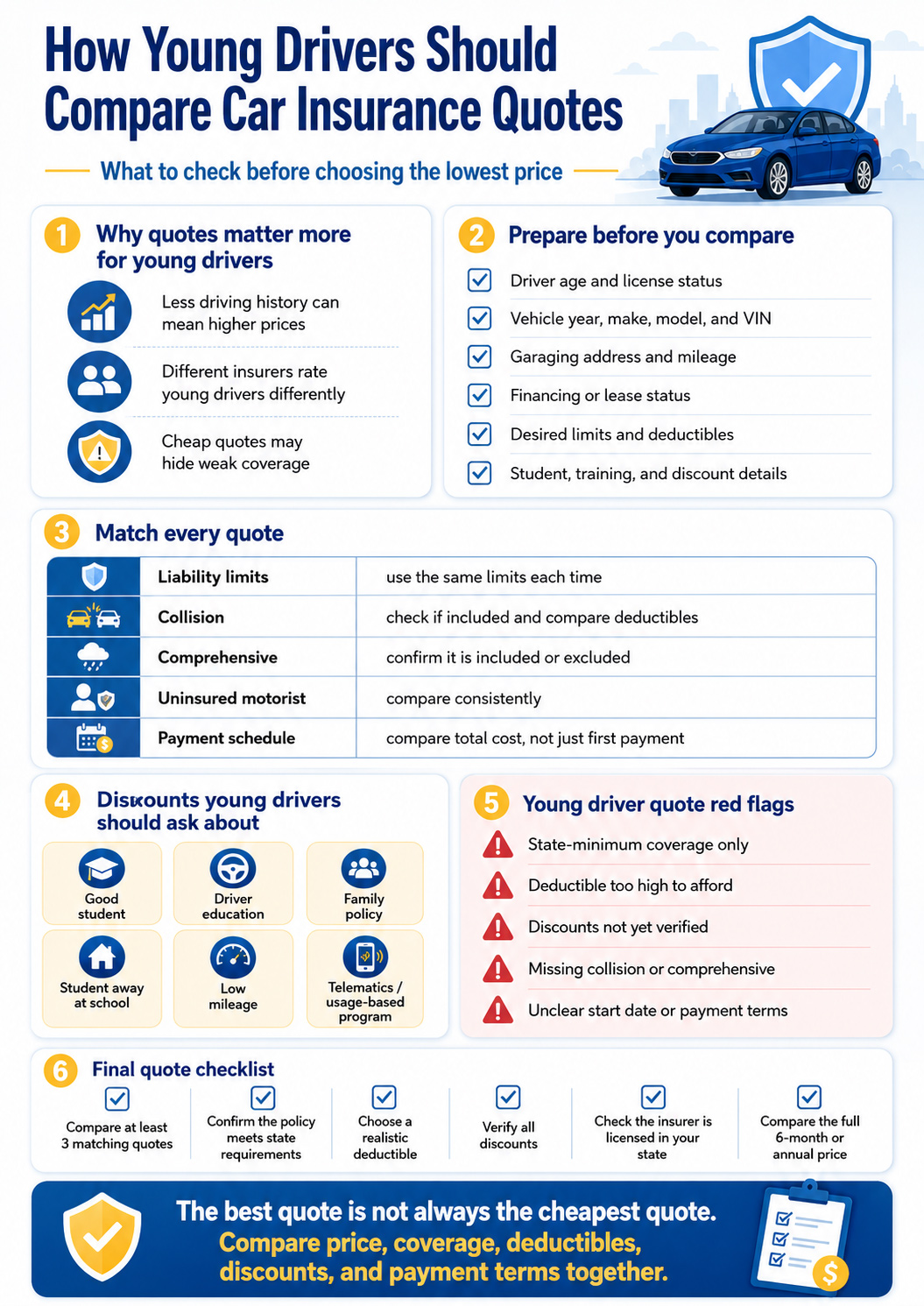
Insurance carriers use sophisticated algorithms to calculate risk, which determines your premium. To get an accurate quote, you must provide consistent information to every insurer. Before you start, gather the following:
- Vehicle Information: The Vehicle Identification Number (VIN), make, model, year, and annual estimated mileage for all vehicles you intend to insure.
- Driver History: A list of all traffic violations, accidents, or claims filed within the last three to five years for every licensed driver in your household.
- Current Policy Declarations: A copy of your current policy’s "Declarations Page," which details your existing limits, deductibles, and discounts. This serves as your baseline for comparison.
- Coverage Preferences: Decide in advance whether you require comprehensive and collision coverage, as well as your preferred deductible amounts—the portion of a claim you agree to pay out of pocket.
The Systematic Comparison Process
The most effective way to compare quotes is to dedicate a single session to data entry. Avoid using a single website to get one quote; instead, leverage the process to reach out to at least three different types of insurers: a direct-to-consumer online company, an independent agent who represents multiple brands, and a traditional captive agent.
Step-by-Step Methodology
- Select Your Carriers: Choose a mix of national carriers and regional providers that serve Monterey County.
- Standardize Inputs: Enter your data into each portal or provide it to the agent exactly the same way. Changing a ZIP code or altering your estimated mileage mid-process will invalidate your comparison.
- Request Quotes for Multiple Deductibles: If a carrier allows, ask for quotes at both a $500 and $1,000 deductible level. This helps you determine if the lower premium of a higher deductible is worth the potential out-of-pocket cost during a claim.
- Verify Licensing: Ensure the company is licensed to do business in California by searching their name in the CDI database. This prevents you from inadvertently engaging with unlicensed entities.
- Review Sample Policies: Ask for a sample policy contract to review the fine print regarding "actual cash value" versus "replacement cost" and specific exclusions for Salinas-specific road conditions or hazards.
Comparative Factors in Salinas
When reviewing your results, look beyond the base premium. The following table highlights key variables that often cause discrepancies in quoted prices between providers.
| Factor | Impact on Premium | Why It Matters |
|---|---|---|
| Deductible | Inverse | Higher deductibles lower your monthly premium but increase your risk. |
| Policy Limits | Direct | Higher liability limits provide better protection but raise the cost. |
| Vehicle Safety Tech | Reduction | Modern safety features can qualify for specific discounts. |
| Garaging Address | Varies | Your specific neighborhood in Salinas influences crime and accident rates. |
| Bundling | Reduction | Pairing auto with homeowners or renters insurance often triggers discounts. |
Assessing Insurer Reliability
The lowest price is not always the best value. When comparing quotes, it is critical to evaluate the claims-paying reputation of the insurer. Since 2026 guidelines emphasize transparency, you should check the NAIC (National Association of Insurance Commissioners) complaint index for each company you are considering. A company with a lower-than-average complaint index suggests that their claims processing and customer service departments operate with higher efficiency and fairness.
Additionally, pay close attention to "gap insurance" offerings. If you are financing a newer vehicle, standard insurance may only pay the current market value of your car if it is totaled. If you owe more on your loan than the car is worth, gap insurance covers that difference. Not all insurers include this or offer it as an add-on, making it a critical differentiator during your comparison process.
Common Mistakes to Avoid
Many drivers fall into traps that result in misleading comparisons or inadequate coverage. One common mistake is failing to disclose all drivers in the household. Insurance premiums are calculated based on the risk profile of everyone who has access to the vehicle; omitting a teenager or a roommate can lead to a denial of a claim later.
Another error is ignoring "non-owner" or "uninsured motorist" coverage. In areas with high traffic density, being hit by an uninsured driver is a statistically significant risk. Ensure that your quote includes Uninsured Motorist Bodily Injury (UMBI) and Uninsured Motorist Property Damage (UMPD) coverage, as these are often optional but highly recommended.
Finally, do not blindly accept the initial quote. Once you have a list of premiums, call the companies that provided the best offers. Ask explicitly: "Are there any other discounts I might qualify for?" You may be eligible for reductions based on professional affiliations, defensive driving courses, or low-annual-mileage programs that were not captured in the online quote tool.
Next Actions
To finalize your search:
- Summarize findings: Create a spreadsheet of the three best quotes, detailing premium, limits, deductibles, and discount types.
- Verify financial strength: Look up the AM Best rating for your top two choices to ensure the company is financially stable enough to pay out large claims.
- Initiate the change: Once you select a policy, contact your current insurer to verify if there are any cancellation fees before activating your new policy to prevent a lapse in coverage.
Image Gallery