Workers Compensation Including Employers Liability: Essential Key Facts for 2026
Workers' compensation provides no-fault medical and wage benefits to injured employees, while employers' liability protects businesses against lawsuits alleging negligence related to workplace injuries. In 2026, these coverages are gen...
Workers' compensation provides no-fault medical and wage benefits to injured employees, while employers' liability protects businesses against lawsuits alleging negligence related to workplace injuries. In 2026, these coverages are generally bundled in a single policy to provide comprehensive protection against statutory claims and common law litigation risks.
Contents
Understanding the Dual Nature of the Policy
To understand workers' compensation (WC) in 2026, one must view it as a two-part shield for business owners. While the terms are often used interchangeably, they represent distinct legal protections that work in tandem to mitigate the financial impact of workplace accidents.
Part One: Workers' Compensation (Statutory)
The first part of a standard policy is the statutory workers' compensation coverage. This is a "no-fault" system. Under this arrangement, an employee does not have to prove the employer was negligent to receive benefits. If the injury occurred "out of and in the course of employment," the insurance pays for medical expenses, a portion of lost wages, vocational rehabilitation, and death benefits to survivors.
The trade-off for this no-fault system is known as the exclusive remedy doctrine. By accepting these benefits, the employee generally gives up their right to sue the employer for the injury. This provides predictable costs for the employer and immediate support for the worker.
Part Two: Employers' Liability (Tort-Based)
The second part of the policy is the employers' liability (EL) section. This covers the gaps where the exclusive remedy doctrine might not apply. Unlike Part One, EL is "fault-based." For a claim to be paid here, the employee (or a third party) must prove that the employer's negligence caused the injury.
In 2026, EL remains critical because it covers legal defense costs and settlements for lawsuits that fall outside the scope of statutory workers' compensation. This includes claims for "consequential bodily injury" to family members or "third-party over" actions where another company sued by your employee seeks indemnification from you.
Key Facts Regarding Coverage Requirements in 2026
As of 2026, the legal requirements for carrying workers' compensation and employers' liability are stringent across most jurisdictions. Understanding who must be covered and what constitutes "employment" is the first step in compliance.
Mandatory Coverage Thresholds
In the United States, nearly every state requires businesses with at least one employee to carry workers' compensation. While some states previously allowed exemptions for very small headcounts (e.g., fewer than three employees), the trend in 2026 has moved toward universal coverage to ensure social safety nets remain intact.
Failure to carry coverage can lead to severe consequences, including:
- Stop-work orders: Regulators may shut down operations until proof of insurance is provided.
- Civil penalties: Fines can reach thousands of dollars per day of non-compliance.
- Personal liability: In many jurisdictions, business owners can be held personally liable for an injured worker's medical bills if the company is uninsured.
The Evolution of Remote and Hybrid Work Claims
A significant development in 2026 is the stabilization of rules regarding remote work. If an employee is injured while working from home, the "arising out of employment" test still applies. Employers are increasingly required to provide guidelines for home office ergonomics, as courts have frequently ruled that home-based injuries occurring during work hours are compensable under workers' compensation.
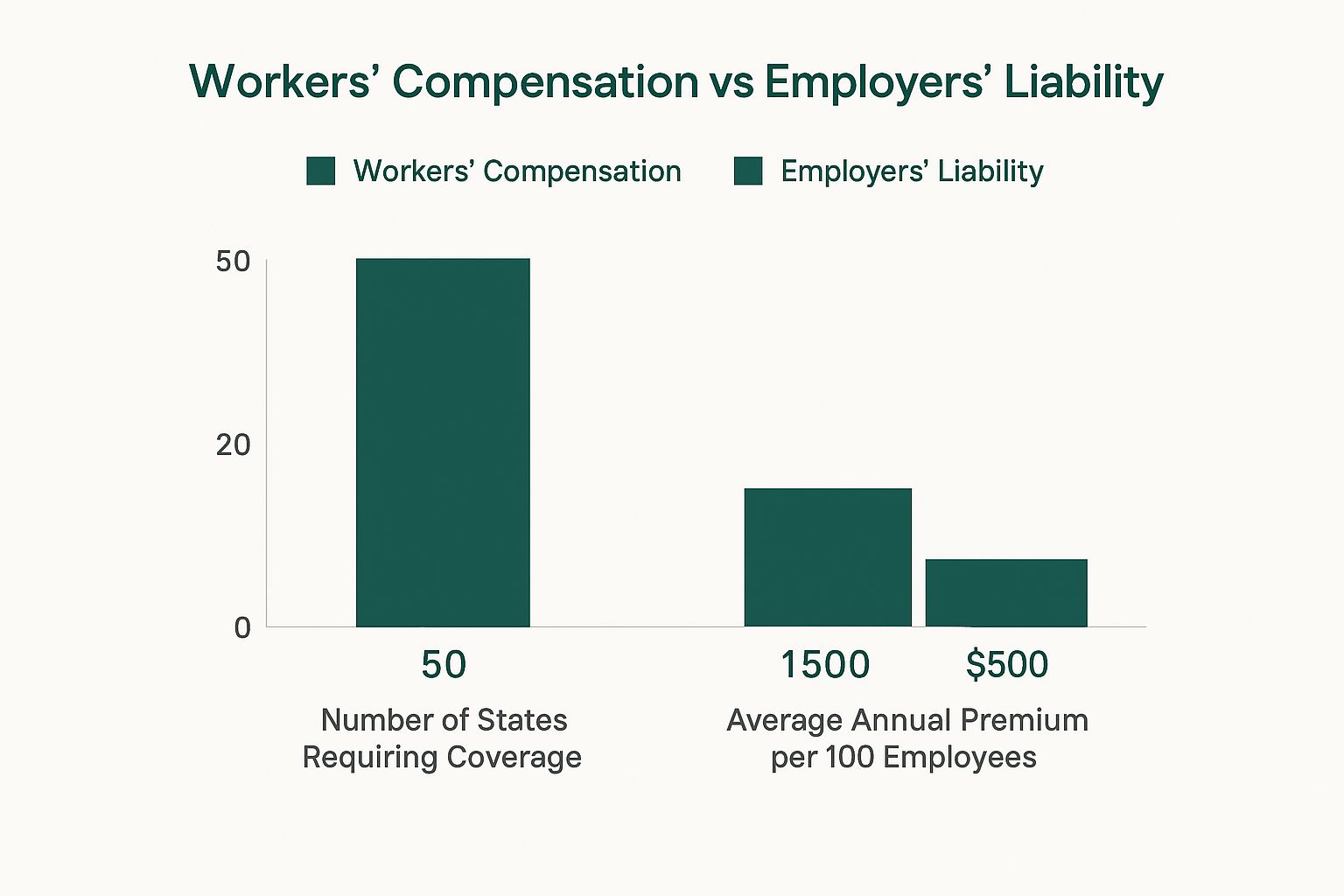
Comparison of Workers' Compensation vs. Employers' Liability
It is helpful to visualize how these two components differ in practice. The following table outlines the primary distinctions between Part One and Part Two of a standard policy.
| Feature | Workers' Compensation (Part 1) | Employers' Liability (Part 2) |
|---|---|---|
| Basis of Claim | Statutory / No-Fault | Negligence / Tort-Based |
| Benefit Limits | Mandated by state law (No policy limit) | Stated in the policy (e.g., $500,000) |
| Legal Defense | Not typically applicable to the claim | Included for lawsuits against the employer |
| Primary Goal | Medical care and wage replacement | Protection against litigation and damages |
| Who Receives Payment? | The injured employee or medical provider | The employee, family, or third parties |
| Exclusivity | Usually the only remedy for employees | Triggered when exclusive remedy is challenged |
The Four Types of Employers' Liability Claims
While workers' compensation handles the vast majority of workplace injuries, four specific types of lawsuits frequently trigger the Employers' Liability portion of the policy.
1. Third-Party Over Actions
This is perhaps the most complex EL claim. It occurs when an injured employee sues a third party (such as a machinery manufacturer) for their injury. That third party then files a lawsuit against the employer, claiming that the employer’s negligence (e.g., failing to maintain the machine) contributed to the accident. The employer's liability insurance steps in to defend the employer against the manufacturer's claim.
2. Dual Capacity Suits
In these cases, an employee argues that the employer had a relationship with them beyond just "employer and employee." For example, if an employee is injured by a product manufactured by their own company, they might sue the company as a "manufacturer" rather than an "employer," attempting to bypass workers' compensation limits.
3. Loss of Consortium
These claims are filed by the family members of an injured worker. They seek damages for the loss of the "services" or companionship of their spouse or parent due to the work-related injury. Since the family member is not an employee, their claim is not barred by the exclusive remedy doctrine.
4. Consequential Bodily Injury
This covers injuries to family members that occur as a direct consequence of the employee's injury. An example would be a spouse suffering a heart attack or severe psychological distress upon witnessing or learning of the employee’s catastrophic workplace accident.
Factors Influencing Costs and Premiums
In 2026, insurance carriers use sophisticated data modeling to determine premiums. Understanding these factors allows businesses to manage their overhead effectively.
Classification Codes
Every job role is assigned a classification code based on its inherent risk. A structural steel worker will have a significantly higher rate than an administrative assistant. Misclassification is a common error that can lead to expensive audits or "catch-up" premiums. The National Council on Compensation Insurance (NCCI) manages these classifications in most U.S. states.
The Experience Modification Factor (E-Mod)
The "E-Mod" is a multiplier applied to your premium based on your company's claims history compared to other businesses in your industry.
- 1.0 is the industry average.
- Below 1.0 (e.g., 0.85) means you have a good safety record and receive a discount.
- Above 1.0 (e.g., 1.25) means you have more frequent or severe claims and will pay a surcharge.
In 2026, the E-Mod is calculated using a rolling three-year window, excluding the most recent year. This means your safety performance today will impact your premiums for several years to come.
Payroll Audits
Premiums are initially based on estimated payroll. At the end of the policy term, the insurer performs an audit of actual payroll. If the business grew and hired more staff than anticipated, they will owe an additional premium. Conversely, if payroll decreased, they may receive a refund.
Strategies for Risk Mitigation and Premium Control
To remain competitive in 2026, businesses must move beyond simply buying insurance and toward active risk management.
- Safety Programs: Implementing OSHA-compliant safety protocols is the most direct way to lower the E-Mod over time. You can find updated 2026 safety guidelines on the Occupational Safety and Health Administration (OSHA) website.
- Return-to-Work (RTW) Programs: Bringing injured employees back to work in "light-duty" roles as soon as medically possible significantly reduces the cost of wage-replacement benefits. This keeps the claim "medical only" when possible, which has a smaller impact on the E-Mod than a "lost-time" claim.
- Telemedicine and On-Site Clinics: In 2026, many WC policies offer integrated telemedicine. Immediate access to a physician after an injury can prevent minor issues from escalating into major claims.
- Wearable Technology: Some insurers now offer premium discounts for companies that use wearable sensors to monitor worker ergonomics and prevent musculoskeletal disorders, which remain the leading cause of WC claims.
Frequently Asked Questions
Is Employers' Liability insurance mandatory?
In most jurisdictions, yes. It is typically included as "Part B" of a standard workers' compensation policy. In "monopolistic" states (Washington, Ohio, North Dakota, and Wyoming), employers must purchase workers' compensation through a state fund, which does not automatically include employers' liability. In those states, businesses must add a "Stop Gap" endorsement to their general liability policy to gain this protection.
Does workers' compensation cover mental health?
By 2026, many states have expanded coverage for mental health issues, such as Post-Traumatic Stress Disorder (PTSD), particularly for first responders and healthcare workers. For general employees, "mental-mental" claims (stress-related issues not accompanied by physical injury) are still subject to strict evidentiary standards and vary significantly by state.
What happens if an employee is injured while traveling for work?
The "Portal-to-Portal" and "Coming and Going" rules generally mean that commuting to a fixed place of work is not covered. However, if an employee is traveling for business (e.g., going to a client meeting or a conference), they are typically covered from the moment they leave their home until they return, provided they do not make a significant personal deviation from the trip.
Can an employee sue me even if I have workers' compensation?
Yes, but only under specific circumstances. The exclusive remedy doctrine protects you from most lawsuits, but employees can still sue for intentional harm, gross negligence (in some states), or if the injury falls under the four types of Employers' Liability claims mentioned earlier.
How does the 2026 labor market affect WC rates?
In 2026, a tighter labor market often leads to the hiring of less experienced workers, which statistically correlates with higher injury rates. Additionally, wage inflation directly increases WC premiums since the premium is calculated as a percentage of total payroll.
Practical Recommendation
For business owners in 2026, the most effective strategy is to treat workers' compensation and employers' liability as a continuous safety loop rather than a static expense. Conduct an annual review of your classification codes to ensure you aren't overpaying. Simultaneously, invest in a formal Return-to-Work program. Reducing "lost-time" days is the single most effective lever for lowering your Experience Modification Factor and keeping insurance costs manageable while ensuring your workforce remains productive and protected.
Image Gallery