4AA Embryo Success Rate by Age: 2026 Clinical Guide to Blastocyst Grading and Live Births
Receiving an embryo report indicating a "4AA" blastocyst is one of the most encouraging milestones in an In Vitro Fertilization (IVF) cycle. Widely recognized in embryology laboratories as an exemplary grade, a 4AA blastocyst exhibits...
Receiving an embryo report indicating a "4AA" blastocyst is one of the most encouraging milestones in an In Vitro Fertilization (IVF) cycle. Widely recognized in embryology laboratories as an exemplary grade, a 4AA blastocyst exhibits pristine cellular organization and optimal expansion. However, reproductive potential is dictated by two independent variables: laboratory morphology (how the embryo looks under high-magnification microscopy) and cytogenetic competency (whether the embryo possesses a balanced set of 46 chromosomes).
Contents
While a 4AA grade indicates top-tier cellular architecture, maternal age remains the single greatest predictor of reproductive success when transferring untested embryos. Understanding the real-world statistical performance of a 4AA embryo across different age brackets empowers patients and clinicians to make evidence-based decisions regarding Preimplantation Genetic Testing for Aneuploidies (PGT-A), single embryo transfers (eSET), and frozen transfer protocols.
Decoding the Embryo Report: What Does a 4AA Blastocyst Mean?
In modern embryology laboratories, blastocysts evaluated on Day 5 or Day 6 post-insemination are universally scored using the standardized Gardner and Schoolcraft grading system. This system evaluates three distinct morphological parameters:
- Blastocyst Expansion (Number 4): The initial number reflects the degree of structural expansion and the thinning of the surrounding protective shell, the zona pellucida. A score of 4 denotes an expanded blastocyst with an enlarged blastocoel cavity fully filling the embryo, alongside an ultra-thin zona pellucida preparing for natural hatching.
- Inner Cell Mass (First Letter A): The first letter grades the Inner Cell Mass (ICM), the tightly bound cluster of pluripotent stem cells destined to form the fetus. A grade of "A" indicates a prominent, tightly packed, and well-defined cluster containing a large number of viable cells.
- Trophectoderm Epithelium (Second Letter A): The second letter evaluates the trophectoderm (TE), the outer cellular monolayer responsible for orchestrating uterine invasion and developing into the placenta and amniotic sac. An "A" score designates a cohesive, healthy layer composed of numerous contiguous cells without fragmented borders.
Clinical Laboratory Takeaway
A 4AA blastocyst represents an ideal laboratory specimen. Its morphology demonstrates high mitotic vitality, robust energy metabolism, and excellent cellular cohesion, which correlates directly with rapid post-thaw recovery and strong initial human chorionic gonadotropin (hCG) production.
The Intersection of Morphology, Maternal Age, and Chromosomal Ploidy
The critical nuance in reproductive medicine is that visual morphology does not guarantee chromosomal normalcy (euploidy). An embryo can divide precisely on schedule, form a pristine inner cell mass, and earn a 4AA score while carrying lethal chromosomal abnormalities such as trisomies, monosomies, or large structural deletions.
As oocytes age within the ovaries, the meiotic spindle apparatus degrades. This structural degradation leads to increased non-disjunction events during the final stages of oocyte maturation, causing elevated rates of aneuploidy regardless of how structurally perfect the resulting blastocyst appears.
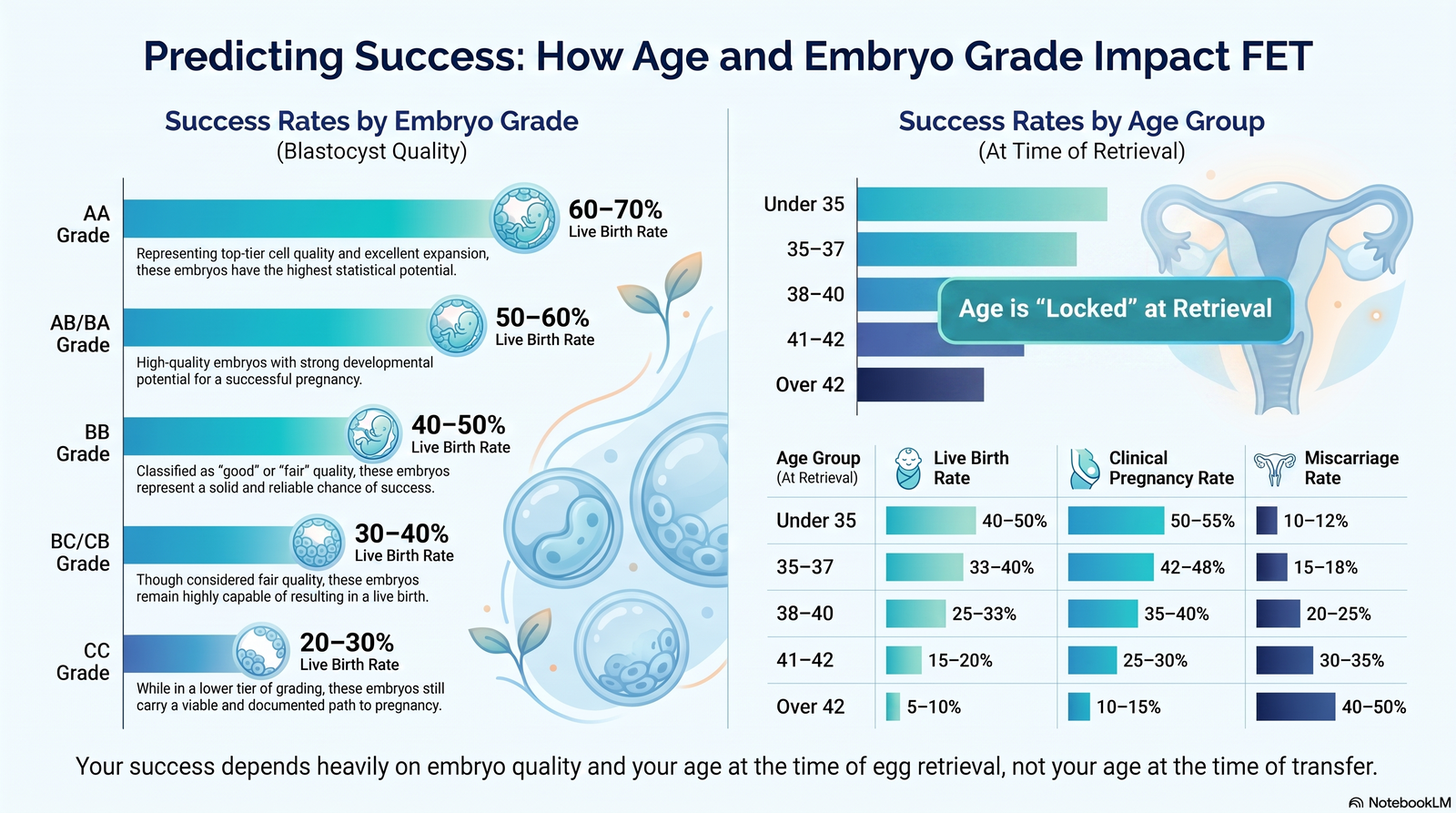
- Untested (Non-PGT-A) Transfers: The live birth rate of an untested 4AA embryo correlates directly with the age of the egg provider at the time of retrieval. Younger patients yield a high proportion of euploid blastocysts, so their untested 4AA success rates mirror their PGT-tested counterparts. Conversely, in patients over 40, the majority of morphologically pristine 4AA embryos are aneuploid, leading to lower implantation rates and higher biochemical or clinical miscarriage rates.
- Euploid (PGT-A Tested) Transfers: Once an embryo is confirmed to be chromosomally normal via trophectoderm biopsy and next-generation sequencing (NGS), the age penalty diminishes significantly. A verified euploid 4AA embryo transferred into an optimized uterine cavity yields roughly comparable live birth rates across nearly all age categories.
Statistical Breakdown: 4AA Embryo Success Rates by Age
The following benchmark data synthesizes contemporary clinical registry reports, Society for Assisted Reproductive Technology (SART) clinic summary trends, and high-volume reproductive laboratory outcomes.
| Maternal / Egg Age at Retrieval | Estimated Euploidy Rate for 4AA Blastocysts | Untested 4AA Live Birth Rate (Per Transfer) | PGT-A Euploid 4AA Live Birth Rate (Per Transfer) | Miscarriage Rate (Untested 4AA) |
|---|---|---|---|---|
| Under 35 Years | 65% – 72% | 55% – 63% | 65% – 70% | 10% – 12% |
| 35 – 37 Years | 52% – 60% | 46% – 52% | 63% – 68% | 14% – 18% |
| 38 – 40 Years | 35% – 42% | 32% – 38% | 60% – 65% | 22% – 28% |
| 41 – 42 Years | 18% – 25% | 16% – 22% | 58% – 63% | 35% – 42% |
| 43+ Years | 8% – 12% | 6% – 10% | 55% – 60% | 48% – 55%+ |
Note: Data applies to single embryo transfers (eSET) in cryopreserved cycles using autologous eggs. When donor eggs from a healthy provider under age 30 are utilized, success rates default to the "Under 35" category regardless of the gestational carrier's biological age, assuming an anatomically normal uterine cavity.
Clinical Interpretations of the Data
- Patients Under 35: Due to baseline high euploidy, selecting a 4AA embryo provides superior implantation and live birth rates without requiring invasive biopsies, provided patient history does not mandate genetic screening.
- Patients Aged 38 to 40: While an untested 4AA yields a reasonable 32% to 38% live birth rate, two out of three visually perfect embryos in this demographic harbor chromosomal aneuploidy. Preimplantation genetic testing acts as a diagnostic filter, sparing patients from implantation failures and first-trimester pregnancy losses.
- Patients Over 40: A pristine 4AA rating in this demographic confirms excellent lab development, yet fewer than one in four of these embryos is genetically balanced. When a patient in this age cohort secures a validated euploid 4AA, the live birth prognosis elevates substantially, approaching 60%.
Development Day: Day 5 vs. Day 6 vs. Day 7 4AA Blastocysts
Embryo grading does not occur in a vacuum; the precise developmental speed (embryo kinetics) required to reach the 4AA stage influences its clinical viability.
Day 5 4AA Blastocysts
Day 5 represents the physiological gold standard. Embryos that reach a fully expanded 4AA status between 116 and 120 hours post-insemination possess high metabolic efficiency and ideal mitochondrial dynamics. These embryos demonstrate the highest baseline implantation rates and survive vitrification and warming at rates exceeding 98%.
Day 6 4AA Blastocysts
It is exceedingly common for embryos to require an additional 24 hours of culture to achieve full blastocyst expansion, reaching 4AA status on Day 6 (138 to 144 hours). When comparing untested blastocysts, Day 6 4AAs show slightly lower live birth rates than Day 5 4AAs. However, clinical evidence shows that when Day 6 4AA embryos are confirmed to be euploid via PGT-A, their live birth rates are nearly identical to Day 5 euploids, provided they are transferred into an appropriately synchronized, programmed endometrium during a frozen embryo transfer (FET).
Day 7 4AA Blastocysts
Slower-growing embryos reaching 4AA expansion on Day 7 present reduced clinical implantation rates and higher baseline aneuploidy. Nevertheless, a Day 7 4AA verified as euploid remains clinically viable, offering a reasonable secondary option with live birth rates averaging between 35% and 45%.
Primary Etiologies for Failed 4AA Implantation
When a high-grade 4AA embryo—even one confirmed to be euploid—fails to implant, the clinical focus pivots from embryology toward the uterine environment, systemic pathology, and transfer mechanics.
1. Endometrial Receptivity and Window of Implantation (WOI)
Implantation requires precise synchronization between the developmental stage of the blastocyst and the receptive state of the endometrium. In programmed hormone replacement therapy (HRT) cycles, premature or delayed progesterone exposure can shift the window of implantation by 12 to 24 hours. Specialized diagnostic testing, such as an Endometrial Receptivity Array (ERA), evaluates transcriptomic profiles to identify displaced receptivity windows in patients experiencing recurrent implantation failure.
2. Structural and Cavitary Anomalies
A pristine embryo cannot establish stable vascular connections in an anatomically compromised uterine cavity. Key disruptors include:
- Submucosal Fibroids or Endometrial Polyps: Physical lesions that compromise local perfusion and induce mechanical distortions.
- Intrauterine Adhesions (Asherman's Syndrome): Fibrotic scarring secondary to prior instrumentation that limits endometrial proliferation.
- Hydrosalpinx: A fluid-filled, chronically inflamed fallopian tube that leaks toxic fluid retrograde into the uterine cavity, mechanically washing away the blastocyst and generating localized embryotoxic cytokines.
3. Chronic Endometritis
Different from endometriosis, chronic endometritis is an asymptomatic, persistent inflammation of the endometrial lining characterized by the infiltration of CD138-positive plasma cells. Often triggered by subtle bacterial imbalances, it alters the local immune microenvironment and drastically reduces 4AA implantation efficiency. It is diagnosed via endometrial biopsy and resolved with targeted antibiotic protocols.
4. Thrombophilic and Immunologic Factors
Systemic autoimmune conditions, such as Antiphospholipid Syndrome (APS), cause micro-thromboses at the maternal-fetal interface during early trophoblast invasion. Unchecked immunologic overactivation or maternal-fetal HLA/KIR mismatches are also investigated when multiple transfers of top-tier embryos fail consecutively.
Clinical Transfer Protocol Strategies for 4AA Blastocysts
To maximize the implantation potential of a 4AA blastocyst, clinical protocols are personalized based on ovulatory function, previous cycle responses, and systemic biomarkers:
Natural and Modified Natural Frozen Embryo Transfer (mNat-FET)
- Mechanics: Relies on the patient's endogenous ovulatory cascade. In a modified natural cycle, human chorionic gonadotropin (hCG) is administered to trigger ovulation once a lead follicle reaches maturity (typically 17–20 mm) alongside an endometrial thickness greater than 7 mm with a distinct trilaminar pattern.
- Advantages: Promotes the formation of a biological corpus luteum, which produces endogenous relaxin and vasoactive mediators. This approach correlates with reduced risks of maternal hypertensive disorders of pregnancy and preeclampsia compared to fully artificial cycles.
Programmed / Medicated (HRT) Transfer Cycles
- Mechanics: Suppresses natural ovulation via exogenous estrogen administration (oral, transdermal, or intramuscular) to build the endometrial lining, followed by intramuscular or vaginal progesterone supplementation to mimic the luteal phase.
- Advantages: Offers precise scheduling control for both the patient and clinic. Highly effective for patients with irregular ovulatory patterns, such as Polycystic Ovary Syndrome (PCOS), or those who demonstrate thin endometrial responses in natural cycles.
Frequently Asked Questions
What is the difference in success between a 4AA and a 4BB embryo?
A 4AA embryo holds an approximately 10% to 15% higher baseline implantation rate than a 4BB embryo when transferring untested blastocysts. The "A" ratings in a 4AA denote higher total cell numbers in both the fetal-forming inner cell mass and the placenta-forming trophectoderm. However, if both embryos are confirmed to be chromosomally normal (euploid) via PGT-A, the success gap narrows considerably, with 4BB embryos achieving live birth rates of roughly 50% to 58%, compared to 60% to 70% for a 4AA.
Does a 4AA embryo split into identical twins more frequently?
Yes, high-grade blastocysts, particularly those graded AA, experience slightly higher rates of monozygotic (identical) twinning compared to lower-grade embryos or natural conception. The incidence of monozygotic splitting in blastocyst-stage transfers ranges from 1.5% to 3%, compared to roughly 0.4% in unassisted conceptions. Factors contributing to this include extended laboratory culture, micromanipulation during ICSI or assisted hatching, and high initial cell numbers within the inner cell mass.
Can an untested 4AA embryo cause a miscarriage?
Yes, an untested 4AA embryo can lead to early pregnancy loss, and the primary driver of this risk is maternal age. Even though the embryo possesses ideal external morphology, it may harbor microscopic numerical chromosome errors (aneuploidies). In patients aged 40 and older, roughly 75% to 80% of untested blastocysts carry genetic imbalances, which represent the underlying cause of over 70% of first-trimester miscarriages.
Is PGT-A necessary if my embryo is already graded 4AA?
PGT-A is not strictly mandatory, but it provides critical diagnostic information, especially for patients over 35 or those with a history of recurrent pregnancy loss. Visual morphology scores the physical growth and structure of an embryo, while PGT-A assesses its 46 chromosomes. If a patient is under 35 with a favorable prognosis, transferring an untested 4AA yields excellent live birth rates; for older demographics, PGT-A prevents the transfer of aneuploid embryos that appear morphologically flawless.
What is the frozen thaw survival rate for a 4AA blastocyst?
In modern embryology laboratories utilizing rapid flash-freezing (vitrification), 4AA blastocysts demonstrate a thaw survival rate between 95% and 99%. Because 4AA blastocysts have well-formed cellular junctions and membrane integrity, they tolerate the cryoprotectant exposure and dehydration steps exceptionally well, routinely re-expanding within a few hours post-thaw prior to transfer.
Optimizing Your Path to Transfer
A 4AA blastocyst represents an optimal starting point in an assisted reproductive cycle, reflecting exceptional in vitro development and cellular health. However, successful live births require aligning this embryo quality with individualized genetic insights and a meticulously evaluated uterine environment.
If you are planning an upcoming transfer, collaborate closely with your reproductive endocrinologist to review your diagnostic profile. Assessing uterine cavity architecture via saline infusion sonography or hysteroscopy, optimizing the luteal phase support regimen, and determining the appropriate role of PGT-A based on maternal age will ensure your high-grade embryo is positioned for the greatest likelihood of clinical success.
Image Gallery