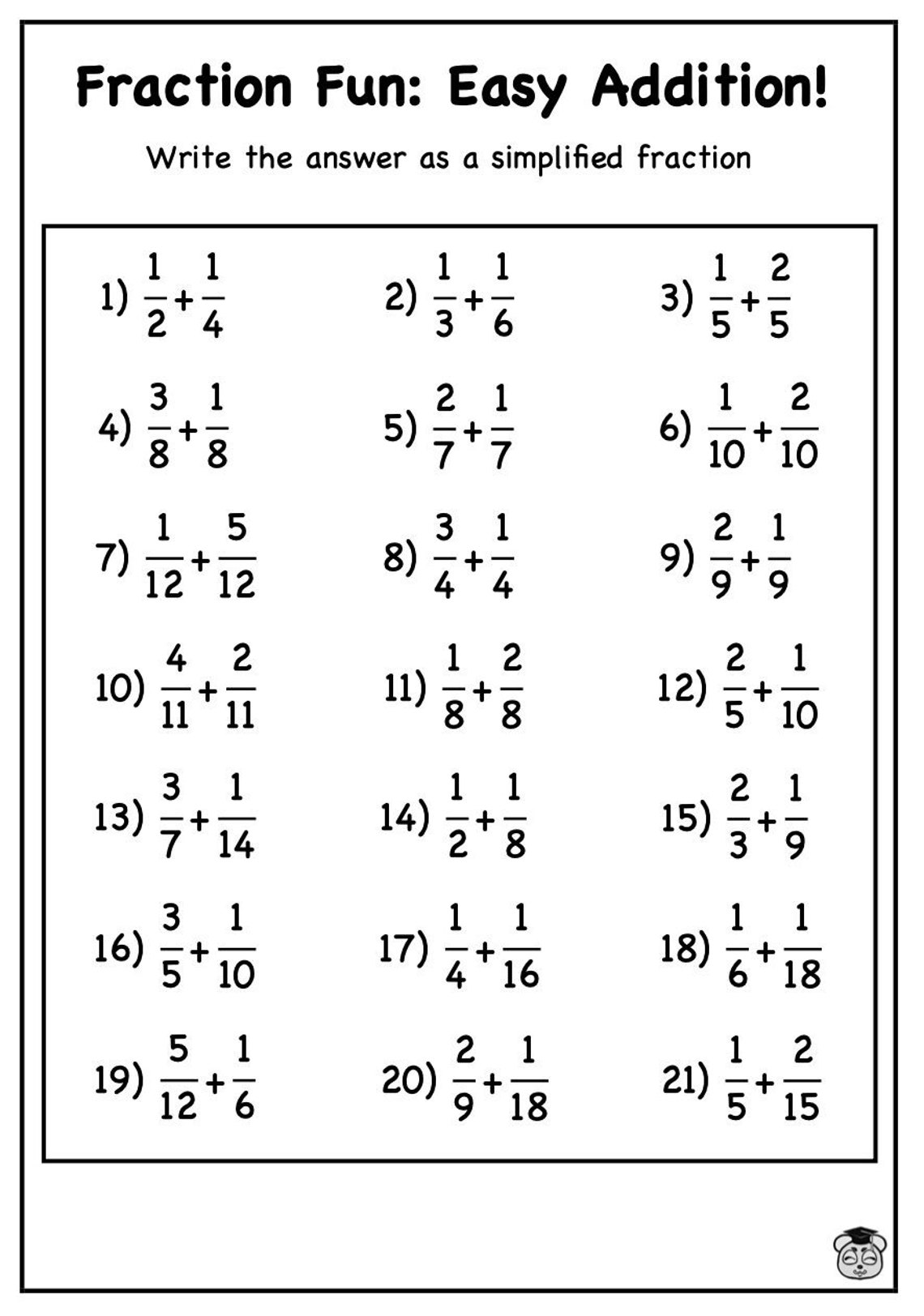
How a Fraction Addition Worksheet Reshapes Classroom Practice
A fraction addition worksheet acts as a structural bridge in mathematics education, shifting classroom dynamics from passive reception to active, iterative problem-solving. By providing a tangible, scaffolded medium for practicing oper...
A fraction addition worksheet acts as a structural bridge in mathematics education, shifting classroom dynamics from passive reception to active, iterative problem-solving. By providing a tangible, scaffolded medium for practicing operations, these tools enable educators to diagnose specific conceptual hurdles—such as finding common denominators or simplifying results—allowing for real-time instructional adjustments that foster deeper student mastery.
Contents
The Pedagogical Role of Structured Practice
In the landscape of 2026 mathematics curricula, the movement toward personalized learning necessitates tools that offer both consistency and flexibility. While digital platforms and interactive simulations have become prevalent, the traditional worksheet remains a cornerstone of classroom practice for its unique ability to capture a student’s cognitive process.
When students work through fraction addition problems on paper, they are externalizing their thinking. This is particularly vital when dealing with fractions, a topic that often marks the transition from additive to multiplicative reasoning. A well-designed worksheet forces a student to document each step—finding the least common multiple, adjusting the numerators, and performing the final sum. For the teacher, this provides a "process map" rather than just a final score.
By analyzing the completed worksheet, an educator can distinguish between a child who struggles with the arithmetic of addition and one who has not yet grasped the fundamental requirement of equal parts. This granularity transforms the worksheet from a mere assessment tool into a diagnostic instrument that dictates the flow of the next day’s lesson.
Scaffolding Complexity in Fraction Operations
Effective classroom practice relies on the intentional sequencing of tasks. Worksheets allow for this sequencing to be standardized and repeatable. A high-quality fraction addition worksheet typically follows a pedagogical arc designed to build confidence and competence:
- Concrete Visualization: Early sections often utilize visual models (pie charts or number lines) to reinforce the identity of the fraction.
- Guided Practice: Problems with matching denominators are introduced, allowing students to focus solely on the additive process.
- Conceptual Challenge: The introduction of unlike denominators requires the application of equivalent fractions, a prerequisite skill.
- Abstract Application: Finally, students work through word problems or mixed-number calculations that demand higher-order synthesis.
By structuring a lesson around these layers, teachers avoid the "cognitive load" trap, where a student becomes overwhelmed by the number of simultaneous steps required to solve a complex equation. Instead, the worksheet segments the difficulty, ensuring that the student is consistently working at the edge of their current ability—a concept often referred to as the Zone of Proximal Development.
Comparative Methods: Digital vs. Analog Worksheets
The integration of educational technology has not rendered the paper worksheet obsolete; rather, it has clarified its specific use cases. The table below outlines how these two modalities serve different pedagogical needs in the modern classroom.
| Feature | Paper-Based Worksheet | Digital Interactive Platform |
|---|---|---|
| Feedback Latency | Delayed (teacher-led) | Instant (algorithmic) |
| Cognitive Engagement | High tactile/writing focus | High visual/audio engagement |
| Process Tracking | Detailed error analysis | Automated performance metrics |
| Adaptability | Low (static content) | High (dynamic difficulty) |
| Environmental Cost | Moderate (paper/ink) | Minimal (hardware dependent) |
The most effective classroom practices of 2026 often utilize a hybrid approach. A digital tool may be used for initial engagement or rapid drill-and-practice, while a structured, paper-based worksheet is used during the "deep work" phase to ensure that students can articulate their process without the assistance of automated hints or multiple-choice interfaces.
Identifying and Addressing Common Student Pitfalls
A primary reason educators rely on specific worksheet designs is the prevention of systemic misconceptions. When a fraction addition worksheet is poorly designed, it can actually reinforce common errors. For instance, if a worksheet only contains problems with denominators that are multiples of one another, students may fail to develop strategies for finding the least common denominator.
Experienced educators look for worksheets that vary the mathematical relationship between denominators. They prioritize sets that include:
- Direct multiples: (e.g., 1/2 + 1/4)
- Relatively prime numbers: (e.g., 1/3 + 1/5)
- Cases requiring simplification: (e.g., 2/6 + 1/6, which requires reducing the result)
By ensuring these specific types of problems are present, the worksheet helps the teacher uncover "procedural bugs." When a teacher sees a student consistently adding denominators (the "add-across" error), the physical worksheet provides a canvas where the teacher can draw a visual representation to correct the misunderstanding on the spot.
Strategies for Implementation
To maximize the impact of a fraction addition worksheet, educators must treat it as part of a dialogue rather than a solitary task.
- The Think-Aloud Protocol: Encourage students to narrate their steps while writing. This slows down the impulsive tendency to solve problems incorrectly and promotes metacognition.
- Peer Review Clusters: Use completed worksheets as the basis for peer review, where students compare the methods they used to arrive at a common denominator. This exposes them to multiple valid strategies (e.g., finding the LCD versus multiplying denominators).
- Strategic Differentiation: Teachers should prepare varied versions of the worksheet. While all students cover the core concepts, the number of problems and the complexity of the fractions should be adjusted based on the teacher's assessment of student mastery.
Frequently Asked Questions
How does a worksheet help with student retention of fraction concepts? Writing is a kinesthetic act that reinforces neural pathways differently than clicking or tapping. By physically writing out the steps for fraction addition, students are more likely to internalize the logic of equivalent fractions rather than simply memorizing a rule.
What should I look for in a high-quality fraction worksheet? Prioritize worksheets that include a mix of conceptual visual aids and varied numerical types. Avoid "busy work" sheets that feature repetitive, identical problems; instead, look for those that progress in difficulty and include a clear section for writing down the steps taken.
Can these worksheets be used for remote or hybrid learning? Yes. While digital PDFs are common, the goal remains the same: the student should be encouraged to solve problems on paper to demonstrate their thinking process. For remote settings, having students scan and upload their written work allows for the same level of diagnostic feedback as in-person instruction.
How often should students use these worksheets? They should be used as a targeted intervention following initial instruction. Using them daily can lead to disengagement, but using them 2–3 times a week during the unit on fractions provides the right balance of repetition and cognitive challenge.
What is the best way to grade these worksheets for learning? Do not grade for completion or accuracy alone. Use a "check for understanding" approach where you mark the correct procedures even if the final result is slightly off. This encourages students to value the method over the result, which is the cornerstone of mathematical literacy.
Recommendation for Practice
To reshape your classroom, stop viewing the fraction addition worksheet as a tool for assessment and start viewing it as a tool for inquiry. Select a set of problems that specifically targets the most common misunderstandings in your current lesson plan. During the session, circulate through the room specifically looking for the "add-across" error or issues with finding common denominators. Use the worksheet as a prompt for discussion, asking students to defend their choice of denominator. This shifts the focus from "getting the right answer" to "developing a robust mathematical method," which will serve students far beyond the fraction unit.
Image Gallery