The Best Carry-On Travel Backpack for Women Explained: Fit, Features, and Sizing Guide
Selecting the best carry-on travel backpack for women requires balancing anatomical fit, airline size limits, and volume optimization. Women-specific travel backpacks feature shorter torso ranges, S-curved shoulder straps, and conical...
Selecting the best carry-on travel backpack for women requires balancing anatomical fit, airline size limits, and volume optimization. Women-specific travel backpacks feature shorter torso ranges, S-curved shoulder straps, and conical hip belts tailored to narrower shoulders and wider hips. Choosing the right pack ensures comfortable weight distribution and effortless movement through airports without checking luggage.
Contents
Why Women-Specific Design Matters in Travel Backpacks
Unisex travel backpacks are usually designed around an average male torso, which often leads to discomfort, chafing, and poor weight distribution for female travelers. A true women-specific carry-on backpack is engineered around distinct physiological differences rather than simply being a smaller version with different color options.
Women-Specific Harness Design
- Shoulder Straps: S-shaped curve avoids pressure across chest
- Sternum Strap: Higher/lower sliding tracks clear bust line
- Torso Length: Scaled shorter (14" - 19") for proper frame
- Conical Hip Belt: Angled to flare outward over pelvic bones
Torso Length and Frame Geometry
Torso length—the distance from the base of the neck to the top of the hip bones—is often shorter in women relative to overall height. Standard unisex packs frequently sit too low, causing the hip belt to rest on the buttocks rather than transferring load to the pelvis. Women-specific backpacks utilize shorter frame sheets or micro-adjustable suspension systems that position the load-bearing hip belt directly over the iliac crest.
Curved S-Shape Shoulder Straps
Unisex shoulder straps generally follow a straight or subtle "J" curve. On narrower shoulders or across the chest, J-straps can pinch the neck, rub under the arms, or press uncomfortably against the bust. Women-specific shoulder straps feature an pronounced "S" curve. This shape contours outward around the chest and inward under the arms, preventing friction while keeping the harness flat against the torso.
Conical Hip Belts
A pack's hip belt should transfer up to 70–80% of the bag's total weight onto the skeletal structure of the lower body. Male hips tend to be straight and vertical, whereas female hips flair outward from the waist. A women-specific hip belt uses conical shaping: the belt is cut at an angle so it flares open toward the bottom, wrapping securely around the top of the hip bones without digging into the abdomen or thighs.
Sliding Sternum Strap Placement
The chest or sternum strap stabilizes the shoulder straps to prevent them from slipping off the shoulders. Women's backpacks feature longer vertical tracks for the sternum strap, allowing it to slide higher or lower to avoid sensitive chest areas while maintaining load stability.
Understanding Airline Carry-On Size and Volume Constraints
A travel backpack is only effective if it fits reliably into overhead bins or beneath airplane seats. Dimensions and weight allowances vary significantly between domestic US carriers, international long-haul flights, and European budget airlines.
| Airline Category | Dimensions | Volume |
|---|---|---|
| US Domestic Standard | 22" x 14" x 9" (56 x 36 x 23 cm) | ~40-45L |
| International Standard | 21.5" x 15.5" x 9" (55 x 40 x 20 cm) | ~35-40L |
| Budget Carrier Strict | 21.5" x 14" x 7.8" (55 x 35 x 20 cm) | ~30-35L |
Domestic vs. International Carry-On Dimensions
- US Domestic Carriers (e.g., Delta, United, American): The standard maximum carry-on dimension is 22 x 14 x 9 inches (56 x 36 x 23 cm). Packs up to 40 to 45 liters capacity generally fit comfortably, provided they are not over-stuffed.
- International Carriers (e.g., Lufthansa, Singapore Airlines, BA): Dimensions are often stricter, frequently capped at 21.5 x 15.5 x 9 inches (55 x 40 x 20 cm) or 55 x 35 x 23 cm. Maximum volume should generally remain between 35 and 40 liters.
- Strict Regional and Budget Carriers (e.g., Ryanair, EasyJet, AirAsia): Overhead allowance limits can be as compact as 55 x 35 x 20 cm, with personal item limits as small as 40 x 30 x 20 cm.
Weight Limits and Enforcement
While US airlines rarely weigh carry-on luggage, international and budget carriers frequently enforce strict weight limits ranging from 7 kg (15.4 lbs) to 10 kg (22 lbs). A heavy backpack frame weighing 4.5 lbs (2 kg) empty consumes over 25% of a 7 kg weight allowance. Choosing a lightweight, durable pack (under 3.5 lbs / 1.6 kg) is essential for one-bag travel abroad.
Essential Features of a Premium Women's Travel Backpack
Travel backpacks differ from hiking backpacks in structure, accessibility, and organization. When evaluating a travel backpack, specific design elements determine its practicality on the road.
Opening Style: Clamshell vs. Top-Loading
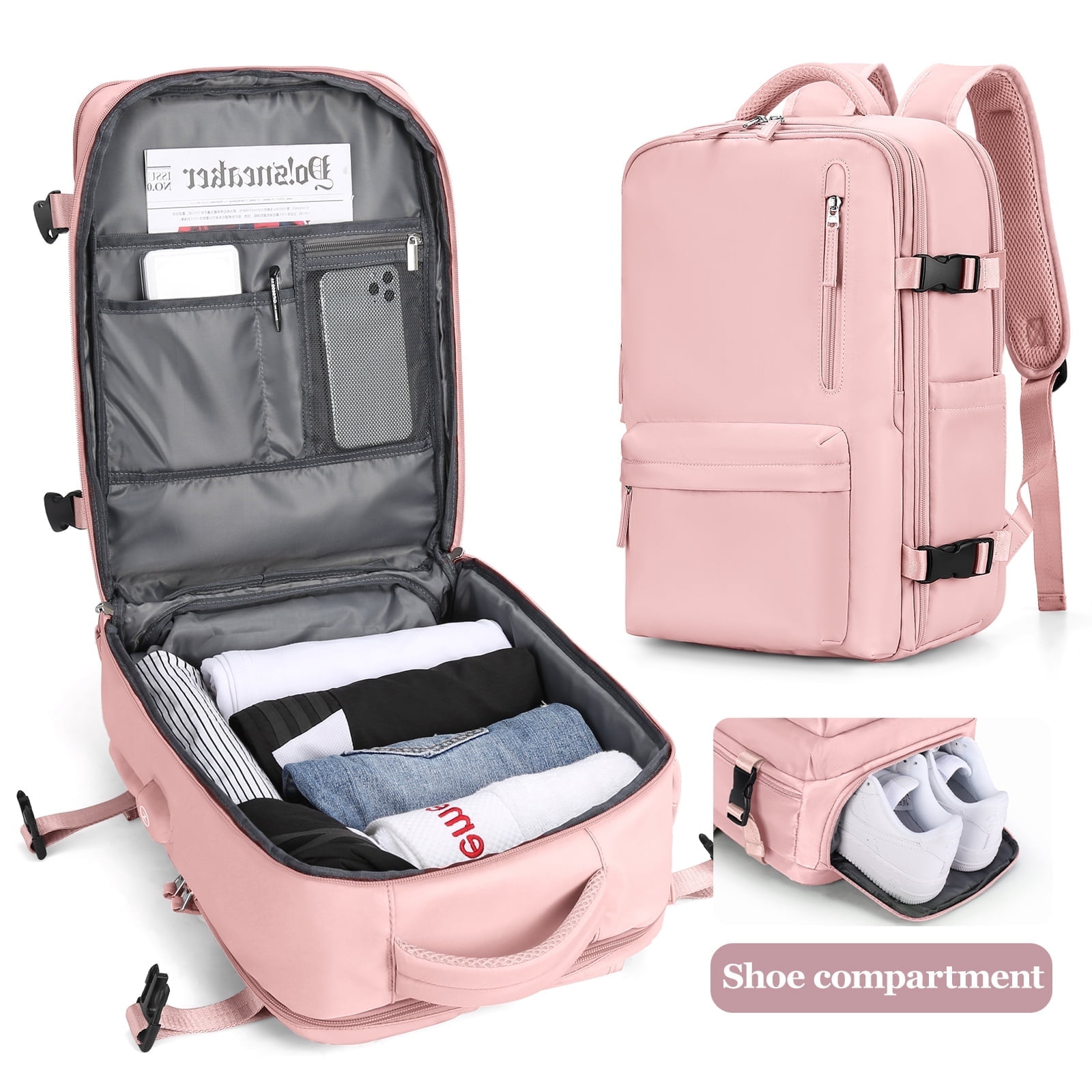
- Clamshell (Panel Loading): Zips open flat around three sides, similar to a suitcase. This design allows immediate access to all packed items without disturbing the rest of the contents, making it the superior choice for travel.
- Top-Loading: Standard hiking design with a drawstring top. Accessing items at the bottom requires digging through the entire pack, making it inefficient for urban transit and hotel stays.
Harness Stowability and Luggage Pass-Through
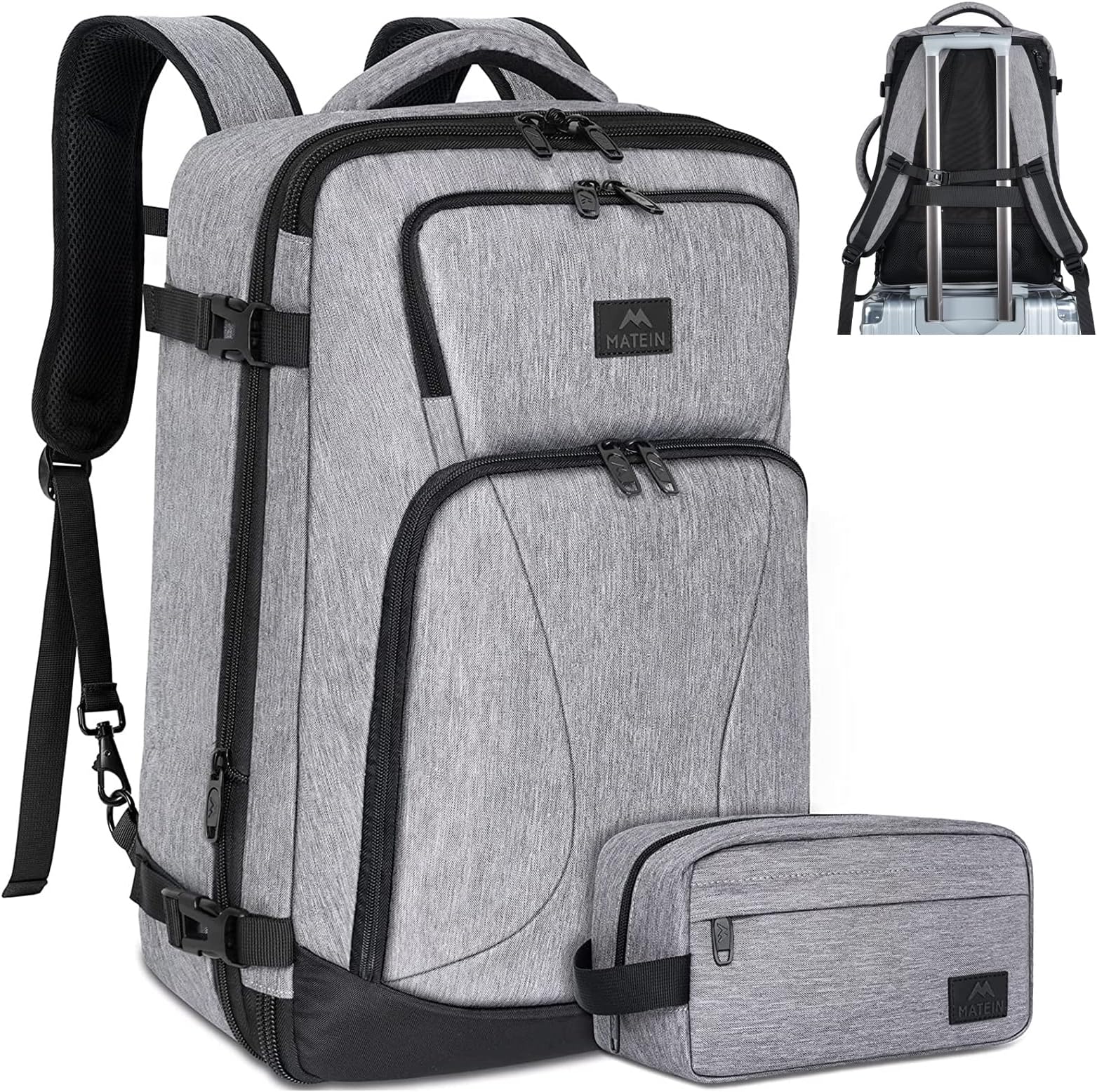
When boarding regional jets or using train luggage racks, dangling straps present a snag hazard. Premium travel packs feature a zippered rear flap or dedicated tuck-away slots to conceal the shoulder straps and hip belt completely. A luggage pass-through sleeve is also useful, allowing the pack to slide securely over the rolling handle of a wheeled suitcase when traveling with multiple bags.
Fabric Durability and Denier Ratings
Backpack fabrics must withstand friction, luggage carousels, and inclement weather. Common high-performance materials include:
- CORDURA® Nylon: Highly abrasion-resistant woven nylon fabric, typically rated between 500D and 1000D.
- Robic® Nylon: Lightweight, high-tenacity nylon offering superior tear resistance relative to its weight.
- X-Pac / VX42: A multi-ply laminated fabric that is lightweight, inherently waterproof, and dimensionally stable.
- TPU-Coated Polyester: Water-resistant rubberized coating often used on weather-resistant duffel-backpack hybrids.
Higher Denier (D) numbers indicate thicker, heavier threads. A 500D Cordura pack offers an ideal middle ground of durability and low empty weight.
Comparing Top Carry-On Backpacks Designed for Women
The following matrix compares leading travel backpacks designed for female travelers or featuring dedicated women's fits.
| Backpack Model | Volume | Weight (Empty) | Dimensions (H x W x D) | Torso Adjustment | Harness Stowable | Best For |
|---|---|---|---|---|---|---|
| Osprey Fairview 40 | 40L | 3.4 lbs (1.55 kg) | 21.5" x 14" x 9" | Yes (Adjustable Ladder) | Yes (Zippered Panel) | Overall Comfort & Ergonomics |
| Cotopaxi Allpa 35L | 35L | 3.5 lbs (1.60 kg) | 22" x 12" x 10" | No (Fixed S/M) | Yes (Tuck-Away) | Internal Organization |
| Peak Design Travel 30L | 27–33L | 3.15 lbs (1.44 kg) | 20.9" x 13" x 7" | No (Fixed) | Yes (Magnetic Slots) | Tech & Minimalist Travel |
| Aer Travel Pack 3 Small | 28L | 3.79 lbs (1.72 kg) | 19" x 13" x 7.5" | No (Fixed) | No (Luggage Pass-Through) | Short Trips & Urban Commutes |
| Gregory Jade 38 | 38L | 2.8 lbs (1.27 kg) | 23" x 12.5" x 11" | Yes (VaporSpan System) | No | Hybrid Wilderness & Travel |
Deep Dive: Osprey Fairview 40
The Osprey Fairview 40 remains a benchmark for women's travel backpacks. Unlike its unisex counterpart (the Farpoint), the Fairview features a narrow shoulder harness with sharp angled curves, an adjustable torso length system via a hook-and-loop ladder, and a contoured hip belt. The internal LightWire peripheral frame transfers weight directly to the hip belt, making 30-pound loads feel significantly lighter.
Osprey Fairview 40 Harness
- LightWire Frame: Direct load transmission to hip belt
- Adjustable Torso: Slides 14" to 19" for tailored back fit
- Stowable Panel: Zips over harness for checking at gate
Deep Dive: Cotopaxi Allpa 35L
The Cotopaxi Allpa 35L uses a rugged TPU-coated 1000D polyester shell combined with 840D ballistic nylon paneling. It features a suitcase-style layout with internal zippered mesh compartments. The harness utilizes flexible, contoured shoulder straps designed to fit a wide variety of shoulder slopes, though it lacks an adjustable frame sheet for precise torso fitting.
Deep Dive: Peak Design Travel Backpack (30L / 45L)
Peak Design uses a clean, tech-focused aesthetic built from weatherproof 400D double-poly-coated recycled nylon canvas. While non-gendered in marketing, the harness features axial strap pivots that automatically self-adjust to fit narrow shoulder angles. The back panel uses magnetic catch points to store straps instantly when loading into overhead bins.
How to Measure Your Torso and Select the Right Fit
Sizing a travel backpack depends on torso length, not total height. A 5'10" traveler may have a short torso and long legs, while a 5'3" traveler may have a longer torso.
Torso Measurement Procedure
- Tilt head forward to locate C7 Vertebra (bony bump at base).
- Place hands on hips, thumbs pointing backward along iliac crest.
- Run flexible tape measure down spine from C7 to thumb line.
- Measurement (typically 14"-19" for women) determines size.
Step 1: Locate the C7 Vertebra
Tilt your chin down toward your chest. Feel for the prominent bony bump at the base of your neck where the slope of your shoulders meets your spine. This is the C7 vertebra, which marks the top of your torso measurement.
Step 2: Locate the Iliac Crest
Place your hands flat on top of your hip bones with your fingers pointing forward and your thumbs pointing behind you toward your lower back. Draw an imaginary horizontal line between your thumbs across your spine. This line marks the bottom of your torso measurement (iliac crest).
Step 3: Measure Along the Spine
Have a second person use a flexible tailor's tape measure to measure along the contour of your spine from the C7 vertebra down to the intersection point between your thumbs.
- Extra Short / Short: 14" to 16" (35 to 40 cm)
- Medium / Women's Standard: 16" to 19" (40 to 48 cm)
- Long / Unisex Standard: 19"+ (48+ cm)
Step 4: Test the Loaded Fit
Put 15 to 20 lbs (7 to 9 kg) of gear into the bag to evaluate fit under load:
- Fasten the hip belt first, ensuring the padded center sits directly over your hip bones.
- Tighten the shoulder straps so they wrap smoothly over the shoulders without gaps or severe pressure.
- Adjust the load lifter straps (if present) at a 45-degree angle to pull the top of the pack closer to your center of gravity.
- Position the sternum strap 1 to 2 inches below your collarbone.
Packing Strategies: Weight Distribution and One-Bag Travel
Proper weight distribution within a carry-on pack prevents shoulder fatigue and stabilizes your gait while walking through transit hubs.
Pack Weight Distribution
- TOP / OUTSIDE: Lightweight items, toiletries, jacket
- CENTER CLOSE: Heaviest gear (shoes, tech, packing cubes)
- BOTTOM / AWAY: Sleeping gear, light clothing, sandals
Weight Distribution Principles
- Heavy Items (Center & Back): Place dense objects—such as shoes, electronics, and heavy packing cubes—against the back panel near the center of the pack. Keeping heavy items close to your spine prevents the pack from pulling backward.
- Medium-Weight Items (Top & Outer): Store jackets, sweaters, and medium-weight clothing in the top and outer sections.
- Lightweight Items (Bottom): Place lighter clothing items or underwear in the bottom corners of the bag to fill out the structure without weighting down the base.
Maximizing Space with Compression Cubes
Using structured packing cubes creates distinct compartments within a single large pack volume. Compression cubes with dual-zipper systems allow clothing to be compressed by up to 30%, preventing bulk and keeping items organized during airport security checks.
Frequently Asked Questions
What is the maximum volume allowed for an international carry-on backpack?
For international airlines, the recommended maximum volume is 35 to 40 liters. While 45-liter bags are accepted by US domestic airlines, they often exceed the stricter 55 x 40 x 20 cm limits enforced by European, Asian, and South American carriers.
Can a women's travel backpack fit under an airplane seat as a personal item?
Standard travel backpacks rated between 35L and 40L generally do not fit under airplane seats. To qualify as a personal item, a backpack must usually stay under 25 liters in volume, with maximum dimensions near 18 x 14 x 8 inches (45 x 35 x 20 cm).
What is the difference between a hiking backpack and a travel backpack?
Hiking backpacks are top-loading, tall, and narrow to keep weight balanced on uneven terrain, but their tall frames often violate airline carry-on height restrictions. Travel backpacks are wide, rectangular, use clamshell suitcase openings, feature laptop sleeves, and offer stowable harness systems for transit protection.
How do I protect backpack straps if forced to gate-check my bag?
If an overhead bin is full and gate-checking is required, unclip or zip away the harness using the stowable back panel cover (such as on the Osprey Fairview or Cotopaxi Allpa). If your bag lacks a stow panel, cross and buckle all external straps tightly around the pack body to prevent them from catching in conveyor belts.
Are waterproof fabrics necessary for a travel backpack?
Fully waterproof fabrics (like thick TPU or PVC) add significant weight and stiffen the bag. Water-resistant fabrics—such as DWR-coated 500D Cordura or 400D Robic nylon—are sufficient for travel. Pair them with an inexpensive rain cover or internal dry sacks for protection during sudden heavy downpours.
Actionable Recommendations for Choosing Your Backpack
- Measure Your Torso First: Before purchasing, measure your C7-to-iliac-crest distance to ensure you select the correct frame size.
- Determine Your Flight Profile: If you fly primarily on international or budget carriers, limit your search to packs under 38 liters weighing under 3.5 lbs (1.6 kg) empty.
- Prioritize Open Access: Choose a pack with a full clamshell opening and dedicated laptop pocket to simplify security screening.
- Test Under Load: Load the backpack with 15–20 lbs of clothing and test it at home. Ensure the hip belt carries the majority of the weight without digging into your waist or hips.
Image Gallery