Lifting After Vasectomy: Safe Recovery Timeline, Risks, and Exercise Guidelines
Most urologists advise refraining from lifting anything over 10 to 15 pounds for at least seven days following a vasectomy, with heavy weightlifting and strenuous manual labor delayed for two to four weeks. Resuming heavy lifting too e...
Most urologists advise refraining from lifting anything over 10 to 15 pounds for at least seven days following a vasectomy, with heavy weightlifting and strenuous manual labor delayed for two to four weeks. Resuming heavy lifting too early elevates intra-abdominal and scrotal pressure, which significantly increases the risk of scrotal hematomas, severe swelling, and delayed wound healing.
Contents
Disclaimer: This guide provides general educational information regarding post-vasectomy recovery. It is not a substitute for formal medical advice. Always consult your operating urologist or healthcare provider for specific post-operative care instructions tailored to your health profile.
The Science Behind Post-Vasectomy Restrictions: Why Lifting Is Dangerous Early On
A vasectomy is a minimally invasive surgical procedure that severs, seals, or blocks the vas deferens—the muscular tubes that carry sperm from the testicles to the ejaculatory ducts. While the external skin incision or puncture site is quite small (often measuring under a few millimeters), the internal structural adjustments require time to stabilize.
The scrotal tissue is uniquely elastic and rich in blood vessels. The veins surrounding the vas deferens and testicles, known as the pampiniform plexus, operate under relatively low pressure when a person is at rest. However, when you lift a heavy object, push against resistance, or perform a bracing motion, your body naturally engages the Valsalva maneuver.
The Mechanics of the Valsalva Maneuver
The Valsalva maneuver occurs when you take a breath and hold it while bearing down, contracting your diaphragm and abdominal wall muscles. This mechanical action creates a rapid spike in intra-abdominal pressure. This surge in pressure cascades through the circulatory system, directly increasing venous pressure within the pelvic floor and scrotum.
During the initial phase of post-vasectomy healing (the first 72 hours to seven days):
- Vascular Clots Are Fragile: Microscopic blood vessels cauterized or tied during the procedure are holding back bleeding under normal pressure. A sharp increase in scrotal venous pressure can dislodge these initial clots, leading to internal scrotal bleeding.
- Surgical Sites Are Vulnerable: The cut ends of the vas deferens are undergoing tissue repair. Mechanical strain can cause internal tugging along the spermatic cord, leading to inflammation and sharp, localized pain.
- Tissue Permeability Is High: Acute surgical trauma initiates an inflammatory response. Increased localized blood flow coupled with high abdominal pressure allows fluid to leak into the loose connective tissue of the scrotum, triggering rapid, painful edema (swelling).
Because the scrotum lacks rigid anatomical walls to limit fluid accumulation, bleeding inside the scrotum does not quickly self-tamponade. A minor vascular leak can easily expand into a massive accumulation of blood known as a scrotal hematoma, which often requires bed rest, extended recovery, or emergency surgical drainage.
Weight Limits and Recovery Timeline
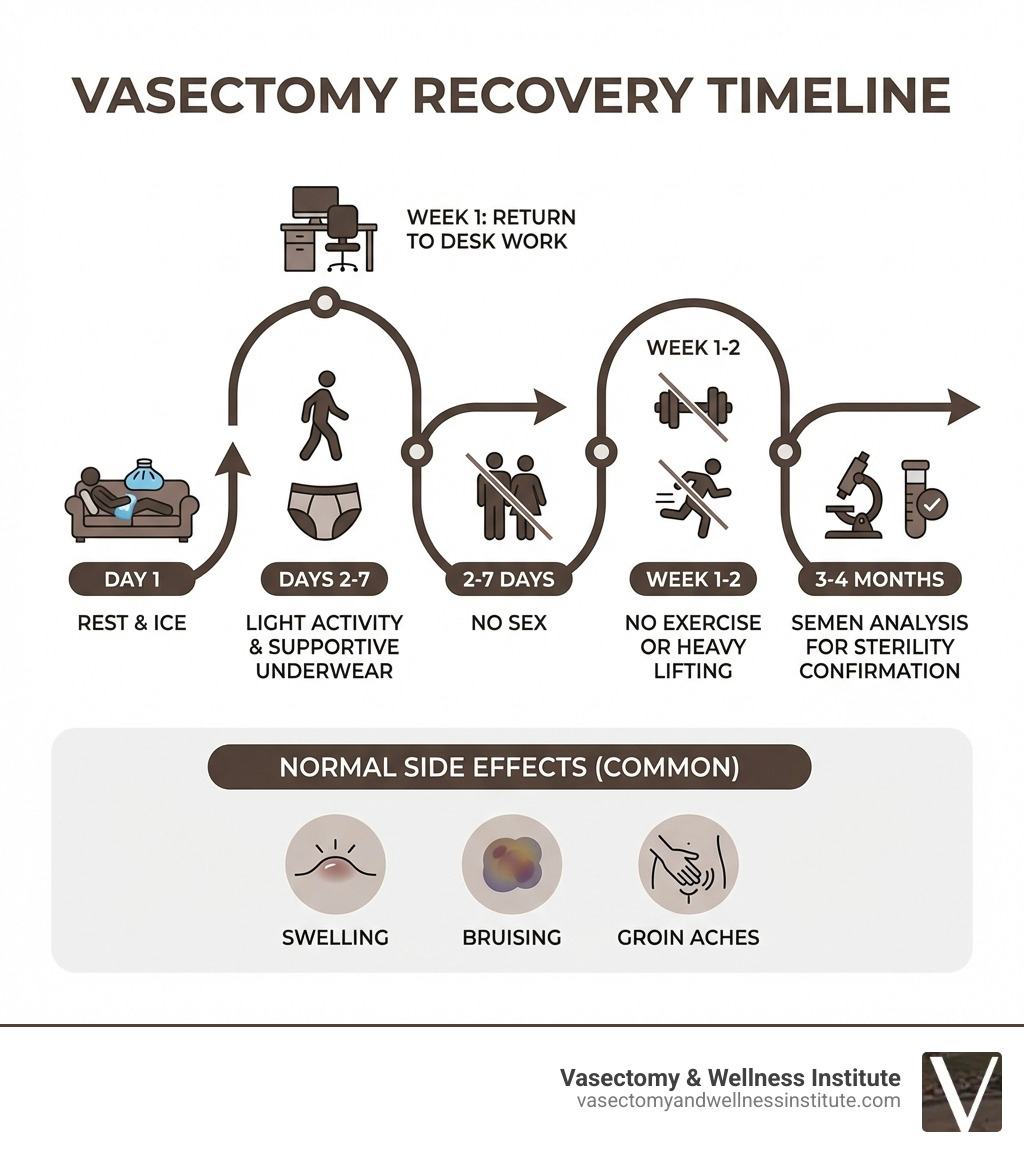
Recovery after a vasectomy occurs in distinct physiological phases. Adhering to strict weight limits during each stage allows tissue repair to outpace physical stress.
Vasectomy Recovery Spectrum:
- Days 1–3: Strict Rest
- Max: < 10 lbs
- Days 4–7: Light Mobility
- Max: ~15 lbs
- Week 2: Moderate Activity
- Max: 20–30 lbs
- Weeks 3–4+: Full Strength
- Progressive Heavy Loads
Days 1 to 3: Immediate Rest Phase
- Lifting Limit: Strict limit of 0 to 10 pounds (0 to 4.5 kg).
- Primary Objective: Hemostasis (stopping all micro-bleeding) and tissue immobilization.
- Permitted Movement: Gentle household walking, standing for brief periods, and self-care activities.
- Prohibited Movement: Lifting groceries, picking up toddlers, carrying laundry baskets, bending repeatedly at the waist, or engaging in prolonged walking.
During this 72-hour window, you should focus on rest. Keep your scrotum elevated with supportive underwear and apply cold therapy (ice packs wrapped in a cloth towel) for 15 to 20 minutes at a time.
Days 4 to 7: Light Mobility Phase
- Lifting Limit: Maximum of 10 to 15 pounds (4.5 to 7 kg).
- Primary Objective: Encouraging localized circulation without straining surgical sites.
- Permitted Movement: Light office work, walking around the neighborhood on flat ground, light household tasks (e.g., preparing meals, carrying light items).
- Prohibited Movement: Any exercise involving resistance, heavy yard work, carrying luggage, or straining during bowel movements.
Even if surgical pain has completely subsided by day four, the internal vascular repairs remain fragile. Avoid testing your limits simply because you feel fine; pain suppression does not equal full structural healing.
Days 8 to 14 (Week 2): Moderate Functional Phase
- Lifting Limit: 15 to 30 pounds (7 to 13.5 kg), introduced gradually.
- Primary Objective: Reintroducing functional movement while monitoring scrotal feedback.
- Permitted Movement: Brisk walking, light dumbbell exercises while seated (upper body only), gentle household chores, and returning to light physical work duties.
- Prohibited Movement: Maximal strength training, heavy squats, deadlifts, high-impact running, jumping, or intense abdominal core work.
Weeks 3 to 4 and Beyond: Progressive Return to Heavy Lifting
- Lifting Limit: Gradual escalation back to 100% capacity.
- Primary Objective: Full restoration of training volume and occupational capacity.
- Permitted Movement: Moderate-to-heavy weightlifting, high-intensity interval training (HIIT), running, and demanding physical labor.
- Safety Condition: Progression must be completely painless. If deep scrotal aching occurs, immediately reduce weight loads by 50% for an additional 5 to 7 days.
Summary Matrix: Post-Vasectomy Activity Progression
| Recovery Phase | Weight Limit | Permitted Physical Tasks | Prohibited Activities | Primary Red Flags to Stop |
|---|---|---|---|---|
| Days 1–3 | $< 10\text{ lbs}$ ($4.5\text{ kg}$) | Resting, short household walks | Lifting children, groceries, stairs | Sudden scrotal enlargement, severe throbbing |
| Days 4–7 | $10\text{--}15\text{ lbs}$ ($4.5\text{--}7\text{ kg}$) | Light desk work, flat walking | Gym training, yard work, heavy carrying | Increasing ecchymosis (bruising), sharp tugging |
| Days 8–14 | $15\text{--}30\text{ lbs}$ ($7\text{--}13.5\text{ kg}$) | Light resistance, light labor | Powerlifting, heavy squats, running | Dull ache in lower abdomen or spermatic cord |
| Weeks 3–4+ | Full Capacity | Heavy resistance, intense sport | Painful or un-supported heavy loads | Persistent localized swelling or tender nodules |
Differentiating Between Casual Lifting, Heavy Workouts, and Physical Labor
Not all physical loads affect the pelvic floor equally. How you lift and the mechanics required play a significant role in your post-vasectomy risk profile.
Intra-Abdominal Pressure Impact:
- Casual Lifting (Grocery Bags)
- Seated Upper Body Weights
- Standing Compound Lifts
- Heavy Manual Labor & Demolition
1. Casual Everyday Lifting
Casual lifting involves common daily activities: lifting a grocery bag, carrying a small pet, or moving a trash bag. These tasks generally impose low intra-abdominal stress if performed without holding your breath.
- Guideline: Keep objects close to your center of gravity during Week 1. Avoid twisting your body while holding items weighing more than 10 pounds.
2. Gym Workouts and Resistance Training
Weightlifting in a fitness context involves focused tension, elevated heart rates, and high intra-abdominal pressure.
- Upper Body Seated Exercises: Movements like seated bicep curls, chest supported rows, or seated shoulder presses generate lower pelvic floor strain than standing variations. These can usually be resumed gently late in Week 2.
- Standing Compound Lifts: Exercises such as barbell squats, deadlifts, barbell overhead presses, and heavy leg presses create high levels of intra-abdominal pressure. The Valsalva maneuver required to stabilize your spine during a heavy deadlift forces venous blood downward into the testicular veins.
- Guideline: Postpone all heavy compound lifts for 3 to 4 weeks. When resuming, lower your previous working weight by 50% and focus on continuous breathing rather than holding your breath to brace your core.
3. Heavy Physical Labor and Demolition Work
Occupational lifting in industries such as construction, warehousing, landscaping, and emergency services presents unique risks. Unlike controlled gym environments where you choose the weight and lift duration, manual labor often requires lifting awkward, heavy, or shifting loads repeatedly over an eight-hour shift.
- Guideline: If your job requires lifting items over 20–30 pounds regularly, discuss light-duty accommodations with your employer or surgeon before your procedure. Most urologists will provide a formal medical note restricting heavy workplace lifting for 7 to 14 days.
How to Safely Transition Back to Resistance Training
Returning to your weightlifting or fitness routine requires a deliberate, methodical strategy to prevent micro-trauma to the recovering vas deferens.
Transition Protocol:
- Apply Compression Support
- Reduce Load (50%)
- Exhale on Exertion
- Monitor Post-Workout Symptoms
Step 1: Wear Adequate Scrotal Support
Never lift weights in loose boxer shorts during the first month following a vasectomy. Testicular movement pulls directly on the spermatic cord, inflaming the healing vas deferens.
- Wear a dedicated jockstrap or high-compression supportive athletic briefs under your workout apparel.
- The support should lift the testicles snugly against the body without causing uncomfortable compression or pinching.
- Continue using supportive underwear during workouts for at least 3 to 4 weeks post-surgery.
Step 2: Implement a Deload Strategy
When you return to the weight room in Week 2 or Week 3, do not attempt your previous one-rep max or high-intensity working sets.
- Week 2: Start at 30% to 40% of your pre-surgery weight. Stick strictly to machine exercises or seated dumbbell work. Avoid heavy free-weight compound exercises.
- Week 3: Progress to 50% to 60% of pre-surgery loads if you remain symptom-free. You may reintroduce light barbell work and light standing movements.
- Week 4: Move up to 75% to 80% capacity. Reintroduce standard training routines gradually.
- Week 5: Return to 100% intensity, provided you experience zero testicular pain, groin aching, or swelling.
Step 3: Modify Your Breathing Technique
To minimize blood pressure spikes in the scrotum, alter your breathing mechanics during your initial weeks back to training:
- Exhale on Exertion: Forcefully exhale during the concentric phase (the lifting portion) of the repetition.
- Inhale on the Eccentric Phase: Inhale controlled breath as you lower the weight.
- Avoid Holding Your Breath: Do not use full intra-abdominal breath-holding locks (Valsalva) until you are entirely healed and cleared for maximum weight load.
Step 4: Perform Post-Workout Self-Checks
After completing a light-to-moderate workout during your recovery window, perform a visual and physical check:
- Look for fresh bruising or swelling in the scrotum.
- Pay attention to any dull, heavy aching feeling in your lower abdomen or groin. A persistent ache indicates that the intensity was too high and that you should step back your training load.
Warning Signs and Complications Related to Early Lifting
Lifting heavy objects prematurely is the leading behavioral cause of post-vasectomy complications. Recognizing early symptoms allows for timely intervention before minor issues develop into major surgical complications.
Complication Cascade:
- Premature Lifting
- Spiked Scrotal Pressure
- Vascular Bleed
- Scrotal Hematoma
- Delayed Healing / Surgical Drainage
1. Scrotal Hematoma
A scrotal hematoma is a collection of blood that pools within the tissue of the scrotum. It typically occurs when a small blood vessel inside the spermatic cord reopens due to physical strain or elevated blood pressure.
- Symptoms: Rapid expansion of the scrotum (reaching the size of a tennis ball, baseball, or larger), intense throbbing pain, deep purple or black discoloration, and a scrotum that feels firm or heavy to the touch.
- Action: Contact your surgeon immediately. While small hematomas can be managed with strict bedrest, elevation, and pain management, large hematomas may require surgical evacuation under anesthesia.
2. Sperm Granuloma
A sperm granuloma is a benign, small nodule that forms when sperm leaks from the cut end of the vas deferens into surrounding tissue, causing an immune reaction.
- Symptoms: A small, firm, sometimes tender bump (usually the size of a pea) near the top of the testicle along the vas deferens site.
- Impact of Lifting: Excessive movement or premature heavy lifting increases inflammation around the vas deferens, making granulomas more likely to become painful and symptomatic.
- Action: Gentle anti-inflammatory medications (such as ibuprofen) and warm sitz baths usually resolve symptoms, but consult your urologist for diagnosis.
3. Incisional Dehiscence and Infection
Physical strain stretches the scrotal skin. If you perform heavy lifting, squatting, or wide-leg movements early in recovery, you risk tearing open the skin incision or no-scalpel puncture site (dehiscence).
- Symptoms: Open wound edges, clear fluid or yellow pus draining from the site, worsening redness, local warmth, or fever.
- Action: Keep the area clean and dry, cover it with sterile gauze, and seek evaluation from your physician for potential antibiotic treatment.
Frequently Asked Questions
What happens if I accidentally lift something heavy 3 days after a vasectomy?
If you lift a heavy object accidentally, stop immediately and lie down in a flat, comfortable position. Apply a cold gel pack wrapped in a towel to your scrotum for 15 to 20 minutes and ensure your scrotal support is snug. Monitor the area closely over the next 24 to 48 hours for signs of rapid swelling, sharp pain, or expanding discoloration. If no swelling or pain develops, you likely avoided injury, but you should strictly maintain your rest protocol moving forward.
Can I lift heavy weights if I wear a tight jockstrap?
No. While high-compression underwear and jockstraps significantly reduce testicular movement and relieve external strain on the spermatic cord, they do not reduce internal intra-abdominal pressure. When you perform heavy lifts, the spike in blood pressure within the pelvic veins occurs regardless of external athletic support. A jockstrap is a protective tool for allowed activity, not a shield against heavy lifting complications.
Why does my scrotum ache the day after I resumed lifting?
A dull, heavy ache in the scrotum or lower abdomen after physical activity is a sign of localized tissue inflammation. This indicates that your internal surgical sites were subjected to more physical stress, friction, or pressure than they were ready to handle. If this occurs, scale back your activity level, take two to three days of complete rest, wear supportive underwear, and apply ice packs until the aching fully resolves.
How long until I can safely do heavy squats, deadlifts, or leg presses?
Most urologists recommend waiting 3 to 4 weeks before resuming maximum-effort compound lifts like squats, deadlifts, leg presses, or clean-and-jerks. These movements generate exceptionally high intra-abdominal pressure and put direct mechanical tension on the groin and pelvic floor. Always reintroduce these lifts at a reduced weight (50% capacity) before working back up to your pre-surgery weight.
Does a no-scalpel vasectomy allow you to lift heavy objects sooner?
While a no-scalpel vasectomy results in smaller skin wounds, faster surface healing, and less skin discomfort, the internal procedure remains essentially the same: the vas deferens is cut, tied, cauterized, or clipped. Internal blood vessels remain susceptible to pressure spikes regardless of the technique used on the skin. Therefore, the weight-restriction timeline for internal vascular recovery (at least 7 days for light activity, 2 to 4 weeks for heavy loads) remains identical for both traditional and no-scalpel techniques.
Practical Recovery Summary and Next Actions
Protecting your vasectomy recovery requires balancing patience with structured rest. To ensure a safe return to full strength without complications, follow this simple roadmap:
- Prioritize 72 Hours of Rest: Rest continuously for the first three days following surgery. Do not lift anything over 10 pounds under any circumstances.
- Wear Continuous Support: Wear a well-fitting athletic supporter or high-compression briefs constantly for the first week, and during all workout sessions for the first month.
- Follow a 4-Week Progression: Limit lifting to under 15 pounds in Week 1, progress to light functional tasks in Week 2, introduce moderate resistance in Week 3, and reserve heavy compound lifts for Week 4 and beyond.
- Listen to Physical Signals: If you experience sharp pain, dull aching in the groin, or swelling after an activity, step back to an earlier recovery phase immediately.
- Contact Your Doctor When Needed: If you notice rapid scrotal expansion, a firm swelling larger than a golf ball, active bleeding, or a fever above 100.4°F (38°C), contact your urology provider immediately for medical evaluation.
Image Gallery