Is Cup Stacking an Olympic Sport? Current Status and Recognition Explained
No, cup stacking—officially designated as sport stacking—is not an Olympic sport. Although it is a fast-growing, highly organized competitive discipline governed by an international sanctioning body, it is not currently recognized by t...
No, cup stacking—officially designated as sport stacking—is not an Olympic sport. Although it is a fast-growing, highly organized competitive discipline governed by an international sanctioning body, it is not currently recognized by the International Olympic Committee (IOC) and is not included on the program for either the Summer or Winter Olympic Games.
Contents
While sport stacking features world championships, verified world records, timed head-to-head competitions, and strict technical regulations, it lacks the formal status required for Olympic consideration. Understanding why cup stacking remains outside the Olympic movement requires examining how the discipline is governed, how the IOC selects Olympic events, and how the sport continues to expand globally through educational and recreational channels.
What Is Sport Stacking? Terminology and Governance
Casual observers often refer to the activity as "cup stacking," but the official competitive title recognized across international bodies is sport stacking. The evolution from a backyard novelty to a structured competitive sport began in the early 1980s in Southern California. The activity gained widespread public visibility following a 1990 television appearance on The Tonight Show Starring Johnny Carson, after which physical educators recognized its potential as a tool for motor skill development.
To establish uniform competition standards, physical education teacher Bob Fox helped formalize the sport's infrastructure by founding Speed Stacks in 1998 to produce standardized equipment. Shortly thereafter, the World Cup Stacking Association was formed in 2001. In 2007, the organization changed its name to the World Sport Stacking Association (WSSA) to emphasize its global standardizing authority.
The WSSA serves as the international governing body for the sport. It performs several key administrative functions:
- Maintaining standardized equipment specifications and competitive rules.
- Sanctioning state, national, and international tournaments.
- Verifying and maintaining official world records across various age categories and event divisions.
- Training and certifying competition judges and tournament directors.
Official Equipment and Competitive Formats
Unlike traditional recreational cup stacking, sport stacking requires engineered equipment designed specifically to facilitate high-speed movement and eliminate friction or vacuum resistance.
Standardized Gear Requirements
Official WSSA competitions require athletes to use sanctioned equipment manufactured to strict engineering standards:
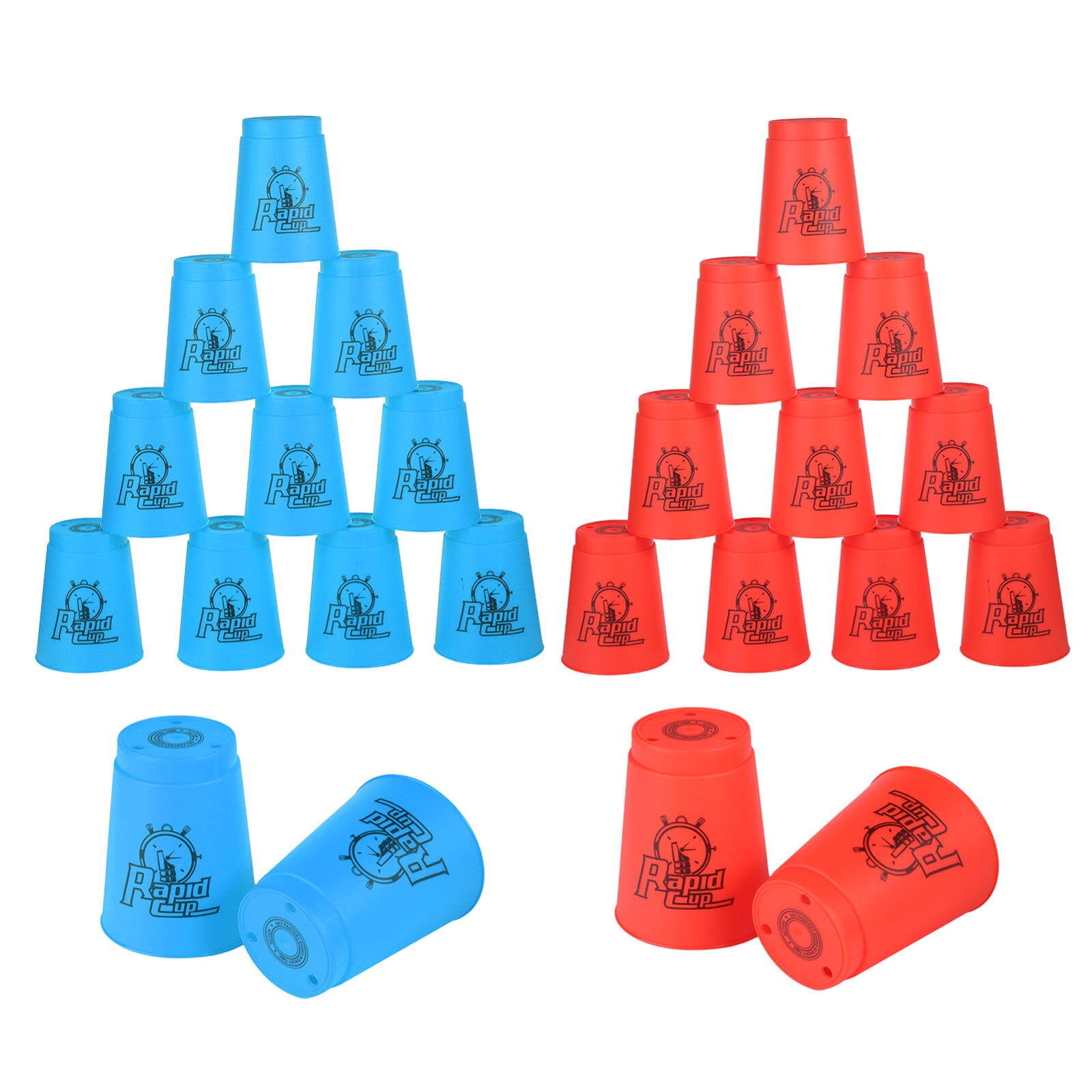
- Sanctioned Stacking Cups: Specially molded plastic cups feature air vents in the bottom to prevent vacuum pressure from causing cups to stick together. They also include textured exteriors for grip and reinforced rims to maintain structural shape under rapid physical contact.
- Precision Timing Systems: Competitors execute stacks on a specialized pressure-sensitive mat paired with an electronic digital timer (commonly known as a StackMat). The timer starts when the competitor lifts both hands off the sensor pads and stops the instant both hands return to the pads following the completion of the required sequence.
- Padded Stacking Surfaces: Competitions require a padded neoprene mat beneath the cups to prevent sliding, reduce noise, and ensure consistent bounce dynamics during rapid maneuvers.
3-3-3 Event: [3 Cups] [3 Cups] [3 Cups] 3-6-3 Event: [3 Cups] [6 Cups] [3 Cups] Cycle Event: 3-3-3 --> 3-6-3 --> 1-10-1 (downstacked back to 3-6-3)
Core Competition Events
WSSA competitions feature individual, doubles, and relay events. Each event requires stacking and downstacking specific cup pyramids in predefined sequences as quickly as possible without knocking over or misplacing cups.
- The 3-3-3 Stack: The competitor stacks and downstacks three pyramids constructed from three cups each (working left-to-right or right-to-left, maintaining consistent directional flow).
- The 3-6-3 Stack: The competitor stacks and downstacks three pyramids composed of three cups on the left, six cups in the center, and three cups on the right.
- The Cycle Stack: A continuous sequence combining a 3-3-3 stack, a 3-6-3 stack, and a 1-10-1 stack (a twelve-cup sequence consisting of a ten-cup pyramid flanked by individual cups used for turning), concluding with the cups returned to their original nested 3-6-3 starting position.
- Doubles and Relays: Two stackers work together (each using only one hand) to complete a Cycle stack in doubles, while four-person relay teams complete 3-6-3 stacks in a timed head-to-head format.
Why Sport Stacking Is Not Recognized by the IOC
The path to becoming an Olympic sport is defined by the International Olympic Committee through specific criteria set forth in the Olympic Charter. While sport stacking meets some basic requirements of athletic competition—such as standardized rules, global presence, and anti-discrimination policies—it faces substantial structural hurdles regarding full Olympic inclusion.
1. International Federation Recognition
To be considered for the Olympic Games, a sport must be governed by an independent International Federation (IF) recognized by the IOC. The IF must be affiliated with bodies like the Association of IOC Recognised International Sports Federations (ARISF).
Although the WSSA functions effectively as a global governing organization, it has not officially applied for or achieved IOC-recognized IF status. Furthermore, international sports federations must operate completely independently from commercial equipment manufacturers. Because sport stacking equipment is heavily linked to commercial entity production and licensing, fulfilling strict IOC independence standards presents administrative complexities.
2. World Anti-Doping Code Compliance
Olympic recognition requires an international federation to become a full signatory to the World Anti-Doping Agency (WADA) Code. Signatories must implement out-of-competition testing, maintain registered testing pools, and establish formal anti-doping educational frameworks. The WSSA does not currently participate in the WADA testing program.
3. Geographic Breadth and Participation Demographics
Rule 45 of the Olympic Charter historically established minimum global participation thresholds: a sport must be widely practiced by men in at least 75 countries across four continents and by women in at least 40 countries across three continents. While sport stacking is practiced in over 50 countries, concentrated competitive registration remains heavily tied to school physical education programs in North America, Asia, and Western Europe, rather than adult elite sporting clubs.
4. Physicality, Media Appeal, and Program Constraints
The IOC evaluates candidate sports on physical exertion, spectator interest, television broadcast viability, and alignment with youth culture. Additionally, the Summer Olympic program is capped at approximately 10,500 athletes and 310 events. To add a new sport, the IOC or an Olympic host city must typically replace or trim existing event allocations.
Comparing Sport Stacking to Recognized and Candidate Sports
To contextualize sport stacking's current position within global athletics, it is helpful to compare its governance and Olympic status with other non-traditional or emerging speed-based and precision disciplines.
| Sport / Discipline | International Governing Body | IOC Recognized Federation? | Olympic Status (as of 2026) | Primary Hurdle / Driver for Inclusion |
|---|---|---|---|---|
| Sport Stacking | World Sport Stacking Association (WSSA) | No | Not Included | Commercial equipment ties, lack of WADA integration |
| Sport Climbing | International Federation of Sport Climbing (IFSC) | Yes | Full Olympic Program | Strong youth engagement, global participation growth |
| Skateboarding | World Skate | Yes | Full Olympic Program | High broadcast appeal, urban youth culture alignment |
| Breaking (Breakdancing) | World DanceSport Federation (WDSF) | Yes | Included in Paris 2024 (Excluded for 2028) | Host-city inclusion choice, rotational event status |
| Chess | International Chess Federation (FIDE) | Yes | Recognized Non-Olympic Sport | Considered a mental sport rather than physical contest |
| Esports | Various / IOC Esports Commission | Partial (Olympic Esports Series) | Specialized Exhibition Events | Fragmented publisher IP ownership, physical activity debates |
Physical and Cognitive Benefits of Sport Stacking
Even without Olympic status, sport stacking is broadly recognized by physical educators and neuroscientists for its physical and cognitive value. Rather than focusing solely on traditional cardiovascular endurance, sport stacking targets neurological motor skill execution.
Motor Skill Development and Ambidexterity
Sport stacking requires bilateral coordination, forcing athletes to use both the left and right sides of the body equally. Standard stacking patterns mandate alternating hand usage, which builds equal dexterity in both the dominant and non-dominant hands.
Cross-Lateral Brain Stimulation
Executing rapid motor tasks across the body's midline stimulates neural connections between the brain's left and right hemispheres. Studies published in physical education journals indicate that cross-lateral movements used in sport stacking can improve:
- Hand-eye coordination and spatial awareness.
- Reaction times and visual processing speeds.
- Concentration, rhythm, and fine motor sequencing under time pressure.
Inclusivity in Physical Education
Because sport stacking relies on hand-eye coordination rather than body height, physical strength, or contact athleticism, it provides an inclusive platform for athletes of diverse physical abilities, including adaptive athletes and individuals with physical or developmental impairments.
Could Sport Stacking Ever Become an Olympic Sport?
For sport stacking to eventually achieve Olympic inclusion, the sport's leadership would need to complete several formal administrative transitions:
- Restructure Governance Independence: The global governing body would need to establish complete structural separation from commercial gear vendors to mirror models used by traditional international federations.
- Apply for ARISF Recognition: The international federation would need to meet IOC governance criteria, adopt the WADA code, and secure formal recognition under ARISF.
- Seek Inclusion in Multi-Sport Events: A typical intermediate step involves inclusion as a medal sport or demonstration event in major international multi-sport competitions, such as the World Games, Asian Games, or Pan American Games.
- Host-City Nomination Pathway: Under modern Olympic guidelines, Olympic host organizing committees (such as Los Angeles 2028 or Brisbane 2032) have the flexibility to propose short-term inclusion for popular local or emerging sports. If sport stacking builds sufficient global commercial and youth appeal, it could theoretically seek inclusion as a host-nominated event.
While these steps are administratively possible, the immediate trajectory for sport stacking remains focused on expanding school physical education programs, growing the WSSA World Championships, and establishing regional club leagues.
Frequently Asked Questions
What is the official standard name for competitive cup stacking?
The official name for competitive cup stacking is sport stacking. The name was formalized by the World Sport Stacking Association (WSSA) to distinguish structured competitive stacking using engineered gear from informal recreational play.
Who holds the world record for the fastest Cycle stack in sport stacking?
World records in sport stacking are recorded and verified by the WSSA down to thousandths of a second. Records fluctuate as competitors refine techniques, with top overall elite Cycle stack times dropping well below 5.00 seconds. Current official record listings across all divisions are updated on the official WSSA record registry.
What equipment is required to participate in official sport stacking competitions?
Official WSSA-sanctioned events require a set of 12 official stacking cups featuring engineered air vents, an electronic timing device (StackMat) accurate to thousandths of a second, and a textured neoprene mat to maintain stability during speed maneuvers.
How does a sport get added to the Olympic Games program?
A sport must first be governed by an IOC-recognized International Federation that complies with the Olympic Charter and the World Anti-Doping Code. Once recognized, the sport can be recommended by the IOC Program Commission or proposed as an additional event by an individual Olympic host city organizing committee, subject to approval by the IOC Executive Board.
Is sport stacking included in the World Games or X Games?
No, sport stacking is not currently part of the World Games or the X Games. Its major global competitions are held independently under the administration of the World Sport Stacking Association (WSSA), headlined by the annual WSSA World Sport Stacking Championships.
Practical Guidance for Aspiring Competitive Stackers
If you are interested in transitioning from casual cup stacking to formal competitive sport stacking, follow these initial steps:
- Acquire Sanctioned Gear: Ensure your cups and mat meet current WSSA standards so that your practice times translate accurately to formal tournament conditions.
- Master the Basic Sequences: Focus on clean mechanics for the 3-3-3 and 3-6-3 stacks before attempting the Cycle sequence. Minimizing fumbles and missed cup edges yields faster times than simply rushing hand movements.
- Track Official Times: Use an electronic touch timer to measure progress, taking care to keep both hands flat on the sensors before starting and after finishing each stack.
- Locate Local and Regional Events: Check the official WSSA event calendar to find sanctioned local meets, school tournaments, or regional state championships to gain experience under verified judging conditions.
Image Gallery