The 10 Most Terrifying Sea Creatures of the Deep Ocean
The most terrifying sea creatures inhabit the ocean’s darkest depths and coastal reefs, possessing extreme evolutionary adaptations for survival. From the venomous box jellyfish and blue-ringed octopus to abyss-dwelling monstrosities l...
The most terrifying sea creatures inhabit the ocean’s darkest depths and coastal reefs, possessing extreme evolutionary adaptations for survival. From the venomous box jellyfish and blue-ringed octopus to abyss-dwelling monstrosities like the anglerfish, fangtooth, and goblin shark, these organisms feature terrifying appendages, lethal neurotoxins, and nightmare-inducing hunting mechanisms.
Contents
Understanding Ocean Zonation and Evolutionary Extremes
To understand why marine animals develop unnerving physical traits, one must first examine the environments in which they evolved. The ocean is divided into distinct depth layers, each imposing harsh physiological constraints on life:
- Epipelagic Zone (Sunlight Zone: 0 to 200 meters): High sunlight and abundant plant life. High competition drives venomous defenses and extreme camouflage.
- Mesopelagic Zone (Twilight Zone: 200 to 1,000 meters): Sunlight vanishes, temperatures drop, and pressure rises. Organisms rely heavily on bioluminescence and enlarged eyes.
- Bathypelagic Zone (Midnight Zone: 1,000 to 4,000 meters): Total darkness, freezing temperatures, and crushing hydrostatic pressure. Food is scarce, forcing species to evolve opportunistic feeding structures like expandable stomachs and massive jaws.
- Abyssopelagic Zone (The Abyss: 4,000 to 6,000 meters): Near-freezing conditions where organisms exhibit unique physiological adaptations such as deep-sea gigantism and extremely slow metabolisms.
When resources are minimal and darkness is perpetual, evolutionary traits lean heavily toward maximum efficiency. Massive teeth, extendable jaws, bio-chemically potent toxins, and glowing lures are not designed to frighten humans; they are precise biological toolkits built for survival in an uncompromising realm.
The 10 Most Terrifying Sea Creatures Explained
1. The Deep-Sea Anglerfish (Melanocetus johnsonii)
- Bioluminescent Esca
- Needle-Sharp teeth
Living in complete pitch-black darkness between 1,000 and 3,000 meters below the surface, the humpback anglerfish (Melanocetus johnsonii) is the quintessential deep-sea nightmare. The female features an oversized, cavernous mouth filled with translucent, needle-sharp teeth angled inward to prevent any captured prey from escaping.
Its most famous characteristic is the illicium—a modified spine extending from above its snout—tipped with a glowing lure called the esca. The esca houses symbiotic bioluminescent bacteria (Photobacterium) that produce a pale blue-green light. Unwary fish and crustaceans, drawn to the glow in the pitch-black water, swim directly into the anglerfish's strike zone.
Anglerfish also exhibit extreme sexual dimorphism. Males are dwarf organisms lacking the lure and large teeth. Upon finding a female, the male bites into her tissue, releasing enzymes that fuse their circulatory systems together. Over time, the male degenerates into a parasitic appendage, supplying sperm whenever the female spawns.
2. The Goblin Shark (Mitsukurina owstoni)
Often called a "living fossil," the goblin shark (Mitsukurina owstoni) represents a lineage of elasmobranchs that has remained largely unchanged for over 125 million years. Inhabiting continental slopes at depths up to 1,300 meters, this pale pink, flabby-bodied shark possesses an elongated, blade-like snout crammed with ampullae of Lorenzini—electro-receptive organs that detect weak electric fields emitted by hidden prey.
What makes the goblin shark uniquely terrifying is its feeding mechanism. Its jaws are tethered to elastic ligaments. When prey comes within range, the shark hurls its entire jaw apparatus forward at speeds exceeding 3 meters per second, snatching prey with rows of long, nail-like teeth. Once captured, the jaw retracts into its head, returning the shark to its deceptive, sluggish appearance.
3. The Box Jellyfish (Chironex fleckeri)
While deep-sea monsters look horrifying, the Indo-Pacific box jellyfish (Chironex fleckeri) is arguably the most lethal creature in the ocean. Inhabiting coastal waters across Northern Australia and the Indo-Pacific region, this cube-shaped jellyfish is nearly invisible in shallow waters due to its translucent body.
Unlike passive drift jellyfish, Chironex fleckeri is an active swimmer capable of moving at speeds up to 4 knots. It features 24 complex eyes capable of detecting light and navigating around obstacles. Each of its 60 tentacles can extend up to 3 meters long and contains millions of microscopic stinging cells known as nematocysts.
- Tentacle Surface
- Mechanoreceptor Triggered
- High-Pressure Capsule Fires
- Microscopic Dart Injects Venom into Bloodstream
When a tentacle contacts human skin, hyperbaric pressure inside the nematocysts propels venom-coated micro-darts directly into the tissue. The venom contains potent cardiotoxins, neurotoxins, and dermatoxins that trigger rapid cell rupture, excruciated pain, severe hyperkalemia, and potential cardiac failure within minutes.
4. The Fangtooth Fish (Anoplogaster cornuta)
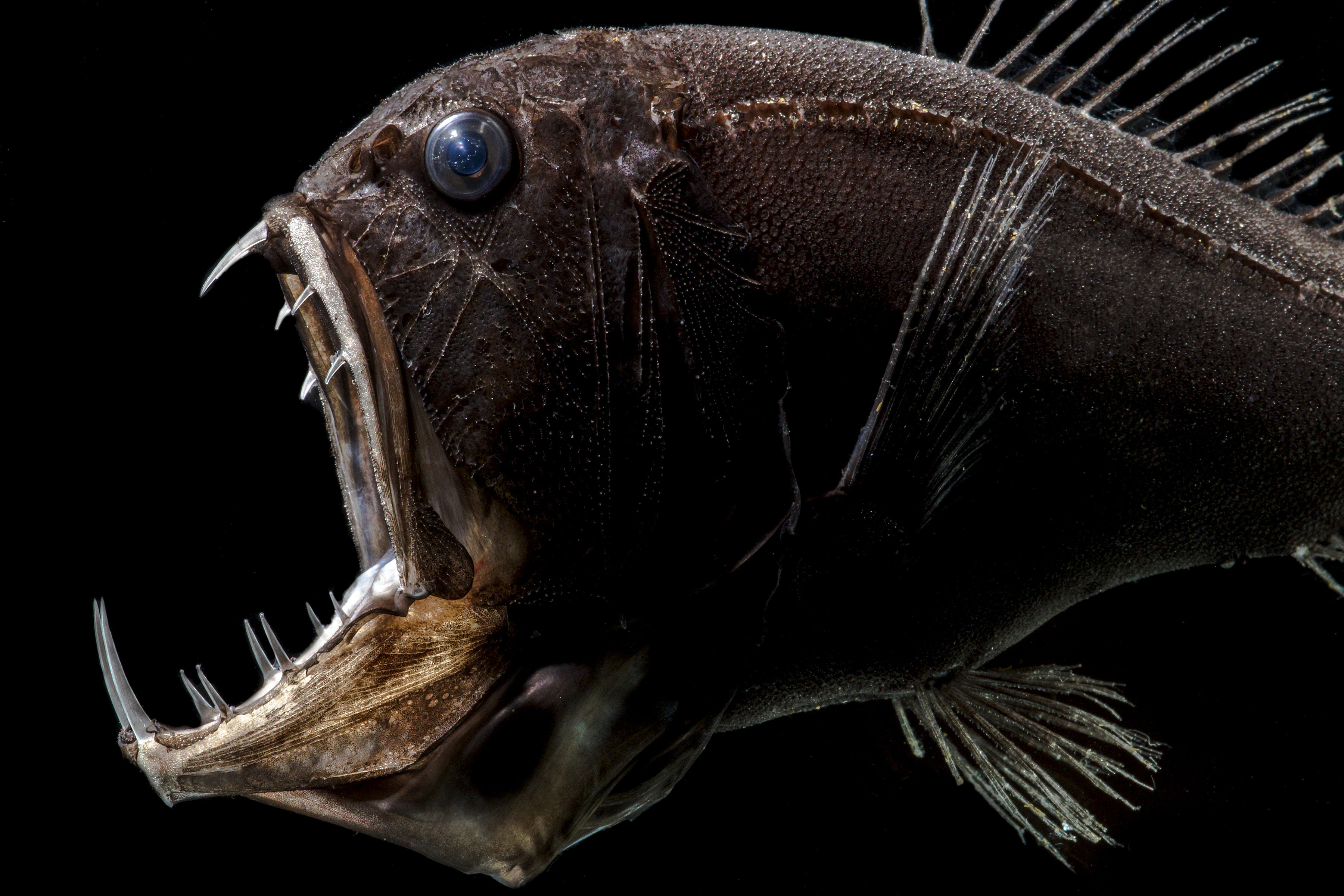
Despite growing to a maximum length of only 16 centimeters, the fangtooth (Anoplogaster cornuta) possesses the largest teeth in the ocean relative to body size. Found at depths down to 5,000 meters, this fish operates under extreme hydrostatic pressure and near-freezing temperatures.
The lower jaw of the fangtooth carries two exceptionally long fangs. To allow the mouth to close completely without piercing its own brain, the fish has evolved socket cavities on either side of its upper palate into which the lower teeth slide.
Because prey is extremely scarce in the bathypelagic zone, the fangtooth is an opportunistic hunter. It will attack virtually anything that crosses its path, including organisms larger than itself, using its lateral line system to detect pressure changes caused by moving prey in total darkness.
5. The Blue-Ringed Octopus (Hapalochlaena)
Found across tidepools and coral reefs in the Pacific and Indian Oceans, the blue-ringed octopus genus (Hapalochlaena) relies on warning signals rather than size to intimidate potential threats. Measuring under 20 centimeters, this mollusk spends most of its time hidden in rock crevices. When threatened, it flashes bright, iridescent blue rings across its skin using specialized pigment cells called chromatophores and iridophores.
The octopus carries a potent weapon: tetrodotoxin (TTX), a neurotoxin produced by symbiotic bacteria in its salivary glands. TTX works by selectively blocking voltage-gated sodium channels along nerve cells, preventing the transmission of electrical signals to muscles.
A single bite from a blue-ringed octopus contains enough TTX to paralyze 26 adult humans. The bite itself is often entirely painless, but symptoms develop rapidly:
- Numbness in the lips and tongue within minutes.
- Loss of motor function and difficulty swallowing.
- Complete skeletal muscle paralysis leading to respiratory arrest while the victim remains fully conscious.
Because there is currently no approved antivenom for tetrodotoxin, survival relies entirely on immediate artificial respiration until the body metabolizes and clears the toxin.
6. Sloane's Viperfish (Chauliodus sloani)
Sloane's viperfish (Chauliodus sloani) is a top predator of the mesopelagic zone, dwelling at depths between 200 and 4,700 meters. This fish features long, fang-like teeth that are so curved and extensive they cannot fit inside its mouth when closed; instead, they curve upward over its eyes.
The viperfish hunts by swimming with its head tilted slightly upward, using a long modified dorsal ray equipped with a glowing photophore to lure prey. To swallow large prey whole, its skull tilts upward on a specialized jaw hinge, while its heart and major arteries shift position to avoid damage during ingestion. Furthermore, the viperfish's first vertebra acts as a shock absorber to cushion its brain against violent impacts during a strike.
7. The Frilled Shark (Chlamydoselachus anguineus)
The frilled shark (Chlamydoselachus anguineus) resembles a strange hybrid of a snake, an eel, and a prehistoric shark. Inhabiting deep waters along outer continental shelves, this species retains primitive traits reminiscent of ancient Devonian fish, including six pairs of frilly gill slits across its throat.
- Individual Tooth Profile:
- 3 Trident Cusps
The shark's jaw contains approximately 300 individual teeth arranged across 25 rows. Each tooth features three sharp, needle-like points (tridentate structure) that face backward toward its throat. When a frilled shark strikes using its flexible, eel-like body, prey items caught by the teeth are pulled inward with every movement, making escape virtually impossible.
8. The Giant Isopod (Bathynomus giganteus)
A striking example of deep-sea gigantism, the giant isopod (Bathynomus giganteus) is a crustacean related to common terrestrial pill bugs. Operating at depths ranging from 170 to 2,100 meters, where pressure exceeds 200 atmospheres, these scavengers grow up to 50 centimeters in length and weigh over 1.5 kilograms.
Giant isopods roam the ocean floor feeding on fallen organic material, including whale carcasses, sunken fish, and cephalopod remains. Their bodies are protected by a thick, calcified chitinous exoskeleton made of overlapping segments. They possess complex compound eyes with over 4,000 individual facets, allowing them to spot faint luminescent signals in the dark.
Because food falls to the abyssal floor unpredictably, giant isopods have evolved to endure long periods of starvation; individuals in controlled laboratory environments have survived up to five years without eating.
9. The Sarcastic Fringehead (Neoclinus blanchardi)
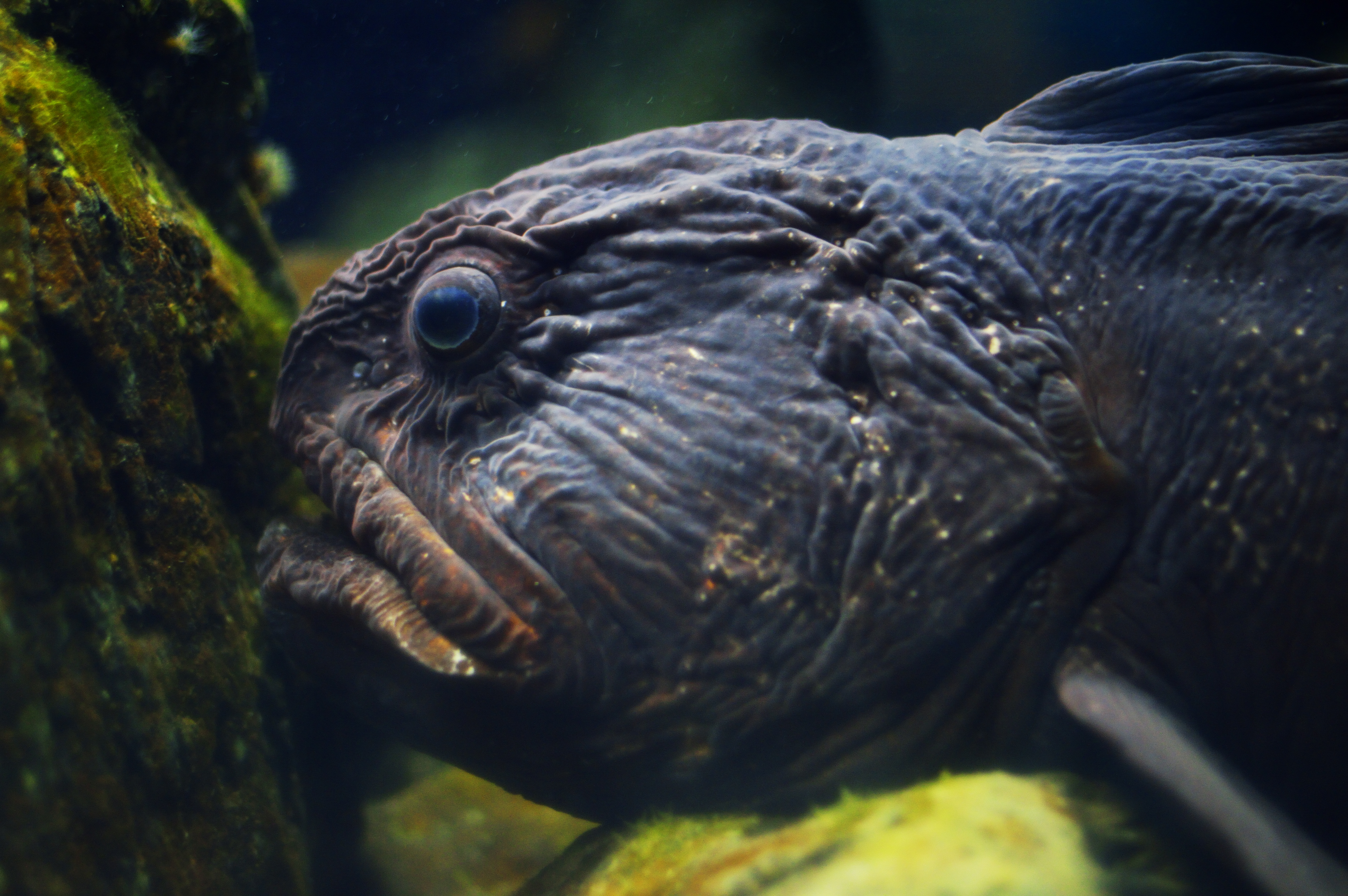
The sarcastic fringehead (Neoclinus blanchardi) is a small but exceptionally aggressive fish found along the Pacific coast of North America at depths of 3 to 70 meters. Resting inside empty clam shells, rock crevices, or discarded man-made debris, this creature vigorously defends its territory against intruding fish, divers, and competitors.
When another fringehead challenges its territory, the fish engages in a mouth-flaring display. It unfolds huge, brightly colored membranes along its cheeks, expanding its gape to several times its normal width. If neither fish backs down, they press their expanded mouths together in a wrestling match to establish dominance.
10. The Giant Squid (Architeuthis dux)
The giant squid (Architeuthis dux) is an elusive deep-ocean predator capable of reaching lengths up to 13 meters for females. Living at depths between 300 and 1,000 meters, this cephalopod possesses the largest eyes in the animal kingdom, measuring up to 27 centimeters in diameter—roughly the size of a dinner plate. These massive eyes allow it to detect faint bioluminescent flashes caused by moving predators like the sperm whale (Physeter macrocephalus).
The giant squid hunts using two long feeding tentacles equipped with hundreds of sharp, serrated suckers. Each sucker is lined with a ring of hard chitinous teeth designed to latch onto slippery prey. Once captured, prey is drawn to a central parrot-like beak capable of slicing through muscle tissue and dense bone.
Structural Comparison of Ocean Predators
The table below outlines key biological parameters, depth zones, and primary survival mechanisms for these ten marine species:
| Species Name | Common Name | Primary Depth Range | Defining Physical Trait | Primary Weapon / Mechanism |
|---|---|---|---|---|
| Melanocetus johnsonii | Humpback Anglerfish | 1,000 to 3,000 m | Bioluminescent lure (esca) | Inward-curved translucent fangs |
| Mitsukurina owstoni | Goblin Shark | 200 to 1,300 m | Extendable, slingshot jaw | Nail-like teeth with ampullae sensing |
| Chironex fleckeri | Box Jellyfish | 0 to 10 m | Translucent cube-shaped bell | Cardiotoxic nematocyst arrays |
| Anoplogaster cornuta | Fangtooth Fish | 500 to 5,000 m | Massive lower fangs | Socketed jaws for brain protection |
| Hapalochlaena spp. | Blue-Ringed Octopus | 0 to 50 m | Flashing iridescent blue rings | Tetrodotoxin neurotoxin |
| Chauliodus sloani | Sloane's Viperfish | 200 to 4,700 m | Overgrown fang jaw | Hinged skull with shock absorber spine |
| Chlamydoselachus anguineus | Frilled Shark | 50 to 1,500 m | Eel-like body with 6 gill slits | 300 tridentate backward-facing teeth |
| Bathynomus giganteus | Giant Isopod | 170 to 2,100 m | Enlarged chitinous exoskeleton | Deep-sea scavenging gigantism |
| Neoclinus blanchardi | Sarcastic Fringehead | 3 to 70 m | Massive wide-flaring mouth | High territorial jaw-wrestling |
| Architeuthis dux | Giant Squid | 300 to 1,000 m | Dinner-plate sized eyes | Serrated chitin-ringed suckers |
Why Do Deep-Sea Animals Look So Frightening?
The frightening appearances of these species stem directly from biological adaptations required to conquer extreme marine environments.
Bioluminescence as a Survival Tool
In the mesopelagic and bathypelagic zones, sunlight fails to penetrate. Animals use chemical bioluminescence—typically generated through luciferin-luciferase reactions—for counterillumination camouflage, prey attraction, or species recognition. For research into how bioluminescence functions across marine taxa, explore the NOAA Ocean Exploration Portal.
Extreme Jaw Mechanics
Because prey encounters in the deep ocean are rare, predators cannot afford to lose an opportunity to feed. As a result, species like the goblin shark, viperfish, and anglerfish evolved expandable stomachs and unhinging jaws that accommodate prey items equal to or larger than their own body mass.
Deep-Sea Gigantism
Deep-sea gigantism is a biological phenomenon where invertebrates and cold-blooded vertebrates attain much larger sizes than their shallow-water relatives. Hypotheses published by marine institutions like the Smithsonian Ocean Initiative attribute this to lower ambient temperatures (which decrease metabolic rates), reduced predation pressure, and cell size expansion driven by high hydrostatic pressure.
Safety and Guidance for Coastal Explorers
While most deep-sea creatures remain inaccessible to humans without submersibles, several hazardous species inhabit shallow reefs, tide pools, and open ocean waters. Understanding proper safety procedures minimizes risks during aquatic activities:
- Coastal Marine Safety Protocol
- Tropical Reefs / Tidepools
- Avoid handling small cephalopods
- Wear protective footwear on rocks
- Never touch flashing or bright marine life
- Open Coastal Waters
- Swim in patrolled zones
- Heed stinger suit warnings
- Avoid swimming during blooms
- Tropical Reefs / Tidepools
- Maintain Distance from Venomous Species: Never touch small marine animals displaying bright colors or warning signals. The blue-ringed octopus often rests inside decorative shells in shallow tidepools.
- Wear Protective Gear in Stinger Zones: When swimming in tropical waters (such as Northern Australia or Southeast Asia) during box jellyfish season, wear full-body lycra or neoprene stinger suits.
- Seek Immediate Medical Assistance:
- Box Jellyfish Stings: Flush the wound immediately with vinegar (acetic acid) to neutralize un-fired nematocysts. Seek emergency medical care immediately for artificial life support and antivenom administration.
- Blue-Ringed Octopus Bites: Begin artificial respiration immediately if breathing becomes labored. Maintain cardiopulmonary support until emergency services arrive.
Frequently Asked Questions
Which sea creature is the most dangerous to humans?
The Indo-Pacific box jellyfish (Chironex fleckeri) is considered the most dangerous marine animal. Its venom can cause severe cardiac arrest and death within two to three minutes. Unlike deep-sea predators, box jellyfish inhabit shallow coastal zones where humans swim, increasing the frequency of encounters.
Why do deep-sea fish have translucent or reddish skin?
Red light waves do not reach deep ocean waters because long wavelengths of light are absorbed near the surface. As a result, red-colored animals appear pitch black in the abyss, providing optimal camouflage against predators equipped with bioluminescent searchlights.
Can deep-sea creatures like the fangtooth or anglerfish survive near the surface?
No. Deep-sea creatures have adapted to immense hydrostatic pressures. When brought to the surface, the rapid decrease in ambient pressure causes cellular damage, tissue expansion, and metabolic failure. Furthermore, warmer surface temperatures rapidly degrade their cold-adapted enzymes.
What is the difference between venomous and poisonous marine animals?
Venomous animals (like the box jellyfish and blue-ringed octopus) actively inject toxins into victims using specialized apparatuses such as nematocysts, fangs, or teeth. Poisonous animals (like pufferfish containing tetrodotoxin in their organs) cause harm passively when ingested or touched.
Has a giant squid ever attacked a human?
There are no verified records of a giant squid (Architeuthis dux) attacking or consuming a human. Giant squids live at depths exceeding 300 meters, making natural encounters with humans extremely rare. Most historical encounters involve dead or dying specimens washed ashore.
Summary and Key Takeaways
The terrifying adaptations of marine organisms highlight the remarkable diversity of life on Earth. While shallow-water species rely on neurotoxins and warning signals to defend their territories, deep-sea organisms utilize bioluminescent lures, expandable jaws, and enlarged teeth to maximize hunting efficiency in an environment devoid of light. Respecting these natural adaptations allows scientists and explorers to safely observe and study ocean life.
Image Gallery