Architecting High-Availability Live Incident Management Frameworks in 2026
Effective live incident response remains the definitive metric of operational maturity for modern digital infrastructures. As enterprise systems scale across multi-cloud and hybrid environments in 2026, minor architectural anomalies fr...
Effective live incident response remains the definitive metric of operational maturity for modern digital infrastructures. As enterprise systems scale across multi-cloud and hybrid environments in 2026, minor architectural anomalies frequently cascade into widespread service degradations. Managing a live incident requires moving past reactive firefighting into disciplined, framework-driven triage. Modern reliability engineering frameworks demand precise orchestration across observability pipelines, incident command structures, and post-event remediation cycles to protect Service Level Objectives (SLOs).
Contents
Modern operations teams face mounting complexity driven by distributed microservices, ephemeral workloads, and automated continuous deployment pipelines. When a live incident strikes, organizations cannot rely on ad-hoc communication channels or unstructured debugging. Implementing an enterprise-grade incident management lifecycle ensures rapid detection, containment, resolution, and learning. This guide explores the technical methodologies, communication protocols, and tooling standards required to maintain operational resilience during active production failures.
Deconstructing the Live Incident Lifecycle
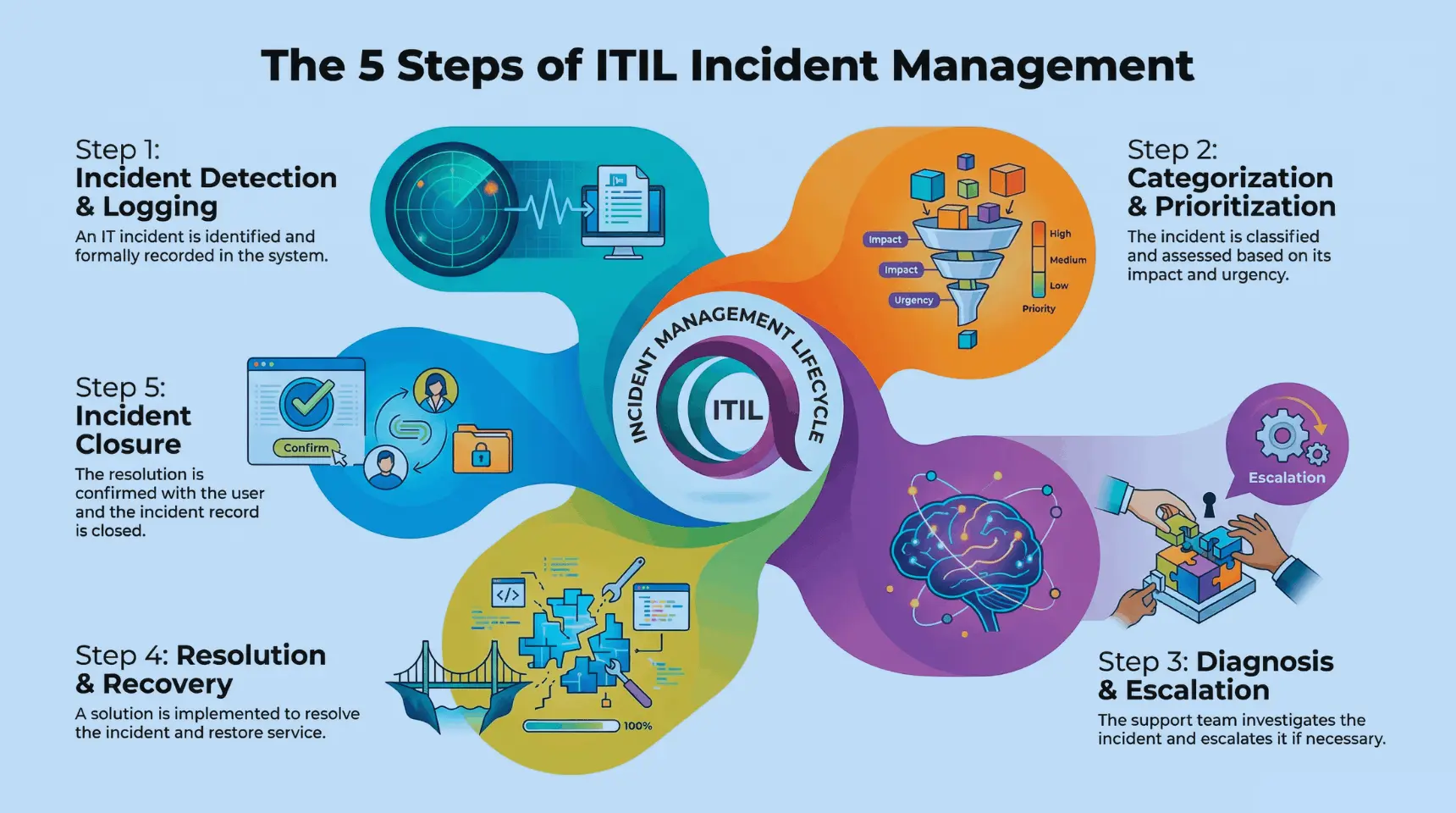
An effective incident lifecycle transforms chaotic system failures into managed, predictable workflows. Every live incident transitions through distinct phases, each requiring specific technical inputs, toolsets, and communication protocols. Understanding these phases allows response teams to shorten Mean Time to Detect (MTTD) and Mean Time to Resolution (MTTR).
- Detection and Alerting: Automated monitoring platforms capture anomalies through synthetic monitoring, log aggregation, and real-time metric thresholds, triggering automated paging systems.
- Triage and Classification: On-call engineers assess the blast radius, service impact, and severity level to establish an initial Incident Command structure.
- Containment and Mitigation: Teams execute pre-approved runbooks, feature flag toggles, or traffic shifting to halt the spread of the failure and restore partial functionality.
- Resolution and Verification: Root causes are addressed permanently, and verification steps confirm normal operating conditions across all dependent services.
- Post-Incident Review: A blameless retrospective identifies systemic vulnerabilities, resulting in actionable engineering tickets to prevent recurrence.
Incident Severity Matrix and Escalation Tiers
Categorizing a live incident accurately prevents alert fatigue while ensuring severe operational outages receive immediate executive and technical focus. Organizations must establish clear, objective criteria for classifying incidents based on user impact, financial loss, and data integrity risks.
| Severity Level | User Impact Criteria | Response Time SLA | Required Roster Roles |
|---|---|---|---|
| Sev-1 (Critical) | Total outage of core revenue-generating systems or widespread data corruption. | Immediate (< 5 minutes) | Incident Commander, Tech Lead, Comms Lead, C-Suite Update |
| Sev-2 (Major) | Core functionality impaired for a significant subset of users; no immediate workaround. | < 15 minutes | Incident Commander, Primary On-Call, Secondary Support |
| Sev-3 (Moderate) | Minor feature degradation, internal tooling failure, or isolated user impact with workaround. | < 1 hour | Single Engineer On-Call |
| Sev-4 (Low) | Cosmetic issues, non-blocking bugs, or non-production environment anomalies. | Next Business Day | Standard Ticketing Queue |
Technical Diagnostics and Observability Best Practices
During a live incident, telemetry data serves as the single source of truth. Engineers must quickly navigate through mountains of telemetry data without getting lost in operational noise. Modern observability stacks rely on the three pillars: metrics, logs, and traces, augmented by continuous profiling and real-time user monitoring (RUM).
Leveraging Distributed Tracing Under Pressure
Distributed tracing reveals the exact execution path of a request across dozens of microservice boundaries. When investigating a latency spike or cascading failure, engineers should immediately filter traces by error status codes and high latency percentiles (p99). Identifying the outermost span where the error rate spikes isolates the failing service or third-party dependency.
Effective Log Querying Strategies
Unstructured log analysis wastes precious seconds during a high-severity incident. Response teams should utilize structured JSON logging standards that include correlation IDs, service names, and explicit error codes. Querying logs should focus on rate-of-change anomalies rather than absolute error counts, identifying when a specific error signature deviates from its baseline historical frequency.
Communications Protocol and Stakeholder Management
Technical resolution is only half the battle during a live incident; managing internal and external communication is equally critical. Technical teams often fail because they lack a structured framework for keeping stakeholders informed. Clear lines of communication prevent duplicate troubleshooting efforts and manage customer expectations effectively.
Operational Communication Guidelines:
Designate a Communications Lead: The Incident Commander must assign a dedicated scribe and communicator to handle status page updates and executive summaries, freeing technical engineers to focus entirely on remediation.
Maintain Single Sources of Truth: All updates must be centralized in a dedicated incident bridge channel and public status page. Avoid fragmented direct messages and scattered text threads.
Standardize Update Frequency: Provide structured status updates every 30 minutes for Sev-1 incidents, detailing current impact, actions taken, and estimated time to resolution when available.
Advanced Mitigation Strategies and Fallback Architectures
When live incidents threaten core infrastructure, standard troubleshooting may take too long. Engineers must rely on aggressive, pre-tested mitigation patterns designed to shed load, isolate faults, and preserve system integrity.
- Circuit Breakers: Automatically trip when downstream service failure rates exceed threshold limits, failing fast to prevent thread pool exhaustion and cascading system-wide crashes.
- Graceful Degradation: Disable non-critical features, such as personalized recommendations or analytics tracking, to preserve core transaction processing capacity.
- Traffic Shifting and Blue-Green Rollbacks: Instantly route traffic away from a failing deployment cluster back to the previous stable release artifact via load balancer configurations.
- Rate Limiting and Shedding: Drop incoming requests that exceed system capacity, prioritizing authenticated or premium tier traffic over unauthenticated scrapers.
Frequently Asked Questions About Live Incident Management
What is the primary objective of an Incident Commander during a live incident?
The Incident Commander directs the high-level response strategy, delegates technical tasks, manages communication, and ensures the engineering team follows established runbooks without getting bogged down in low-level debugging.
How do modern teams distinguish between a Sev-1 and a Sev-2 incident?
Sev-1 incidents involve complete outages of core revenue-generating systems or severe data loss risks affecting a vast majority of users, whereas Sev-2 incidents impact specific features or smaller user subsets with viable workarounds available.
What should be included in every post-incident review meeting?
A comprehensive post-incident review must include a precise timeline of events, identification of the root cause, immediate remediation steps taken, and preventative action items assigned to specific owners with strict delivery deadlines.
How can organizations reduce Mean Time to Detect (MTTD)?
Reducing MTTD requires implementing comprehensive automated synthetic testing, setting up anomaly-based alerting thresholds on key business metrics, and ensuring all critical microservices emit standardized health check telemetry.
Why are traditional blameworthy post-mortems discouraged in reliability engineering?
Blameworthy reviews drive fear, discourage transparent reporting of near-misses, and hide systemic architectural flaws, whereas blameless post-mortems focus on process and system improvements that foster a sustainable culture of reliability.
Securing Long-Term System Reliability
Mastering live incident response requires continuous refinement of tooling, rigorous testing of failure modes through chaos engineering, and a commitment to blameless operational learning. By establishing clear severity matrices, enforcing strict communication protocols, and prioritizing robust observability pipelines, engineering organizations can minimize downtime and build enduring user trust in an increasingly complex digital landscape.
Image Gallery