Google Bid Management: Strategies for Maximizing ROI in 2026
Google bid management is the process of setting, monitoring, and adjusting the amounts you pay for ad placements within the Google Ads ecosystem to achieve specific marketing objectives. By optimizing bids based on performance data and...
Google bid management is the process of setting, monitoring, and adjusting the amounts you pay for ad placements within the Google Ads ecosystem to achieve specific marketing objectives. By optimizing bids based on performance data and real-time signals, advertisers can maximize their return on investment (ROI), lower acquisition costs, and ensure their ads appear to the most relevant audiences at the most cost-effective moments.
Contents
As we move through 2026, the landscape of Google bid management has shifted significantly toward automated, AI-driven solutions. However, the fundamental goal remains unchanged: ensuring that every dollar spent on a click or conversion contributes to the bottom line. This guide explores the mechanisms of modern bidding, the transition from manual control to algorithmic precision, and the best practices for managing bids in an increasingly automated environment.
The Evolution of Google Bid Management
In the early years of search engine marketing, bid management was primarily a manual, "set-and-forget" task. Advertisers would select a maximum cost-per-click (CPC) for a keyword and adjust it based on basic metrics like average position. Today, the concept of "average position" has long been retired, replaced by metrics focused on impression share and conversion value.
Modern bid management is defined by auction-time bidding. Unlike manual changes that might occur once a day or once a week, Google’s algorithms now evaluate millions of signals in the millisecond before an ad is served. These signals include the user's location, time of day, device, intent, browser, and historical behavior. Effective bid management in 2026 is less about choosing a number and more about choosing the right strategy and feeding the system high-quality data.
Manual vs. Automated Bidding: Selecting the Right Approach
Despite the prevalence of AI, the choice between manual and automated bidding is still a strategic decision for PPC (Pay-Per-Click) managers.
Manual CPC Bidding
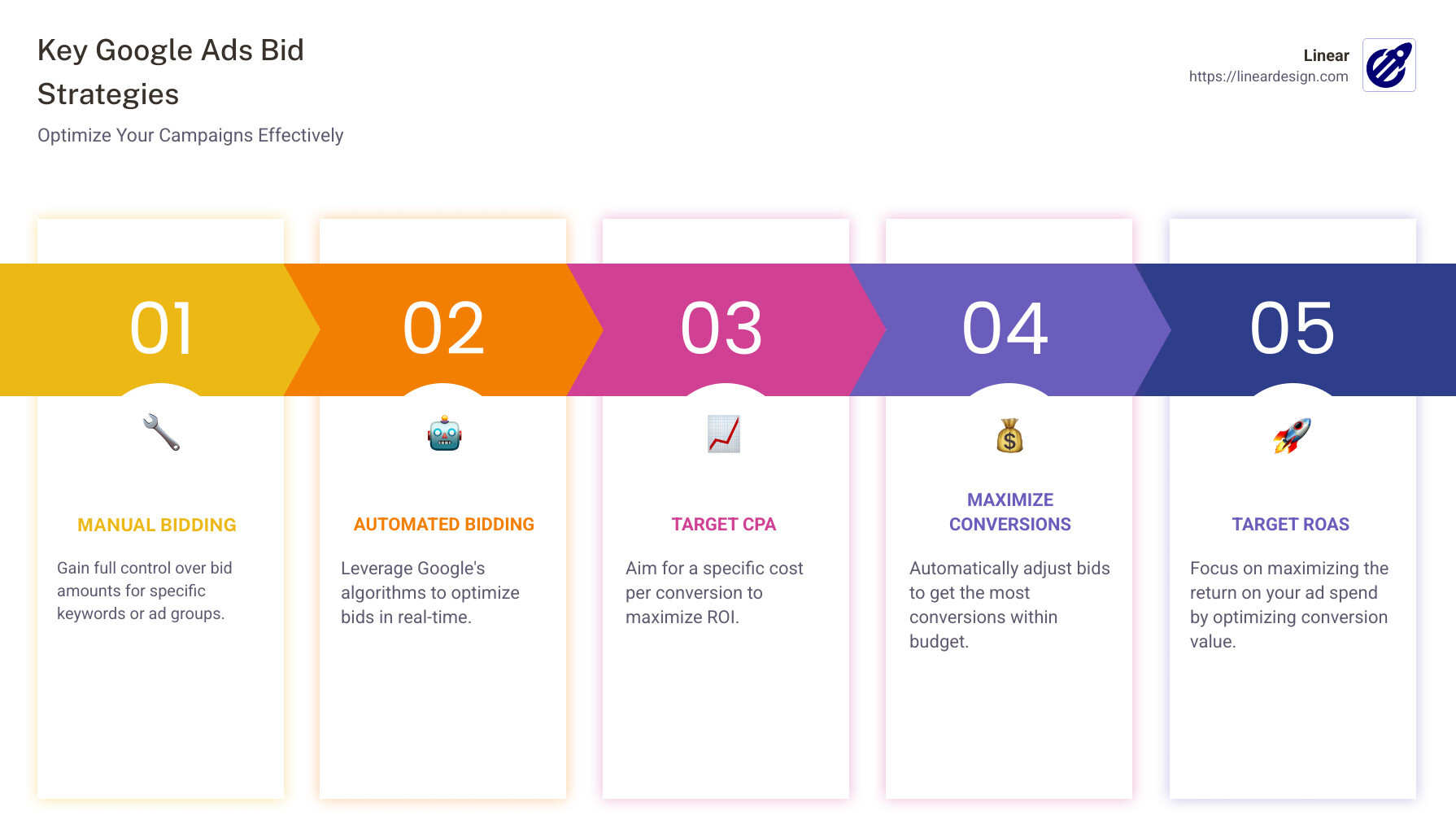
Manual bidding allows advertisers to set a maximum price for each click at the keyword or ad group level. While it offers the highest level of control, it is labor-intensive and lacks the ability to adjust for user-specific signals at the moment of the auction.
- Best for: Small accounts with very limited budgets, campaigns where every penny must be accounted for, or new accounts with no historical conversion data.
- Limitations: It cannot react to real-time competition or user intent changes, often leading to missed opportunities or overpayment for low-value traffic.
Automated (Smart) Bidding
Smart Bidding uses Google’s machine learning to optimize for conversions or conversion value. By 2026, these algorithms have become highly sophisticated, incorporating Gemini-based predictive modeling to forecast the likelihood of a conversion.
- Best for: Most businesses aiming for scale, efficiency, and ROI. It is particularly effective for accounts that have at least 30 conversions per month to provide the algorithm with sufficient training data.
- Benefits: Saves time, scales across thousands of keywords, and uses "auction-time" data that humans cannot access.
Core Smart Bidding Strategies
To manage bids effectively, you must align your strategy with your specific business goals. Google classifies its primary automated strategies under the "Smart Bidding" umbrella.
1. Target CPA (Cost-Per-Action)
This strategy sets bids to get as many conversions as possible at or below the target cost-per-acquisition you set. If you know that a lead is worth $50 to your business, setting a Target CPA of $40 ensures a margin of safety while maintaining volume.
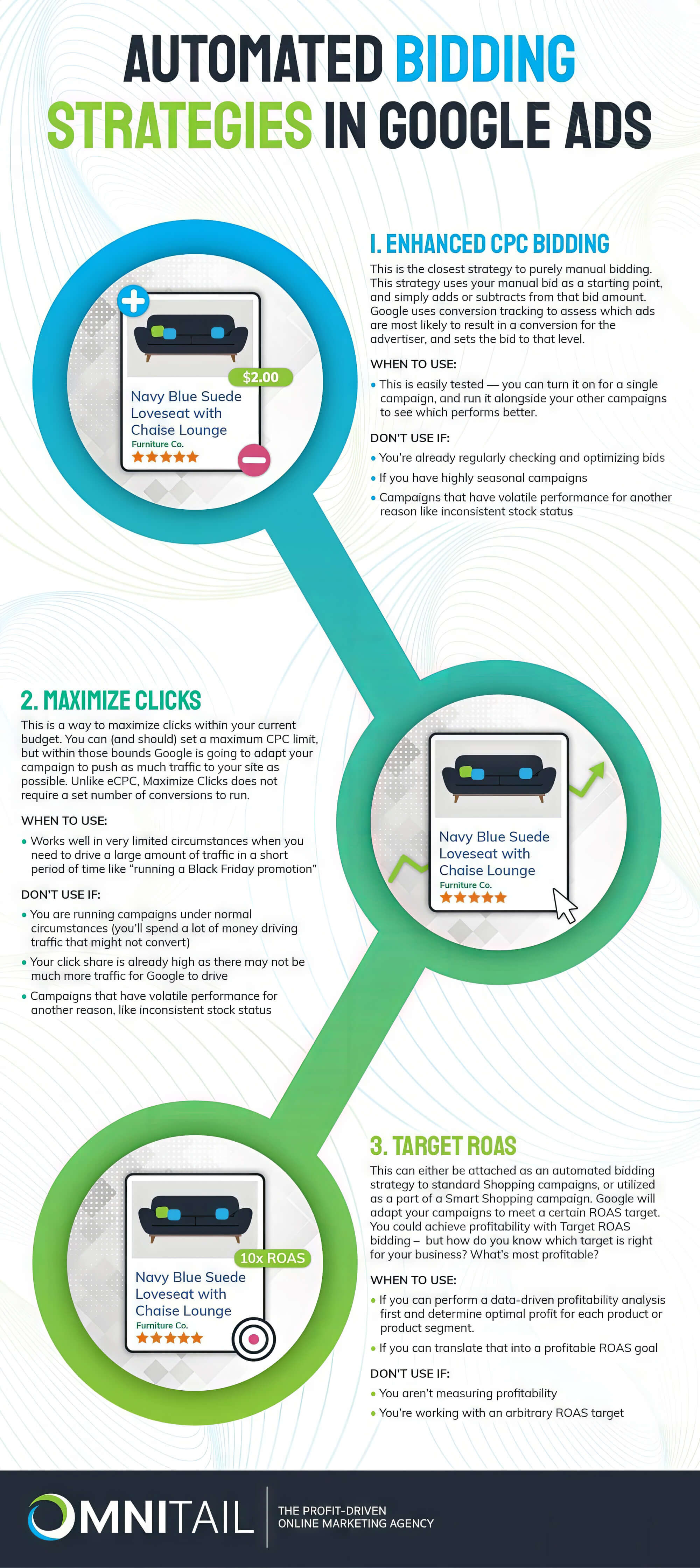
2. Target ROAS (Return on Ad Spend)
Commonly used by e-commerce retailers, Target ROAS focuses on the value of the conversion rather than just the count. If you want $5 in revenue for every $1 spent, you set a 500% Target ROAS. The system will bid higher for users likely to make large purchases and lower for "window shoppers."
3. Maximize Conversions
This strategy is designed to spend your entire daily budget while capturing the highest number of conversions possible. It does not consider a specific CPA goal, making it useful for brands that want to aggressive capture market share or clear out inventory.
4. Maximize Conversion Value
Similar to Maximize Conversions, this strategy focuses on spending the budget to generate the highest possible total revenue. It is the default choice for many high-growth e-commerce brands in 2026.
The Role of First-Party Data and Value-Based Bidding
In 2026, the competitive edge in bid management has moved from "how you bid" to "what data you provide." This is known as Value-Based Bidding (VBB).
Because privacy regulations and the phase-out of third-party cookies have limited the tracking of users across the web, Google’s bidding algorithms rely more heavily on the first-party data advertisers upload. By importing data from your CRM (Customer Relationship Management) system—such as offline sales, lead quality scores, or customer lifetime value—you can train the bidding algorithm to ignore "cheap" leads and focus on high-value prospects.
For example, if a law firm knows that a "Consultation Request" from an organic search is worth more than a "Newsletter Sign-up," they can assign different weights to these conversions. The bid management system will then automatically prioritize spending on the traffic that generates consultations.
Comparison of Bidding Strategies by Goal
| Goal | Best Bidding Strategy | Primary Metric | Best Use Case |
|---|---|---|---|
| Lead Generation | Target CPA | Cost per Lead | Professional services (Legal, SaaS, Medical). |
| E-commerce Revenue | Target ROAS | Revenue / Spend | Retailers with varying product prices. |
| Market Penetration | Maximize Conversions | Conversion Volume | New product launches or seasonal liquidations. |
| Brand Awareness | Target Impression Share | Top of Page % | High-end luxury brands or defensive brand campaigns. |
| Strict Budget Control | Manual CPC | Max CPC | Very small budgets or highly niche B2B keywords. |
Advanced Bid Management Techniques
For enterprise-level accounts, standard automated bidding is often supplemented by advanced techniques to maintain a competitive advantage.
Portfolio Bidding Strategies
A Portfolio Bidding Strategy allows you to group multiple campaigns together and apply a single bidding goal across them. This is particularly useful for campaigns that share a budget or have similar conversion goals, as it pools data to help the algorithm learn faster. It also allows for "Min/Max" CPC limits, providing a safety net that standard Smart Bidding lacks.
Google Ads Scripts
For technical PPC managers, scripts remain a powerful tool in 2026. Scripts are snippets of JavaScript code that can automate bid adjustments based on external factors like weather patterns, stock market fluctuations, or internal inventory levels. If a retail store runs out of a specific SKU, a script can instantly lower the bids for that product's keywords to zero.
Seasonality Adjustments
While Smart Bidding accounts for historical trends, it may not anticipate a sudden, short-term spike in traffic (e.g., a 48-hour flash sale). Seasonality adjustments are tools within Google Ads that tell the algorithm to expect a higher conversion rate for a specific period, preventing the system from "over-learning" from a temporary anomaly.
Common Mistakes in Google Bid Management
Even with advanced AI, human oversight is necessary to prevent budget waste.
- Adjusting Targets Too Frequently: Smart Bidding requires a "learning phase" (usually 7–14 days). Changing a Target ROAS or CPA every three days resets this phase, leading to volatile performance and higher costs.
- Neglecting Conversion Tracking: Bidding algorithms are only as good as the data they receive. If your conversion tracking is broken or double-counting, the system will bid aggressively for worthless traffic.
- Ignoring Negative Keywords: High bids on irrelevant terms can drain a budget quickly. Bid management must be paired with robust negative keyword lists to ensure you aren't paying a premium for "junk" searches.
- Setting Unrealistic Targets: If your historical CPA is $100 and you set a Target CPA of $20, the algorithm will likely stop serving your ads because it cannot find auctions that meet that impossible threshold.
Frequently Asked Questions
How long does the "learning phase" last in 2026?
The learning phase typically lasts between 7 and 14 days, depending on conversion volume. During this time, Google Ads explores different auction environments to see which users are most likely to convert. It is critical to avoid making significant changes to the budget or bidding targets during this window, as it can delay the optimization process and lead to inefficient spending.
Can I use third-party bid management tools with Google Ads?
Yes, tools like Search Ads 360, Optmyzr, and various AI-driven platforms are still widely used. These tools offer cross-channel management and more granular reporting than the native Google Ads interface. However, for most small to medium businesses, Google's native Smart Bidding has become so effective that third-party tools are often better utilized for reporting and "guardrail" automation rather than the core bidding logic itself.
What is the difference between Target CPA and Maximize Conversions with a cap?
Maximize Conversions will attempt to spend your entire daily budget to get the most conversions possible. If you add a "Target CPA" to that strategy, it instructs the system to prioritize volume but stay within that price limit. Without the cap, the system might spend $200 on a single conversion if it believes that is the only way to exhaust the budget, whereas Target CPA provides a efficiency constraint.
Does Quality Score still affect my bids in 2026?
Absolutely. Quality Score remains a fundamental component of the Ad Rank formula (Ad Rank = Bid × Quality Score). A higher Quality Score—driven by ad relevance and landing page experience—allows you to win higher positions at lower costs than competitors with poor-quality ads. Efficient bid management is impossible without also optimizing for quality.
Should I use Smart Bidding for brand campaigns?
It depends on your goal. If your goal is to protect your brand name from competitors, "Target Impression Share" is often the best choice, as it ensures your ad appears at the very top of the page regardless of the conversion likelihood. However, if your brand terms drive a high volume of sales, Target ROAS can help you maximize the revenue from your most loyal customers.
Strategic Recommendation
To succeed with Google bid management in 2026, prioritize data quality over manual adjustments. Start by ensuring your conversion tracking is flawlessly implemented and enriched with first-party data (Value-Based Bidding). Transition your campaigns to Smart Bidding strategies like Target ROAS or Target CPA, but give the system at least two weeks to stabilize before judging performance. Finally, use Portfolio Bidding to manage budgets across similar campaigns, ensuring your AI-driven "bidding engine" has enough data to make informed, profitable decisions at the moment of the auction.
Image Gallery