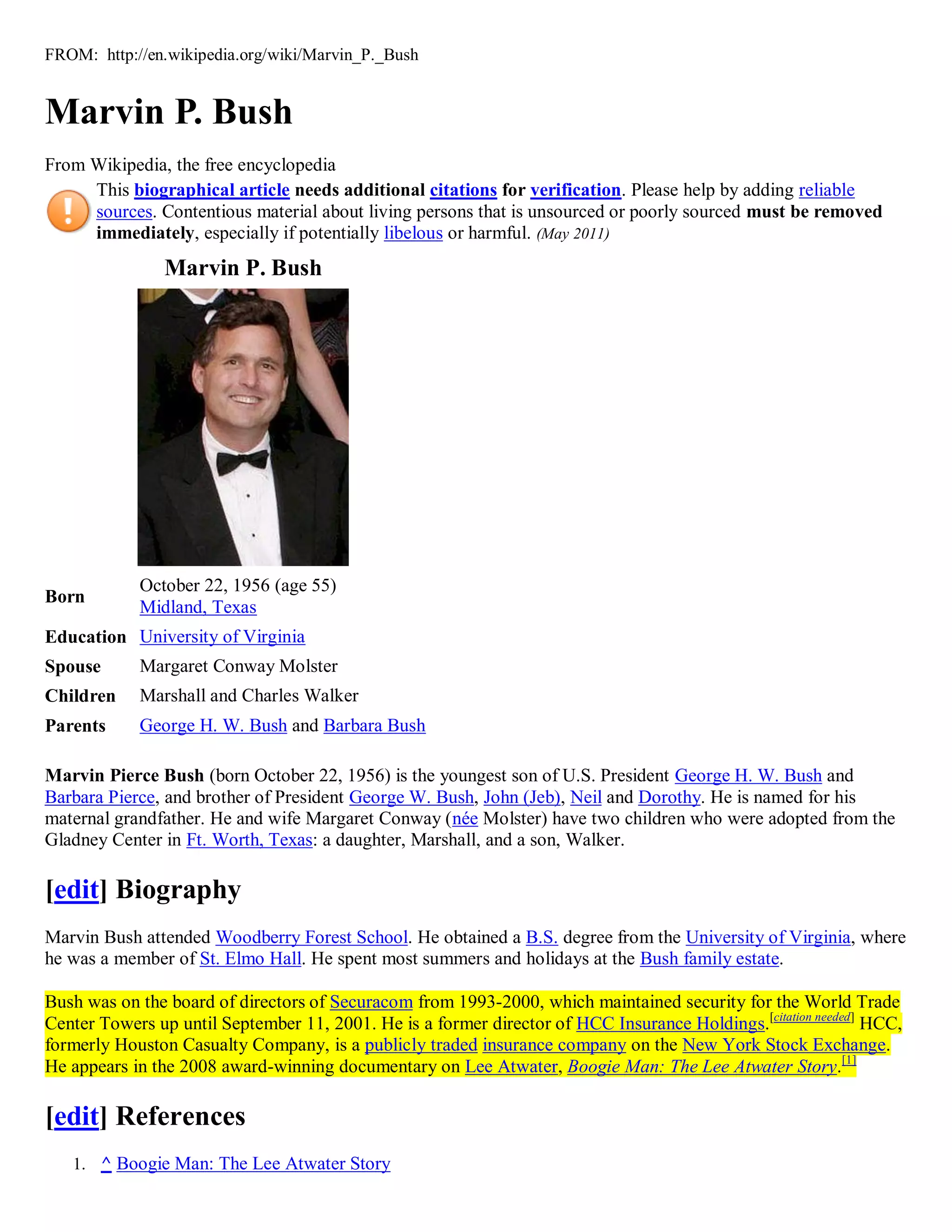
Marvin Bush Net Worth 2026: A Detailed Analysis of His Career and Assets
As of 2026, Marvin Bush’s net worth is estimated to be approximately $50 million. This wealth is the result of a multi-decade career in investment management, private equity, and professional board service. While his family name is syn...
As of 2026, Marvin Bush’s net worth is estimated to be approximately $50 million. This wealth is the result of a multi-decade career in investment management, private equity, and professional board service. While his family name is synonymous with American politics, his personal fortune stems largely from his co-founding of Winston Partners and strategic roles in major corporations.
Contents
Marvin Pierce Bush, the youngest son of President George H.W. Bush and Barbara Bush, has long maintained a lower public profile than his brothers, George W. Bush and Jeb Bush. However, in the realm of private finance and corporate governance, he has been a consistent and influential figure. Understanding his net worth requires an analysis of his professional ventures, the compensation structures of the boards he has served on, and the broader context of the Bush family’s financial legacy.
The Foundation of Wealth: Winston Partners
The cornerstone of Marvin Bush’s financial portfolio is Winston Partners, an investment management firm he co-founded in 1993. Based in Arlington, Virginia, the firm was established to provide investment advisory services to high-net-worth individuals and institutional clients.
Investment Strategy and Market Positioning
Winston Partners has historically operated as a "manager of managers" and a direct private equity investor. By identifying undervalued companies and niche market opportunities, the firm built a reputation for steady growth during the late 1990s and 2000s. Bush’s role as Managing Director involved capital raising and strategic oversight, leveraging a network that spanned both the political and financial sectors.
The firm’s success was built on several key pillars:
- Alternative Investments: Focusing on hedge funds and private equity rather than traditional retail banking.
- Small and Mid-Cap Focus: Targeting businesses with high growth potential that were often overlooked by larger Wall Street firms.
- Risk Management: Implementing conservative fiscal policies that allowed the firm to navigate the dot-com bubble and the 2008 financial crisis.
For an investment professional at this level, compensation typically consists of a combination of management fees (often 1-2% of assets under management) and "carried interest" (a share of the profits, usually around 20%). Over thirty years, these earnings constitute a significant portion of his total net worth.
Corporate Board Memberships and Executive Compensation
Beyond his primary firm, Marvin Bush has held influential positions on the boards of directors for several publicly traded and private companies. In the United States, serving as a director for a major corporation is a lucrative endeavor, often involving six-figure annual retainers and substantial stock options.
HCC Insurance Holdings
Bush served on the board of HCC Insurance Holdings, a leading international specialty insurance group. His tenure (from roughly 1999 to 2014) coincided with a period of massive expansion for the company. During this time, board members typically received annual compensation packages ranging from $150,000 to over $300,000, depending on committee assignments. The 2015 acquisition of HCC by Tokio Marine for $7.5 billion likely resulted in a significant liquidity event for board members holding equity.
Fresh Del Monte Produce
Another major pillar of his corporate career is his long-standing role on the board of Fresh Del Monte Produce Inc. (FDP). As a director, Bush has been involved in the governance of one of the world's largest producers and distributors of fresh fruit and vegetables. According to Fresh Del Monte's proxy statements, non-employee directors receive a mix of cash and restricted stock units (RSUs). Over a decade or more, the appreciation of these stock grants contributes millions to a director’s net worth.
Securacom (StratumSec)
Historically, Bush was a member of the board of directors for Securacom (later known as StratumSec). The company provided electronic security systems for high-profile clients, including the World Trade Center and Dulles International Airport. While this role ended in 2000, it remains a notable part of his professional history and initial wealth accumulation during the late 1990s tech and security boom.
Asset Allocation and Real Estate
Like many high-net-worth individuals, Marvin Bush has diversified his wealth into tangible assets. This includes high-value real estate and potentially inherited assets from the Bush family estate.
Residential Holdings
The Bush family has deep roots in Maine and Texas. While Marvin has lived primarily in the Virginia and Washington D.C. area to be near his business operations, he has owned several properties that have appreciated significantly in value. The Northern Virginia real estate market, particularly in areas like Alexandria and McLean, has seen consistent growth, with many estates valued between $3 million and $10 million.
Inherited Wealth and Family Trusts
While Marvin Bush earned the majority of his fortune through his own business ventures, the generational wealth of the Bush family cannot be ignored. Following the passing of George H.W. Bush in 2018 and Barbara Bush in 2018, the family estate was distributed among the children. This includes interests in family-owned properties and trust funds designed to provide for the family's descendants.
| Professional Entity | Primary Role | Estimated Impact on Net Worth |
|---|---|---|
| Winston Partners | Co-Founder / Managing Director | High (Primary source of long-term wealth) |
| Fresh Del Monte Produce | Board of Directors | Moderate (Annual fees and stock grants) |
| HCC Insurance Holdings | Board of Directors (Former) | High (Exit/Acquisition liquidity) |
| Real Estate Holdings | Personal Investor | Moderate (Asset appreciation) |
| Family Trusts | Beneficiary | Low to Moderate (Generational wealth preservation) |
The "Bush Brand" and Economic Influence
It is often discussed how a former president’s children benefit from their family name. In Marvin Bush’s case, his name undoubtedly provided access to rooms that others might struggle to enter. This "access capital" is a form of intangible asset that facilitates the growth of tangible wealth.
However, it is important to note that Marvin Bush has avoided the political arena entirely, unlike his father, grandfather (Prescott Bush), and brothers. By focusing strictly on the private sector, he has been able to build a career based on financial performance and corporate governance. This distinction has allowed him to accumulate wealth that is more aligned with that of a successful investment banker or private equity partner than a public servant.
Financial Comparison Within the Bush Family
In 2026, Marvin Bush’s net worth of $50 million places him in a solid financial position, though he is not necessarily the wealthiest member of the family.
- George W. Bush: With a net worth estimated over $50 million, largely from the sale of the Texas Rangers and book deals/speaking engagements.
- Jeb Bush: Estimated at $30 million to $40 million, following his consulting and investment work post-governorship.
- Neil Bush: Also involved in international business and education ventures, with varying estimates depending on the success of his overseas partnerships.
Marvin's wealth is characterized by its stability. Unlike the fluctuating income of political figures, his income stream from investment management and board fees is relatively consistent and less dependent on the political climate.
Frequently Asked Questions
What is Marvin Bush’s main source of income?
His primary income comes from his role as a Managing Director at Winston Partners, a firm he co-founded in 1993. This is supplemented by substantial annual fees and stock options from serving on the boards of directors for major corporations like Fresh Del Monte Produce.
Did Marvin Bush serve in the government?
No. Unlike his father and brothers, Marvin Bush has never held an elected or appointed government office. He has focused his entire career on the private sector, specifically in investment management and corporate governance.
How does his wealth compare to his brother George W. Bush?
Their net worths are relatively similar, though the sources differ. George W. Bush’s wealth saw a massive spike from the sale of the Texas Rangers baseball team and his post-presidency activities. Marvin’s wealth has been built more gradually through long-term investment management and corporate board compensation.
What happened to his role at Securacom?
Marvin Bush served on the board of Securacom (a security firm) from 1993 to 2000. He left the board a year before the 9/11 attacks. While the company has been the subject of various public inquiries and internet theories due to its contract with the World Trade Center, no legal wrongdoing was ever attributed to Bush regarding his time there.
Where did Marvin Bush go to college?
He is an alumnus of the University of Virginia (UVA). His connection to the university has remained strong throughout his career, and he has been involved in various alumni and fundraising activities for the institution.
Is he still active in business in 2026?
Yes, as of 2026, Marvin Bush remains active in the investment world, though he has transitioned into more of a senior advisory and governance role, focusing on his long-term board positions and the oversight of his private equity interests.
Next Steps for Investors and Observers
For those looking to learn from Marvin Bush’s financial trajectory, the key takeaway is the power of institutional board service and private equity. While the Bush name provided the initial platform, the longevity of his career in the specialty insurance and agricultural sectors demonstrates a disciplined approach to corporate oversight.
If you are interested in building similar wealth through corporate governance, consider researching the requirements for becoming a non-executive director, which include industry expertise, a clean regulatory track record, and a strong professional network. Tracking the proxy statements of companies like Fresh Del Monte can also provide insights into how executive and director compensation is structured in the current market.
Image Gallery