Understanding Acetaminophen ICD-10 Coding for Overdose
Accurate ICD-10 coding for acetaminophen overdose is essential for clinical documentation, billing integrity, and public health surveillance. Because acetaminophen (paracetamol) is a common ingredient in both prescription and over-the-...
Accurate ICD-10 coding for acetaminophen overdose is essential for clinical documentation, billing integrity, and public health surveillance. Because acetaminophen (paracetamol) is a common ingredient in both prescription and over-the-counter medications, coding requires specific identification of the intent, the substance involved, and the clinical encounter details to ensure compliance with the International Classification of Diseases, Tenth Revision, Clinical Modification (ICD-10-CM) guidelines.
Contents
The Foundation of ICD-10 Coding for Poisoning
In the ICD-10-CM framework, an overdose is classified under the umbrella of "poisoning." Unlike adverse effects, which occur when a medication is taken correctly as prescribed, a poisoning refers to the improper use of a drug, including overdoses, medication errors, or interactions.
When coding for acetaminophen, the coder must identify three primary components:
- The Poisoning Code: This identifies the substance (acetaminophen) and the intent (accidental, intentional self-harm, assault, or undetermined).
- The External Cause Code: This provides context, such as the place of occurrence and the activity being performed at the time.
- The Manifestation Code: This describes the specific clinical result of the overdose, such as acute hepatic failure or toxic effects.
Identifying the Substance and Intent
Acetaminophen falls under the T39.0 category in the ICD-10-CM manual, specifically T39.01, which identifies "Poisoning by dextropropoxyphene" or, more commonly for pure acetaminophen, T39.01X (Poisoning by 4-aminophenol derivatives). It is vital to select the correct fifth and sixth characters to denote the intent:
- T39.011 (Accidental/Unintentional): Used for accidental ingestions, including children who find medication or patients who miscalculate doses.
- T39.012 (Intentional Self-Harm): Used when the ingestion was a deliberate attempt to cause self-harm.
- T39.013 (Assault): Used when the medication was administered to the patient by another person with malicious intent.
- T39.014 (Undetermined): Used when the medical record does not provide sufficient information to determine the intent behind the ingestion.
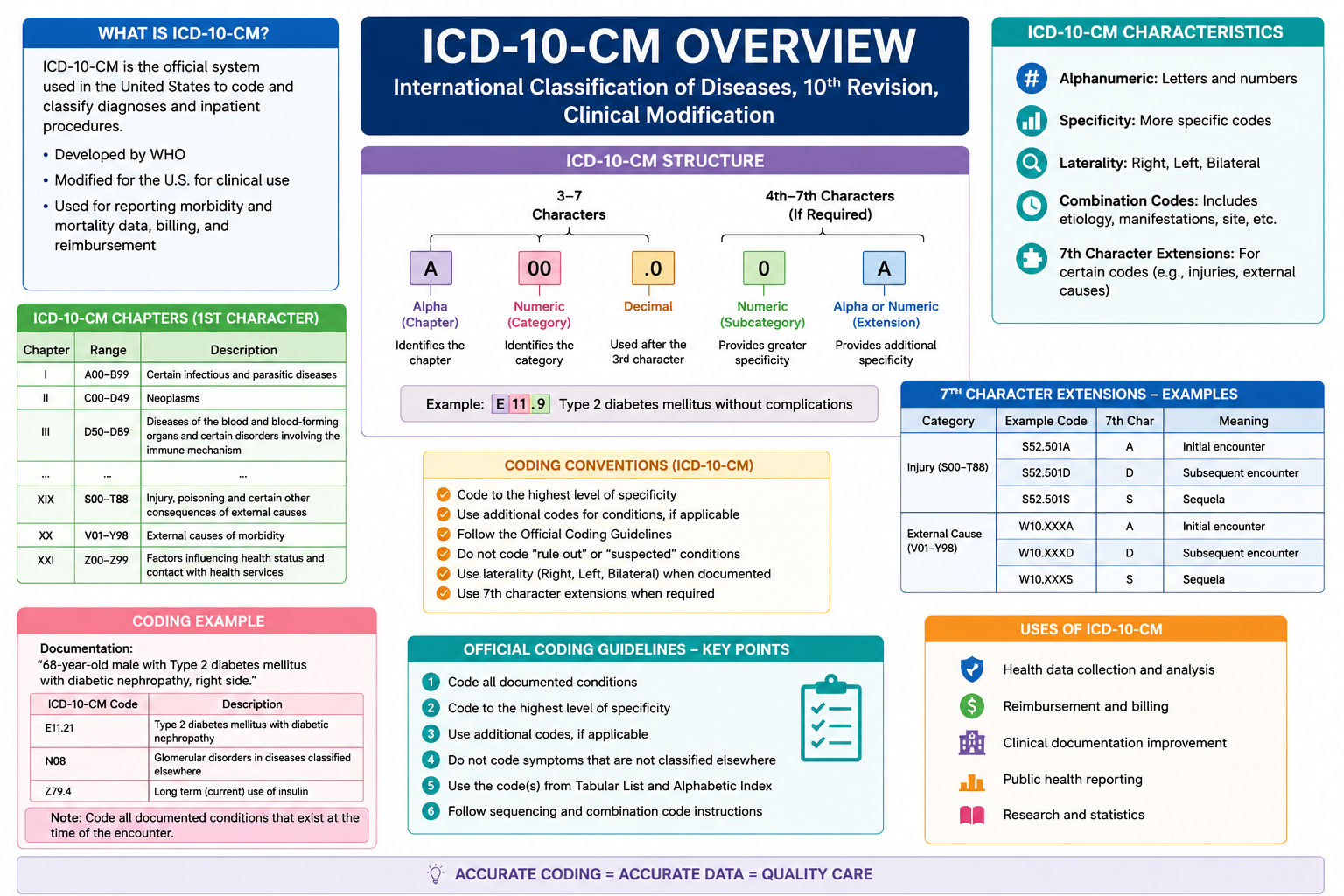
The seventh character—usually "A" for the initial encounter, "D" for subsequent encounters, or "S" for sequela—is mandatory to satisfy the coding requirements for an encounter.
Clinical Manifestations and Sequelae
Documentation must explicitly link the poisoning to the resulting physical harm. Acetaminophen overdose is famously associated with hepatotoxicity. If a patient presents with liver failure following an ingestion, the coder must sequence the poisoning code first, followed by the specific manifestation code.
For example, if a patient develops acute hepatic failure due to an acetaminophen overdose, the primary diagnosis code will be the T39.01- series, followed by K72.0 (Acute and subacute hepatic failure). Failure to code both the poison and the resulting condition leads to incomplete clinical narratives and can negatively impact hospital reimbursement and quality reporting metrics.
Comparison of ICD-10 Coding Scenarios
| Scenario | Primary Code | Context |
|---|---|---|
| Accidental ingestion (child) | T39.011A | Unintentional, initial encounter |
| Intentional overdose (suicide attempt) | T39.012A | Intentional, initial encounter |
| Follow-up for liver damage (sequela) | T39.01-S | Long-term complications |
| Unknown intent ingestion | T39.014A | Undetermined, initial encounter |
The Role of External Cause Codes
In addition to the T-codes, ICD-10-CM requires the use of External Cause of Morbidity codes (V00-Y99). These codes provide vital data for public health researchers tracking the epidemiology of drug-related incidents. For a poisoning, you must code the location where the incident occurred (e.g., Y92.010 for a single-family house) and the activity being performed (e.g., Y93.84 for resting or sleeping). While these codes do not generally impact the financial reimbursement of a claim, they are mandatory for hospitals reporting under the Uniform Hospital Discharge Data Set (UHDDS).
Common Challenges and Mistakes
Coding professionals frequently encounter challenges when distinguishing between "adverse effect" and "poisoning."
- Confusion with Adverse Effects: If a patient develops an allergic reaction or a side effect while taking a prescribed dose of acetaminophen as directed, the coding changes to the T-code for an "Adverse Effect" (usually found in the T39.095 or similar range). This is a distinct clinical concept from poisoning.
- Failure to Specify Intent: Documentation that lacks a clear assessment of intent—for instance, a clinician merely noting "ingested pills"—makes accurate coding impossible. Coders should query the physician if the intent is not documented to avoid using "undetermined" by default.
- Missing Manifestations: Capturing only the poisoning code (the T-code) without coding the patient’s physical condition (e.g., elevated liver enzymes, acute toxicity, or metabolic acidosis) is a significant compliance error.
Verification of Documentation
Before finalizing a code, it is imperative to cross-reference the clinical documentation with the Alphabetic Index and the Tabular List. Ensure that the physician has clearly linked the condition to the substance. If the record states "acetaminophen overdose" but the laboratory tests confirm toxicity, the physician’s documentation must support the diagnosis for the code to be valid.
Frequently Asked Questions
1. How do I distinguish between an adverse effect and a poisoning in the medical record? Adverse effects occur when a drug is taken correctly (therapeutic use) and results in an unintended side effect. Poisoning occurs when there is an error in dose, an overdose, or an ingestion that was not prescribed. If the clinician documents "therapeutic use," use the adverse effect code. If they document "overdose" or "wrong dose," use the poisoning code.
2. Should I include an alcohol-related code if the patient was intoxicated during the overdose? Yes. If the medical record indicates the patient was intoxicated or had consumed alcohol at the time of the acetaminophen ingestion, this should be coded separately to provide a complete picture of the patient's state, as alcohol can exacerbate the toxicity of acetaminophen.
3. What if the patient is a toddler who ingested medication found in the home? This is coded as an accidental poisoning (T39.011A). In the context of pediatrics, the "accidental" classification is the standard for ingestion of substances not intended for the child.
4. Does the type of medication (liquid vs. pill) change the ICD-10 code? No. The ICD-10-CM classification for acetaminophen (T39.01) focuses on the substance itself rather than the delivery mechanism.
5. How do I code a patient who was treated for an acetaminophen overdose but has no liver damage? You would still code the poisoning (T39.011A) and any symptoms that were present (e.g., nausea or vomiting, R11.2). If there are no physical symptoms, you may code the poisoning as the first-listed diagnosis to explain the reason for the encounter.
Professional Guidance and Limitations
This information is provided for educational purposes based on the 2026 ICD-10-CM guidelines. Medical coding is a high-stakes task that directly impacts clinical care, financial reimbursement, and legal compliance. Always consult the most current version of the ICD-10-CM Official Guidelines for Coding and Reporting and your facility's internal compliance office. Clinical coding is not a substitute for medical judgment, and diagnoses must always be supported by clinical documentation from the treating provider. If you are unsure of the coding for a specific encounter, query the physician to ensure the documentation is precise and exhaustive.
Recommended Next Actions
To ensure accuracy in your facility, perform a monthly audit of records containing T39.01 codes. Review whether the medical record supports the intent documented (accidental vs. intentional) and confirm that all clinical manifestations (such as liver function test results) were appropriately captured with secondary diagnosis codes. If discrepancies are found, provide targeted feedback to the clinical team to improve the specificity of their documentation.
Image Gallery