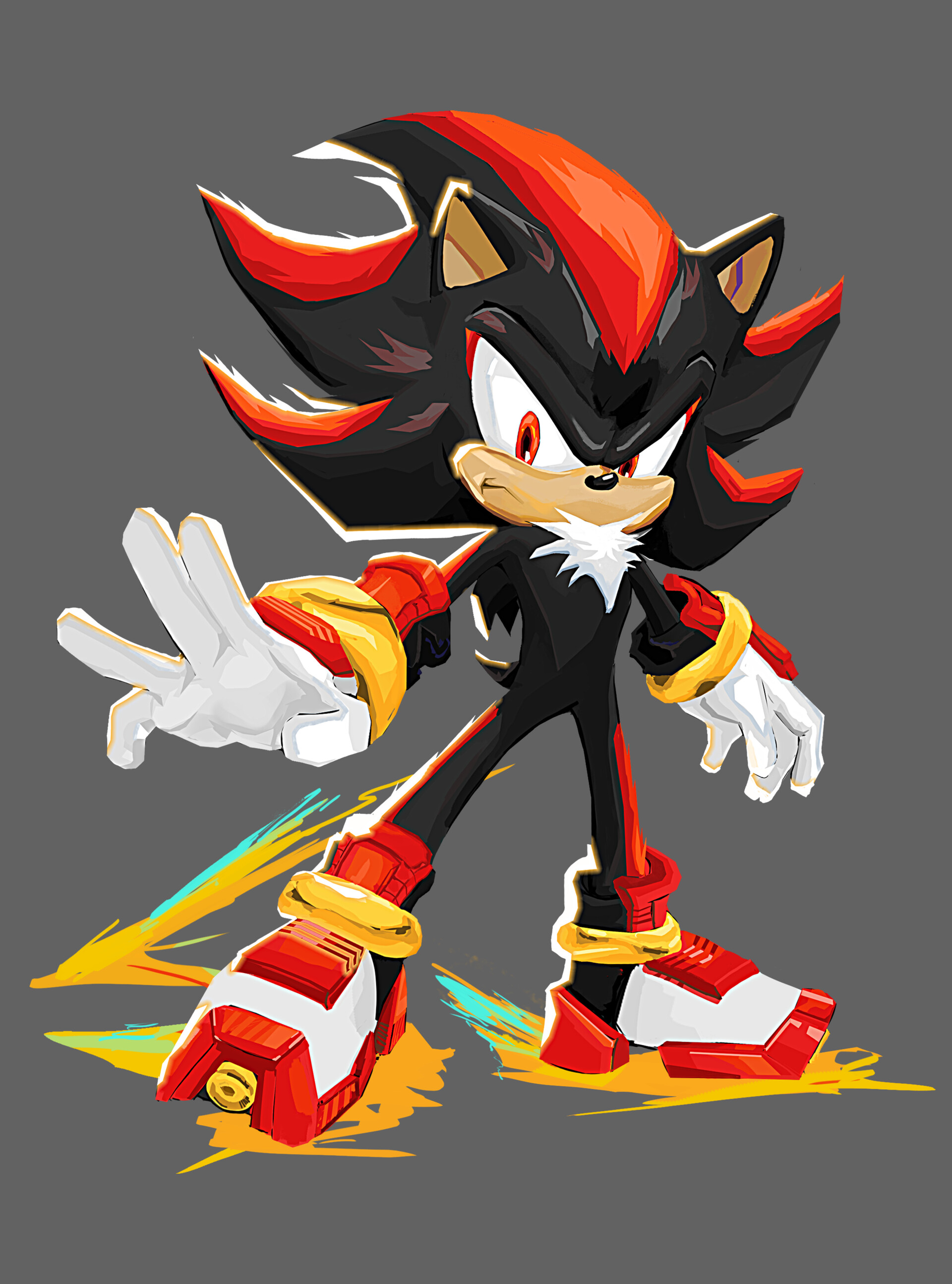
Anti-Shadow the Hedgehog: Moebius Lore, Canon Feasibility, and Alternate Variants
Anti-Shadow the Hedgehog refers to the conceptual mirror-universe counterpart to Shadow the Hedgehog, primarily within the context of Archie Comics' "Anti-Mobius" (Moebius) dimension. While primary characters like Sonic have direct inv...
Anti-Shadow the Hedgehog refers to the conceptual mirror-universe counterpart to Shadow the Hedgehog, primarily within the context of Archie Comics' "Anti-Mobius" (Moebius) dimension. While primary characters like Sonic have direct inverted counterparts such as Scourge, an official Anti-Shadow never debuted in canonical Sonic media due to Shadow's unique artificial origins and narrative role.
Contents
The concept of "Anti" characters has long fascinated fans of Sonic the Hedgehog, originating in the long-running Archie Comics continuity. In this multiverse, Mobius Prime had a dark, inverted twin known as Anti-Mobius (later renamed Moebius). In this mirror dimension, morality was flipped: heroes became self-serving villains, while villains became freedom fighters. Sonic became Scourge, Miles "Tails" Prower became the scheming Miles, and Antoine became the treacherous Patch.
Naturally, lore enthusiasts and readers frequently ask: Where is Anti-Shadow?
Understanding why an official Anti-Shadow never manifested requires analyzing the rules of the Sonic multiverse, Shadow's biological and synthetic genesis, and how franchise writers have addressed the character's conceptual paradox.
The Multiverse Rules of Moebius: Why Natural Counterparts Exist
To understand why Anti-Shadow does not exist in canonical print, one must examine how the Anti-Mobius universe functioned prior to the franchise-wide Super Genesis Wave continuity reset.
Introduced by writer Michael Gallagher and extensively expanded by Ken Penders and later Ian Flynn, Anti-Mobius operated on a principle of moral and behavioral reflection:
- Sonic the Hedgehog was mirrored by Evil Sonic (who later used the Master Emerald to transform into Scourge the Hedgehog).
- Miles "Tails" Prower had Miles, a cold, intellectual youth who resented Scourge's posturing.
- Knuckles the Echidna had O'Nocker, an easygoing, pacifistic guardian.
- Rotor Walrus was mirrored by Boomer, an amoral cybernetic engineer.
- Bunnie Rabbot was reflected by Buns Rabbot, an outcast battling localized neuro-degenerative illness without cybernetics.
- Amy Rose was mirrored by Rosy the Rascal, a dangerously unhinged, violent youth wielding a spiked hammer.
In every case, the native Anti-Mobians were biological organisms born through natural lineage on the planet. Their ancestors existed, their parents mated, and their biological lines paralleled Mobius Prime.
Shadow the Hedgehog breaks this biological continuity entirely.
Why There Is No Canonical Anti-Shadow
Shadow the Hedgehog is not an organic child of Mobius. His existence is an artificial anomaly resulting from deliberate, highly classified scientific intervention.
- Gerald Robotnik + Black Doom (Alien DNA)
- Project Shadow
- Space Colony ARK (Orbit)
- Shadow the Hedgehog
1. The Artificial Nature of Project Shadow
Shadow was bio-engineered aboard the Space Colony ARK roughly fifty years prior to the modern era by Professor Gerald Robotnik. Gerald's motivation was deeply personal: he sought a cure for Neuro-Immuno Deficiency Syndrome (NIDS), the terminal genetic illness afflicting his granddaughter, Maria Robotnik.
To achieve cellular immortality and absolute physical perfection, Gerald struck a bargain with Black Doom, the leader of the extraterrestrial Black Arms, infusing the alien warlord’s genetic material into the synthetic hedgehog embryo.
Because Shadow was constructed in an orbital laboratory from extraterrestrial biology rather than born naturally on Mobius, he has no intrinsic genetic anchor to the planet's standard evolutionary track.
2. The Moebian Dilemma: What Happened to Anti-Gerald?
For an "Anti-Shadow" to exist naturally on Moebius, an Anti-Gerald Robotnik would have needed to execute Project Shadow in reverse. Archie Comics head writer Ian Flynn addressed this paradox during various Q&A discussions and podcast interviews (including The BumbleKast).
Flynn clarified that if Moebius followed inverted moral logic:
- An Anti-Gerald would have been an altruistic saint or an incompetent failure, rather than a driven, compromised military contractor.
- An Anti-Maria might not have suffered from a terminal illness, eliminating the desperate motivation that spurred Project Shadow in the first place.
- The alien Black Arms might never have forged a deal with an orbital laboratory on Moebius, or Anti-Black Doom would have operated on entirely incompatible cosmological terms.
- Had an artificial life form been attempted on Moebius, it likely remained an unviable failure (similar to the grotesque Biolizard prototype) or was never commissioned by the Moebian United Federation.
Because the conditions required to engineer Shadow were a fragile series of historical catastrophes, those exact variables were never replicated in Moebius.
3. The Redundancy of an Inverted Anti-Hero
From a narrative-design perspective, Sonic Team and comic writers avoided introducing an Anti-Shadow because Shadow already fulfills the dark archetype within the main cast.
Shadow is an anti-hero: brooding, pragmatic, willing to use lethal force, and emotionally detached. If an author applied the Moebius "morality flip" to Shadow, the resulting character would be:
- A cheerful, naive, hyper-idealistic Boy Scout.
- A cowardly, non-combative pacifist.
- A chaotic, sloppy buffoon.
Any of these archetypes would drastically undermine the aura that defines Shadow the Hedgehog. A comedic or overly sunny Shadow reduces the character to a parody, clashing with the high-stakes dramatic tone required whenever the Ultimate Lifeform appears.
Alternate and Synthetic Counterparts: The Functional "Anti-Shadows"
While Moebius lacked an official inverted Shadow, the Sonic the Hedgehog franchise has introduced numerous functional "Anti-Shadows"—entities engineered as physical clones, philosophical foils, or dark duplicates.
| Entity | Origin / Debut | Relationship to Shadow | Distinguishing Characteristics |
|---|---|---|---|
| Shadow Androids | Sonic Heroes (2003) / Shadow the Hedgehog (2005) | Mechanical mass-produced clones | Programmed obedience, metallic chassis beneath synthetics, disposable foot soldiers. |
| Mephiles the Dark | Sonic the Hedgehog (2006) | Shadow's physical silhouette copied from his shadow | Malevolent cosmic consciousness, mouthless, sadistically uses time-travel manipulation. |
| Biolizard | Sonic Adventure 2 (2001) | The biological precursor / "Prototype" | Primitive reptilian physiology, external life-support engine, driven by feral survival and rage. |
| Sonic Prime Variants | Sonic Prime (2022–2024) | Shatterverse duplicates (None for Shadow) | Shadow remained whole and singular in the Void; his existence resisted fragmentation. |
| Scourge the Hedgehog | Archie Sonic the Hedgehog #160 | The true Anti-Sonic who fought Shadow | Green quills, scarred chest, leather jacket; serves as Shadow's ideological rival during incursions. |
The Shadow Androids
In Sonic Heroes and the 2005 standalone title Shadow the Hedgehog, Dr. Eggman produced legions of mass-manufactured android duplicates designated as the Shadow Androids.
These units featured identical physical silhouettes and quills, distinguished by yellow lens visors and mechanical internal architecture. The androids caused significant psychological distress for the real Shadow, who spent substantial narrative time questioning whether he was the original biological creation or merely another disposable robotic duplicate carrying false memories.
These androids fulfill the functional role of an "Anti-Shadow army": soulless, expendable tools deployed to enforce Dr. Eggman's will, directly contrasting Shadow's independent moral agency.
- Original Shadow
- Independent moral agent
- Possesses Chaos energy
- Preserves Maria's promise
- Shadow Androids
- Hard-coded robotic servitude
- Simulated, mechanical energy
- Devoid of authentic memory
Mephiles the Dark
In the 2006 video game Sonic the Hedgehog (frequently designated Sonic '06), the aquatic entity Solaris was divided into Iblis (raw destructive force) and Mephiles the Dark (the malicious intellect).
Upon escaping confinement from the Scepter of Darkness, Mephiles absorbed Shadow's physical shadow, adopting his exact form, vocal profile, and quill configuration—altered only by cold green eyes, a mouthless face, and a crystalline secondary form.
Mephiles represents the philosophical antithesis of Shadow:
- Shadow represents personal responsibility, overcoming trauma, and honoring the selfless sacrifice of Maria.
- Mephiles represents nihilism, manipulation, and the total eradication of timeline stability.
Mephiles serves as the most narratively complete "Anti-Shadow" in official gaming canon, weaponizing Shadow's likeness to break his spirit and force the world into apocalypse.
Shadow's Unique Status in the Shatterverse (Sonic Prime)
The canonical status of Shadow as a multiversal constant received modern reinforcement in the Netflix animated series Sonic Prime.
When Sonic shattered the Paradox Prism in Green Hill, reality fractured into the Shatterverse, creating multiple alternate versions of primary characters:
- Sonic had parallel variants across New Yoke City, the Boscage Maze, and No Place.
- Tails fractured into Nine, Mangey, and Sails.
- Amy Rose fractured into Rusty Rose, Thorn Rose, and Black Rose.
- Knuckles fractured into Renegade Knucks, Gnarly, and Dread.
Shadow was not shattered.
By utilizing Chaos Control at the exact instant the Paradox Prism ruptured, Shadow slipped between dimensional seams, existing entirely within the interstitial Ghost Hill / Shatterspace Void.
Just as in the Archie Comics era, the franchise reinforced a critical storytelling rule: Shadow the Hedgehog is singular. He does not fragment easily into casual multiverse tropes. His identity is defined by absolute self-possession and isolation, rendering alternate copies either mechanically synthetic (Androids) or multiversally prohibited.
The Community and Fandom Interpretations of "Anti-Shadow"
Because official media never introduced a native Moebius counterpart, the Sonic fan-fiction, modding, and role-playing communities developed distinct interpretations of what an Anti-Shadow would look like.
1. The "Terios" Concept
Long before Sonic Adventure 2 shipped to store shelves, Sonic Team developed prototype concept sketches for Shadow. The original concept was named Terios (meaning "reflection" or "wish").
Terios featured asymmetrical quills, a ragged cloak, a scarred face, and a more monstrous, vampiric silhouette. Many community writers and artists utilize the Terios design as the template for a hypothetical Moebius Anti-Shadow, characterizing him as a ragged, vengeful vagrant who never escaped the ruins of a destroyed orbital laboratory.
2. The Inverted Hero Archetype ("Shade" or "Bright")
Fandom creators exploring the literal rules of Anti-Mobius often design Anti-Shadow with:
- Pure white or reflective silver quills with cyan stripes.
- A cheerful, open-hearted, hyper-optimistic disposition.
- Hover boots that generate radiant light rather than combustion flames.
- A deep need for social approval and friendship, directly contrasting Shadow's solitary lifestyle.
While entertaining in transformative works, this conceptualization illustrates why official Sega brand managers avoid greenlighting an Anti-Shadow: stripping Shadow of his brooding anti-heroic edge removes the foundational identity of the character.
Verifying Shadow Canon and Multiverse Inquiries
If you are researching Sonic the Hedgehog alternate-universe continuity or tracking character appearances across comic arcs, follow these steps to verify lore authenticity:
- Examine the Era: Determine whether the reference falls under Pre-Super Genesis Wave Archie continuity (Issues #1–252), Post-Super Genesis Wave Archie continuity (Issues #252–290), or the canonical IDW Publishing run (2018–present). Moebius and "Anti" variants exist exclusively within Pre-Super Genesis Wave Archie lore.
- Verify Off-Panel Confirmations: Consult documented writer responses from series leads such as Ian Flynn via official publishing columns or creator-run podcasts rather than unverified fan wikis.
- Cross-Reference the Sonic Lore Team Guidelines: Following the consolidation of franchise lore under Sega's internal lore team, parallel-universe depictions must adhere to strict character guidelines that emphasize Shadow's biological uniqueness and dimensional resilience.
Frequently Asked Questions
Did an Anti-Shadow ever appear in Archie Comics?
No. An Anti-Shadow never appeared in any issue of the Archie Comics Sonic the Hedgehog series. While characters like Sonic, Tails, Knuckles, Antoine, and Amy had direct Anti-Mobius counterparts, Shadow was explicitly omitted due to his artificial origin on the Space Colony ARK.
Is Scourge the Hedgehog the Anti-Shadow?
No. Scourge the Hedgehog is the Anti-Sonic. Originally known as Evil Sonic, he dyed his quills green and acquired twin torso scars after absorbing residual energy from the Master Emerald. While Scourge fought Shadow on multiple occasions, he is the inverted reflection of Sonic, not Shadow.
What is the closest official character to an Anti-Shadow?
Mephiles the Dark from Sonic the Hedgehog (2006) serves as the closest functional Anti-Shadow. Mephiles took the physical form of Shadow's shadow, mirroring his silhouette, powers, and combat style while embodying pure nihilism and cosmic cruelty.
Why didn't Shadow get shattered in Sonic Prime?
Shadow avoided being split into Shatterverse variants because he activated Chaos Control with an Air Shoe booster right as the Paradox Prism shattered. This teleported him outside the immediate blast radius and trapped him in the Void, preserving his singular identity.
Could Dr. Eggman make an Anti-Shadow?
Dr. Eggman has already constructed hundreds of functional opposites through his Shadow Android program in Sonic Heroes and Shadow the Hedgehog (2005). These androids mimic Shadow's Chaos capabilities and silhouette but lack his genuine consciousness, emotional memories, and soul.
Image Gallery