Native American Athletes at the 1912 Olympics: Achievements, Controversy, and Legacy
At the 1912 Stockholm Olympic Games, Native American athletes delivered historic performances that altered international sports history. Led by Jim Thorpe’s dominant gold-medal victories in the pentathlon and decathlon, alongside Louis...
At the 1912 Stockholm Olympic Games, Native American athletes delivered historic performances that altered international sports history. Led by Jim Thorpe’s dominant gold-medal victories in the pentathlon and decathlon, alongside Louis Tewanima’s silver medal in the 10,000-meter run and Andrew Sockalexis’s impressive marathon finish, Indigenous American track and field competitors demonstrated unprecedented athletic excellence.
Contents
Despite competing for a nation that did not yet grant full citizenship to all Indigenous peoples, these athletes achieved global renown. However, the legacy of the 1912 Games was almost immediately overshadowed by an unfair amateurism controversy that stripped Thorpe of his medals, initiating a century-long effort for official restoration and historical justice.
Historical Context: The Carlisle Indian School and 1912 America
To understand the magnitude of Native American achievements at the 1912 Stockholm Games, one must examine the socio-political reality of the United States in the early 20th century. In 1912, Native Americans occupied a complex legal status. The Indian Citizenship Act was not passed until 1924, meaning many Indigenous athletes who represented the United States on the world stage were legally recognized as wards of the federal government rather than full American citizens with voting rights.
Many prominent Indigenous athletes of this era were educated at federal Indian boarding schools, most notably the Carlisle Indian Industrial School in Pennsylvania. Established under a policy of cultural assimilation, Carlisle aimed to integrate Native youths into European-American society. However, under the guidance of legendary athletic director and coach Glenn S. "Pop" Warner, Carlisle became an unexpected powerhouse in collegiate football and track and field.
Carlisle Indian Industrial School Athletic Pipeline (1900s–1910s):
- Federal Assimilation Policy & Boarding School System
- Elite Training under Coach Glenn "Pop" Warner
- U.S. Olympic Trials Qualification (Stockholm 1912)
- Global Recognition: Thorpe, Tewanima, and Teammates
The athletic program at Carlisle served a dual role. For the institution, sports victories were used to prove to the public that Native students could excel in modern Western disciplines. For the athletes themselves, track and field offered an arena where merit, speed, and endurance surpassed racial barriers. When the U.S. Olympic team assembled for the V Summer Olympiad in Stockholm, Sweden, Indigenous competitors were among the team's most vital contenders.
Jim Thorpe: The Dominant Force of the 1912 Stockholm Games
Jim Thorpe (Wa-Tho-Huk, meaning "Bright Path"), a member of the Sac and Fox Nation, entered the 1912 Stockholm Olympics as a multi-sport phenom. His performance in Stockholm remains one of the most remarkable individual feats in Olympic history.
Thorpe entered two newly formalized multi-event competitions: the classic pentathlon (comprising the broad jump, javelin throw, 200-meter dash, discus throw, and 1500-meter run) and the inaugural Olympic decathlon (a ten-event test over three days).
Thorpe's 1912 Stockholm Olympic Schedule & Victories:
- Pentathlon (July 7, 1912):
- Long Jump (1st Place: 7.07 m)
- Javelin Throw (3rd Place: 46.71 m)
- 200-Meter Dash (1st Place: 22.9 s)
- Discus Throw (1st Place: 35.57 m)
- 1500-Meter Run (1st Place: 4:44.8)
- RESULT: GOLD MEDAL (4 Place Points)
- Decathlon (July 13–15, 1912):
- 100m, Long Jump, Shot Put, High Jump, 400m
- 110m Hurdles, Discus, Pole Vault, Javelin, 1500m
- RESULT: GOLD MEDAL (8,412.95 points – World Record)
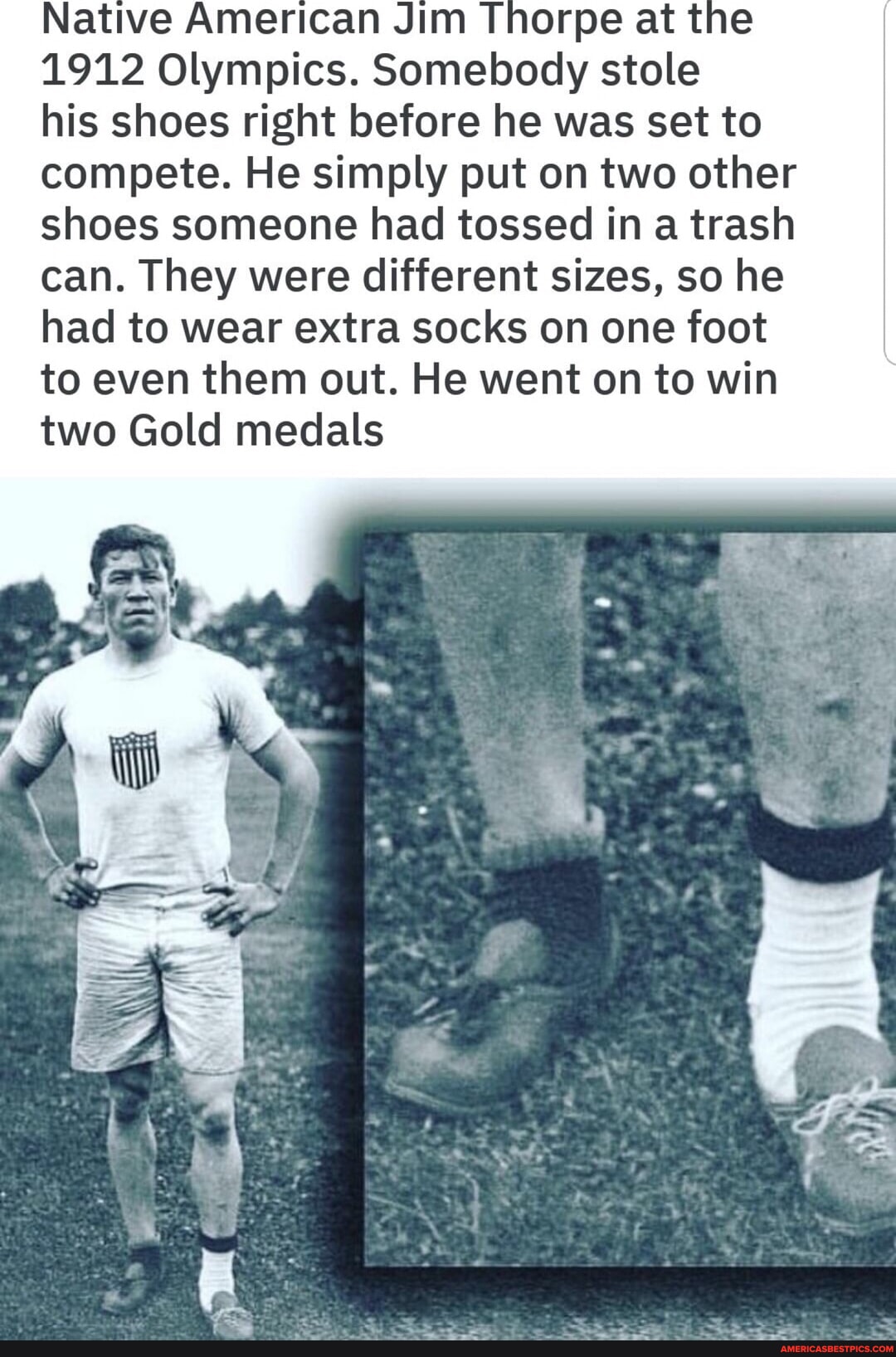
Thorpe dominated the pentathlon on July 7, winning four of the five events to secure his first Olympic gold medal. One week later, he competed in the grueling decathlon. Despite discovering that his athletic shoes had been stolen on the morning of the competition, Thorpe improvisational spirit led him to wear two discarded shoes found in a trash bin—one of which required extra socks to fit. Wearing mismatched footwear, Thorpe recorded 8,412.96 points out of a possible 10,000, setting a world record that stood for over a decade.
During the trophy ceremony, King Gustav V of Sweden handed Thorpe his prizes—including a bronze bust of the King and a chalice shaped like a Viking ship—and reportedly proclaimed: "You, sir, are the greatest athlete in the world." Thorpe famously replied: "Thanks, King."
Beyond Thorpe: Louis Tewanima and Andrew Sockalexis
While Jim Thorpe dominated national headlines, other Indigenous athletes achieved remarkable success at the 1912 Games, demonstrating the depth of Native talent on Team USA.
Louis Tewanima (Hopi Nation)
Louis Tewanima, a Hopi distance runner from Second Mesa, Arizona, was also a student at the Carlisle Indian School. Having previously competed in the 1908 London Olympics (finishing ninth in the marathon), Tewanima returned to Europe for the 1912 Stockholm Games to run the 10,000-meter race.
On July 8, 1912, Tewanima won the silver medal in the 10,000 meters with an official time of 32:06.6. His performance set an American record in the event that endured for 52 years, until another Native American distance runner, Billy Mills (Oglala Lakota), broke it by winning gold at the 1964 Tokyo Olympics.
Andrew Sockalexis (Penobscot Indian Nation)
Andrew Sockalexis, an elite distance runner from the Penobscot Indian Reservation at Indian Island, Maine, represented the United States in the 1912 Olympic Marathon. Sockalexis ran a disciplined race in extreme heat, finishing in fourth place with a time of 2:42:07.9, missing a podium spot by just a short margin. His achievement highlighted the historical tradition of Indigenous distance running, long rooted in tribal communication, hunting, and cultural practice.
The Amateurism Controversy and Stripping of Titles
The triumphs of the 1912 Olympics were soon met with severe administrative action. In early 1913, newspapers published reports that Jim Thorpe had played minor league baseball for the Rocky Mount Railroaders in North Carolina during the summers of 1909 and 1910, receiving small payments of roughly $2 to $35 per game.
At the time, the Olympic movement strictly enforced rules of amateurism. Professional athletes—defined as anyone who accepted monetary compensation for playing any sport—were banned from Olympic competition. While many collegiate athletes used pseudonyms to play paid summer baseball without losing their amateur status, Thorpe had played under his own name, unaware that receiving modest expense money jeopardized his track and field eligibility.
Timeline of the Amateurism Conflict & Medal Restorations:
- 1909–1910: Thorpe plays minor league baseball in North Carolina.
- July 1912: Thorpe wins Gold in Pentathlon & Decathlon at Stockholm.
- Jan 1913: Disclosures spark Amateur Athletic Union (AAU) inquiry.
- May 1913: IOC strips Thorpe's medals (violating 30-day challenge window).
- 1982: IOC awards replica medals to Thorpe's family (listed as Co-Champion).
- July 2022: IOC officially restores Thorpe as SOLE CHAMPION in official records.
In January 1913, the Amateur Athletic Union (AAU) retroactively stripped Thorpe of his amateur status. The International Olympic Committee (IOC) followed suit, demanding the return of his medals and striking his times and scores from the official Olympic record books.
Crucially, the IOC’s decision violated its own rulebook. The official 1912 Olympic handbook stipulated that any protest regarding an athlete's eligibility had to be submitted within 30 days of the Games' closing ceremony. The inquiry against Thorpe did not begin until six months after the Stockholm Games had ended. Nevertheless, his titles were revoked, and the second-place finishers in the pentathlon (Ferdinand Bie of Norway) and decathlon (Hugo Wieslander of Sweden) were offered the gold medals. Both athletes reportedly declined to accept the medals, acknowledging Thorpe as the rightful champion.
Historical Data: Native American Athletes at Stockholm 1912
The table below summarizes the key Native American participants at the 1912 Stockholm Olympic Games, detailing their tribal affiliations, events, results, and historical milestones.
| Athlete | Tribal Nation | Olympic Event(s) | 1912 Stockholm Result | Historical Milestone / Legacy |
|---|---|---|---|---|
| Jim Thorpe (Wa-Tho-Huk) | Sac and Fox Nation | Classic PentathlonDecathlon | Gold Medal (4 pts)Gold Medal (8,412.95 pts) | Named "World's Greatest Athlete"; world record holder; stripped of medals in 1913; fully reinstated in 2022. |
| Louis Tewanima | Hopi Nation | 10,000-Meter Run5,000-Meter Run | Silver Medal (32:06.6)Eliminated in heat | Set U.S. 10,000m record that stood for 52 years until Billy Mills (1964); 2-time Olympian (1908, 1912). |
| Andrew Sockalexis | Penobscot Nation | Olympic Marathon | 4th Place (2:42:07.9) | Finished 4th out of 68 international starters; two-time top-meter finisher in the Boston Marathon (1912, 1913). |
| Lewis Tewanina (Alternate spelling) | Hopi Nation | Distance Events | Qualified / Team Member | Represented early Hopi long-distance running traditions in international U.S. trials. |
The Century-Long Campaign for Reinstatement (1982–2022)
Following Jim Thorpe's death in 1953, his family, tribal leaders, historians, and sports advocates launched a decades-long campaign to persuade the IOC to correct the historical record.
1982 Partial Restoration
In October 1982, the IOC Executive Board approved a compromise. Recognizing the procedural violation of the 30-day rule, the IOC officially restored Thorpe’s amateur status prior to 1912. On January 18, 1983, IOC officials presented commemorative replica gold medals to Thorpe's children. However, the official record books were modified to list Thorpe as a "co-champion" alongside Ferdinand Bie and Hugo Wieslander, rather than the sole victor.
The Bright Path Strong Initiative and 2022 Sole Victory Decision
Advocates continued to push for complete historical accuracy. The organization Bright Path Strong, supported by Native leaders, Olympic scholars, and the National Congress of American Indians, submitted formal petitions requesting that Thorpe be recognized as the sole winner of both the 1912 pentathlon and decathlon.
On July 15, 2022, exactly 110 years after Thorpe completed his decathlon victory, the International Olympic Committee officially announced that Jim Thorpe was restored as the sole gold medalist in both events. The IOC updated its official database to reflect Thorpe's standalone victories, reclassifying Bie and Wieslander as silver medalists, thereby bringing a formal resolution to a century of athletic injustice.
Full Reinstatement Framework (IOC Resolution):
- Pentathlon: Jim Thorpe (Sole Gold Medalist)
- Ferdinand Bie (Reclassified to Silver Medalist)
- Decathlon: Jim Thorpe (Sole Gold Medalist)
- Hugo Wieslander (Reclassified to Silver Medalist)
How to Research and Verify 1912 Olympic Records
For researchers, historians, and educators examining the history of Indigenous Olympic athletes, primary sources and official archives provide verified evidence of these athletic accomplishments:
- Official Olympic Reports: The Swedish Olympic Committee published The Official Report of the Olympic Games of Stockholm 1912, available in digital collections via the International Olympic Committee Library.
- Smithsonian National Museum of the American Indian: Holds historical documentation, photographs, and archival material on Carlisle Indian School athletes and early 20th-century Native American history. Explore these exhibits at the National Museum of the American Indian.
- U.S. National Archives: Maintains federal records related to the Carlisle Indian Industrial School, including student rosters, athletic logs, and correspondence involving Jim Thorpe and Louis Tewanima.
- Library of Congress Chronicling America: Contains digitized contemporary newspaper archives from 1912 and 1913 covering the Stockholm Olympic trials, event summaries, and the subsequent amateurism hearings.
Frequently Asked Questions
Who was the primary Native American athlete at the 1912 Olympics?
Jim Thorpe (Wa-Tho-Huk) of the Sac and Fox Nation was the most famous Native American athlete at the 1912 Stockholm Olympics. He won gold medals in both the classic pentathlon and the decathlon, earning recognition as the greatest overall athlete of his era.
Why were Jim Thorpe's 1912 Olympic medals initially revoked?
Thorpe's medals were revoked in 1913 because he had received small monetary payments for playing minor league baseball in North Carolina during 1909 and 1910. Under the strict Olympic amateurism rules of the period, accepting pay for athletic performance disqualified a competitor from amateur status.
Did other Native American athletes win medals at the 1912 Games?
Yes. Louis Tewanima, a Hopi distance runner, won the silver medal in the 10,000-meter run at the 1912 Stockholm Games. His performance set an American record that stood for 52 years until 1964.
When did the IOC fully restore Jim Thorpe as the sole champion?
The IOC restored Thorpe as the sole gold medalist in the pentathlon and decathlon on July 15, 2022. Although replica medals were returned to his family in 1983, he had been listed as a "co-champion" until the 2022 decision officially updated the Olympic record books.
Were Native American athletes U.S. citizens during the 1912 Olympics?
Not all of them. In 1912, many Native Americans were classified as wards of the federal government under federal policy. Universal U.S. citizenship was not extended to all Indigenous people born within the country until the passage of the Indian Citizenship Act of 1924.
Recommended Next Steps for Historians and Educators
To further explore the legacy of Native American athletes at the 1912 Olympics:
- Review Primary Documentation: Access digital archives at the National Archives or the IOC Museum to examine original 1912 Stockholm scoring heat sheets and contemporary news reports.
- Incorporate Indigenous History into Curricula: Utilize educational kits from the Smithsonian Institution to teach the intersections of federal boarding school policies, athletic achievement, and civil rights.
- Support Native Athletic Initiatives: Engage with organizations like Bright Path Strong and Native American sports halls of fame that document and preserve Indigenous athletic contributions.
Image Gallery