Why a Disruptive Example Matters in Innovation
A disruptive example acts as a tangible proof of concept that validates non-traditional business models, shifts market psychology, and provides a strategic blueprint for challengers. By demonstrating that an industry’s established "rul...
A disruptive example acts as a tangible proof of concept that validates non-traditional business models, shifts market psychology, and provides a strategic blueprint for challengers. By demonstrating that an industry’s established "rules" can be broken, it reduces perceived risk for investors and forces incumbents to confront their own structural vulnerabilities.
Contents
Innovation is often discussed in the abstract—as a series of theoretical frameworks or brainstorming sessions. However, the true catalyst for industry-wide transformation is almost always a concrete, disruptive example. Whether it is the way decentralized finance challenged traditional banking or how generative AI restructured the creative economy leading into 2026, these examples serve as more than just success stories; they are the empirical evidence required to shift capital, talent, and consumer behavior.
The Role of the Disruptive Example as a Cognitive Anchor
The human brain, and by extension the corporate board, is naturally biased toward the status quo. This is known as cognitive inertia. In the context of business, this manifests as a belief that "the way we have always done things" is the only viable path to profitability. A disruptive example matters because it functions as a cognitive anchor that resets what is considered "possible."
When a disruptive example enters the market, it provides a reference point that cannot be ignored. For years, the automotive industry argued that high-performance electric vehicles (EVs) were technically or economically unfeasible at scale. The example provided by early pioneers did not just sell cars; it dismantled the psychological barriers for every other manufacturer. By 2026, we see this pattern repeating in the field of fusion energy and modular housing. These examples force a re-evaluation of technical constraints, shifting the internal dialogue of competitors from "if it can be done" to "how quickly we must respond."
Validation of Asymmetric Business Models
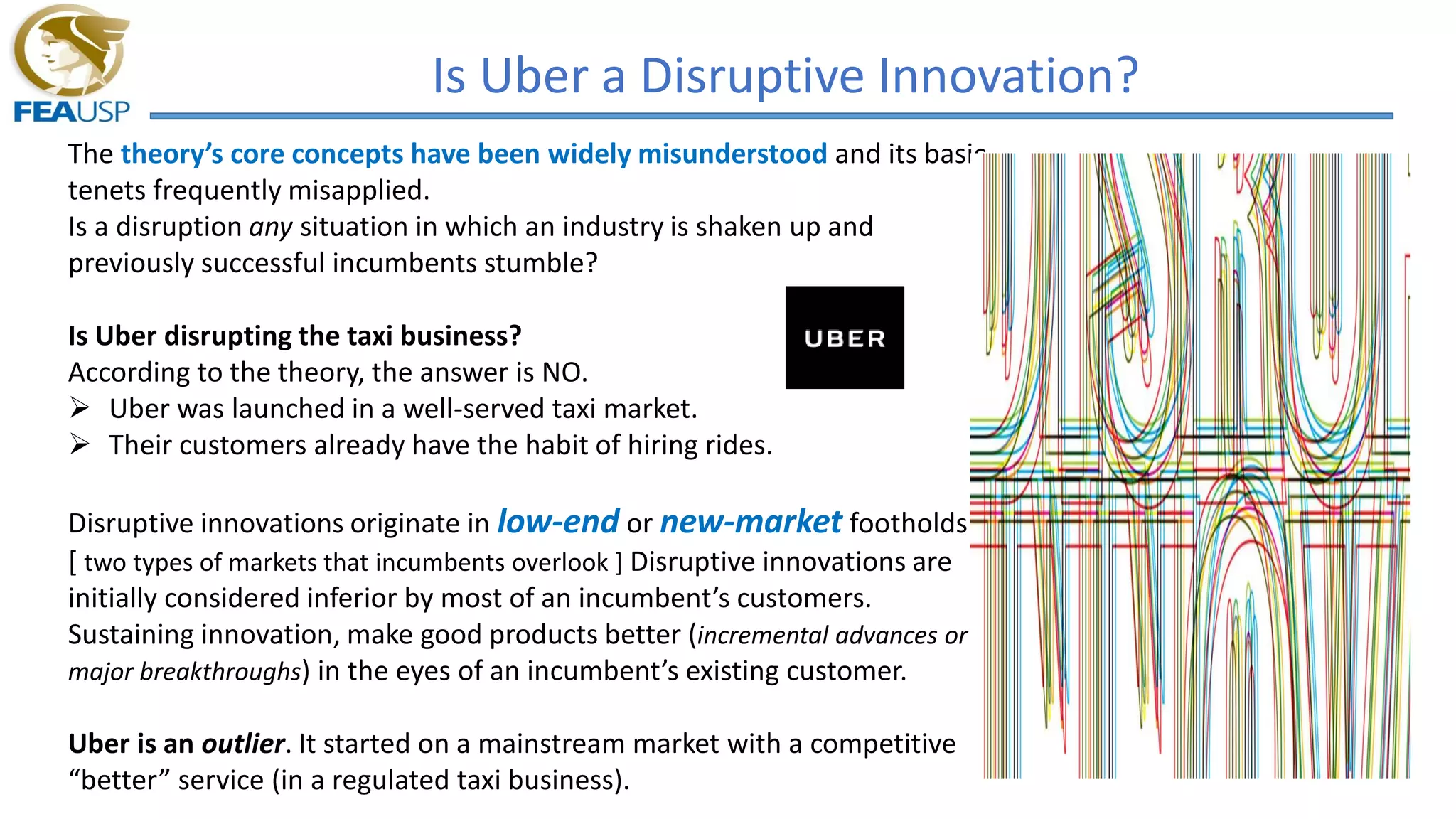
Most established companies operate on a model of sustaining innovation—making better products to sell at higher margins to their best customers. Disruptive innovation, as defined by Clayton Christensen, usually starts at the low end of the market or in a completely new market entirely. A disruptive example is crucial here because it validates "asymmetric motivation."
Asymmetric motivation occurs when a challenger pursues a segment of the market that the incumbent is actually happy to ignore or cede. For example, early cloud storage providers were ignored by enterprise hardware giants because the margins were too low. The disruptive example of a scalable, low-margin, high-volume cloud model proved that wealth could be built on the "scraps" of the industry. For innovators in 2026, looking at current examples in autonomous micro-logistics provides the necessary proof that low-cost, high-frequency delivery models are not just "cheap" versions of existing services, but entirely new ecosystems with different economic foundations.
Lowering the Cost of Capital and Entry
Innovation is expensive and risky. For a startup or an internal R&D unit to secure funding, they must often prove that a market exists for their radical idea. This is where a disruptive example becomes a financial tool.
When a disruptive example achieves market fit, it "de-risks" the category for venture capitalists and institutional investors. It provides a set of metrics—customer acquisition cost (CAC), lifetime value (LTV), and churn rates—that others can use to benchmark their own potential. Without a clear example, an innovator is selling a dream; with an example, they are selling a proven trajectory. This leads to a "cluster effect" where one disruptive example triggers a wave of investment into similar or complementary technologies, accelerating the overall pace of innovation across the sector.
Comparative Framework: Sustaining vs. Disruptive Examples
To understand why a disruptive example matters, it is helpful to compare it to a sustaining example. A sustaining example shows how to do things better; a disruptive example shows how to do things differently.
| Feature | Sustaining Innovation Example | Disruptive Innovation Example |
|---|---|---|
| Primary Goal | Margin improvement and feature parity. | Accessibility, affordability, or convenience. |
| Target Audience | Most profitable, high-end customers. | Overlooked or non-consumers. |
| Market Impact | Reinforces existing market structures. | Creates new markets or devalues old ones. |
| Strategic Response | Incremental R&D investment. | Total business model pivot or acquisition. |
| Risk Profile | Low (Execution risk). | High (Market and model risk). |
| 2026 Trend | Incremental AI integration in SaaS. | Autonomous, agent-based service economies. |
Forcing the Incumbent’s Dilemma
A disruptive example is the "smoking gun" that forces the Incumbent's Dilemma. Large organizations are often held captive by their most profitable customers. These customers rarely want disruptive changes; they want better versions of what they already have.
When a disruptive example gains traction, it highlights the gap between what the incumbent provides and what the broader market actually needs. It proves that there is a "good enough" solution that is significantly cheaper or more convenient. This forces the incumbent into a difficult choice:
- Ignore the example: Risk becoming obsolete as the disruption moves up-market.
- Cannibalize their own business: Launch a competing disruptive product that might undermine their current high-margin offerings.
- Acquisition: Spend significant capital to buy the disruptive example to bring the innovation in-house.
The presence of a tangible example makes this dilemma unavoidable. It moves the threat from a theoretical risk in a five-year plan to an immediate operational crisis.
The Example as a Blueprint for Regulatory and Ethical Standards
In 2026, innovation is increasingly constrained by regulatory frameworks, particularly in data privacy, AI ethics, and carbon accounting. A disruptive example matters because it often serves as the "guinea pig" for new regulations.
When a new model emerges—for instance, a platform that uses decentralized autonomous organizations (DAOs) for governance—it forces regulators to react. The way the first major disruptive example is handled by the legal system sets the "rules of engagement" for everyone who follows. For innovators, studying these examples is essential for understanding the "regulatory moat" they will need to navigate. It allows them to see where the first-mover faced legal friction and to design their own systems to be more compliant or resilient from the outset.
How to Utilize a Disruptive Example in Strategic Planning
If you are leading an innovation team or an organization, you should not just wait for a disruptive example to appear; you must actively use existing ones to shape your strategy.
- Identify the "Anomalies": Look for companies or products that are succeeding despite violating traditional industry logic. These are your disruptive examples.
- Reverse Engineer the Economics: Don't look at the product; look at the unit economics. How does the example make money? If their margins are lower than yours, but their growth is higher, they are likely using a disruptive model.
- Analyze the "Non-Consumer": Who is using the disruptive example that wasn't buying anything in this category before? This reveals the "new market" disruption potential.
- Stress-Test Your Defenses: Use the disruptive example as a "red team" tool. If that company's model becomes the industry standard, what parts of your current business become liabilities?
Common Pitfalls in Analyzing Disruptive Examples
While these examples are valuable, they can be misinterpreted. A common mistake is confusing "breakthrough technology" with "disruptive innovation." A breakthrough technology (like a faster processor) is often a sustaining innovation because it helps the leaders stay on top.
Another mistake is failing to recognize the "up-market march." A disruptive example often looks toy-like or inferior in its early stages. If you dismiss an example because it doesn't meet the needs of your best customers today, you are ignoring the trajectory. By the time the disruptive example meets the quality standards of your best customers, it is usually too late to compete on cost or agility.
FAQ
Why is a disruptive example more important than a theoretical model?
Theoretical models provide the "how," but examples provide the "proof." In high-stakes business environments, stakeholders are rarely moved by theory alone. An example demonstrates that the barriers to entry—whether technical, social, or economic—have been successfully breached in the real world.
Can an incumbent create their own disruptive example?
Yes, but it is rare and usually requires a "skunkworks" approach. The internal team must be given the freedom to build a product that might compete with or even destroy the parent company’s primary revenue stream. Without this autonomy, the disruptive example will be "smothered" by the existing corporate culture.
How do I distinguish between a fad and a disruptive example?
A fad is characterized by a spike in adoption followed by a rapid decline, usually because it doesn't solve a core problem more efficiently. A disruptive example shows sustained growth and, more importantly, it starts to change the behavior of related industries. If other companies are forced to change their strategy because of the example, it is likely disruptive.
What are the most relevant disruptive examples in 2026?
As of 2026, the most significant examples are found in hyper-personalized AI services that bypass traditional search engines, biomanufacturing firms that are disrupting traditional chemical supply chains, and peer-to-peer energy grids that challenge centralized utility models.
Does every disruptive example lead to the downfall of incumbents?
No. Some incumbents are agile enough to adapt, often by acquiring the disruptor or by successfully launching their own disruptive division. The example doesn't guarantee the incumbent's failure; it only guarantees that the environment has changed forever.
Practical Next Steps for Innovators
To leverage the power of disruptive examples, start by curating a "Disruption Watchlist" for your specific industry. Do not focus on your direct competitors; focus on the fringe players who are serving the customers you don't want. Study their operational model, their funding sources, and their customer feedback. Use these examples to build a case for internal change before the disruption moves from the fringe to the mainstream. The goal is not to copy the example, but to understand the shift in value that the example has proven is possible.
Image Gallery