Lil Wayne Net Worth Compared to Bill Gates: Analyzing the Massively Different Echelons of Wealth
Comparing the net worth of Lil Wayne to Bill Gates reveals the staggering divide between entertainment-industry success and global technological empire-building. As of 2026, Lil Wayne’s net worth is estimated at approximately $170 mill...
Comparing the net worth of Lil Wayne to Bill Gates reveals the staggering divide between entertainment-industry success and global technological empire-building. As of 2026, Lil Wayne’s net worth is estimated at approximately $170 million, while Bill Gates maintains a fortune exceeding $135 billion. This means Gates is roughly 800 times wealthier than the hip-hop icon.
Contents
Understanding the Net Worth of Lil Wayne in 2026
Dwayne Michael Carter Jr., known globally as Lil Wayne, has remained a pillar of the music industry for over two decades. His financial portfolio is a reflection of intense productivity, savvy label management, and strategic asset liquidation. To understand his $170 million valuation in 2026, one must look at the various streams of income that have sustained his status as one of the wealthiest rappers in the world.
The Impact of Young Money Entertainment
A significant portion of Lil Wayne’s wealth stems from his role as the founder of Young Money Entertainment. Established in 2005, the label became a powerhouse by discovering and developing era-defining talent like Drake and Nicki Minaj. While Wayne earns from his own music, the "finder's fee" and equity stakes in the early careers of these superstars provided a massive financial cushion. Even as distribution models shifted toward streaming in the 2020s, the residual income from the Young Money catalog remains a formidable asset.
The Landmark Catalog Sale
In late 2020, Lil Wayne made headlines by selling his masters to Universal Music Group for a reported $100 million. This deal included the rights to his own work as well as portions of the Young Money catalog. In the financial landscape of 2026, such "lump sum" exits are common for legacy artists looking to diversify their investments into real estate or private equity. While this sale provided immediate liquidity, it also meant trading long-term royalty streams for upfront capital—a move that stabilized his net worth during periods of lower touring activity.
Touring and Brand Endorsements
Despite the rise of digital revenue, live performance remains a primary wealth driver for Lil Wayne. His "Lil WeezyAna" festivals and global tours generate millions in gross revenue per year. Additionally, partnerships with brands like Trukfit, as well as various spirits and apparel lines, have padded his earnings. However, unlike some of his contemporaries who moved into high-stakes tech investing or spirits manufacturing (like Jay-Z or Diddy), Wayne has largely kept his focus on the music business.
Analyzing Bill Gates’ Multi-Decade Wealth Accumulation
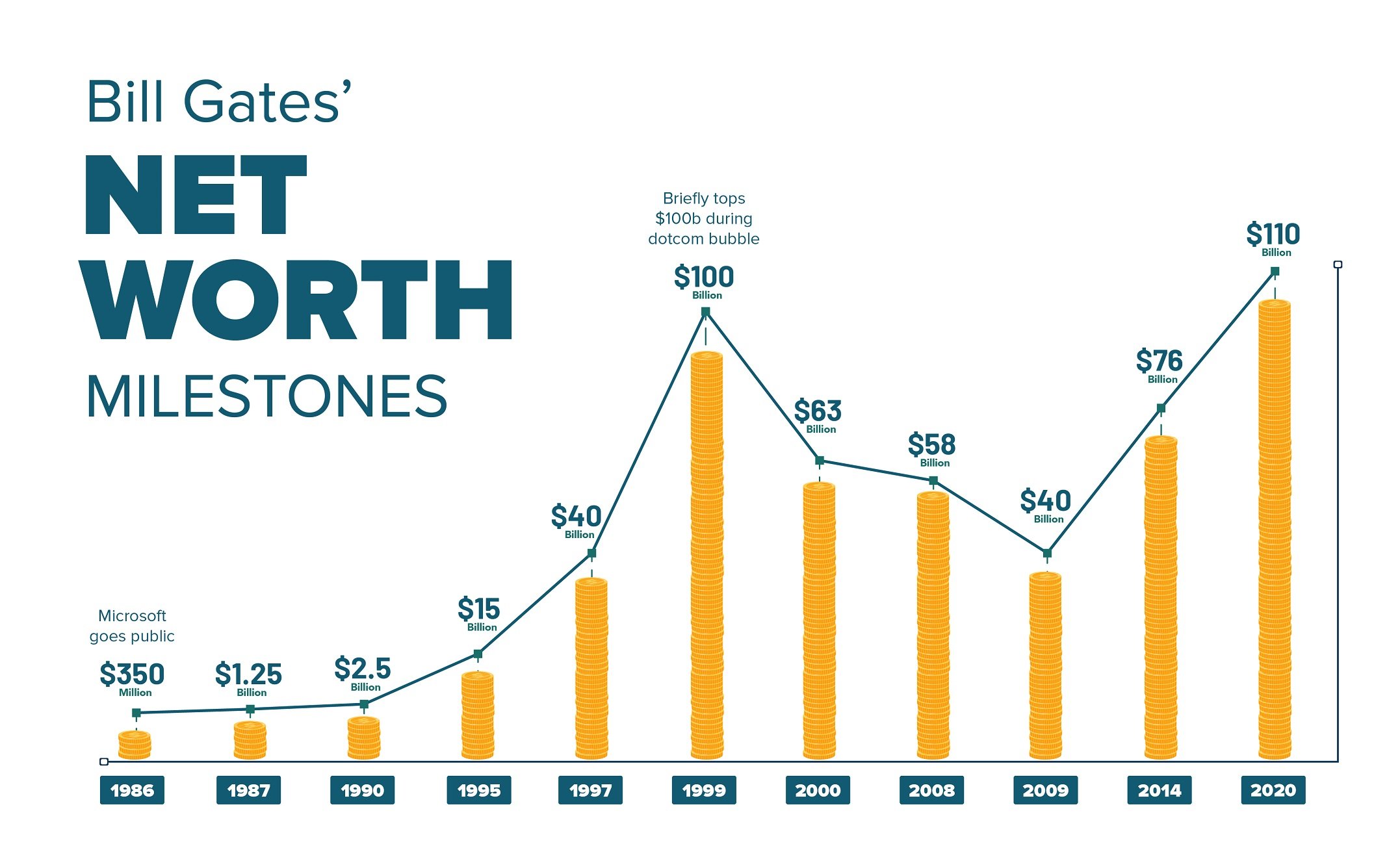
Bill Gates represents a different tier of wealth entirely—the "centibillionaire" class. While Lil Wayne’s wealth is measured in millions, Gates’ fortune is measured in the hundreds of billions. As of 2026, his wealth is no longer tied solely to Microsoft, the company he co-founded in 1975, but is instead managed through a sophisticated investment vehicle called Cascade Investment.
The Microsoft Foundation
Although Gates has sold or donated the vast majority of his Microsoft shares over the last thirty years, the remaining equity he holds still fluctuates by billions of dollars based on the company's performance in cloud computing and artificial intelligence. In 2026, Microsoft’s dominance in the enterprise sector ensures that even a small percentage of ownership results in a multi-billion dollar valuation.
Cascade Investment and Diversification
The true secret to Gates’ wealth preservation is Cascade Investment LLC. This private investment firm holds massive stakes in diverse industries, including:
- Deere & Company: The agricultural machinery giant.
- Republic Services: A leader in waste management.
- Canadian National Railway: A pillar of North American logistics.
- Ecolab: A provider of water, hygiene, and energy technologies.
By diversifying into "boring" but essential infrastructure and utility companies, Gates has protected his fortune from the volatility often seen in the entertainment or pure-tech sectors.
The Role of Philanthropy
It is important to note that Gates’ net worth would be significantly higher—perhaps exceeding $200 billion—if not for his massive philanthropic contributions. Through the Bill & Melinda Gates Foundation, he has donated tens of billions of dollars to global health and education. In the context of 2026, his financial status is often discussed alongside his "Giving Pledge," a commitment to donate the majority of his wealth during his lifetime.
Direct Comparison: Lil Wayne vs. Bill Gates
The following table provides a breakdown of the financial metrics comparing these two figures as of 2026.
| Feature | Lil Wayne | Bill Gates |
|---|---|---|
| Estimated Net Worth | ~$170 Million | ~$135 Billion |
| Primary Industry | Music & Entertainment | Technology & Private Equity |
| Main Asset | Young Money Catalog / Brand | Cascade Investment / MSFT Equity |
| Wealth Multiplier | 1x (Base) | ~794x (Compared to Wayne) |
| Daily Earnings (Est.) | ~$30,000 - $50,000 | ~$10,000,000+ |
| Highest Single Deal | $100M Catalog Sale | ~$100B+ Cumulative Stock Value |
| Investment Strategy | Intellectual Property | Global Infrastructure & Tech |
Why the Wealth Gap is So Large: Industry Differences
The primary reason for the vast difference between Lil Wayne’s net worth and Bill Gates’ net worth lies in the scalability of their respective industries.
Linear vs. Exponential Growth
Lil Wayne operates in the music industry, which is traditionally linear. To make more money, an artist usually needs to produce more content, go on more tours, or sell more merchandise. While streaming allows for some passive income, the profit margins are split between distributors, labels, and managers.
Conversely, Bill Gates built a software empire. Software has zero marginal cost—once the code is written, selling the second copy costs almost nothing compared to the first. This allowed Microsoft to achieve exponential growth. When this growth is paired with the power of compound interest through Cascade Investment, the result is a fortune that grows by millions of dollars every single day, regardless of whether Gates is "working."
Equity vs. Royalties
Wayne’s wealth is largely built on royalties—a percentage of sales. Gates’ wealth is built on equity—ownership of the means of production. Equity in a global corporation like Microsoft or a railway company appreciates in value as the global economy grows, whereas music royalties tend to peak shortly after release and slowly decline unless the artist achieves "legacy" status.
Lil Wayne’s Financial Strategy: Catalog Sales and Label Ownership
In 2026, Lil Wayne’s strategy is seen as a blueprint for high-tier successful musicians who are not quite "business moguls." By owning his label, Young Money, he secured a higher percentage of the "pot" than a standard artist.
- The Power of Ownership: Because Wayne owned his masters for a significant period, he was able to negotiate the $100 million exit. Most artists do not own their recordings and therefore cannot liquidate them in this manner.
- The Downside of the Industry: Even at the top of the rap game, the "ceiling" is generally much lower than in tech or finance. Only a handful of musicians (like Jay-Z, Rihanna, and Taylor Swift) have crossed the billion-dollar threshold, usually through high-margin retail businesses (cosmetics, clothing) rather than music alone.
Bill Gates’ Financial Evolution: From Software to Global Philanthropy
As of 2026, Bill Gates is viewed more as an institutional investor than a software developer. His wealth is so vast that it has become a geopolitical factor.
- Farmland Acquisition: Gates has become one of the largest private owners of farmland in the United States. This is a strategic move into "hard assets" that provide food security and inflation protection.
- Climate Technology: Through Breakthrough Energy, Gates invests in the next generation of green technology. While these are often categorized as philanthropic or "impact" investments, they hold the potential for massive returns if any of the companies become the next "Microsoft" of energy.
Common Misconceptions About Celebrity Wealth
When people search for "Lil Wayne net worth compared to Bill Gates," there is often a misconception about how "rich" a famous person truly is.
- Lifestyle vs. Balance Sheet: Lil Wayne may live a lifestyle that appears as flashy as a billionaire’s—private jets, jewelry, and mansions. However, his net worth is tied to his personal brand. If his brand fades, his income drops.
- Liquidity: Bill Gates could theoretically liquidate a billion dollars in a week without affecting his lifestyle. For Lil Wayne, a large portion of his $170 million is likely tied up in his home, his catalog rights, and his business equipment.
- The "Billionaire" Label: Fans often assume every famous rapper is a billionaire. In reality, the jump from $170 million to $1 billion is massive. To reach Gates' level, Wayne would need to repeat his entire 20-year career roughly 800 times over.
Frequently Asked Questions
Is Lil Wayne a billionaire in 2026?
No, Lil Wayne is not a billionaire. His estimated net worth of $170 million makes him very wealthy, but he is still roughly $830 million short of the billion-dollar mark.
How much does Bill Gates make per second?
Based on his average annual wealth growth, Bill Gates earns approximately $300 to $400 per second. In the time it takes to listen to one Lil Wayne song, Bill Gates has earned more than most average workers earn in several years.
Did Lil Wayne's lawsuit against Birdman affect his net worth?
Yes, the legal battle with Cash Money Records and Birdman, which concluded years ago, significantly impacted his finances. The settlement eventually allowed him to release Tha Carter V and cleared the way for his catalog sale, which is a major component of his current $170 million net worth.
Who is the richest rapper compared to Bill Gates?
As of 2026, Jay-Z remains the richest rapper, with a net worth of approximately $2.5 billion. Even so, Bill Gates is still more than 50 times wealthier than Jay-Z.
Does Bill Gates still own Microsoft?
Bill Gates owns about 1% of Microsoft. While this sounds small, the massive valuation of the company makes that 1% worth billions of dollars. Most of his wealth, however, is now in other sectors via Cascade Investment.
Practical Recommendation: Viewing Wealth Through Different Lenses
When comparing these two individuals, it is helpful to distinguish between professional success and systemic wealth. Lil Wayne is a master of his craft and has achieved the pinnacle of success in the music industry. His $170 million fortune represents a "best-case scenario" for a creative professional.
Bill Gates, however, represents capitalist infrastructure. His wealth is a result of creating a tool (Windows) that became the foundation for global business. For those looking to build wealth, the lesson is clear: Creative talent can make you a millionaire, but ownership of essential technology and diversified equity is the only path to becoming a billionaire.
Image Gallery