What the California Sales Tax Percent Means for You
California features the highest statewide base sales tax rate in the United States, standing at 7.25%, but the actual percentage you pay at the register varies significantly depending on the specific city, county, and special tax distr...
California features the highest statewide base sales tax rate in the United States, standing at 7.25%, but the actual percentage you pay at the register varies significantly depending on the specific city, county, and special tax districts where your purchase takes place. Understanding how this combined percentage operates, what items are subject to taxation, and how local additions alter your final receipt is essential for accurate consumer budgeting, small business compliance, and financial forecasting within the state.
Contents
The Foundation of California Sales Tax
The California sales tax structure is a multi-layered system administered primarily by the California Department of Tax and Fee Administration (CDTFA). While 7.25% serves as the mandatory statewide floor, local jurisdictions add their own district taxes to fund public transportation, emergency services, libraries, and school infrastructure.
Breakdown of the Statewide Rate
The baseline 7.25% rate is not a single tax but a combination of several state-level allocations:
- State Operations and General Fund: 3.9375% goes directly to support state services, health programs, and general government operations.
- Local Revenue Fund: 1.05% is allocated to local governments to support public health and social services.
- Local Law Enforcement: 0.50% is distributed to cities and counties specifically for local public safety and policing.
- Bradley-Burns Uniform Local Sales and Use Tax: 1.25% is returned to the city or county where the transaction occurs to fund local municipal budgets.
- County Transportation Funds: 0.5125% supports regional transit development and highway maintenance.
When you make a purchase in an area with no additional local district taxes, this 7.25% rate applies. However, very few modern transactions in California remain at this exact baseline.
How Local District Taxes Change the Equation
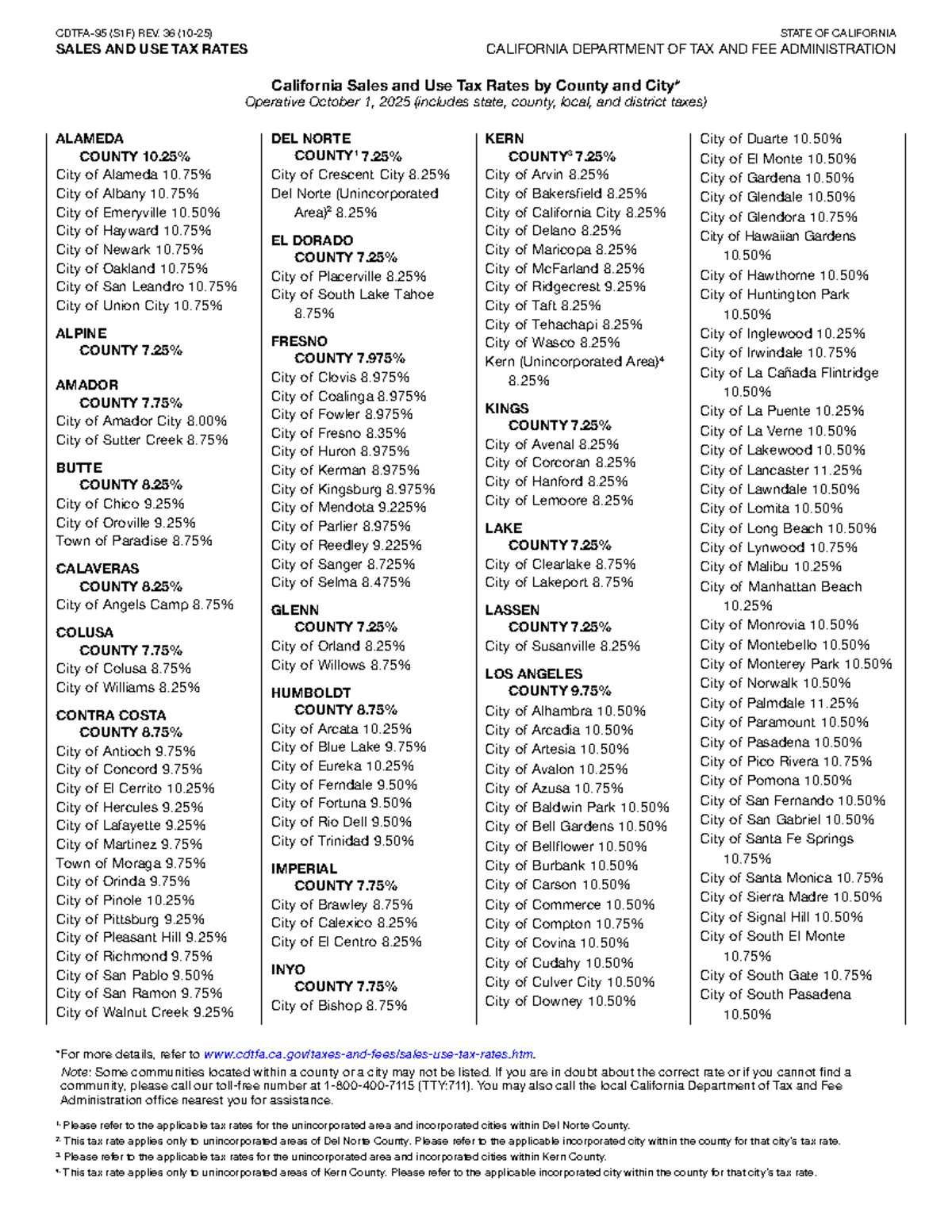
Local voters frequently approve special tax districts to fund community-specific projects. These district taxes come in increments of 0.10%, 0.125%, 0.25%, or 0.50%. Because these districts overlap across municipal boundaries, combined sales tax rates across the state currently range from the base 7.25% up to a maximum of 10.25% in certain high-tax municipalities as of 2026.
| Location Type | Base State Rate | Local & District Additions | Maximum Combined Rate Example | Common Funding Purpose |
|---|---|---|---|---|
| Unincorporated Rural County | 7.25% | 0.00% to 0.50% | 7.25% – 7.75% | Basic county services and infrastructure |
| Standard Suburban Municipality | 7.25% | 1.00% to 1.50% | 8.25% – 8.75% | Local police, fire protection, and parks |
| Major Metropolitan City | 7.25% | 2.00% to 3.00% | 9.25% – 10.25% | Public transit expansions, housing, and libraries |
To determine the exact rate for a specific street address, consumers and business owners must utilize the online lookup tools provided by the CDTFA. Relying on general county estimates often leads to remittance errors for merchants and inaccurate budgeting for consumers.
What is Taxable Versus Exempt?
Not every product or service carries the California sales tax percentage. The state maintains strict statutory guidelines regarding what constitutes a taxable retail sale.
Taxable Goods and Services
- Tangible Personal Property: Standard retail items including clothing, electronics, furniture, books, and vehicles.
- Prepared Foods: Hot foods, meals sold in restaurants, and cold food sold for immediate consumption on the premises.
- Digital Goods: Select pre-written software downloaded electronically, though streaming media taxation rules continue to evolve via legislative updates.
- Leases and Rentals: Equipment, vehicles, and appliances rented for personal or commercial use.
Exemptions to Protect Consumers
To ease the financial burden on residents, California exempts several essential categories from the sales tax calculation:
- Unprepared Groceries: Most food products purchased for home consumption, including produce, meat, dairy, and baking supplies.
- Prescription Medicines: Medications dispensed by a registered pharmacist under a physician's prescription.
- Medical Devices: Prosthetic devices, wheelchairs, crutches, and specialized medical equipment prescribed for patient use.
- Utilities: Natural gas, electricity, and water delivered through mains, lines, or pipes to residential households.
| Category | Taxable Status | Typical Examples |
|---|---|---|
| Fresh Produce | Exempt | Apples, carrots, raw meat, milk |
| Restaurant Meal | Taxable | Burgers, fountain drinks, hot soup |
| Prescription Drugs | Exempt | Blood pressure medication, antibiotics |
| Over-the-Counter Drugs | Taxable | Pain relievers, cough syrup, vitamins |
| Clothing | Taxable | Jeans, jackets, shoes, accessories |
Sales Tax Versus Use Tax
Many California residents confuse sales tax with use tax, though both share the exact same percentage rate.
- Sales Tax: Imposed on retailers for the privilege of selling tangible personal property at retail within California. The retailer collects this amount from the purchaser.
- Use Tax: Imposed on the storage, use, or other consumption of tangible personal property purchased from out-of-state retailers who do not collect California tax.
If you purchase an item online from a retailer with no physical or economic nexus in California, and that retailer does not voluntarily collect California tax, you are legally obligated to report and pay the equivalent use tax directly to the state on your annual state income tax return.
Impact on Personal Finance and Consumer Budgeting
For the average household, the cumulative effect of California's sales tax percentage demands careful financial planning. When purchasing high-ticket items like automobiles, major appliances, or home renovations, the difference between an 8% tax rate and a 10% tax rate translates to hundreds of dollars out of pocket.
Strategies for Managing Retail Costs
- Geographic Shopping Awareness: When purchasing expensive capital goods like furniture or electronics, checking the combined tax rate of neighboring cities can occasionally yield minor savings if delivery fees do not offset the difference.
- Itemized Expense Tracking: Small business owners and freelancers must carefully track sales tax paid on business inputs to ensure accurate deductions and compliance with CDTFA guidelines.
- Verify Online Receipts: Ensure that out-of-state e-commerce platforms are applying the correct destination-based tax rate rather than a flat statewide default.
Compliance and Responsibilities for Business Owners
If you operate a business in California, understanding the sales tax percentage is not optional; it is a legal requirement. Merchants act as agents of the state, charged with collecting the correct tax from customers and remitting it to the CDTFA.
Key Operational Obligations
- Seller's Permit Registration: Every business selling tangible personal property must hold an active CDTFA seller's permit.
- Destination-Based Sourcing: California requires destination-based sourcing for intrastate sales. This means you must charge the tax rate applicable to the location where the buyer takes possession of the item, not where your warehouse or headquarters is located.
- Timely Filing: Depending on sales volume, business owners must file returns and remit collections monthly, quarterly, or annually. Missing deadlines triggers automatic penalties and interest charges.
Frequently Asked Questions
Why does my receipt show a higher tax rate than the 7.25% state minimum?
The 7.25% figure represents only the state base rate. Local cities, counties, and special transit districts add local district taxes on top of this baseline. Your receipt reflects the combined total of all applicable state and local rates for the exact address where the transaction occurred.
Are delivery and shipping charges subject to California sales tax?
It depends on how the delivery is structured. If you purchase taxable merchandise and the retailer ships it via common carrier (like USPS or UPS) as a separate, optional charge, the shipping fee is generally non-taxable. However, if the seller delivers the items using their own company vehicle, the delivery charge is typically taxable.
Do out-of-state online retailers have to collect California sales tax?
Yes. Under state laws and economic nexus standards, out-of-state vendors that exceed specific sales or transaction thresholds into California are required to register with the CDTFA, collect the appropriate combined district tax rate from the buyer, and remit those funds to the state.
How do I report and pay use tax on items bought without tax collected?
Individuals can report and pay use tax annually using their California resident state income tax return (Form 540) via the line item designated for use tax. Businesses report use tax directly on their periodic CDTFA sales and use tax returns.
Can a retailer advertise tax-included pricing in California?
No. California law generally prohibits retailers from absorbing the sales tax or advertising that they will pay the tax for the customer, with rare exceptions for specific admission events or vending machine operators. The sales tax must be separately itemized or clearly stated to the consumer at the point of sale.
Next Actions and Verification
To ensure complete accuracy for your specific purchasing decisions or business operations, verify the active tax rate for your precise delivery or retail location using the official GIS-based lookup portal provided by the California Department of Tax and Fee Administration. Review your receipts, maintain clear records of online out-of-state purchases for use tax compliance, and consult a qualified tax professional or certified public accountant if you manage complex multi-location commercial retail operations.
Disclaimer: Tax laws, district boundaries, and local rates are subject to legislative adjustments. This guide is intended for informational purposes and should not be construed as formal legal or financial advice.
Image Gallery